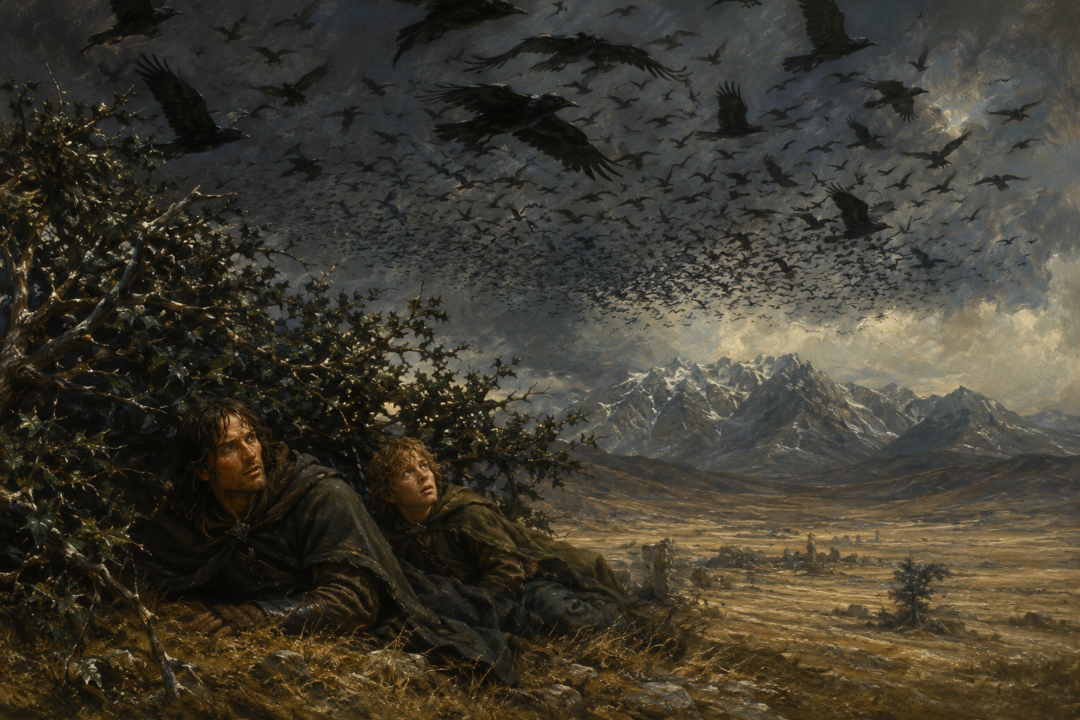
The Fellowship has already crossed dangerous country when a dark shape appears in the southern sky over Hollin. Yet what alarms Aragorn is not an army, an Orc-band, or a Nazgûl. It is a flock of birds.
That seems almost absurdly minor beside the dangers waiting ahead. But Aragorn watches the birds closely, orders Sam down beneath the holly, and afterward wakes Gandalf. The travelers extinguish their fire, remain concealed through the day, and resume their journey after dark. The crebain never attack them. They do not even clearly discover them.
That is precisely why the episode matters.
The danger of the crebain is information. Their appearance tells Aragorn and Gandalf that the Fellowship may have entered a landscape in which being seen is itself a defeat. From that moment, secrecy is no longer merely part of their strategy. It begins determining how they eat, rest, travel, and choose their road.
Hollin Feels Empty—Until Aragorn Realizes It Is Being Watched
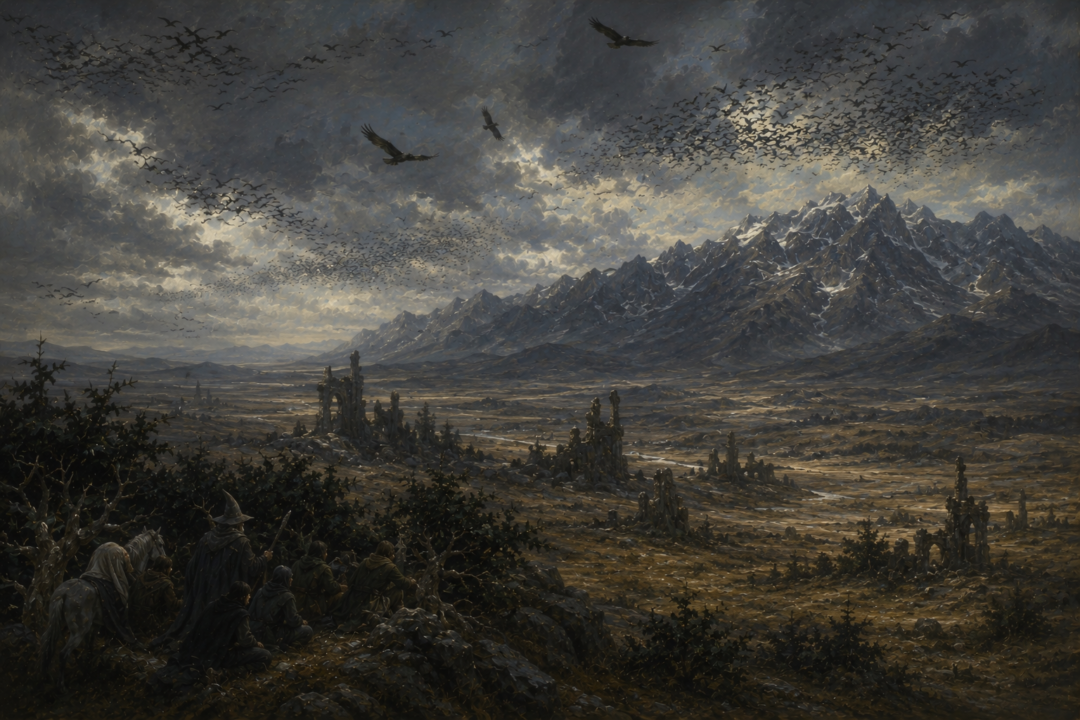
The Fellowship reaches Hollin, or Eregion, after traveling south from Rivendell. Long before their arrival, this country had been an Elvish realm, famous in the Second Age and closely connected with Khazad-dûm. By the end of the Third Age its people are gone.
Legolas can still perceive something of the Elves who once lived there, but the land is deserted.
Aragorn notices something more immediately troubling: an unnatural silence among the living creatures. There are few birds, and the country seems watchful.
This is important because the crebain do not arrive in an atmosphere of ordinary wilderness. Their appearance confirms a suspicion that has already begun forming in Aragorn's mind.
Then Sam notices what looks like a dark patch moving north from the South. It is not a cloud. The birds are traveling in great numbers, wheeling and crossing the country in a manner that looks to Aragorn like searching.
When some descend toward the ridge, Aragorn immediately pulls Sam into concealment.
Nothing attacks.
Nothing needs to.
Once the birds pass, Aragorn identifies them as crebain from Fangorn and Dunland. He also reports seeing hawks high overhead. He admits another explanation is possible: perhaps some disturbance in the South has driven the birds northward.
That qualification matters. Aragorn does not possess certainty.
But he refuses to gamble the Quest on the optimistic interpretation.
Aragorn Reacts to Risk, Not Proof
This small episode reveals something important about Aragorn's judgment.
He does not say that the crebain definitely belong to Saruman. He cannot know what they have seen, where they are going, or whom they serve. His conclusion is cautious: he thinks they are spying.
That possibility is enough.
The Fellowship's mission depends upon secrecy on a scale almost unmatched by an ordinary military expedition. They are not attempting to defeat Sauron by marching a superior army into Mordor. They are carrying the One Ring toward the place where it can be destroyed while hoping the Enemy does not understand what they are doing.
Exposure therefore has an unusual cost.
An army can survive being observed and still win a battle. The Ring-bearer's company may not be able to survive being correctly identified at all.
This changes the normal calculation of danger. Aragorn does not need evidence that an enemy is about to strike. If an unknown observer might carry useful information to a hostile power, concealment becomes the rational response.
The crebain therefore function as an early warning.
The Fellowship has not been attacked.
Its freedom of movement has nevertheless been reduced.
The First Casualty Is Comfort
The practical consequences arrive immediately.
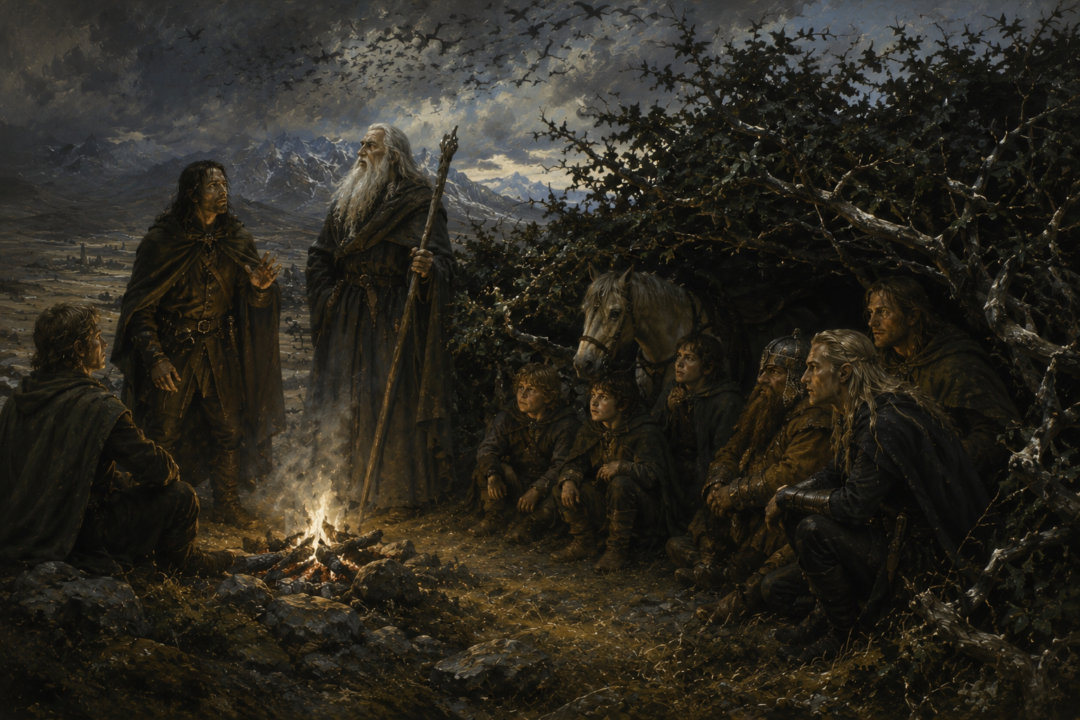
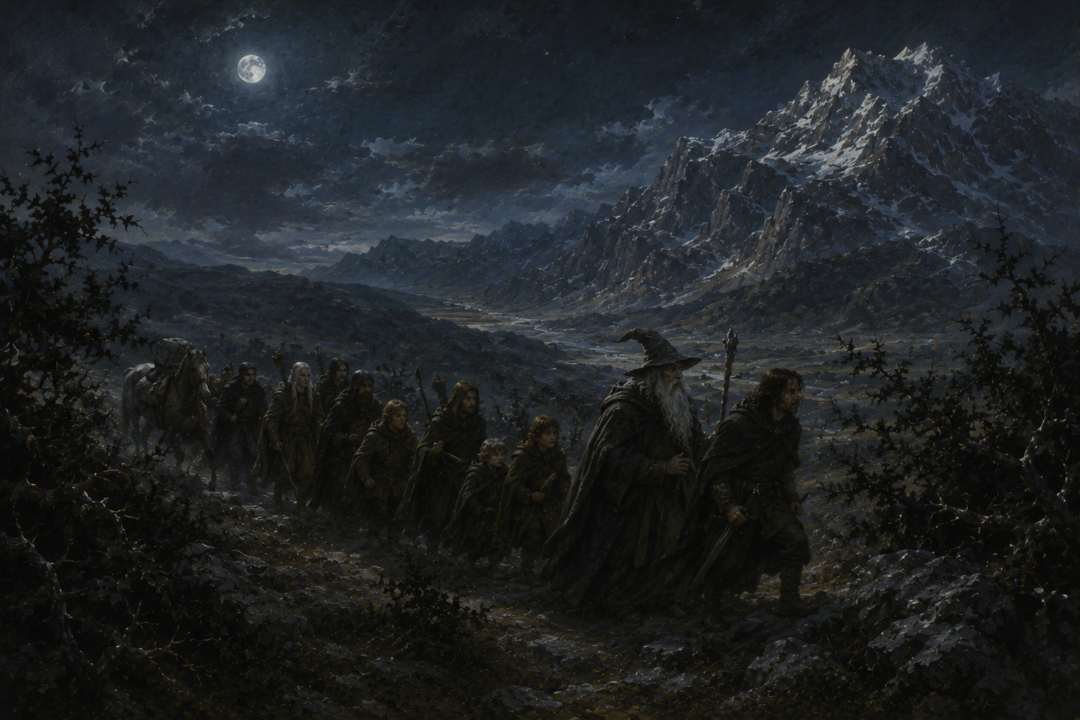
Aragorn recommends moving again that evening. Gandalf agrees. Their fire, which fortunately has produced little smoke and is already low, must be extinguished and not relit.
Pippin's reaction makes the cost wonderfully ordinary: he had expected a proper hot meal.
That detail gives the scene much of its force.
Great quests are not changed only by spectacular battles. Surveillance creates smaller hardships first. A fire becomes dangerous. Rest becomes dangerous. Daylight becomes dangerous. A comfortable camp becomes a possible signal.
The Fellowship consequently spends the remainder of the day hidden while more birds pass over the country.
Their enemies do not have to wound anyone to impose a cost. The mere possibility of observation deprives the company of warmth, food preparation, daylight travel, and confidence in the surrounding land.
The Fellowship begins behaving like prey before any predator visibly appears.
Why the Birds Are So Dangerous to the Quest
There is another reason Gandalf and Aragorn take the threat seriously: the Fellowship's route itself is valuable information.
They have traveled south from Rivendell along the western side of the Misty Mountains and are approaching the attempt on the Redhorn Gate near Caradhras. If hostile watchers can determine their direction, then secrecy about their movements begins to erode.
Gandalf immediately recognizes the implication. If Hollin is watched, then the Redhorn Gate may be watched as well.
That does not prove that the Enemy knows their destination. Nor does the text establish that the crebain identify Frodo or recognize the Ring.
The distinction is crucial.
The Fellowship reacts because reconnaissance does not need to reveal everything to be dangerous. A report that a strange company is moving south from the region of Rivendell could potentially matter to someone already hunting for the Ring or trying to understand the movements of the Wise.
Knowledge accumulates.
A sighting here, a report there, a route observed elsewhere—each can narrow the uncertainty surrounding a secret traveler.
The Fellowship cannot know what the watcher already knows. Therefore they must deny it whatever information they can.
Are the Crebain Saruman’s Spies?
The association is strongly suggested, but this is a place where careful wording matters.
Aragorn identifies the crebain as coming from Fangorn and Dunland and suspects that they are spying. Later events establish Saruman as an active enemy whose power is centered at Isengard, south of the Fellowship's position, and whose influence reaches into the surrounding lands.
It is therefore natural to read the crebain as part of Saruman's intelligence-gathering.
But the scene itself does not present Aragorn with proof of their master or mission. His uncertainty is explicit.
That actually makes his response more interesting.
A lesser leader might wait for confirmation.
Aragorn understands that confirmation may arrive only when concealment has already failed.
His behavior resembles good wilderness judgment more than supernatural insight: notice what does not belong, compare it with the normal pattern of the country, consider several explanations, and act according to the consequences of being wrong.
If the birds are harmless and the Fellowship hides unnecessarily, they lose comfort and time.
If the birds are spies and the Fellowship ignores them, they may compromise the Quest.
The imbalance between those outcomes makes caution obvious.
The Crebain Reveal How Small the Fellowship Really Is
At Rivendell, the Company can seem formidable.
Gandalf is among the Wise. Aragorn is Isildur's heir. Boromir is a great warrior of Gondor. Legolas and Gimli represent ancient peoples. The four hobbits possess remarkable courage, and the Fellowship carries weapons and experience enough to face many ordinary dangers.
Yet the crebain expose the truth of their strategic position.
Nine walkers cannot control the country around them.
They cannot prevent birds from crossing the sky. They cannot secure every ridge. They cannot know who has seen their tracks. They cannot build a safe perimeter across the empty lands between Rivendell and Mordor.
Their strength depends on remaining beneath the notice of greater powers.
That vulnerability becomes increasingly important as the journey continues. The Fellowship repeatedly faces enemies or forces too great to defeat by direct confrontation. Their survival depends upon hidden paths, endurance, judgment, friendship, and sometimes mercy or providence rather than sheer strength.
The crebain make that strategic reality visible before the mountains force it upon them more brutally.
Caradhras Becomes More Dangerous Before They Reach It
The birds also alter how the next stage of the journey feels.
Before their appearance, the Redhorn Gate is a difficult route through the mountains.
Afterward, it is potentially an observed route.
That distinction matters.
Gandalf's response to Aragorn's warning immediately connects the surveillance of Hollin with the problem of crossing the mountains unseen. The Fellowship is being squeezed between geography and secrecy.
Open country risks detection.
The mountain pass offers exposure and severe winter danger.
Moria remains an alternative that Aragorn fears and Gandalf initially does not wish to choose.
The crebain do not cause the storm on Caradhras, and the text does not justify blaming them for the later disaster. Nor should their appearance be treated as proof that every subsequent obstacle is part of one coordinated enemy plan.
What they do is remove confidence.
From this point onward, no road is merely a road. Every choice must be judged not only by terrain but by who might be watching it.
Middle-earth’s Wilderness Is Not Neutral
One of the deeper implications of the scene is that animals and landscapes in Middle-earth cannot always be treated as neutral background.
Birds may carry intelligence. Beasts can serve dark powers. The natural world contains creatures with varying degrees of awareness and allegiance, and the Wise cannot simply assume that an animal overhead is irrelevant.
Yet the crebain are especially effective because nothing spectacular happens.
There is no magical duel.
No arrow is fired.
No member of the Fellowship is harmed.
Instead, Aragorn looks upward and realizes that the rules of travel have changed.
That is the hidden power of reconnaissance. The watcher may affect the watched without ever touching them.
Once the Fellowship believes the sky itself may reveal them, they begin policing their own behavior.
They hide.
They extinguish their fire.
They surrender daylight.
They move at night.
The enemy's greatest success in Hollin is therefore not an attack. It is uncertainty.
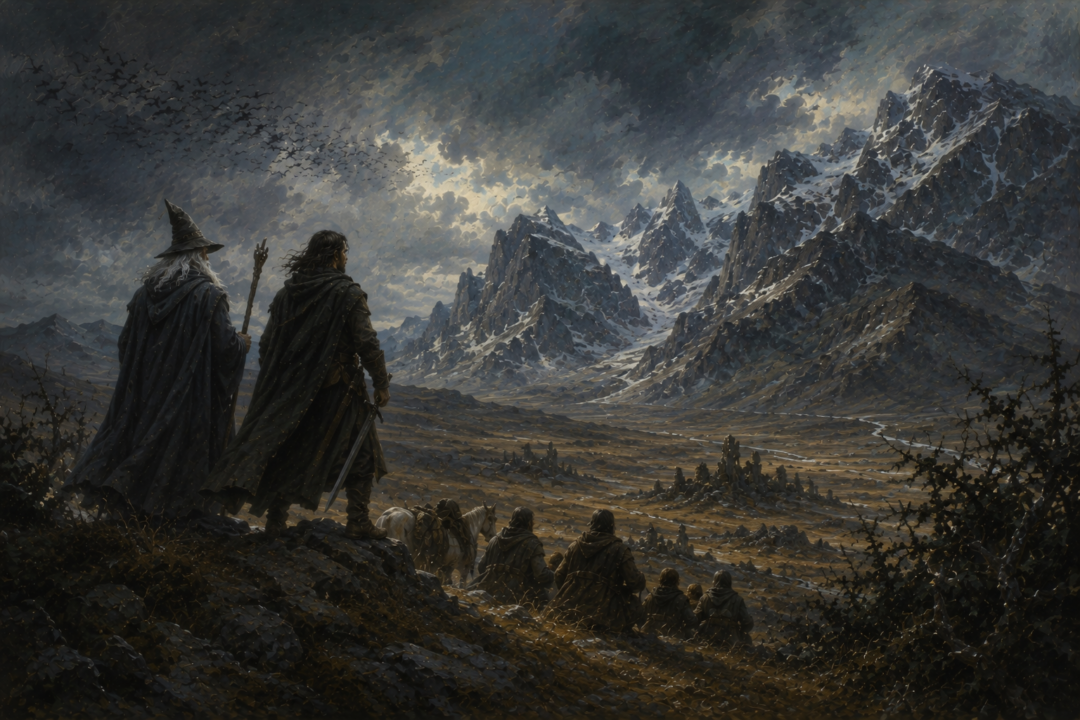
The Warning Hidden in a Flock of Crows
The crebain episode is easy to overlook because so much follows it: Caradhras, Moria, the Balrog, Lothlórien, and eventually the breaking of the Fellowship.
But in miniature, the scene contains the logic of the entire Quest.
The Ring cannot simply be carried east by heroes strong enough to defeat whatever confronts them. The Company must move through a world in which information can be fatal and attention can be more dangerous than battle.
Aragorn understands this before anyone attacks.
He sees birds behaving strangely, recognizes that they do not belong in Hollin, considers the possibility that they are searching the country, and changes the Fellowship's behavior immediately.
He does not wait to discover whether his fear is justified.
Because when your entire hope depends upon the Enemy not discovering what you are doing, being watched is already a form of danger.
And sometimes the most important warning is not the enemy coming toward you.
It is the moment you realize something has begun looking for you.
Sources & Notes
- The Encyclopedia of Arda — Crebain: identifies the large black crows from Dunland and Fangorn that crossed Hollin, prompting the Fellowship to hide for fear they were spies. https://www.glyphweb.com/arda/c/crebain.html
- Tolkien Gateway — Crebain: summarizes the flock’s passage over Eregion, Aragorn’s concern that it was searching the land, and the Fellowship’s concealment and move to night travel. https://tolkiengateway.net/wiki/Crebain
- Tolkien Gateway — Eregion: background on Hollin’s history, its friendship with Khazad-dûm, its depopulation, and the Fellowship’s route through the former Elvish realm. https://tolkiengateway.net/wiki/Eregion
- Tolkien Gateway — Redhorn Gate: covers the Fellowship’s attempted crossing of Caradhras after passing through Eregion and the route decision that ultimately led them toward Moria. https://tolkiengateway.net/wiki/Redhorn_Gate
Sources document the crebain episode and its immediate behavioral consequences, with background on Hollin/Eregion and the route toward the Redhorn Gate.