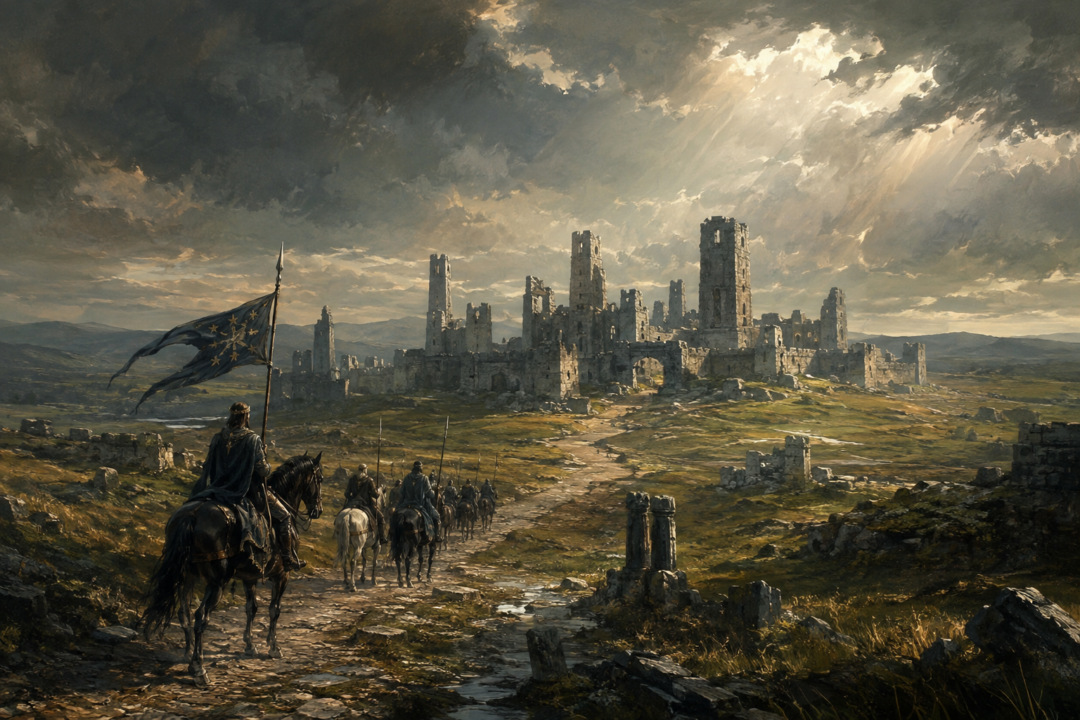
When the hobbits return to Bree after the War of the Ring, Barliman Butterbur still thinks of the distant ruins in the North Downs as Deadmen’s Dike: a haunted place at the far end of the Greenway, avoided by ordinary travelers and visited chiefly by Rangers.
Gandalf corrects him.
The place has another name: Fornost Erain, Norbury of the Kings. More importantly, Gandalf says that the King will come there again one day.
That small exchange carries far more weight than it first appears to. Aragorn has already been crowned King Elessar in Gondor. Sauron is defeated. The great battles are over. Yet the return of the King does not simply mean that Minas Tirith has a monarch again.
Aragorn is also the heir of the lost kings of the North.
And Fornost is one of the clearest physical reminders of everything that northern kingship had lost.
Fornost Was Once a City of Kings
Long before anyone called it Deadmen’s Dike, Fornost belonged to the political heartland of the Northern Dúnedain.
The original capital of Arnor was Annúminas beside Lake Evendim. But the northern Dúnedain diminished, and Annúminas eventually fell into decay. The royal house moved to Fornost Erain.
When Arnor was divided after the death of Eärendur in the Third Age, the northern realm fractured into Arthedain, Cardolan, and Rhudaur. The line descended from Eärendur’s eldest son continued in Arthedain, ruling from Fornost.
That made the city more than another Númenórean settlement.
Fornost became the seat of the dynasty that would eventually produce Aragorn.
Its full Sindarin name, Fornost Erain, means the Northern Fortress of the Kings. Even the name preserved what the ruined city had once represented: organized royal authority in northern Eriador.
But that authority was slowly being strangled.
Angmar arose in the northeast under the Witch-king, and its long wars against the divided successor kingdoms of Arnor gradually destroyed the political world surrounding Fornost.
By the end, the city was not merely a capital.
It was one of the last strongholds of a dying kingdom.
The Fall of Fornost Ended the Northern Kingship
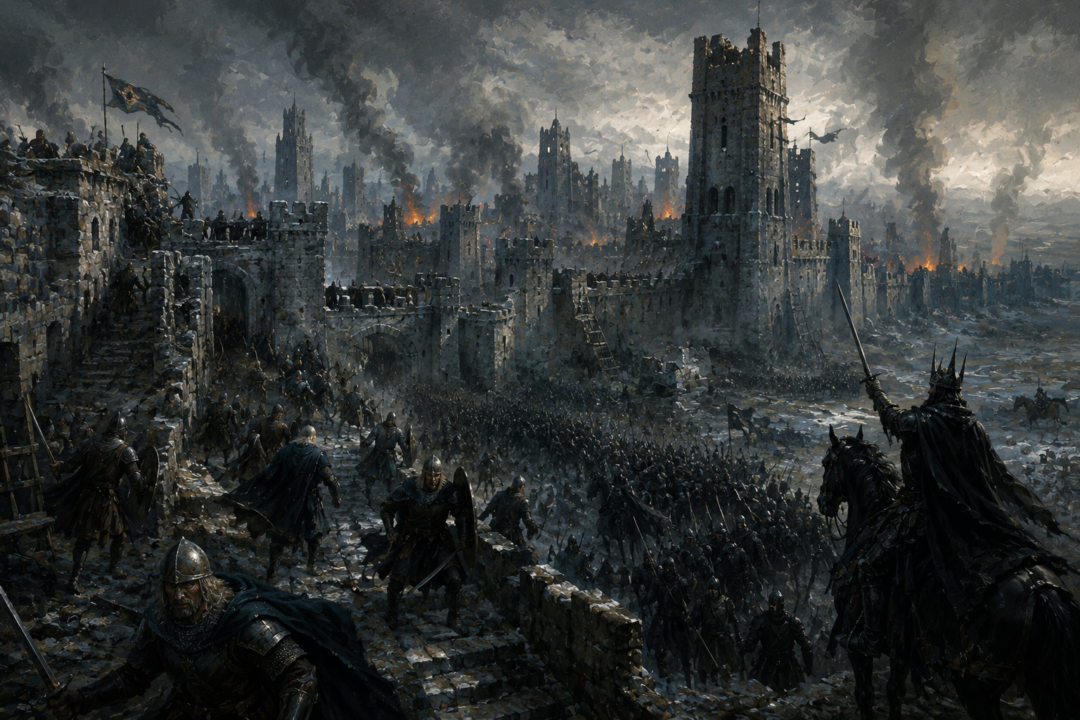
In Third Age 1974, the Witch-king launched his final assault against Arthedain.
Fornost fell.
King Arvedui fled northward and eventually reached the Icebay of Forochel. He was later lost at sea with the two northern palantíri he carried with him.
A Gondorian fleet under Eärnur arrived too late to save Arthedain, but not too late to avenge it. Together with forces gathered in the North, Eärnur’s host defeated the armies of Angmar in the Battle of Fornost in 1975.
The Witch-king escaped.
His kingdom did not.
Yet the victory produced a bitter paradox: Angmar was destroyed, but Arthedain was not restored.
The northern Dúnedain had become too few. Arvedui’s son Aranarth did not establish himself as king in Fornost. Instead, he became the first Chieftain of the Dúnedain.
The royal line survived without a kingdom.
That distinction matters enormously for Aragorn.
For roughly a thousand years, his ancestors preserved the bloodline of Isildur while living without the visible structures of kingship their forefathers had possessed.
Fornost therefore stood as a monument to an unfinished story.
The enemy who had taken it was eventually defeated, yet the throne remained empty.
A Royal City Became Deadmen’s Dike
By the end of the Third Age, memory itself had changed Fornost.
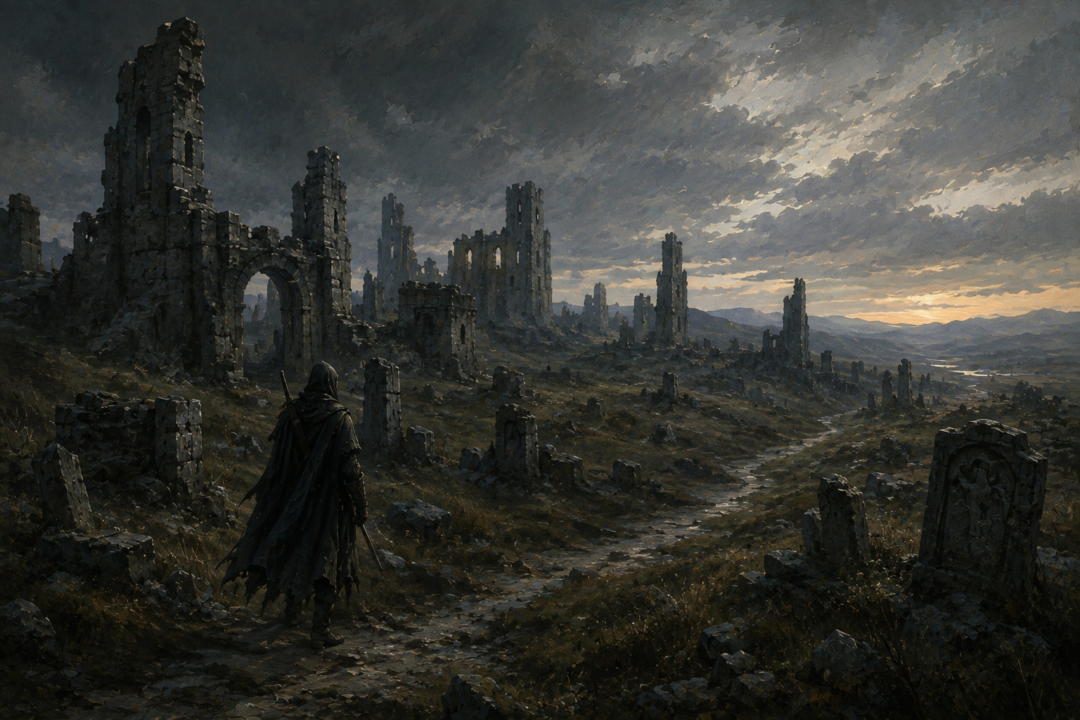
People around Bree no longer primarily understood it as the city of the kings. They called its ruins Deadmen’s Dike and associated the northern lands with danger and haunting.
The contrast is striking.
The Rangers knew the older world. They guarded Eriador and preserved the lineage and traditions of the northern Dúnedain. Ordinary inhabitants of places such as Bree, however, knew surprisingly little about them.
Aragorn could walk into the Prancing Pony as Strider without Barliman realizing that the weather-beaten Ranger was the heir of Isildur.
The same blindness affected the landscape.
Fornost Erain had become Deadmen’s Dike.
A royal road had become the Greenway.
Kingdoms had become wilderness.
The political geography of Arnor survived largely as ruins, names, roads, tombs, and half-remembered stories.
That is why Gandalf’s correction of Butterbur is important. He does not merely predict economic recovery. He restores the proper name of the place before predicting the King’s return.
Deadmen’s Dike belongs to the memory of decline.
Fornost Erain belongs to the memory of kingship.
Aragorn’s Crown Changes What Fornost Means
Aragorn’s coronation transforms Fornost without requiring the text to show us its walls being rebuilt.
Before Aragorn becomes king, Fornost is the ruined capital of a dynasty that no longer rules.
Afterward, the heir of that dynasty rules again.
Elessar is not merely King of Gondor. His kingship reunites the inheritance of the Dúnedain of North and South. The long separation that followed the establishment of Arnor and Gondor after the Downfall of Númenor is politically overcome in the Reunited Kingdom.
This gives the ruins of the North a new meaning.
They are no longer evidence that the northern royal line failed permanently.
They become evidence of what has been recovered.
Gandalf tells Butterbur that the King will come to Fornost again and that fair folk will ride through those lands. In the same conversation he anticipates renewed settlement in regions that have long been empty.
The implication is one of restoration: Eriador will not remain permanently depopulated wilderness.
But the texts should not be pushed further than they go.
They do not provide a detailed account of Aragorn rebuilding Fornost into a great capital, nor do they describe its Fourth Age streets, fortifications, population, or government. Gandalf’s words establish the King’s future connection with Fornost, but the surviving narrative gives us few details about what happens to the city itself.
Another ancient northern city receives clearer attention.
Annúminas, Not Fornost, Becomes Aragorn’s Northern Residence
This is where the restoration of the North becomes more interesting than a simple rebuilding story.
Appendix B records that in Shire Reckoning 1436, King Elessar rode north and stayed for a time beside Lake Evendim. He also came to the Brandywine Bridge and met his friends there.
Lake Evendim is the site of Annúminas, the older capital of Arnor.
So while Gandalf explicitly predicts that the King will return to Fornost, the later record places Elessar at the more ancient royal center by Lake Evendim.
There is no contradiction.
Instead, the two places represent different layers of the restored northern kingdom.
Annúminas reaches back toward Elendil and the original Kingdom of Arnor.
Fornost carries the memory of Arthedain, the long struggle against Angmar, the fall of the northern monarchy, and the survival of Isildur’s heirs after that catastrophe.
One is associated with the beginning of Arnor.
The other is inseparable from its final defeat.
Aragorn inherits both.
The Roads Matter as Much as the Ruins
Gandalf’s prediction also hints that restoring the North means more than reclaiming old royal sites.
It means making the land inhabited again.
For centuries, Eriador contains extraordinary remnants of civilization but comparatively few great settlements. Roads built in an earlier age cross increasingly empty country. Weathertop stands ruined. Annúminas is deserted. Fornost becomes feared. The Rangers protect peoples who often barely understand who their protectors are.
The return of the King reverses that pattern.
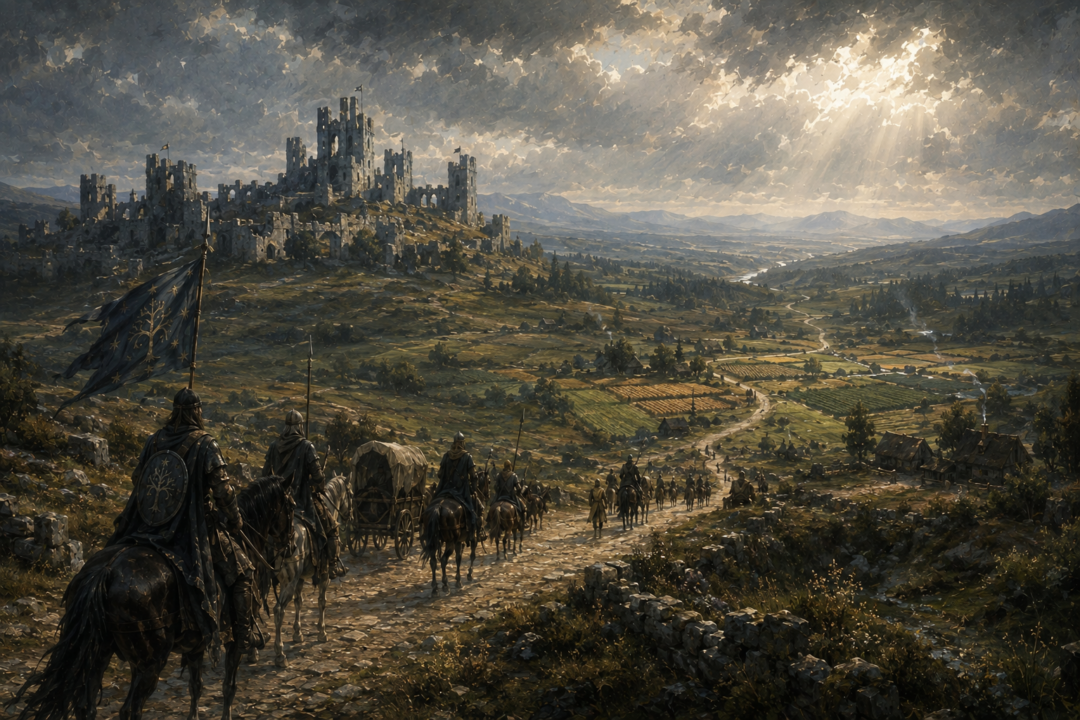
Gandalf expects people and fields where wilderness had prevailed. He tells Butterbur that there is ample room for settlement away from Bree and specifically recalls the lands around the North Downs and Lake Evendim.
This makes the old road northward symbolically important.
Under the Chieftains, Rangers move secretly through these lands.
Under Elessar, royal authority can move openly through them.
The difference between Strider traveling unnoticed and the King riding north is almost a miniature history of the Dúnedain.
The hidden guardians have become a visible kingdom again.
Aragorn Does Not Restore the Past Exactly as It Was
Yet the Fourth Age restoration is not simply an attempt to rewind history.
One of Aragorn’s early decisions concerning the North demonstrates this.
He declares the Shire a Free Land under the protection of the Northern Sceptre and forbids Men to enter it. Later, the Thain, the Master of Buckland, and the Mayor become Counsellors of the North-kingdom.
That arrangement suggests a kingship capable of preserving local freedoms rather than merely absorbing everything into direct royal control.
Aragorn knows the North not as an abstract ancestral possession but as a land through which he has traveled and which the Rangers have guarded.
This makes Fornost’s significance subtler.
Its restoration matters because royal authority has returned.
But the restored kingdom need not reproduce every institution, settlement pattern, or political arrangement of ancient Arnor.
The Fourth Age is a renewal, not a replica.
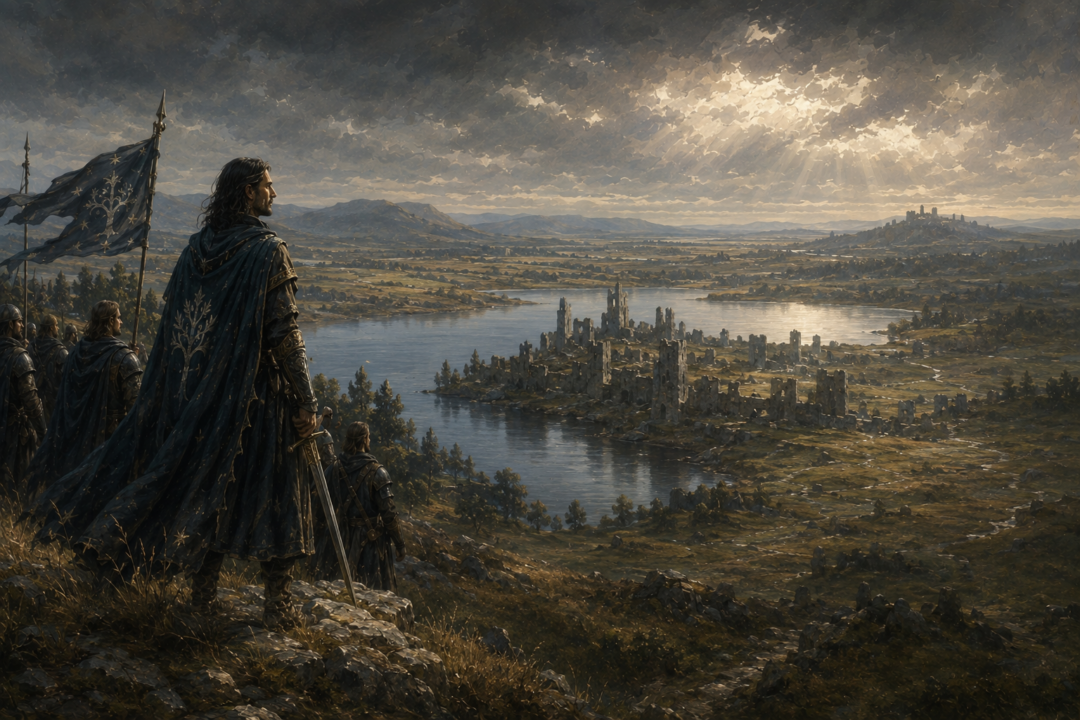
The Real Victory at Fornost Comes a Thousand Years Late
The Battle of Fornost destroyed Angmar’s power in 1975.
But it did not undo the Witch-king’s greatest achievement in the North.
The kingdom was already gone.
Fornost remained empty. The heirs of Isildur became Chieftains instead of kings. Their people dwindled and guarded Eriador from the shadows.
Only with Aragorn does the deeper consequence of Angmar’s victory finally end.
A descendant of Arvedui once again possesses a kingdom.
The Northern Sceptre again has political meaning.
The Shire lives beneath its protection. Northern counsellors are appointed. The King rides back toward Lake Evendim. And Gandalf can speak of Fornost not merely as a grave of the past, but as a place where the King will come again.
That is why Fornost matters after Aragorn’s coronation.
Minas Tirith proves that Aragorn has become king.
Fornost proves what his kingship has healed.
For a thousand years, the ruined fortress marked the point where the visible history of the northern kings ended. In the Fourth Age, the same place can be understood differently.
The stones have not forgotten their defeat.
But defeat is no longer the end of their story.
Sources & Notes
- https://tolkiengateway.net/wiki/Fornost — History and names of Fornost Erain, including its role as Arthedain’s capital, its fall in T.A. 1974, and its later reputation as Deadmen’s Dike.
- https://tolkiengateway.net/wiki/Battle_of_Fornost — Account of the defeat of Angmar after Fornost’s fall and the survival of Arvedui’s line through Aranarth.
- https://tolkiengateway.net/wiki/Chieftains_of_the_Dunedain — Background on Aranarth’s choice to lead the surviving northern Dúnedain as Chieftain and Aragorn’s eventual restoration of kingship.
- https://tolkiengateway.net/wiki/Homeward_Bound — Chapter summary documenting Gandalf’s exchange with Butterbur about Deadmen’s Dike, the King’s return, and renewed safety and prosperity.
- https://tolkiengateway.net/wiki/Reunited_Kingdom — Overview of Aragorn’s reunification of Arnor and Gondor and the northern realm’s restoration under Elessar.
Sources cover Fornost’s history, the end of Arthedain, the northern chieftains, Gandalf’s return prophecy, and Aragorn’s Reunited Kingdom.