Orcs are everywhere in the great wars of Middle-earth. They swarm through Moria, patrol Mordor, serve Saruman, quarrel among themselves, fear their masters, and speak with enough personality that individual Orcs can be cruel, cowardly, ambitious, suspicious, or simply tired of being commanded.
Yet one of the most basic questions about them has no single final answer:
Where did Orcs actually come from?
The familiar explanation is that Morgoth captured early Elves and corrupted them into Orcs. That account appears in The Silmarillion, and it remains the best-known version of their origin.
But it was not the only version considered.
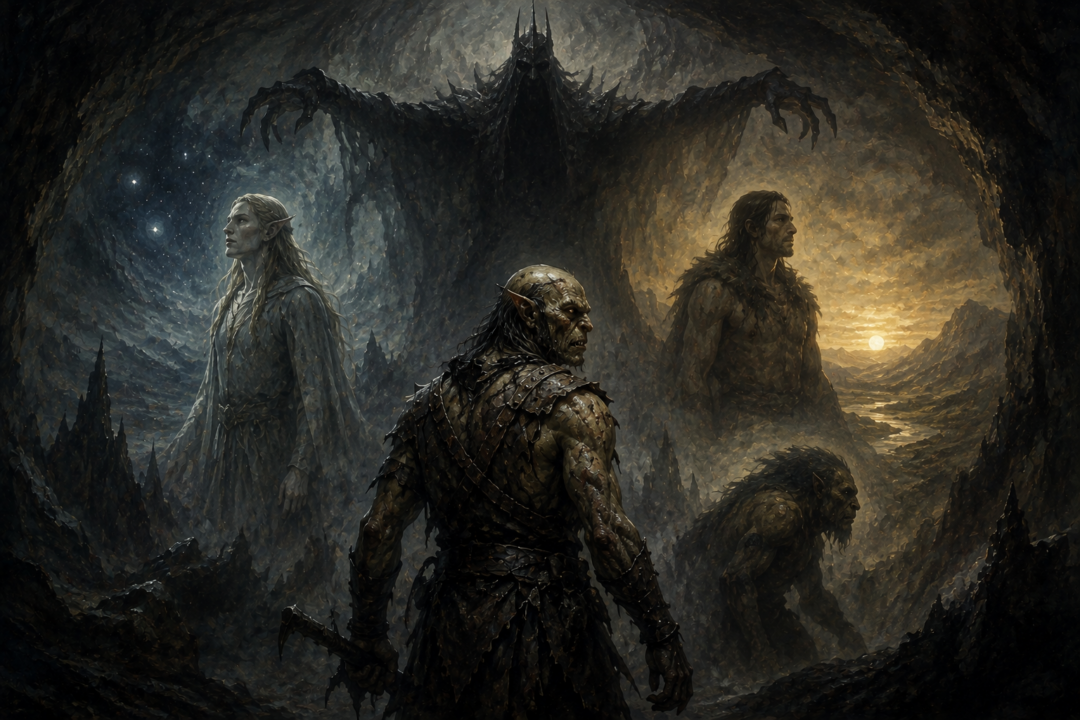
Across different stages of the mythology, Orcs were imagined as creatures made from earth or stone, corrupted Elves, corrupted Men, possibly beings of mixed ancestry, and even—during one line of speculation—as creatures whose apparent intelligence raised difficult questions about whether they possessed rational souls at all.
The problem was deeper than deciding which species belonged at the top of an Orc family tree. Orcs exposed one of the hardest rules in Middle-earth:
If evil cannot truly create life, what exactly did Morgoth do when he made the Orcs?
The Rule That Made Orcs a Problem
The central difficulty becomes visible in The Return of the King.
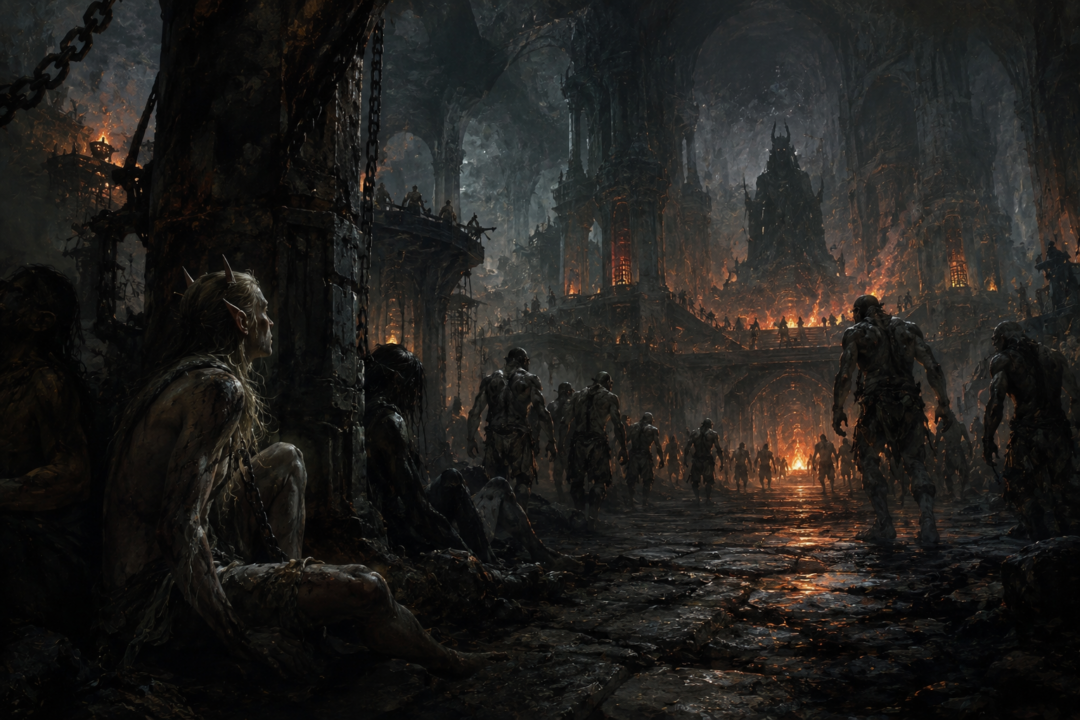
During the journey through Mordor, Frodo rejects the idea that the Shadow can simply create genuine new life of its own. Evil can ruin, distort, enslave, breed, imitate, and corrupt—but it cannot originate independent life in the deepest sense.
That principle fits the wider mythology.
The clearest parallel is Aulë and the Dwarves. Aulë can fashion bodies, but he cannot independently give them the kind of free existence that belongs to the Children of Ilúvatar. Their true life ultimately depends upon Ilúvatar.
Morgoth possesses immense power, but he does not possess a greater creative authority than Aulë.
That creates an immediate problem with Orcs.
They do not consistently behave like puppets.
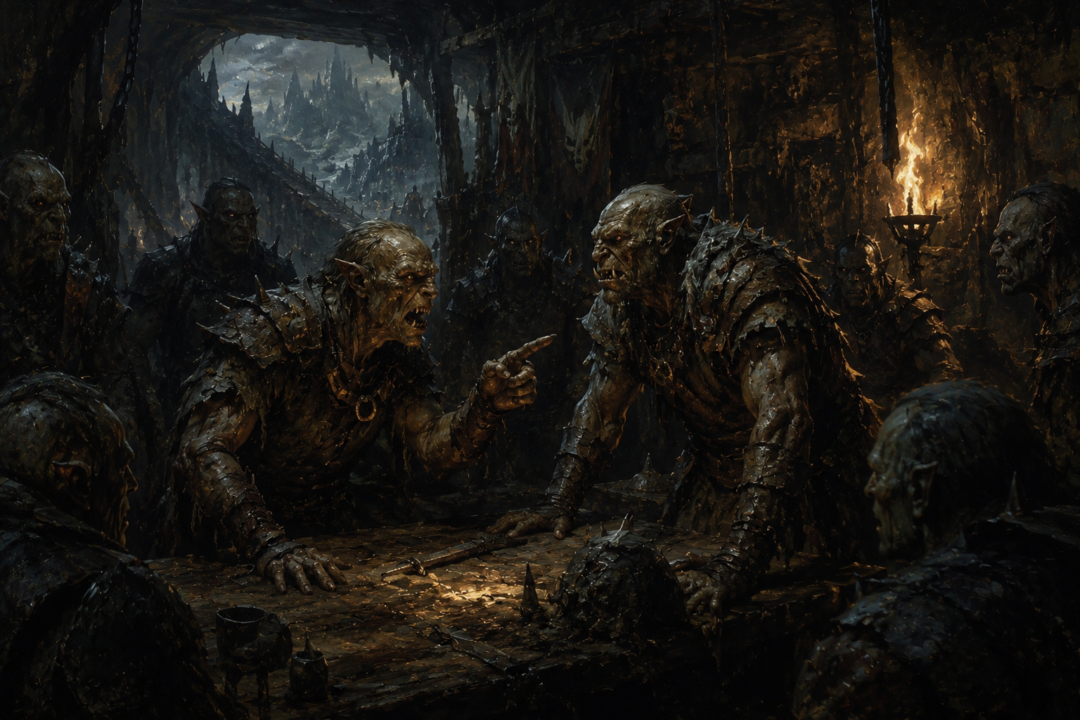
In The Lord of the Rings, Orcs argue, complain, fear punishment, misunderstand orders, insult their superiors, fight one another, and pursue interests that do not perfectly coincide with those of Sauron. Shagrat and Gorbag's conversation near Cirith Ungol is especially revealing: they sound like brutal beings trapped inside a brutal system, not like extensions of a single controlling mind.
So if Orcs possess genuine wills, Morgoth cannot simply have manufactured those wills from nothing.
Something must already have existed for him to corrupt.
But what?
The Famous Answer: Orcs Were Corrupted Elves
The version eventually incorporated into The Silmarillion gives the most recognizable answer.
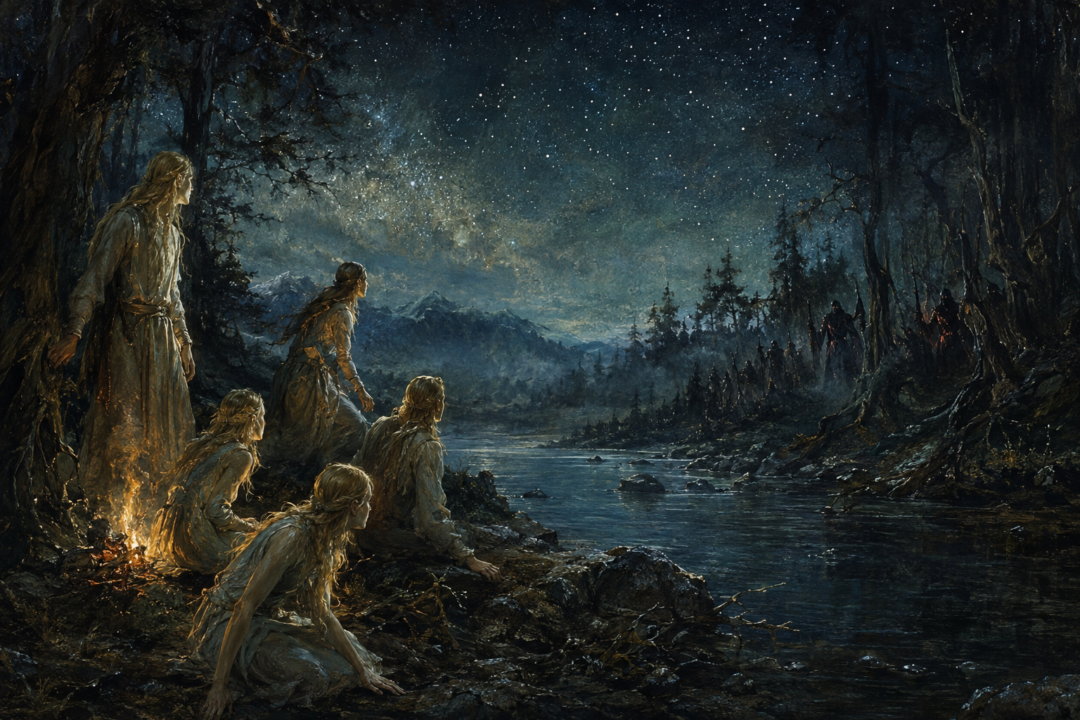
After the awakening of the Elves at Cuiviénen, some disappear before Oromë can bring them into the protection of the Valar. According to the lore preserved by the Eldar, those unfortunate captives were taken by Melkor and corrupted through cruelty until from them he bred the Orcs.
The passage is deliberately horrifying because the Orcs become a mockery of the Children of Ilúvatar rather than an independent creation.
Under this explanation, Morgoth does not create life.
He takes life and desecrates it.
That fits his entire character remarkably well. Morgoth repeatedly corrupts things he did not originate. His power is parasitic. He takes what exists within Arda and bends it toward domination.
The Orcs therefore become one of the darkest examples of his method: not merely soldiers produced for war, but evidence of what prolonged tyranny can do to living beings.
There is even another disturbing element in the Silmarillion account. The Orcs hate Morgoth, despite serving him, because he is ultimately the author of their misery.
Yet this elegant solution produced problems of its own.
Why the Elvish Origin Became Difficult
If Orcs descended from Elves, they inherited implications that could not easily be ignored.
Elves are rational incarnate beings: body and spirit belong together in a particular relationship. Their spirits do not simply vanish when their bodies are slain.
If Orcs were transformed Elves and remained genuine rational beings, then what happened to their spirits?
Were Orcs still Elves at the deepest level?
Could an Orc repent?
What happened when an Orc died?
Could Morgoth's torture corrupt not merely behavior and bodies but permanently transform an entire hereditary population of the Children of Ilúvatar?
The texts do not provide a simple canonical answer to those questions.
The moral problem is equally severe. If Orcs are descendants of kidnapped and tortured Elves, then every Orc encountered thousands of years later belongs to a people whose beginning lies in victimhood.
That does not make their murders or cruelties harmless. But it makes the idea of Orcs as beings who are inherently and irredeemably evil much harder to sustain.
Later writings wrestle directly with precisely these difficulties.
Most importantly, a note written against the Elvish-origin material states that the conception should be changed: Orcs were not to be Elvish.
The famous answer, therefore, was never securely the final one.
Could Orcs Have Been Corrupted Men?
A later solution moved the origin of Orcs toward Men.
This solved several problems.
If Morgoth captured primitive Men and through domination, breeding, corruption, and terror produced the ancestors of Orcs, then Orcish mortality and bodily nature could be explained without giving them the spiritual destiny of corrupted Elves.
But this solution created a chronological problem.
In the established narrative, Orcs appear extremely early. They are already enemies of the Elves before Men traditionally awaken.
The chronology therefore had to change if Men were to become the source of Orcs.
Late writings explored exactly such revisions, including an earlier awakening of Men. One conception placed considerable importance on Sauron during Morgoth's captivity: Morgoth might have conceived the project, while Sauron, remaining active in Middle-earth, could carry forward the breeding of Orcs.
This is a striking possibility because it makes the creation of an Orc population less like a single magical transformation and more like a prolonged program of corruption.
But these ideas were never fully integrated into a completed replacement narrative.
The Mannish solution answered one set of questions by reopening another.
There Was Even a “Talking Beasts” Possibility
One of the strangest stages in the problem considered whether speech itself necessarily proved that Orcs possessed rational souls.
Middle-earth contains creatures capable of remarkable communication, and later speculation considered whether some apparently speaking creatures might be animals elevated or altered beyond ordinary beasts.
Could Orcs therefore be corrupted animals taught language and shaped into a humanoid mockery?
This would avoid the disturbing spiritual consequences of corrupted Elves.
But it clashes with what Orcs actually seem like.
Their conversations show planning, resentment, memory, independent preference, and disagreement. They do not merely repeat commands. They sometimes resent the very powers they serve.
Reducing them to sophisticated animals therefore creates as many problems as it solves.
The Orcs' personalities—the very quality that makes scenes involving them so memorable—make their origin harder to explain.
A Mixed Origin May Have Come Closest to the Complexity
Another possibility was that “Orc” did not describe beings of one perfectly uniform origin.
Some early Orc-like leaders might even have been corrupted lesser spirits embodied in dreadful forms. Later Orc populations could involve corrupted incarnates, with Elvish and Mannish elements considered at different stages of the mythology.
The idea of mixture matters because Middle-earth already shows that the boundaries around the Enemy's servants are not always simple.
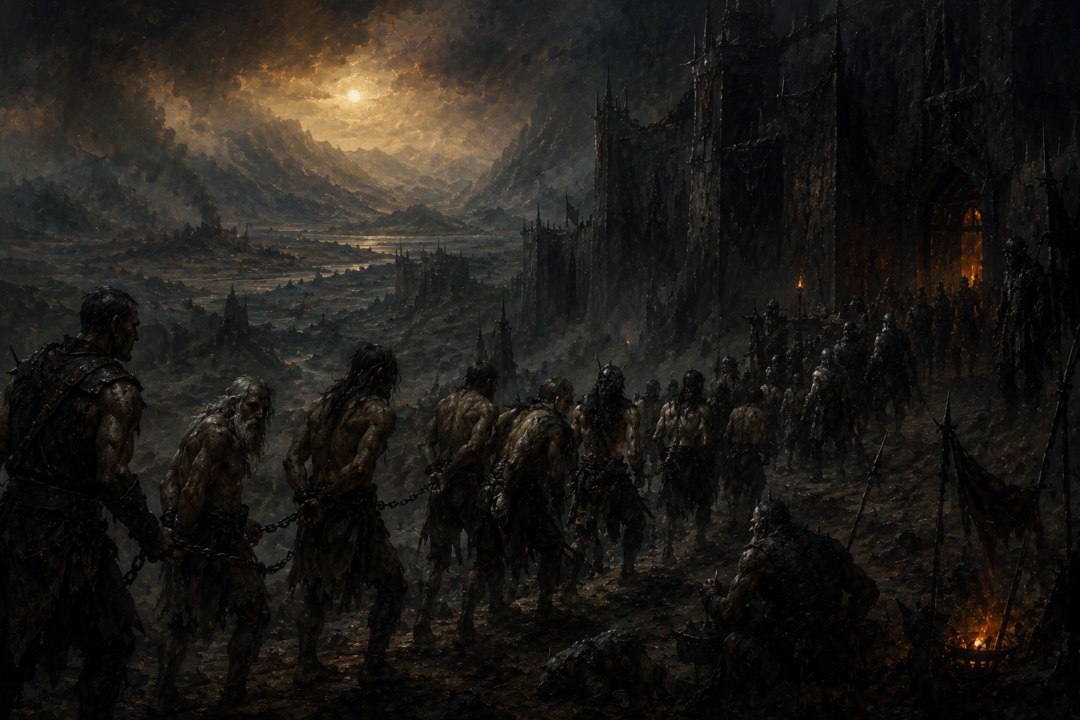
Saruman's forces provide a Third Age example of the horror of deliberate interbreeding involving Orcs and Men. The Lord of the Rings leaves readers with both large fighting Orcs and disturbing humanlike servants associated with Isengard, while later explanatory writings distinguish possible Men-orcs and Orc-men.
That does not prove that the original Orcs had the same origin. It demonstrates something narrower: corruption and breeding could produce blurred boundaries between Orcs and Men.
The texts therefore leave room for Orc-kind to be more complicated than one corrupted ancestor population.
The Most Important Answer Is the One That Never Changed
The biological question changed repeatedly.
The moral principle behind it did not.
Morgoth did not possess the power to originate true independent life in the manner of Ilúvatar.
Whatever Orcs originally were, Morgoth was their corrupter rather than the ultimate source of life itself.
That distinction changes how they should be understood.
Orcs are not evidence that evil can become a competing creator. They are evidence of something arguably more frightening: evil can take what already exists and damage it so profoundly that the original goodness becomes almost impossible to recognize.
That pattern extends far beyond Orcs.
Sauron does not create the desires that the Ring exploits; he turns them toward domination. Saruman begins as one of the Wise and falls through pride and the desire to control. Gollum begins as Sméagol. Even Morgoth himself was not evil in his beginning.
Again and again, the Shadow works upon something that already exists.
Orcs are the most difficult version of that pattern because their corruption appears to have become hereditary, cultural, and enormously long-lasting.
Why There Is No Single Canonical Origin to Discover
It is tempting to treat the competing explanations like clues in a mystery and ask which one is secretly correct.
The surviving texts do not justify that certainty.
The corrupted-Elves account has enormous importance because it appears in the published Silmarillion. But later writings explicitly reconsider it. The Mannish theory solves significant problems but requires chronological revisions that were never fully incorporated into a final narrative. Other possibilities remain exploratory rather than definitive.
So the safest lore-grounded conclusion is not that one obscure text reveals the “real” answer.
It is that no final, fully reconciled origin of the Orcs was completed.
And strangely, that uncertainty fits the Orcs.
Their history begins somewhere beyond the clear memory of the peoples who later fight them. The Wise know that Morgoth's malice lies behind them, yet even the account preserved in The Silmarillion is presented through inherited Elvish belief rather than an eyewitness description of their making.
We can be far more certain about what Morgoth did than about what his victims originally were.
He captured.
He enslaved.
He corrupted.
He bred creatures for hatred and war.
And he took living things whose existence he could never truly originate and attempted to turn them into proof of his own power.
That is the one part of the Orcs' origin that survives every major version.
The unresolved question is whether the first victims beneath that corruption were Elves, Men, beasts, some mixture of origins—or something never finally committed to a completed text.
The mystery remains because every simple answer carried consequences.
And the deeper the nature of Orcs was examined, the harder it became to explain them without confronting the uncomfortable truth at the heart of Middle-earth's vision of evil:
the Shadow's greatest power is not making life, but ruining what was already alive.
Sources & Notes
- The Encyclopedia of Arda, “Orcs” — surveys the published corrupted-Elf account alongside Tolkien’s other proposed origins and explains why the question remained unresolved. https://www.glyphweb.com/arda/o/orcs.php
- The Encyclopedia of Arda, “Morgoth” — documents Melkor’s inability to create independently and his characteristic corruption and breeding of existing life into servants. https://www.glyphweb.com/arda/m/morgoth.php
- The Encyclopedia of Arda, “Ilúvatar” — explains the unique creative authority behind true independent life, the theological limit that makes Orc origins difficult. https://www.glyphweb.com/arda/i/iluvatar.php
- The Encyclopedia of Arda, “Aulë” — recounts the making of the Dwarves and Ilúvatar’s intervention, the legendarium’s clearest comparison for fashioned bodies versus autonomous life. https://www.glyphweb.com/arda/a/aule.php
- The Encyclopedia of Arda, “Morgoth’s Ring” — identifies the volume containing Tolkien’s late metaphysical writings and variant discussions central to the unresolved Orc-origin problem. https://www.glyphweb.com/arda/m/morgothsring.php
Sources added for Tolkien's competing Orc-origin theories, sub-creative limits, and late textual context.