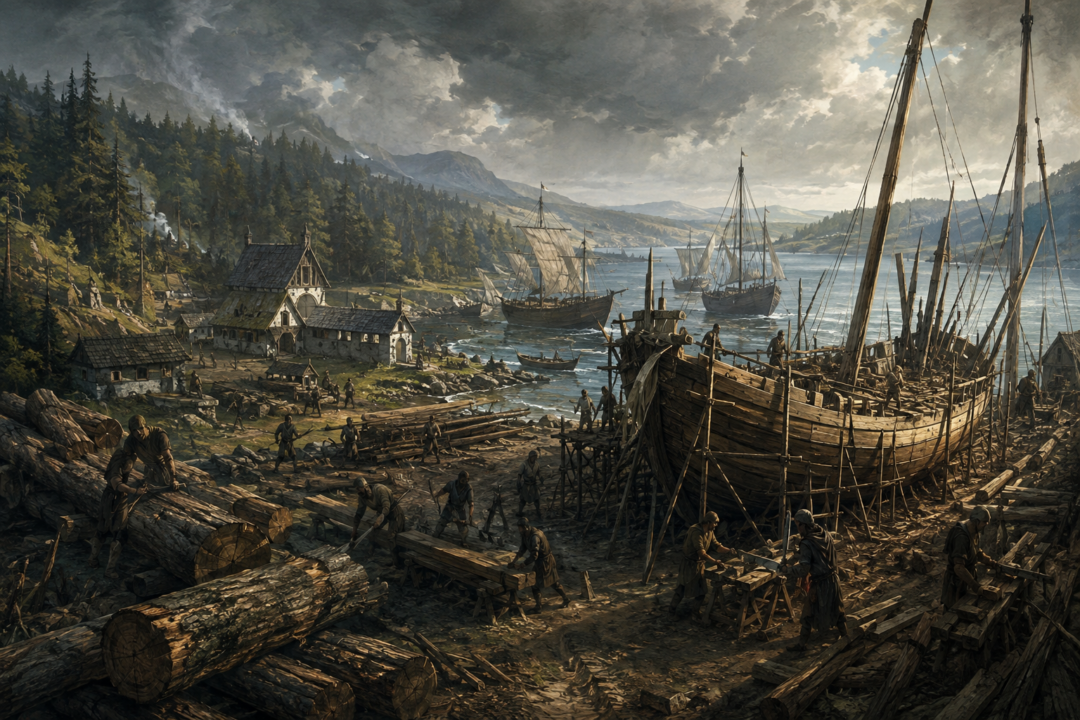
The Hidden Resource Behind Middle-earth’s Sea Power: Why Great Fleets Began With Forests
When Aldarion looked toward the Sea, he saw distance, discovery, and the growing importance of Númenor beyond its island shores. Yet the ships that carried that ambition depended on something far less romantic: trees.
That dependence becomes one of the most revealing logistical details in the history of the Second Age.
Middle-earth contains several important maritime traditions: Círdan’s shipwrights at the Grey Havens, the increasingly formidable fleets of Númenor, the later naval power of Gondor, and the hostile sea-power associated with Umbar. But the surviving texts do not give us equal information about the material economy behind each of them. We should therefore resist turning timber scarcity into a universal rule Tolkien explicitly stated.
What the texts do give us—especially in Unfinished Tales and the material concerning the Gwathló—is one extraordinary case study. Númenor’s rise as a maritime civilization created an appetite for timber so great that shipbuilding helped transform landscapes, provoke resistance, establish overseas bases, and eventually undermine one of the very regions supplying its fleets.
The hidden foundation of sea power was not simply seamanship.
It was access to forests.
Aldarion Understood That Ships Were Resource Systems
The importance of timber appears unusually clearly in the story of Aldarion.
Long before Númenor became the imperial power remembered from the later Second Age, Aldarion was developing its maritime capabilities. He founded the Guild of Venturers, built ships, explored the coasts of Middle-earth, and maintained close relations with Círdan and Gil-galad.
His connection with trees was not incidental.
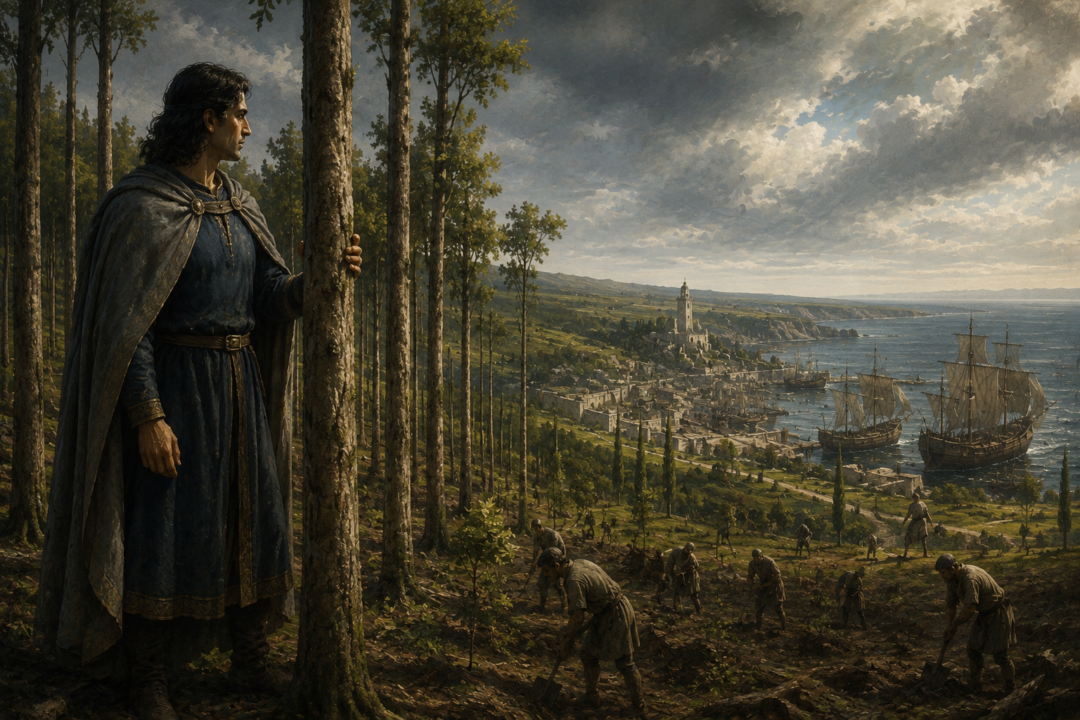
The material associated with “Aldarion and Erendis” describes his concern with timber for shipbuilding. He planted trees in Númenor for this purpose, and the growing demands of his voyages eventually brought the question of woodland directly into his conflict with his father, Tar-Meneldur.
At one point Meneldur closed the shipyards at Rómenna and forbade the felling of trees for Aldarion’s shipbuilding. Aldarion responded not by abandoning his maritime ambitions, but by relying increasingly on Middle-earth.
That is the crucial logistical shift.
A fleet requires more than sailors and harbours. Ships must be constructed, repaired, refitted, and replaced. Maritime expansion therefore ties naval power to a continuing supply of suitable material.
Aldarion’s solution was effectively to extend Númenor’s shipbuilding resource base across the Sea.
Vinyalondë Was a Harbour Built Beside a Supply Chain
Aldarion established Vinyalondë, the “New Haven,” at the mouth of the Gwathló.
Its location was extraordinarily useful. The river gave access to the heavily wooded regions of Minhiriath and Enedwaith, while the estuary provided a place where ships could be repaired and constructed.
The haven was therefore more than a stopping point.
It linked forest, river, shipyard, and ocean.
The surviving accounts describe timber being taken from the forests of Middle-earth, and Aldarion himself returned from one voyage with ships carrying timber after additional vessels had been built at Vinyalondë.
This reveals the physical geography behind Númenórean sea power.
Trees had to be felled inland. Timber could then be transported toward navigable water and the coast. A secure harbour allowed ships to be repaired or built near the resource itself. From there, vessels and materials could move into Númenor’s wider maritime network.
What looks on a map like a naval base was also an industrial frontier.
And that frontier had inhabitants already living in it.
The Forests Were Not Empty
This is where the story becomes darker.
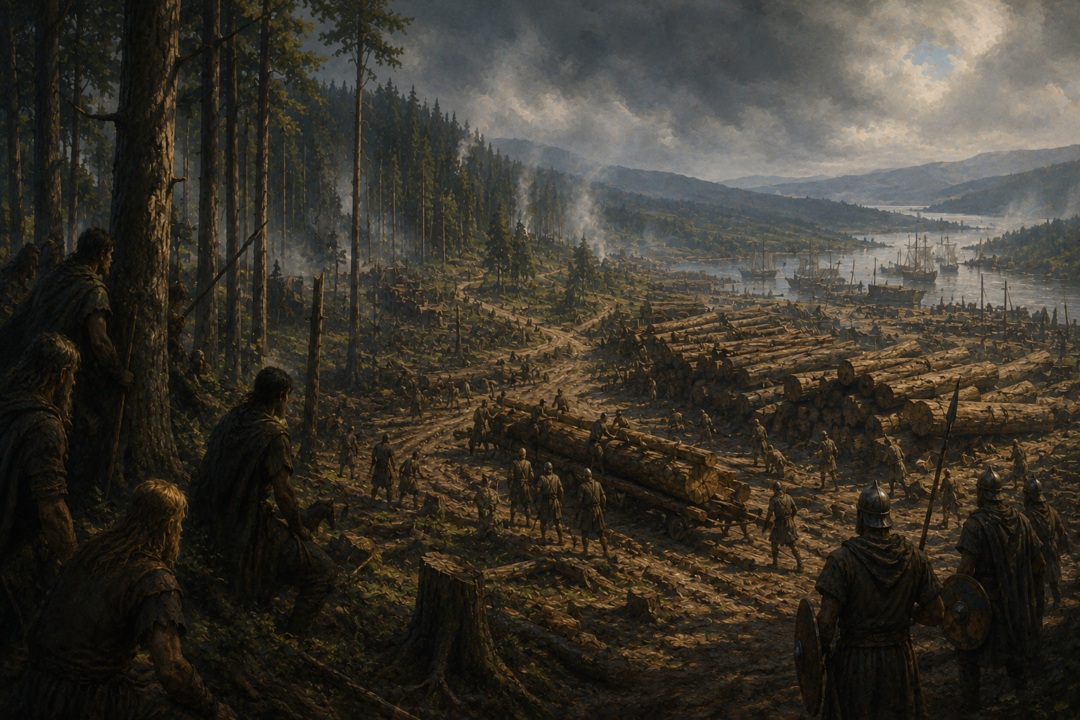
The Númenóreans did not discover an unoccupied timber reserve. The forested lands around the Gwathló were inhabited by Men whose communities were deeply connected to those regions.
Relations deteriorated as Númenórean tree-felling intensified.
The later historical material describes enormous destruction of the forests of Minhiriath and Enedwaith. Roads and tracks were driven into woodland, trees were felled on a growing scale, and timber was brought toward the Gwathló.
The local inhabitants resisted.
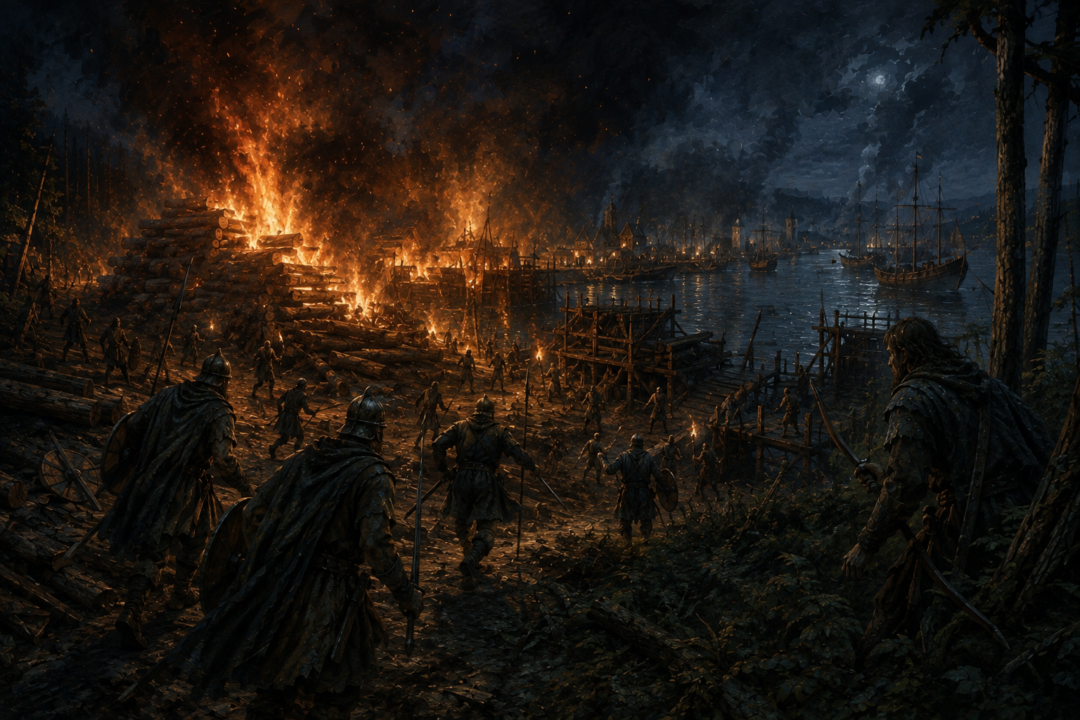
They attacked the Númenóreans, ambushed their workers, and burned timber stores. Númenórean retaliation in turn treated these people as enemies. Survivors were displaced into other regions, including lands toward what would later be called Dunland and the remaining woods of Eryn Vorn.
The implication is important.
Shipbuilding did not merely consume natural resources. It changed political relationships.
A demand originating in distant shipyards became violence on the ground.
Númenor’s ability to project power across the Sea increasingly required control over the landscapes capable of supplying that power.
Sauron Could Attack the Fleet Without Attacking the Fleet
The strategic consequences become even clearer during Sauron’s rise.
The Gwathló region mattered because it connected Númenórean maritime infrastructure with the interior of Eriador. Yet the same timber economy that strengthened Númenor had also produced enemies among local peoples.
Sauron benefited from this hostility.
During the wars of the Second Age, devastation in Eriador completed much of the destruction already begun through Númenórean exploitation. The forests that had supplied the shipbuilding industry were burned and ruined on a vast scale.
This demonstrates a basic vulnerability of wooden naval power.
You do not necessarily have to sink a fleet to weaken its supporting infrastructure.
Destroy its timber supply.
Burn its stores.
Make its resource territory unsafe.
Disrupt the routes connecting forests to shipyards.
A ship already afloat remains dangerous. But a maritime system must also repair damaged vessels and construct replacements. Once the supporting landscape is ruined, naval infrastructure can become much harder to sustain locally.
The later decline of Lond Daer as a major shipbuilding centre is connected to precisely this devastation.
The harbour survived.
The resource system around it did not.
Númenor’s Greatest Strength Created Its Own Pressure
There is a striking irony here.
Aldarion was among the Númenóreans who most clearly understood the strategic importance of Middle-earth. His friendship with Gil-galad helped Númenor recognize the growing danger in the East, and the maritime connections he developed would eventually matter enormously when Númenórean forces intervened against Sauron.
His foresight was real.
But maritime foresight had material consequences.
More ships required more timber. More distant operations required havens and repair facilities. Those facilities required secure access to resources. Protecting those resources encouraged deeper involvement on the mainland.
The texts do not reduce Númenor’s later imperialism to shipbuilding, and it would be inaccurate to claim that timber alone caused its transformation.
But timber provides an unusually concrete example of how exploration could become occupation.
A temporary haven becomes a permanent installation.
A useful forest becomes a strategic resource.
The people living within that forest become obstacles.
Logistics quietly becomes politics.
What About Círdan and the Grey Havens?
Círdan represents another great shipbuilding tradition, but here caution is necessary.
The Grey Havens possessed ships throughout the Second and Third Ages, and Círdan’s identity as the Shipwright makes maritime craftsmanship central to his people. Ships from the Havens carried Elves westward, and Círdan had already been deeply associated with shipbuilding before the foundation of Mithlond.
It is reasonable to observe that wooden ships physically required timber.
But the texts do not present Círdan’s people suffering the kind of documented timber crisis that afflicted the Númenórean operations around the Gwathló.
There is no comparable canonical account of the Elves devastating surrounding forests to maintain their fleets.
So the distinction matters.
The material requirement can be inferred from the technology. The political consequences cannot simply be copied from Númenor and assigned to every maritime culture.
Gondor and Umbar Inherited a World of Naval Competition
The same caution applies to the great fleets of the Third Age.
Gondor became a formidable sea power under its Ship-kings. Eärnil I repaired Pelargir, created a great fleet, and captured Umbar. His successors continued Gondor’s maritime expansion, while Umbar repeatedly became the centre of hostile naval power.
Later, the Corsairs of Umbar remained dangerous enough that their fleet posed a major threat during the War of the Ring.
All of those ships had to come from shipyards and material resources.
Yet the surviving narratives focus primarily on kings, wars, ports, fleets, and territorial control rather than detailed forestry policy. Tolkien never explicitly provides a Third Age equivalent of the Gwathló timber history explaining exactly where Gondor or Umbar obtained every major supply of shipbuilding wood.
We therefore cannot responsibly claim that a documented timber shortage determined each naval campaign.
What we can say is that the Second Age gives us a rare glimpse beneath the heroic narrative.
It shows what maintaining large-scale wooden sea power could require.
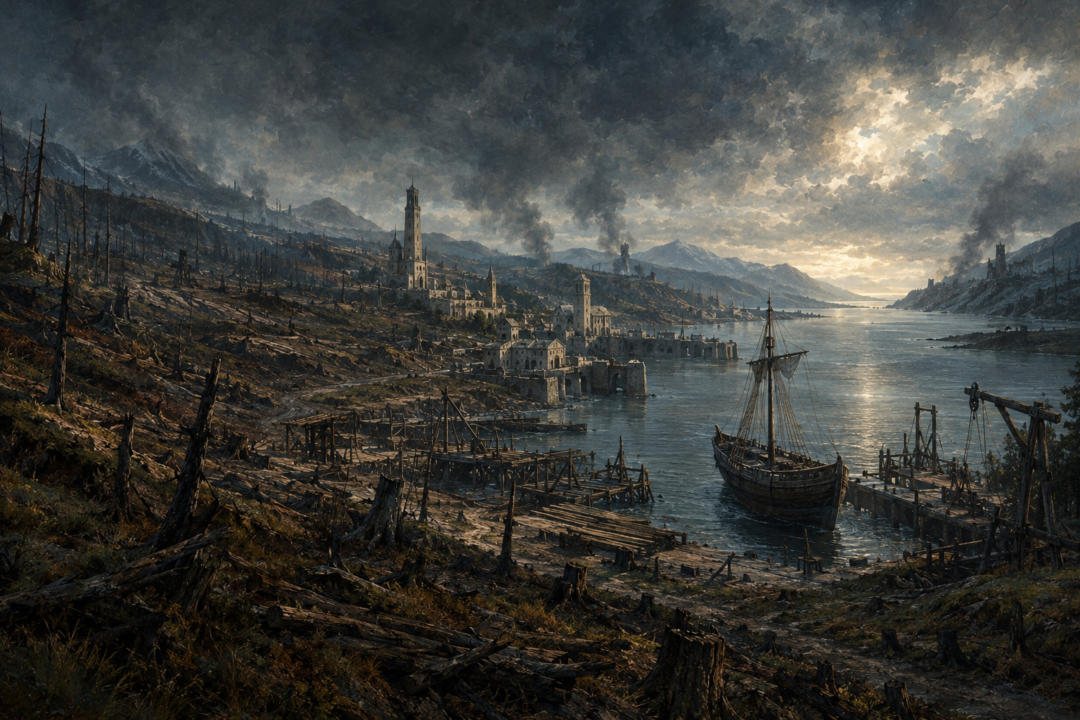
The Landscape Behind the Fleet
That glimpse changes how Númenor’s ships should be imagined.
Behind every great vessel lay more than skilled craftsmen.
There were forests.
There were labourers cutting and transporting timber.
There were rivers capable of moving heavy materials.
There were harbours positioned where resources could reach the Sea.
There were political authorities deciding who could cut which trees.
And, in Middle-earth, there were already people living in many of the lands being treated as sources of raw material.
This is why the destruction around the Gwathló is more than environmental background.
It exposes the cost hidden beneath Númenórean maritime greatness.
Their ships gave them mobility, knowledge, military reach, and eventually immense power over the coasts of Middle-earth. But those ships belonged to a material system whose demands reached far inland.
The sea power visible on the horizon began with axes in forests.
And in the history of Númenor, that dependence helped turn exploration into extraction, extraction into conflict, and conflict into a permanently altered landscape.
The greatest lesson is therefore not that Tolkien explicitly imposed a “timber rule” on every maritime civilization. He did not.
It is subtler.
Whenever the texts allow us to look behind the sails, maritime power proves inseparable from the lands that sustain it.
Númenor provides the clearest example—and perhaps the most tragic one. The civilization that mastered the Sea discovered that its ships were still rooted, quite literally, in the earth.
Sources & Notes
- Encyclopedia of Arda, “Aldarion” — profile of Númenor’s mariner-king, explorer, Captain of Ships, and Master of the Forests: https://www.glyphweb.com/arda/a/aldarion.html
- Encyclopedia of Arda, “Vinyalondë” — identifies Aldarion’s New Haven at the Gwathló mouth as a Númenórean harbour and shipyard: https://www.glyphweb.com/arda/v/vinyalonde.html
- Encyclopedia of Arda, “River Gwathló” — describes the river between Minhiriath and Enedwaith, its outlet at Lond Daer, and the felling of its formerly deep riverside forests: https://www.glyphweb.com/arda/g/gwathlo.html
- Encyclopedia of Arda, “Minhiriath” — geographical background on the region between the Baranduin and Gwathló and its southern border settlements at Lond Daer and Tharbad: https://www.glyphweb.com/arda/m/minhiriath.html
Sources document Aldarion’s maritime role, Vinyalondë’s function as a harbour and shipyard, and the Gwathló–Minhiriath geography and deforestation central to Númenórean timber supply.