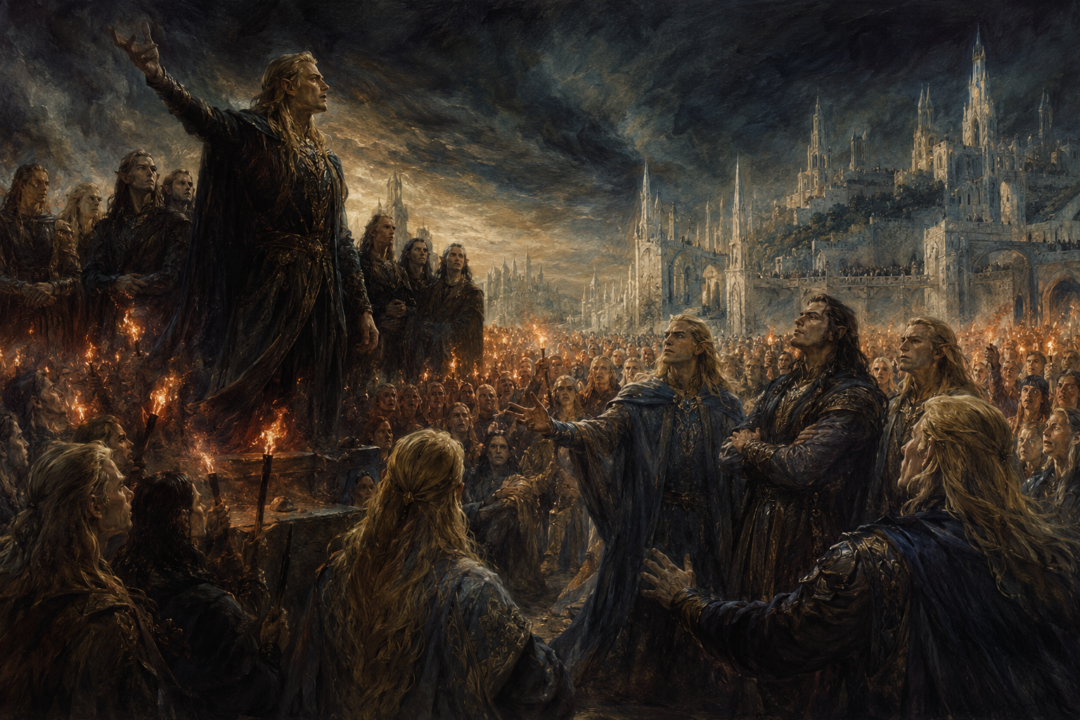
When Fëanor stood beneath the darkened skies of Tirion and called the Noldor to leave Aman, there was no single “Elvish response” to his rebellion.
That distinction matters. The Flight of the Noldor is sometimes remembered as though the Elves of the Blessed Realm suddenly turned against the Valar and marched east behind one furious prince. But the actual picture in The Silmarillion is far more fractured.
The Vanyar did not rebel. The Teleri refused Fëanor’s demands and ultimately fought to defend their ships. Even among the Noldor—the people supposedly following Fëanor—motives ranged from wholehearted loyalty to open opposition, ambition, grief, family obligation, curiosity about Middle-earth, and reluctant participation.
Some left and later repented. Some opposed Fëanor but continued into exile. Some followed the journey without accepting him as their true leader. Some remained in Tirion from the beginning.
Fëanor did not unite the Elves of Aman.
His rebellion revealed how divided they already were.
The Darkening Created a Crisis, Not a Consensus
The rebellion began under extraordinary circumstances.
Melkor and Ungoliant had destroyed the Two Trees. Valinor had been plunged into darkness. Finwë, King of the Noldor, had been murdered at Formenos, and the Silmarils had been stolen.
Fëanor therefore returned to Tirion carrying both personal grief and political fury.
His anger had older roots. Melkor had spent years spreading suspicion among the Noldor, encouraging fears that the Valar restrained them and fostering rivalry within the house of Finwë. Fëanor himself had already been banished from Tirion after threatening Fingolfin with a sword.
The catastrophe of the Darkening transformed those simmering tensions into something explosive.
Fëanor spoke before the Noldor and urged them to leave Aman for Middle-earth. He condemned the Valar, invoked the murder of Finwë, promised freedom and realms in the lands beyond the Sea, and sought the recovery of the Silmarils.
Then Fëanor and his seven sons swore their terrible Oath.
Yet even at this dramatic moment, the Noldor were not unanimous.
The debate that followed is one of the clearest indications that “Fëanor’s rebellion” was never politically simple.
Even the Noldor Were Divided Against Fëanor
Fingolfin opposed Fëanor.
So did Turgon. Finrod also spoke against him. Finarfin urged caution and warned against decisions that could not easily be undone.
Others wanted to depart for reasons that were not the same as Fëanor’s.
Galadriel, Fingon, Angrod, and Aegnor were among those moved by the prospect of leaving Aman and seeking wider lands, although The Silmarillion explicitly distinguishes such desires from love of Fëanor. Galadriel in particular desired lands where she might rule a realm of her own.
This produces an important distinction.
Supporting departure from Aman did not necessarily mean supporting Fëanor.
The Noldor could agree with one part of his program while rejecting another. An Elf might desire Middle-earth without accepting Fëanor’s claims against the Valar. Another might seek vengeance against Morgoth for Finwë while regarding the Oath as disastrous. Another might follow because his people and family were leaving.
Fingolfin illustrates the problem particularly well.
He had opposed Fëanor, and most of the Noldor preferred Fingolfin as their leader. Yet Fingolfin eventually went with the departing host. His motives included loyalty to his people and unwillingness to abandon them to Fëanor’s leadership. Later Tolkien writings also emphasize that Fingolfin did not understand his departure simply as rejection of all rightful authority of the Valar.
So even within the rebellion there were effectively people trying to restrain the rebellion.
That contradiction would shape everything that followed.
Fëanor Led the March, but Not Every Heart
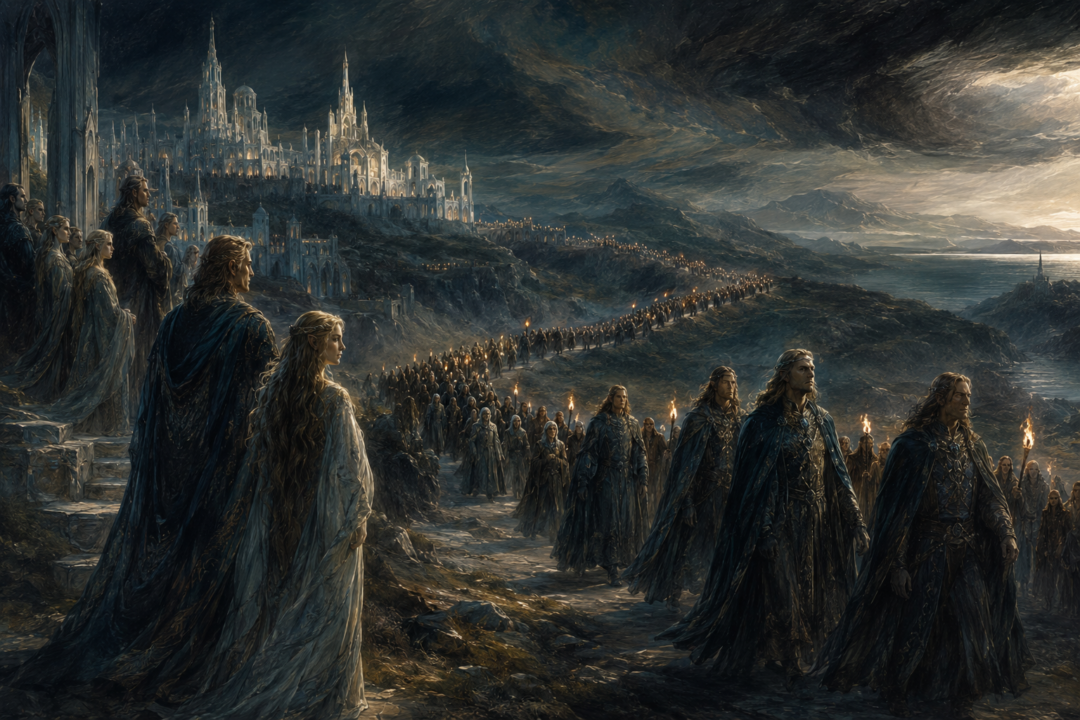
The departing Noldor moved in separate hosts.
Fëanor and his followers went first. Behind them came the much larger following associated with Fingolfin, with Finarfin also among the princes of the rearward host.
This physical separation reflected political separation.
Fëanor possessed enormous rhetorical force, but he did not possess uncomplicated allegiance from the entire people. Many who departed did not accept his leadership in the same way his own sons and immediate followers did.
The journey itself deepened the dissatisfaction.
Fëanor wanted speed. The host was enormous. Crossing the distances northward from Tirion proved difficult, and enthusiasm began to cool.
Then the Noldor reached Alqualondë.
There the differences between the peoples of Aman ceased to be merely political disagreement.
They became bloodshed.
The Teleri Experienced the Rebellion as an Attack
Fëanor needed ships.
The Teleri of Alqualondë possessed them.
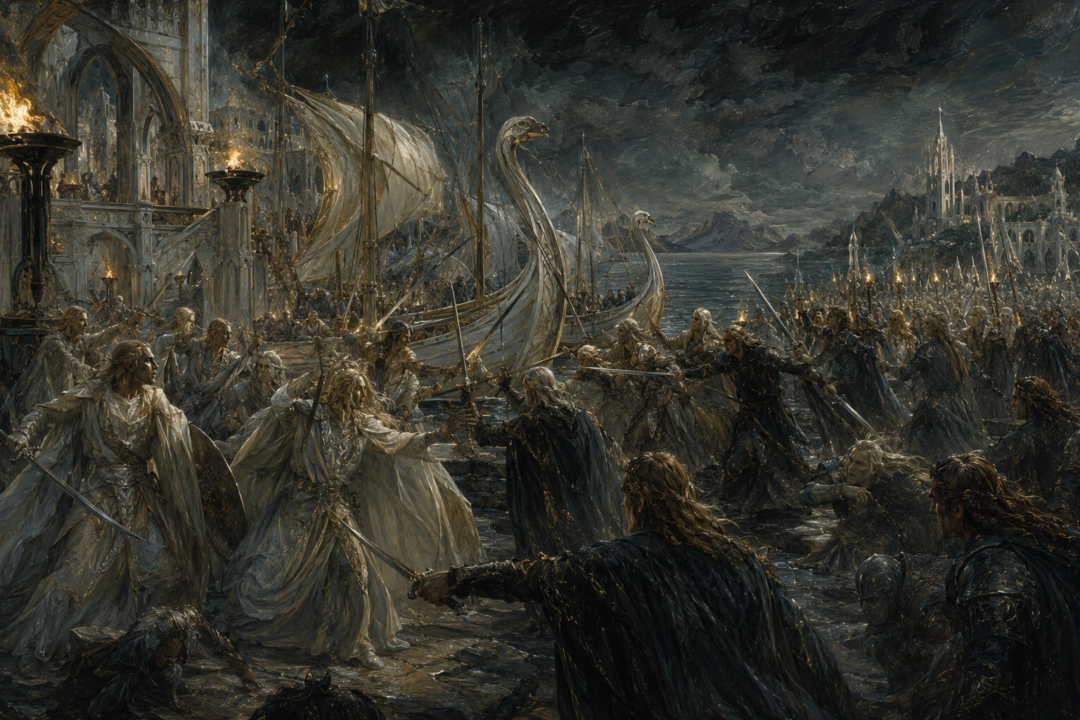
But those vessels were not simply transportation waiting to be requisitioned. The ships were precious works of the Teleri, intimately connected with their own history and craft. When Fëanor asked for their aid, the Teleri refused to join his rebellion and refused to surrender their ships.
Fëanor attempted to seize them.
The Teleri resisted.
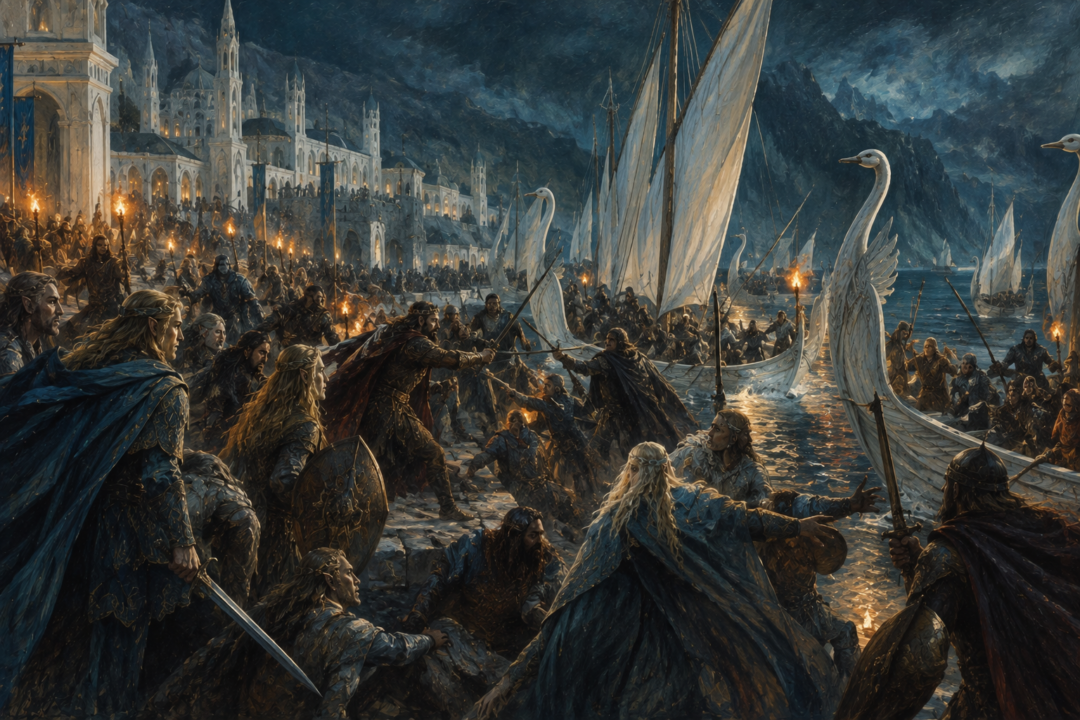
The result was the First Kinslaying at Alqualondë.
This event alone makes it impossible to describe the Elves of Aman as a unified population caught up in Fëanor’s revolt. For the Teleri, the rebellion arrived not as a shared national movement but as armed Noldor attempting to take what they had refused to give.
The tragedy became still more complicated when part of Fingolfin’s following arrived after the fighting had begun.
According to The Silmarillion, they did not initially understand the cause of the conflict. Seeing their own people engaged in battle, some joined the fighting, believing the Teleri had attempted to obstruct or attack the Noldor.
Thus even participation in the Kinslaying was not uniform in motive or knowledge.
That does not erase responsibility. It demonstrates how rapidly Fëanor’s rebellion had escaped the boundaries of his original personal grievance.
People who had opposed him were now being drawn into consequences created by his decisions.
The Vanyar Were Outside the Revolt
There is another major Elvish population in Aman that can disappear from simplified versions of the story: the Vanyar.
They did not join Fëanor.
By this period most of the Vanyar no longer lived in Tirion, having moved nearer to the Valar and Taniquetil. Their relationship with the Powers was very different from the growing unrest among the Noldor.
Nothing in the primary narrative suggests a corresponding Vanyarin rebellion.
This is especially significant because the royal houses were connected by blood. Fingolfin and Finarfin were sons of Indis, a Vanyarin Elf. Finarfin had also married Eärwen, daughter of Olwë of the Teleri.
The house of Finwë therefore stood at the intersection of the three great kindreds of the Eldar in Aman.
Fëanor’s revolt tore directly across those relationships.
For Finarfin, the cost became unbearable.
Finarfin Shows That Leaving Was Not Irreversible
After the Kinslaying, the departing Noldor continued north.
Then came the warning traditionally called the Doom of Mandos.
The Noldor were told of the suffering that would follow their rebellion and of the ruin attached to the Oath and the bloodshed at Alqualondë. At that moment another division appeared.
Finarfin turned back.
He had already argued for caution in Tirion. Now, grieving over the slaughter of the Teleri—his wife’s people—he abandoned the march and returned with part of his following.
He was pardoned and became ruler of the Noldor who remained in Aman.
His children did not return with him.
Finrod, Angrod, Aegnor, and Galadriel continued toward Middle-earth.
Few moments better demonstrate the fragmentation of the rebellion. One family could experience the same catastrophe and reach opposite decisions about what duty now demanded.
Finarfin concluded that continuing was wrong.
His children continued.
Fingolfin, despite having opposed Fëanor, continued as well.
There was no single Noldorin conscience.
Fingolfin’s Host Was Not Simply “Fëanor’s Army”
The final rupture came at Losgar.
Fëanor crossed the Sea using the stolen Telerin ships with his own people. Once in Middle-earth, he refused to send the ships back for Fingolfin’s host.
Instead, the ships were burned.
The people left behind could see the flames.
At this point any appearance of common leadership was shattered. Fingolfin’s followers had several possible choices, including returning toward Valinor. Instead they undertook the terrible crossing of the Helcaraxë, where some of them died.
They entered Middle-earth not as loyal Fëanorians but as a separate host deeply embittered against him.
This distinction becomes essential when considering the later politics of the Noldor in Beleriand. The exiles shared responsibility for rebellion in differing degrees, but they did not share one leader, one motive, or one relationship with the sons of Fëanor.
Their divisions had crossed the Sea with them.
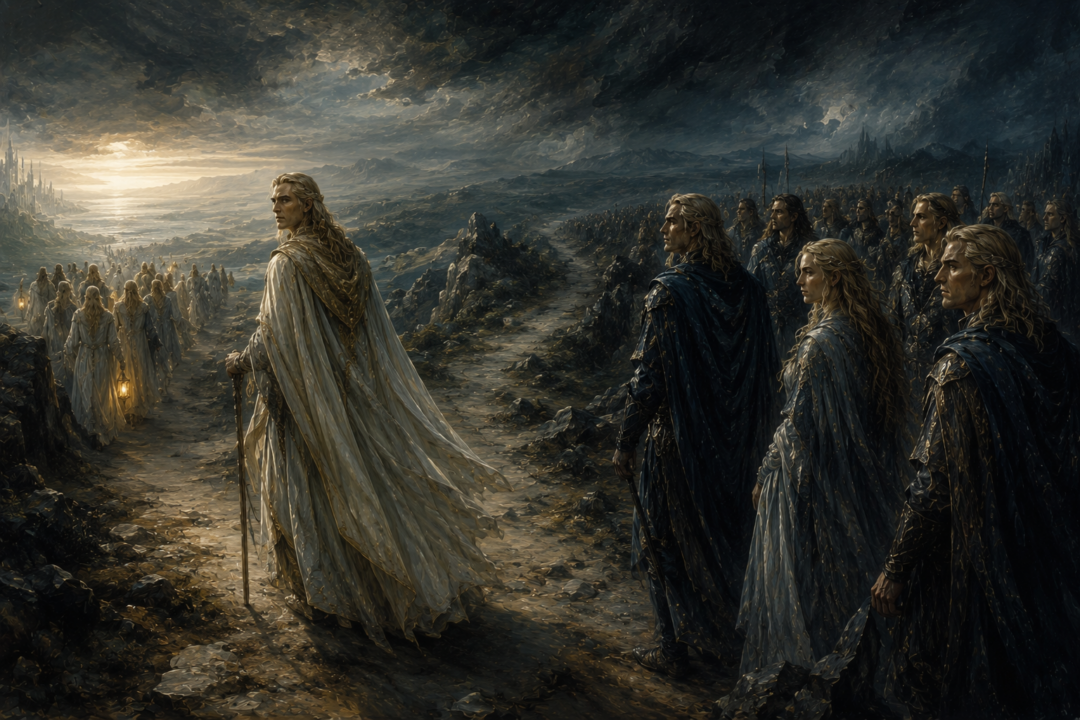
The Rebellion Was Really a Chain of Choices
The Flight of the Noldor becomes more tragic when it is not treated as a single collective decision.
At every stage, individuals faced another choice.
Listen to Fëanor or oppose him.
Remain in Aman or depart.
Follow Fëanor personally or follow another prince.
Take the ships or refuse.
Continue after the Kinslaying or return.
Cross the Helcaraxë or abandon the journey.
And the choices did not always align neatly.
An Elf could oppose Fëanor and still leave Aman. Another could desire Middle-earth while rejecting the Oath. Finarfin could begin the journey and later turn back. Fingolfin could reject Fëanor’s leadership yet continue farther than Fëanor ever expected him to go.
Meanwhile, the Teleri had their own choice—and said no.
The Vanyar remained apart.
The Noldor who stayed in Tirion never joined the rebellion at all.
That is what makes the catastrophe more than the story of one brilliant, furious Elf leading his people astray.
Fëanor could ignite the crisis, but he could not determine how every Elf would respond to it.
His words exposed old ambitions, loyalties, rivalries, grievances, and hopes. Then his increasingly irreversible actions forced everyone around him to decide how far they were willing to follow.
The Elves of Aman did not fall together.
They divided.
And those divisions—between Fëanor and Fingolfin, between the departing and returning Noldor, between Noldor and Teleri, and between those who accepted the rebellion and those who refused it—became part of the tragedy that the exiles carried into the First Age.
Sources & Notes
- https://tolkiengateway.net/wiki/Flight_of_the_Noldor — Tolkien Gateway: the rebellion’s stages, divided leadership, routes, betrayals, and return of some Noldor.
- https://tolkiengateway.net/wiki/First_Kinslaying — Tolkien Gateway: the violent division at Alqualondë and the different participation of Noldorin hosts.
- https://tolkiengateway.net/wiki/Finarfin — Tolkien Gateway: Finarfin’s initial departure, repentance, return to Valinor, and kingship over those who remained.
- https://tolkiengateway.net/wiki/Noldor — Tolkien Gateway: the people’s internal houses and the differing fates of exiles and Aman’s remaining Noldor.
Sources distinguish the choices of Fëanor, Fingolfin, Finarfin, and the Noldorin groups during the rebellion and exile.