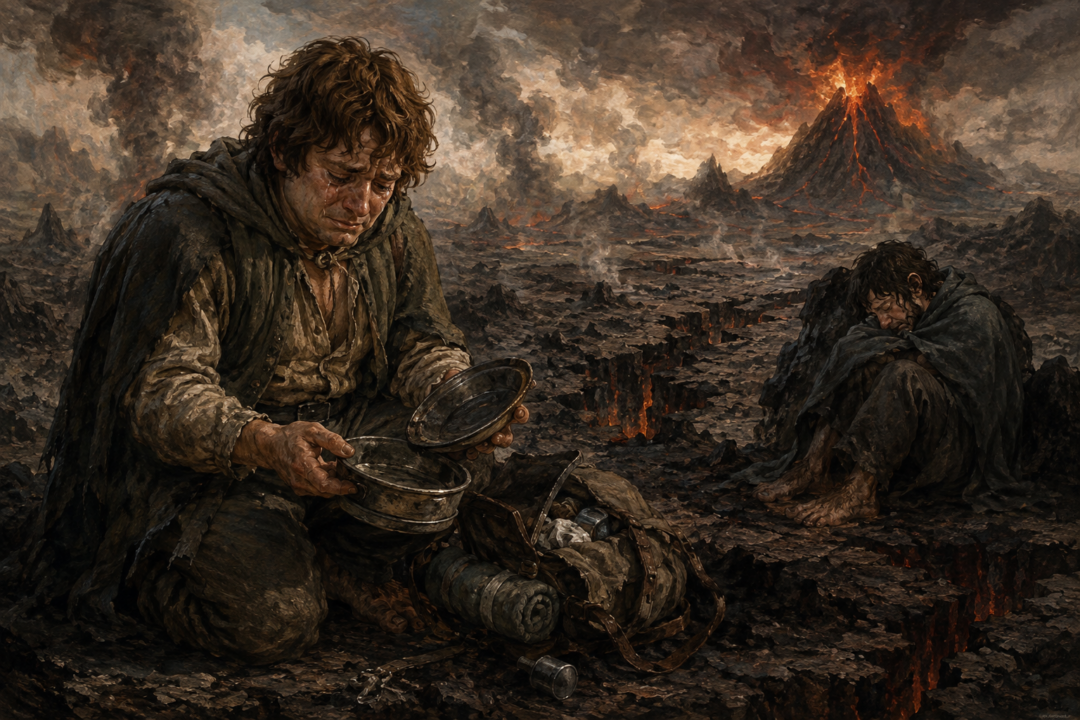
Of all the things Samwise Gamgee carries toward Mordor, few are more thoroughly Sam than his cooking gear.
Long before Mount Doom, when the Fellowship leaves Rivendell, Sam thinks of those utensils as his “chief treasure.” They belong to the practical world he understands: meals, fires, salt, hungry companions, and the ordinary work of keeping people alive. He has carried them through snow, wilderness, battle, loss, and exhaustion.
Then, almost at the end of the Quest, Sam throws them into a fissure in Mordor.
It looks like a simple decision to reduce weight. And practically, that is exactly what it is. But the scene in “Mount Doom” becomes much more painful because of what those pans have come to represent. Sam is not merely abandoning unnecessary equipment.
He is finally accepting that he and Frodo are walking toward a destination from which they have no realistic plan to return.
The Ring Has Made Every Ounce Matter
By the time Frodo and Sam cross Mordor toward Orodruin, Frodo is approaching the limits of endurance.
The Ring has become an increasingly terrible burden. Frodo tells Sam that he cannot simply hand it over: its hold on him has grown too strong. Sam cannot remove that burden without risking a disastrous struggle between them.
So Sam turns to something he can change.
He suggests lightening their physical load.
The reasoning is brutally practical. They are going straight toward the Mountain, and anything they are not certain to need should be discarded. Frodo agrees. He throws away the Orc shield and helmet he has been carrying as part of their disguise, removes the Orc gear, and abandons his sword as well.
Sam follows his example.
This is not preparation for a long expedition anymore. They are reducing themselves to what is required for the last miles.
Sam keeps only a tiny collection of essentials and precious objects: what remains of their lembas, the water-bottle, Sting, his Elven-rope, the Phial of Galadriel, and Galadriel’s small box given to him in Lórien.
Everything else has become weight.
Including the pans.
Why the Cooking Gear Hurts Most
Sam does not discard the cooking gear casually.
The text explicitly says that parting with it is the hardest loss among the possessions he empties from his pack. He is moved to tears.
That reaction makes sense because the utensils have accompanied him almost from the beginning of the Quest. At Rivendell, before the Fellowship even sets out, his cooking gear is singled out as his greatest treasure among his packed belongings.
That tells us something important about Sam.
Other members of the Fellowship carry objects associated with war, lineage, ancient kingdoms, or great deeds. Sam’s treasured possessions are domestic.
His instinct is to feed people.
Throughout the journey, Sam repeatedly remains concerned with food when grander matters dominate everyone around him. This is partly comic and partly practical, but it is also central to his character. He belongs to the Shire’s world of gardens, kitchens, full stomachs, and things that grow.
Cooking is one of the ways Sam carries that world with him.
Until Mordor makes him put it down.
The Rabbits in Ithilien
As Sam prepares to abandon the pans, his mind immediately returns to one particular meal.
He asks Frodo whether he remembers the rabbits in Ithilien.
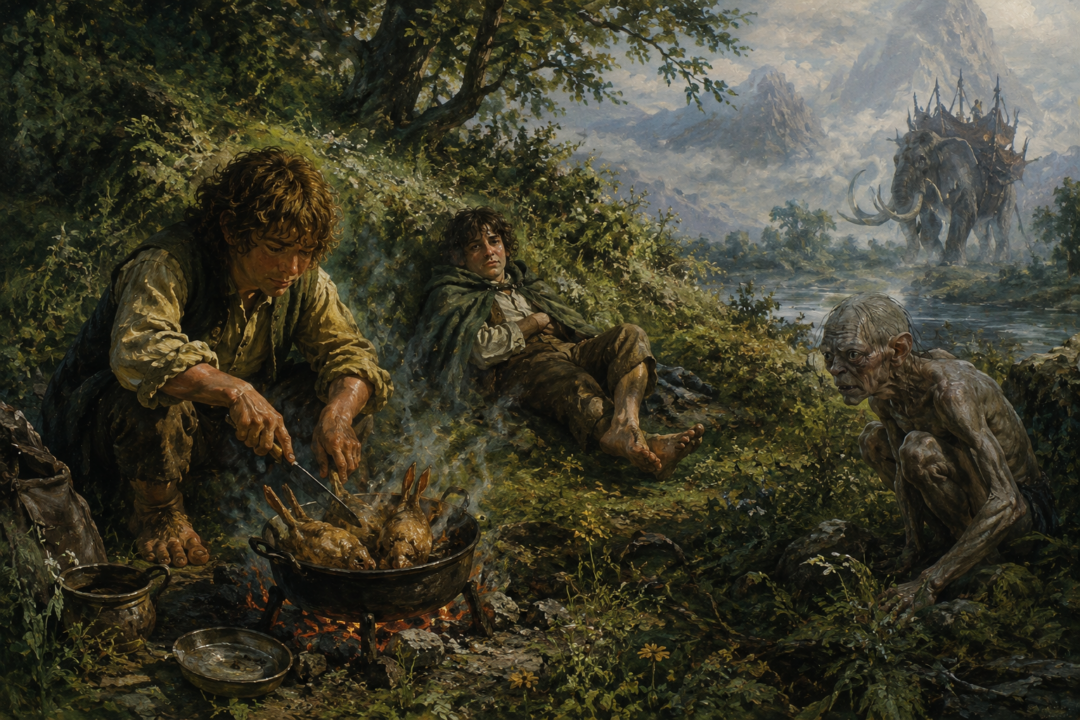
Earlier, while Gollum guided the hobbits through Ithilien, Sam had persuaded him to catch rabbits. Sam then cooked them in his pots, using herbs he found nearby. It is one of the most characteristically Samwise moments in the journey: even while approaching Mordor, Sam tries to transform scavenged food into something resembling a proper meal.
The episode also leads into their encounter with Faramir’s men. The fire Sam has made produces smoke that helps reveal that someone is nearby.
Yet what matters on Mount Doom is not tactical consequence. Sam remembers the meal as something good.
He remembers the warm bank. He remembers the rabbits. He remembers seeing an oliphaunt.
In Mordor, the battered pans have become physical links to that memory.
So Sam tries to give Frodo the same link.
And Frodo cannot follow him.
Frodo Can No Longer See the World Sam Remembers
Frodo’s answer turns a small scene about discarded equipment into one of the bleakest moments of the Quest.
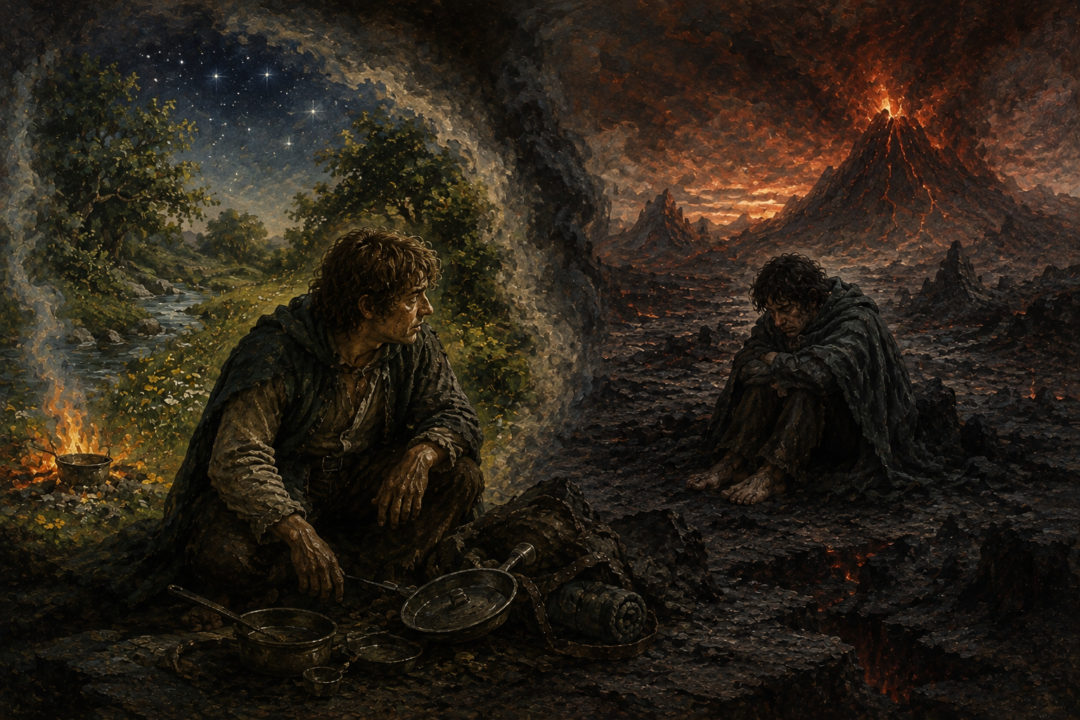
He knows intellectually that the events Sam describes occurred. But he can no longer summon them inwardly.
Food, water, wind, trees, grass, flowers, moonlight and stars have faded from his inner vision. The Ring dominates his consciousness so completely that the ordinary world Sam still loves is becoming inaccessible to him.
This is the crucial contrast.
Sam looks at a cooking pot and remembers Ithilien.
Frodo looks inward and increasingly sees only the Ring.
That difference explains much about their final journey.
Sam is suffering terribly, but he remains connected to the world beyond Mordor. He can still remember food, gardens, stories, stars and home. Frodo’s burden is more isolating. As the Ring approaches the place of its forging, it occupies more and more of his awareness.
Tolkien never states that Sam’s pans possess some formal symbolic meaning, so it would be too strong to claim that they canonically “represent the Shire.” But the surrounding passages make the association difficult to miss.
They belong to precisely the ordinary life that Frodo is losing the ability to imagine.
Sam Finally Gives Up the Return Journey
There is another reason the discarded cooking gear matters.
Sam has spent much of the Mordor journey thinking about supplies not merely for reaching Mount Doom, but for getting back.
That is characteristic of him. Frodo is increasingly focused only on reaching the Fire. Sam, even in near-hopeless circumstances, continues thinking like someone responsible for another person’s survival.
Eventually the arithmetic becomes impossible.
There is not enough food for a proper return journey. Water is desperately uncertain. Their strength is failing. Frodo is being crushed by the Ring.
When they discard their unnecessary belongings, the logic of the Quest changes.
They are no longer equipped as travelers expecting to come home.
Frodo says, in effect, that they will need little on the road ahead and nothing at its end.
That is not a prophecy that they absolutely know they will die. But it shows how little room remains for planning beyond the destruction of the Ring.
Their task has narrowed to one thing: reach the Mountain.
The cooking gear belongs to a future containing another meal.
Sam can no longer afford to carry that future on his back.
Why Sam Throws the Pans Into a Fissure
Even after deciding to abandon the equipment, Sam does something revealing.
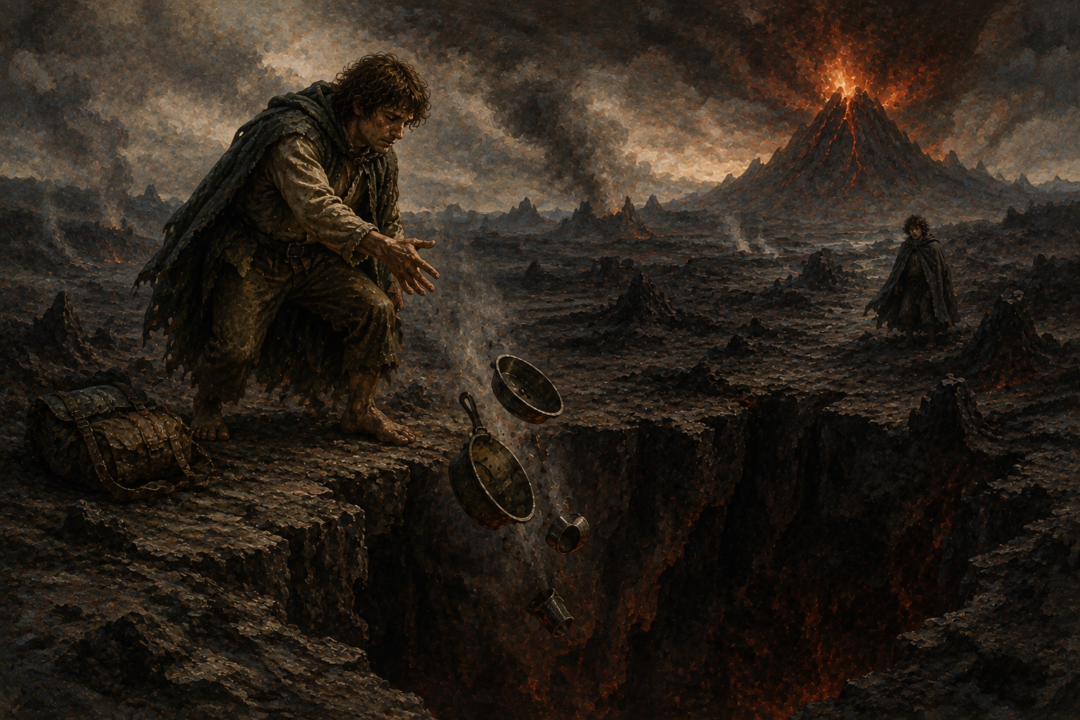
He does not simply leave the pans lying on the ground.
He carries the discarded gear to one of Mordor’s fissures and throws it down, partly because he has seen signs that Gollum is still following them. Sam does not want Gollum interfering with his possessions.
The pans fall into the darkness with a clatter that the narration compares to a death-knell in Sam’s heart.
It is an oddly intimate farewell in the middle of a story about the fate of Middle-earth.
No army has fallen. No king has died. No fortress has been destroyed.
A gardener has thrown away his pots.
Yet that small loss works because the Quest has steadily stripped Frodo and Sam of almost everything. Distance has gone. Comfort has gone. Safety has gone. Their disguises are discarded. Frodo abandons his weapon. Food and water are almost exhausted.
Soon even walking will become too much for Frodo.
The heroes who began with packs full of supplies are approaching the end with almost nothing.
But Sam Does Not Throw Everything Away
What Sam chooses to keep is just as important as what he abandons.
There are necessities: water, waybread, rope and Sting.
There is also the Phial of Galadriel.
And hidden close to his breast is the little box Galadriel gave him.
That box contains earth from her garden and a seed. When she gives it to Sam in Lórien, Galadriel explicitly connects its potential value with the possibility that he might return home.
Sam does not yet know exactly what its contents will accomplish. Much later, after the Shire has been devastated by Saruman’s men, he uses Galadriel’s gift in its restoration, and the seed grows into a mallorn in the Party Field.
This creates a striking contrast on the slopes before Mount Doom.
Sam throws away the equipment with which he could cook another ordinary meal.
But against his breast he carries something meant for a garden that does not yet exist.
It would be too much to say that Sam consciously keeps the box as a calculated declaration that he will survive. The text does not give him that explicit thought in this moment.
But narratively, the distinction is powerful.
He abandons what he cannot carry.
He preserves a gift associated with renewal.
The Final Transformation of Sam’s Burden
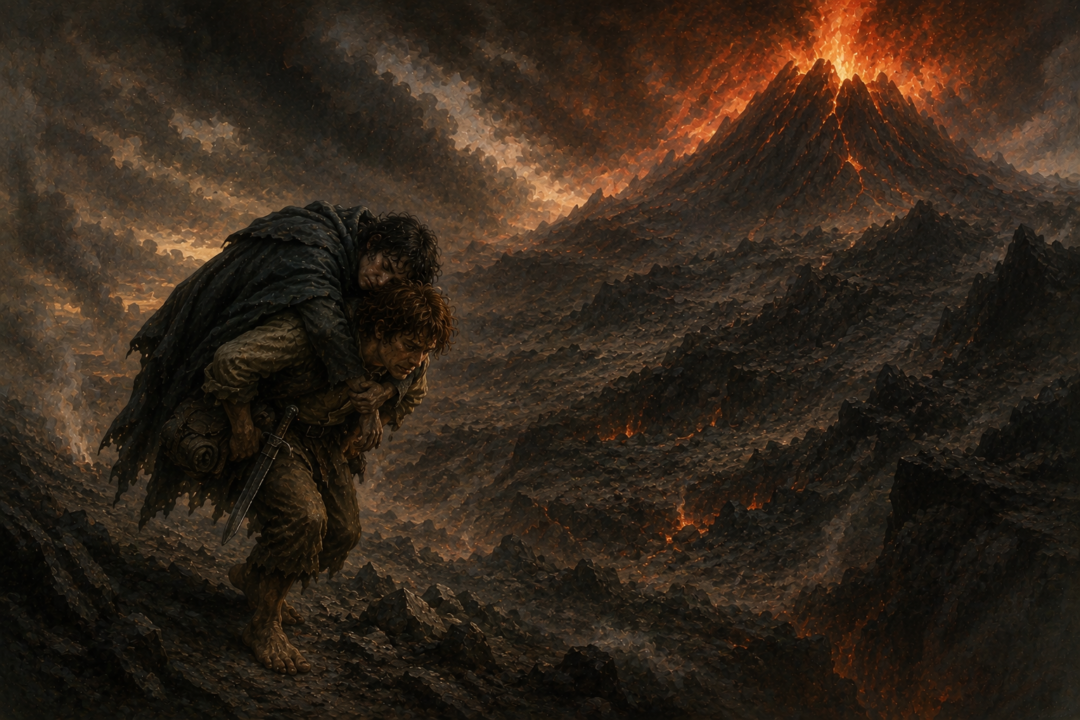
Soon after this stripping away of possessions, Sam discovers what he really must carry.
Frodo.
When Frodo can go no farther, Sam cannot take the Ring from him. Frodo has already made clear why that is impossible.
But Sam can take Frodo himself.
That moment is stronger because of everything that has just been discarded. Sam has spent the Quest carrying useful things: food, cooking equipment, rope, supplies, Frodo’s belongings.
Near the end, usefulness becomes brutally simple.
The pans cannot help Frodo climb.
The extra equipment cannot help.
Sam’s own strength can.
So the gardener who once worried at Rivendell because he had forgotten rope eventually climbs Mount Doom bearing the Ring-bearer on his back.
His greatest contribution is not a weapon, magical power, noble ancestry, or secret knowledge.
It is the ability to decide what still matters.
The Smallest Farewell Before the Greatest Task
Sam throws away his cooking gear because he and Frodo desperately need to reduce their burden for the final approach to Mount Doom.
That is the literal answer.
But the scene stays with readers because those pans have survived almost the entire journey. They connect Sam to meals, comfort, service, memory and the ordinary world for which the Quest is being fought.
Frodo can barely remember that world anymore.
Sam still can.
And then Sam chooses to leave part of it behind so that Frodo has a better chance of reaching the Fire.
There is something deeply characteristic of the whole Quest in that decision. Middle-earth is not saved only through councils, battles and great powers. Its fate also depends upon small acts of relinquishment made by people who would rather be somewhere warm, preparing supper.
Sam hears his pans disappear into the darkness.
Then he turns back toward Frodo.
The Mountain is still ahead.
Sources & Notes
- https://tolkiengateway.net/wiki/The_Land_of_Shadow — Tolkien Gateway: the hobbits’ food and water constraints, forced detours, and final journey across Mordor.
- https://tolkiengateway.net/wiki/Mount_Doom_%28chapter%29 — Tolkien Gateway: Sam’s decision to discard gear before the last approach and carry Frodo upward.
- https://tolkiengateway.net/wiki/Plateau_of_Gorgoroth — Tolkien Gateway: distances, terrain, roads, camps, and route across the exposed plateau.
- https://tolkiengateway.net/wiki/Samwise_Gamgee — Tolkien Gateway: Sam’s provisioning, practical decisions, and support of Frodo through the final stage.
Sources document dwindling supplies, the final change of direction, discarded equipment, and the ascent of Mount Doom.