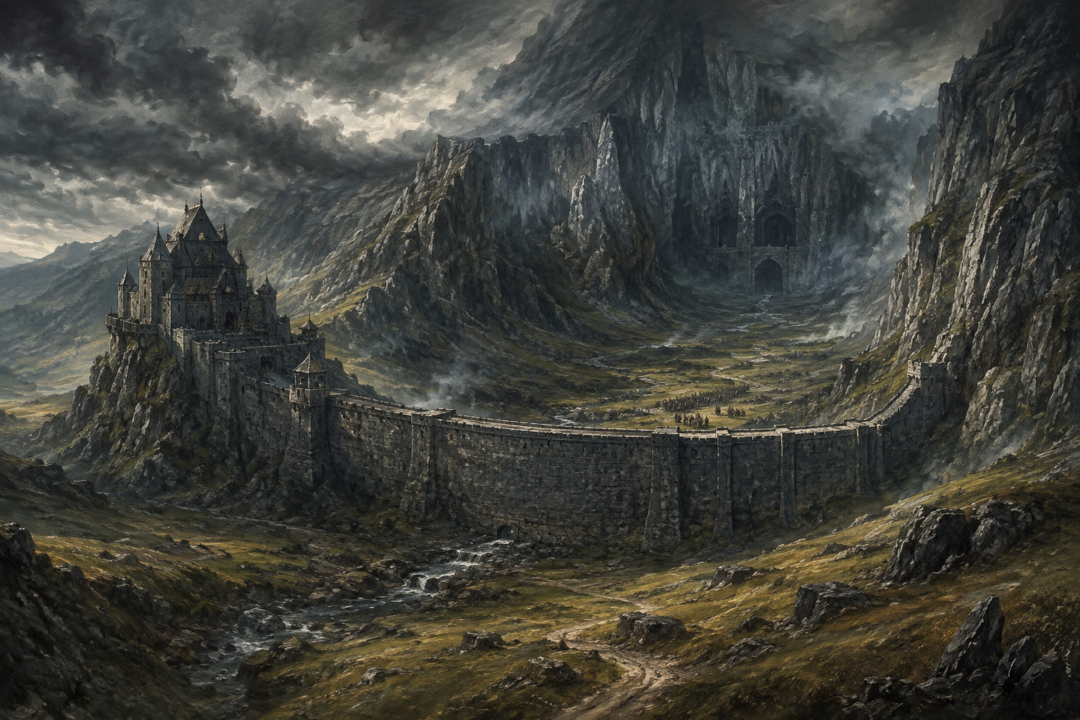
When most readers picture Helm’s Deep, the Deeping Wall seems obvious: a huge stone barrier built to keep an army out.
But the geography of the Hornburg reveals something more interesting.
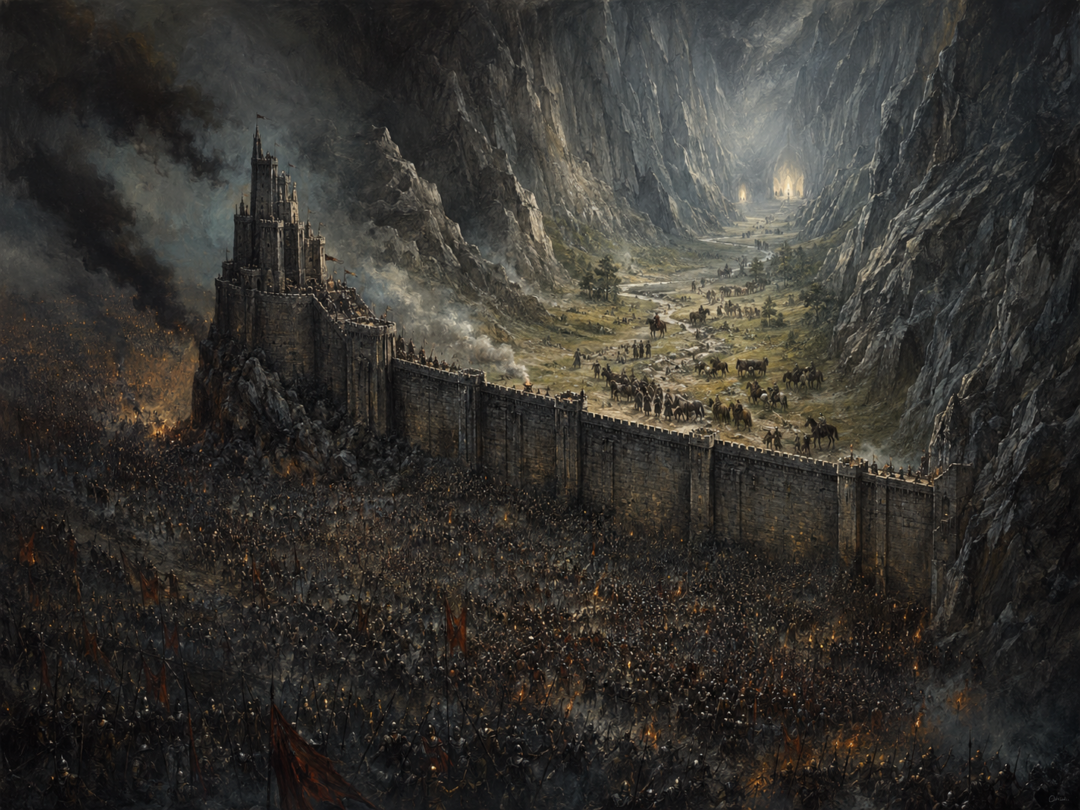
The wall is not simply the outer wall of a castle. The Hornburg itself stands at one end of it, raised upon the Hornrock. The Deeping Wall stretches away from that fortress across Helm’s Gate, closing the mouth of the narrow gorge that runs back into the White Mountains. Behind the wall lie the Deep itself, the entrances to the caverns later celebrated by Gimli, and—in the Battle of the Hornburg—the people, animals, and defenders who have retreated into that protected space.
In other words, the Deeping Wall is protecting something much larger than the Hornburg.
It turns an entire mountain gorge into a refuge.
The Hornburg and the Deeping Wall Are Not the Same Fortification
The easiest mistake is to imagine Helm’s Deep as a conventional castle surrounded by a single curtain wall.
The text describes a more unusual defensive system.
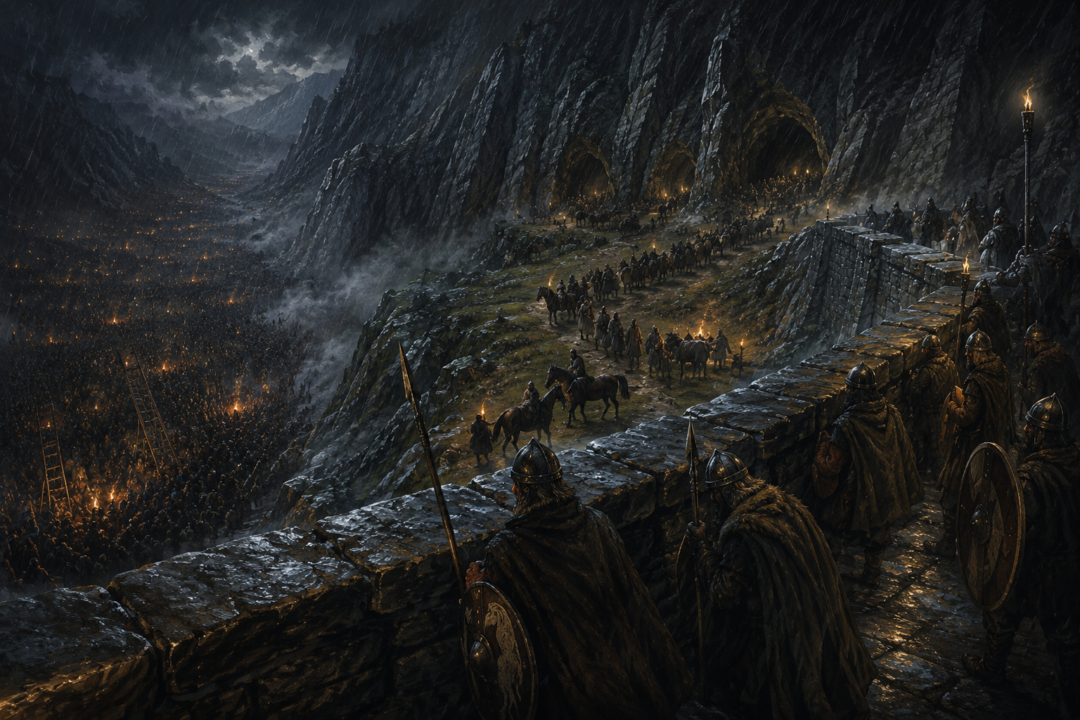
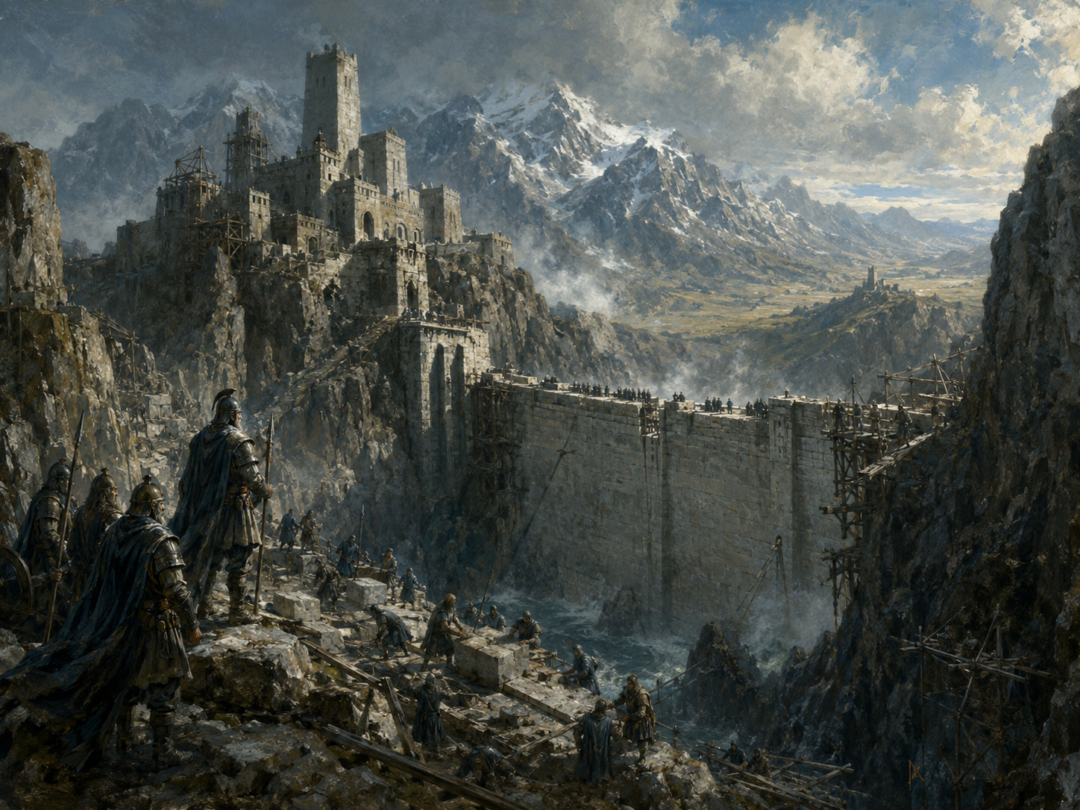
The Hornburg stands upon a spur of rock projecting from the mountains. From that position, the Deeping Wall runs across the entrance to the gorge known as Helm’s Deep. The wall is about twenty feet high and broad enough for four men to walk abreast along its top. Its outer face is smooth, with stones fitted so closely that attackers cannot easily find footholds, while its upper edge projects outward. Go2Train
The Hornburg therefore protects one portion of the position, while the Deeping Wall seals the remaining opening between the fortress and the opposite side of the valley.
Together they create what the terrain alone cannot.
The mountains form most of the enclosure. The builders only have to close the gap.
That distinction explains why Éomer places much of his available strength on the Deeping Wall rather than concentrating everyone inside the Hornburg. The fortress itself is formidable, but an enemy that breaks the wall gains access to the much larger defended space behind it. The narrative explicitly says that Éomer regarded this portion of the defence as the more doubtful point if a powerful assault came against them. Go2Train
What Lies Behind the Wall
Behind the Deeping Wall stretches the narrow gorge itself.
During the Battle of the Hornburg, that space becomes strategically important immediately. Théoden’s forces lead their horses far up the Deep under guard. The refuge is therefore not limited to soldiers standing on battlements. The gorge provides protected depth behind the fighting line. Go2Train
Beyond it are the caverns beneath the White Mountains—the Glittering Caves of Aglarond, which Gimli later describes with astonishment to Legolas. They contain extensive passages, halls, chambers, stone formations, and deep ways beneath the mountains. During the crisis these caves serve as a refuge.
This is the key to understanding the wall.
An attacker looking toward the Deeping Wall sees only masonry.
A defender looking backward sees sanctuary.
The wall protects access to the Deep, and the Deep gives the defenders somewhere to withdraw people and resources away from the exposed Westfold. Its purpose is therefore inseparable from the landscape behind it.
It is essentially a gate across a valley.
The Deeping Wall Protects the Refuge, Not Merely the Castle
This distinction becomes particularly important because Helm’s Deep is used as a refuge in time of invasion.
The Hornburg can shelter warriors, but the surrounding fortified geography allows a much larger defensive concentration than the keep alone would provide. At the time of Saruman’s assault, Westfold-men are already present, and noncombatants from the threatened country have sought safety in the caves.
The wall keeps Saruman’s army from simply pouring into that refuge.
This also explains why the battle along the Deeping Wall matters so much. If the enemy merely wanted possession of the Hornburg, attacking the castle itself would be the obvious objective. Instead, Saruman’s forces assault both the fortress and the barrier.
The Deeping Wall is defending the opening through which an army could penetrate behind the entire fortified line.
Once attackers cross it, the sheltered ground becomes contested ground.
The Deep therefore works almost like the interior of a fortress whose enormous rear and side walls happen to be mountains rather than masonry.
Why the Wall Runs Across the Gorge
The design uses geography with remarkable economy.
A fortress in open country must create its own defensive perimeter. At Helm’s Deep, nature has already created most of one. High ground and the mountain gorge restrict the directions from which a large enemy force can attack the refuge behind Helm’s Gate.
The Deeping Wall closes the vulnerable opening.
At its northern end stands the Hornburg, dominating the approaches from its rocky foundation. Behind the outer defensive position, the gorge narrows toward the mountains and caves.
Farther in front lies another obstacle: Helm’s Dike, an ancient earthwork and trench extending across the Deeping-coomb roughly a quarter-mile below the main fortifications. It functions as an advanced barrier rather than the ultimate defensive line.
The system therefore has layers.
An enemy advances through the Deeping-coomb, encounters the Dike, then reaches the much stronger combination of Hornburg and Deeping Wall. Behind that final barrier lies the refuge.
The architecture makes considerably more sense once Helm’s Deep is viewed from above rather than imagined simply from the battlefield immediately beneath the wall.
The Stream Reveals the Wall’s Most Dangerous Problem
No wall crossing a valley can ignore water.
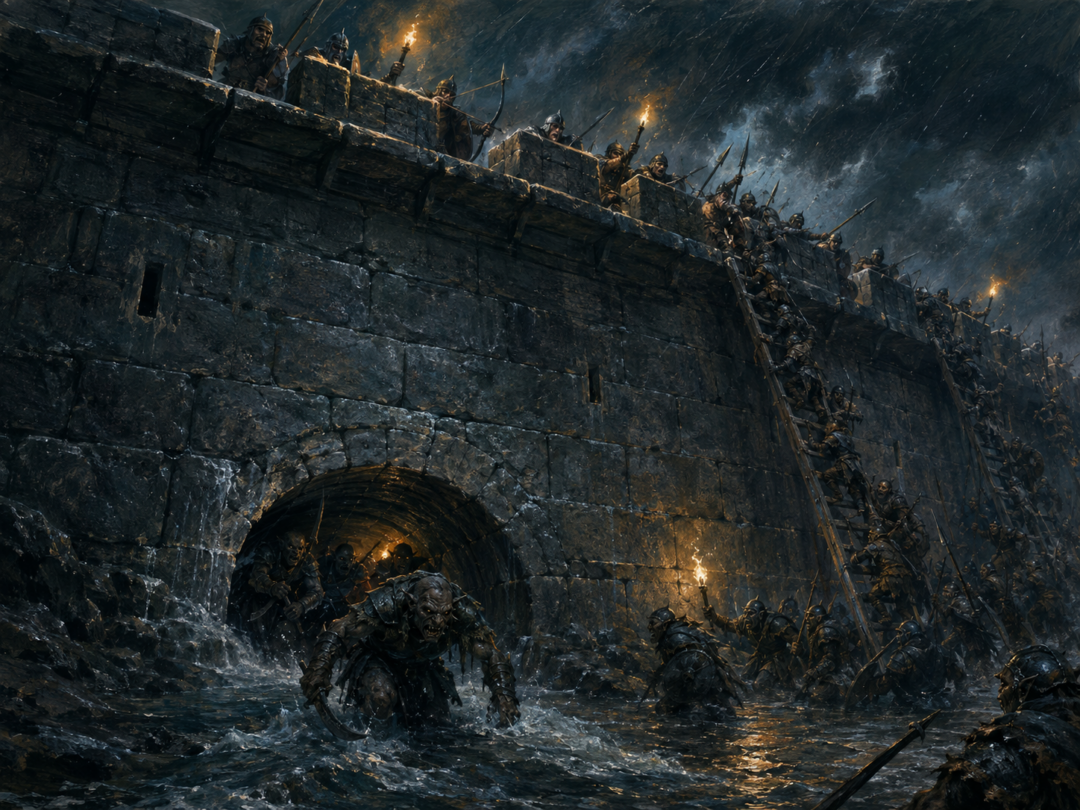
The Deeping-stream flows down from the gorge, so the builders provided a culvert through the base of the Deeping Wall. The stream passes through it and continues beneath the Hornburg’s position toward the lower valley.
That small opening becomes one of the decisive weaknesses of the battle.
Saruman’s Orcs discover that they can enter through the culvert. Men defending the wall are suddenly attacked from behind, forcing the Rohirrim to respond to enemies who have penetrated the barrier without climbing it.
Hall of Beorn
The episode demonstrates the logic of the entire fortification through its failure.
The Deeping Wall exists to prevent hostile movement into the Deep.
The moment enemies pass beneath it, even in small numbers, they have crossed the boundary the wall was built to preserve.
Later Saruman’s forces exploit the same vulnerable area with the mysterious destructive device Aragorn calls a “devilry of Orthanc.” The text does not precisely explain the mechanism, so claims that it was a specific modern kind of explosive go beyond what is explicitly stated. What matters narratively is that the enemy finds a way to rupture a defensive system whose ordinary stonework is extremely difficult to scale or break.
The Wall Was Part of an Older Gondorian Strategy
The fortifications also predate the Rohirrim.
Aglarond—the fortress later called the Hornburg—was originally a Gondorian stronghold from the days when Calenardhon belonged to Gondor. Later writings describe Aglarond and Angrenost, or Isengard, as fortresses associated with guarding the two sides of the Gap of Calenardhon, later the Gap of Rohan. When Cirion granted Calenardhon to the people of Eorl, Gondorian masons helped repair Aglarond before it passed into Rohirric keeping.
That larger context prevents another misleading interpretation.
The Deeping Wall was not constructed specifically because Saruman might someday invade Rohan.
It belongs to an older defensive landscape.
Its location near the southern side of the Gap makes the entire Hornburg complex strategically valuable independently of the particular circumstances of the War of the Ring. Yet by Théoden’s time, its ancient engineering has acquired a second life: what was once part of Gondor’s western defensive system has become the great refuge of the Westfold.
That is one reason the fortress feels so old during the battle. The Rohirrim are relying upon stonework inherited from a civilization whose presence in the region reaches back long before their own settlement there.
Why Helm Hammerhand Could Survive There
The refuge had already demonstrated its value centuries before Saruman’s war.
During the invasion of Rohan by Wulf and the Dunlendings in the Long Winter, King Helm Hammerhand withdrew to the fortress. It was during this grim siege that the place acquired its enduring association with him and eventually the names Hornburg and Helm’s Deep.
That history reinforces what the geography already tells us.
The site is valuable because retreat does not automatically mean surrender.
An army driven from the open country can withdraw into a position where mountains compress the enemy’s numerical advantage and prepared fortifications close the remaining approach.
The wall therefore protects more than physical ground.
It protects the possibility of surviving defeat elsewhere.
The Real Meaning of the Deeping Wall
At the Battle of the Hornburg, Saruman has numbers. Théoden’s defenders have stone, elevation, narrow approaches, and depth.
The Deeping Wall converts those geographical advantages into a defensible boundary.
In front of it lies the enemy.
Behind it lie the Deep, the horses, the surviving defenders, refugees, and the caves beneath the mountains.
That is what the wall is designed to protect.
Not primarily the Hornburg itself—the Hornburg has its own walls, gates, and rocky foundation—but the open mouth of the refuge beside it.
And this helps explain one of the battle’s most important visual contrasts.
The Hornburg remains a fortress even when surrounded. The Deeping Wall is something different: a single artificial line completing a natural enclosure.
Break that line, and the mountains no longer protect those within.
Hold it, and an apparently trapped people possess one of the strongest refuges in Rohan.
The genius of Helm’s Deep is therefore not that someone built an enormous castle against a mountain.
It is that an ancient builder understood that the mountain was already most of the castle.
Sources & Notes
- https://tolkiengateway.net/wiki/Hornburg — Tolkien Gateway: the fortress’s position at Helm’s Deep and relationship to the wall, valley, and caves.
- https://tolkiengateway.net/wiki/Deeping_Wall — Tolkien Gateway: the wall’s construction across the Deep, defensive purpose, and vulnerable culvert.
- https://tolkiengateway.net/wiki/Deeping-coomb — Tolkien Gateway: the approach valley whose population and routes feed into the fortress complex.
- https://tolkiengateway.net/wiki/Battle_of_the_Hornburg — Tolkien Gateway: how defenders use the Hornburg, wall, Deep, and Glittering Caves during the siege.
Sources describe the Hornburg complex, Deeping Wall, defended valley, caves, culvert, and battle deployment.