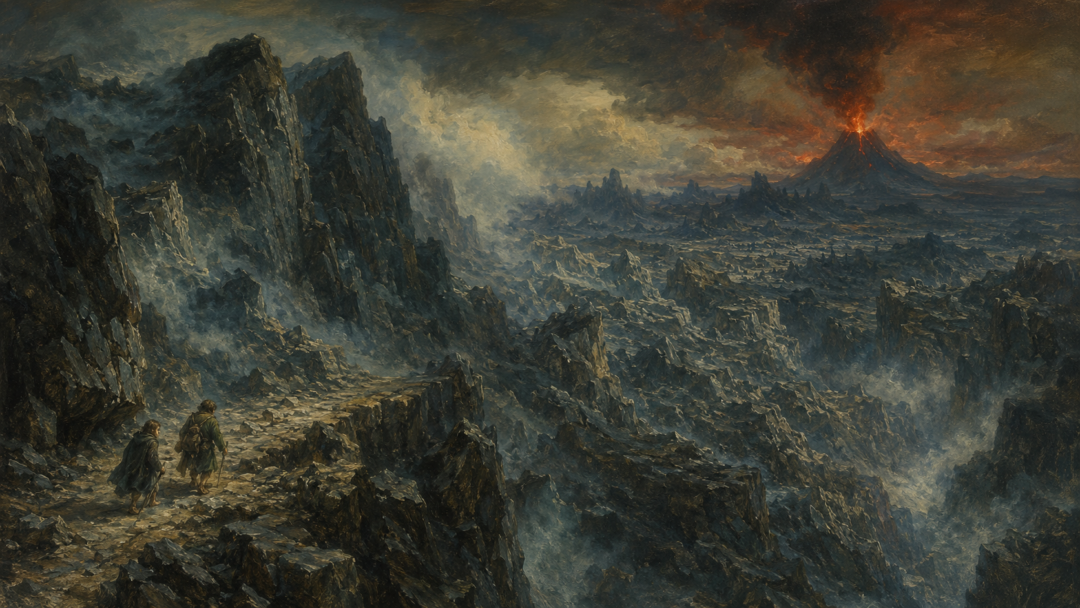
Mount Doom is visible from astonishing distances. Once Frodo and Sam reach the eastern side of the Anduin, their destination is no longer some vague point beyond the horizon. Orodruin stands inside Mordor, rising above the Plateau of Gorgoroth, and everything depends upon reaching its fire.
That makes an obvious question surprisingly important: why do the Hobbits spend so much of the journey moving around Mordor instead of simply heading toward the mountain?
The answer is not that they become lost in a convenient maze. Mordor is built, geographically and militarily, to make a straight approach nearly impossible. Mountains block the western road. The northern entrance is one of the most heavily guarded places in Middle-earth. The alternative path forces them south into Ithilien and then upward through Cirith Ungol. Even after entering Mordor, Frodo and Sam cannot simply point themselves toward Mount Doom and walk there.
Their winding route is the consequence of terrain, fortification, secrecy, exhaustion, and Sauron's overwhelming control of his own land.
And that is precisely why two Hobbits have any chance at all.
The First Problem Is the Emyn Muil
After the breaking of the Fellowship, Frodo and Sam cross the Anduin and enter the eastern Emyn Muil.
Almost immediately, the idea of travelling in a straight line becomes meaningless.
The Emyn Muil are a broken region of steep ridges, gullies, cliffs, and difficult descents. Frodo and Sam spend precious time simply trying to escape them. They can see where they broadly need to go, but visual direction and traversable direction are not the same thing.
This is one of the recurring geographical rules of their journey.
A map allows a reader to draw a line from one place to another. A traveller on foot must obey cliffs, passes, water, roads, and openings through mountains.
The Hobbits do not possess detailed knowledge of Mordor's approaches, either. Frodo knows the purpose of his quest, but that does not make him an experienced guide through the eastern wilderness.
That is why Gollum becomes so important.
His knowledge does not make the road safe. It makes a road possible.
The Dead Marshes Are Already a Detour
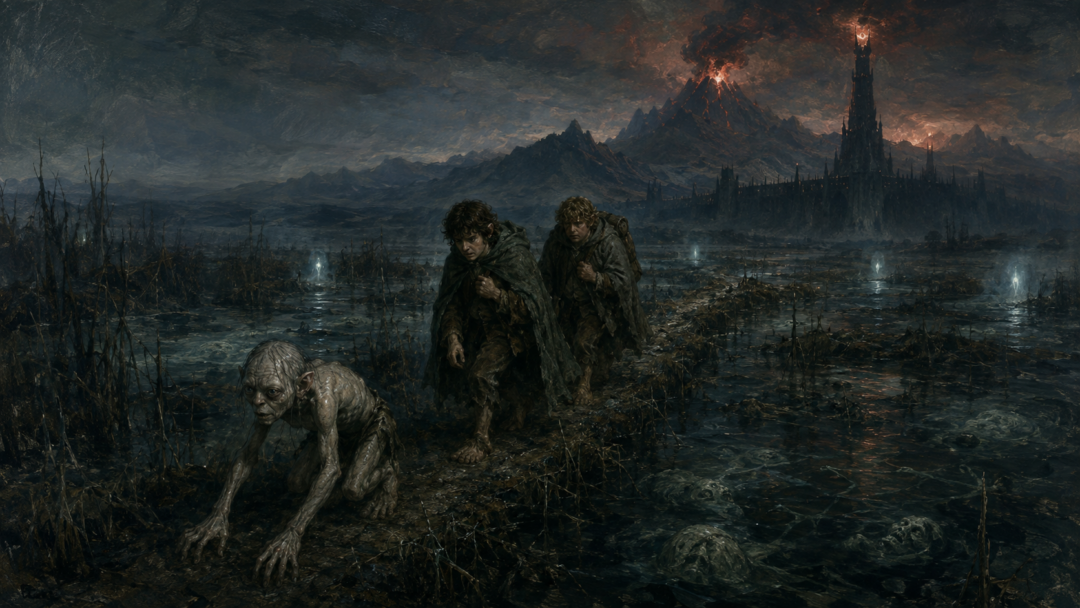
Gollum leads Frodo and Sam away from the more obvious approaches and across the Dead Marshes.
The Marshes lie before Mordor's northwestern defenses, spreading across treacherous ground near the old battlefield of Dagorlad. Pools, mud, reeds, mist, and uncertain footing make them dangerous even before the supernatural horror associated with the dead beneath their waters is considered.
Yet Gollum deliberately uses this country because danger and secrecy have become inseparable.
A broad, direct route would be easier to travel.
It would also be easier to watch.
The fundamental weakness of Frodo's mission is that he cannot fight his way through Mordor. The Quest succeeds only while Sauron fails to understand what his enemies are attempting. Therefore the safest route cannot simply be the shortest route.
It must be the route least likely to expose the Ring-bearer.
The Dead Marshes are dreadful precisely because they offer concealment unavailable on more open ground.
The Black Gate Makes the Straight Route Impossible
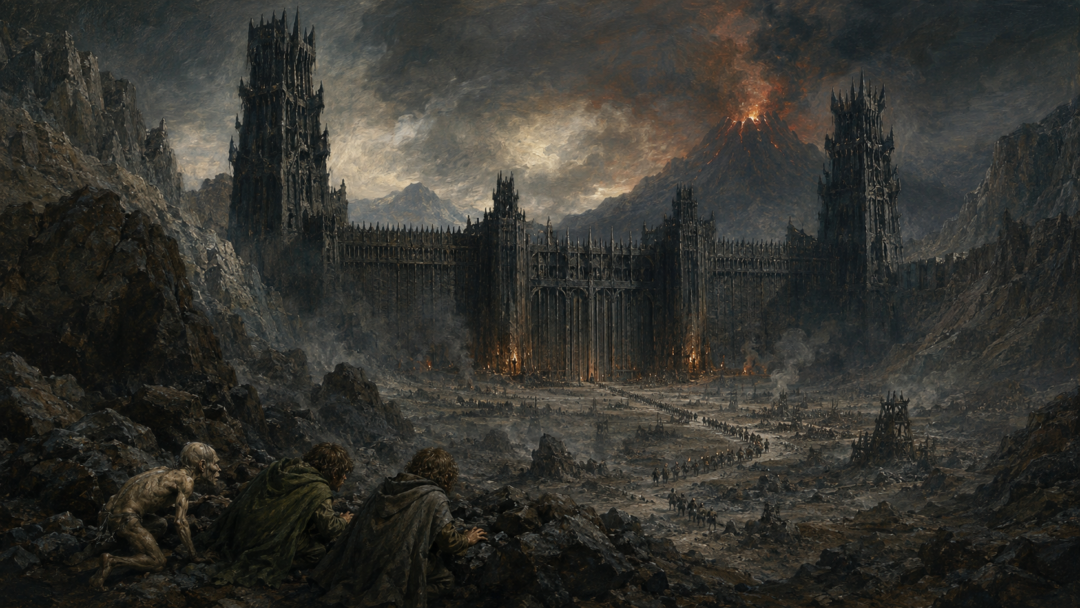
After crossing the Marshes, Frodo finally approaches what looks like the natural entrance into Mordor: the Morannon, the Black Gate.
Here the geographical problem becomes a military one.
Mordor is enclosed by enormous mountain chains. In the northwest, the Ered Lithui and Ephel Dúath converge around the approaches to Cirith Gorgor. The Black Gate blocks the principal northern entrance, with fortifications and the Towers of the Teeth guarding the way.
Frodo initially intends to go forward.
Gollum is horrified by the idea.
And on this point, he is correct.
The Hobbits do not discover some overlooked gap beside the gate because there is no reason to expect one. This is an entrance Sauron controls. His servants move through it. His armies pass beneath it. Watchers and fortifications command the approach.
Two small travellers might sometimes escape notice in wilderness.
They cannot reasonably walk through the primary fortified entrance of the Dark Lord's realm carrying the One Ring.
The straight road ends at the Morannon.
So Frodo must turn away from Mount Doom.
That apparent retreat is actually the only remaining chance.
Why They Go South Instead
Gollum tells Frodo of another way into Mordor.
The choice sends the Hobbits south through Ithilien rather than east toward Orodruin.
Seen on a map, this looks frustratingly indirect. Every mile south seems to take them farther from their goal.
But Mordor's western boundary is the Ephel Dúath, the Mountains of Shadow. The Hobbits cannot simply cross this mountain wall wherever they please. They require a pass.
Gollum knows one above the valley of Minas Morgul: Cirith Ungol.
Therefore the journey bends south because geography demands that they find an entrance.
Their route through Ithilien also shows how dramatic the contrast has become. They pass through a land that, though scarred by war and threatened by Mordor, still contains woods, streams, herbs, and remnants of Gondor's older presence.
Frodo's encounter with Faramir temporarily interrupts the journey, but it also saves him from walking blindly through hostile country. Faramir learns enough about Gollum's intended route to fear what lies ahead, though Frodo remains bound by his need to continue.
There is no comfortable option left.
Only dangerous ones.
Minas Morgul Blocks the Lower Pass
Eventually the travellers reach the Morgul Vale.
Here another seemingly obvious route is closed to them.
A road runs east from the Cross-roads toward Minas Morgul and the pass beyond. But Minas Morgul is one of Sauron's greatest strongholds, occupied by the Nazgûl and dominated by the power of the Witch-king.
The Hobbits cannot use that road as ordinary travellers.
Instead, Gollum's secret path climbs above the vale.
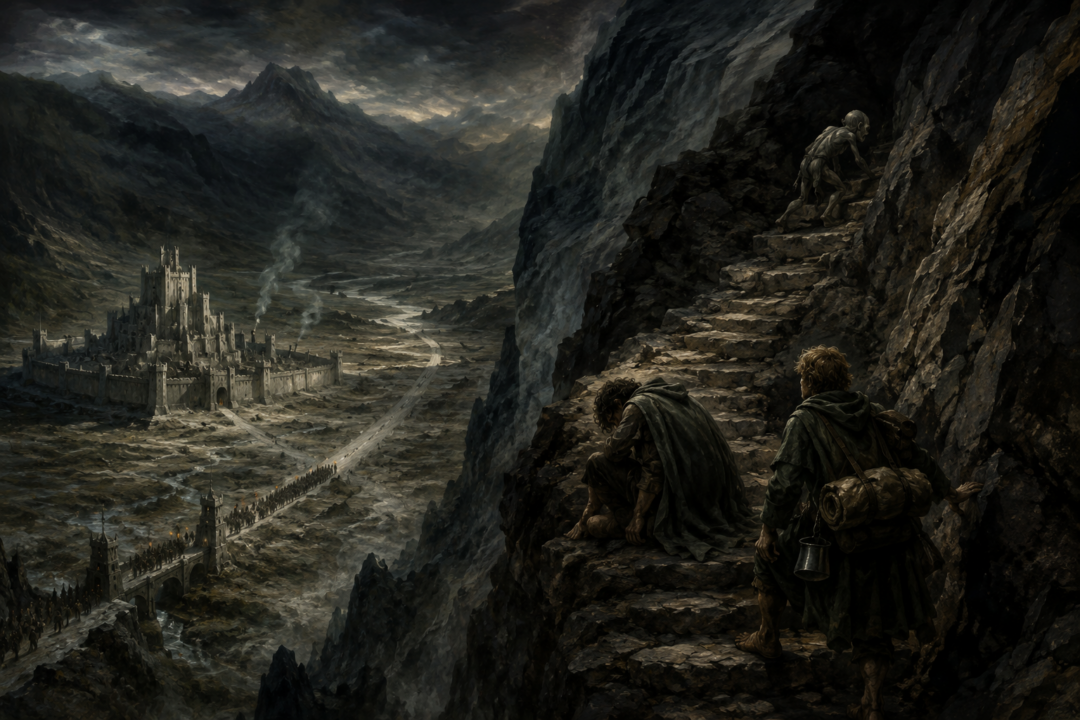
The ascent involves the Straight Stair and the Winding Stair, rising toward Cirith Ungol. The very names emphasize the difficulty of the terrain: the route is not an open mountain crossing but an engineered and ancient passage climbing through the defenses of the Ephel Dúath.
And Gollum has concealed its greatest danger.
Beyond lies Torech Ungol, Shelob's Lair.
The alternative entrance is possible because it is terrible.
Sauron's defenses do not depend on every path being sealed by soldiers. Some places are protected by terrain, terror, monsters, and the assumption that no sane enemy would choose them.
Frodo has to choose them anyway.
Entering Mordor Does Not Solve the Problem
After Shelob attacks Frodo and the Orcs carry him to the Tower of Cirith Ungol, Sam rescues him. At last the two Hobbits are inside Mordor.
But Mount Doom is still not directly accessible.
They have entered near the western mountains and must work northward before crossing toward Orodruin. The Morgai, a lower ridge running inside the Ephel Dúath, shapes their movement. Roads, ravines, enemy traffic, military camps, and open country continually influence where they can safely go.
Their greatest danger is no longer finding an entrance.
It is crossing a functioning war zone without being identified.
At one point Frodo and Sam are even forced into the movement of an Orc-company because escape would expose them. Their path is now determined as much by the Enemy's logistics as by physical geography.
Mordor is not empty volcanic wilderness.
It is the center of Sauron's military power.
Roads exist because armies use them. Fortresses exist because territory is controlled. Movement itself can betray an intruder.
A straight line would be suicidal.
Aragorn Makes the Final Crossing Possible
The final stage contains one of the great ironies of the Quest.
Frodo and Sam reach the Plateau of Gorgoroth at the very moment when Sauron's attention is being pulled elsewhere.
After the victory at the Pelennor Fields, Aragorn and the Captains of the West march toward the Black Gate with a deliberately inadequate army.
Militarily, the expedition cannot conquer Mordor.
That is not its true purpose.
Aragorn hopes to challenge Sauron openly and draw his attention away from whatever might be happening within his borders.
The gamble works.
Sauron gathers his forces against the approaching army. His attention turns toward the Morannon and the possibility that Aragorn possesses the Ring and intends to use it.
As a result, Frodo and Sam find the interior of Mordor less crowded than it might otherwise have been.
Only now does something resembling a direct approach to Mount Doom become possible.
And even then, they are barely capable of completing it.
The Ring Makes Every Mile Longer
There is also a final obstacle no map can show.
The closer Frodo comes to Mount Doom, the heavier the burden of the Ring becomes.
Physical exhaustion, hunger, thirst, fear, and the poisoned environment of Mordor reduce both Hobbits almost to collapse. Frodo increasingly experiences the Ring as an overwhelming weight.
Sam can carry supplies.
Eventually he can even carry Frodo.
But he cannot simply remove Frodo's spiritual burden for him.
That means distance near the end of the Quest cannot be measured only in miles. A stretch of ground that might once have been crossed in hours becomes a test of endurance.
By the slopes of Orodruin, Frodo is crawling toward the place where the Ring was made.
The journey has narrowed from continents to footsteps.
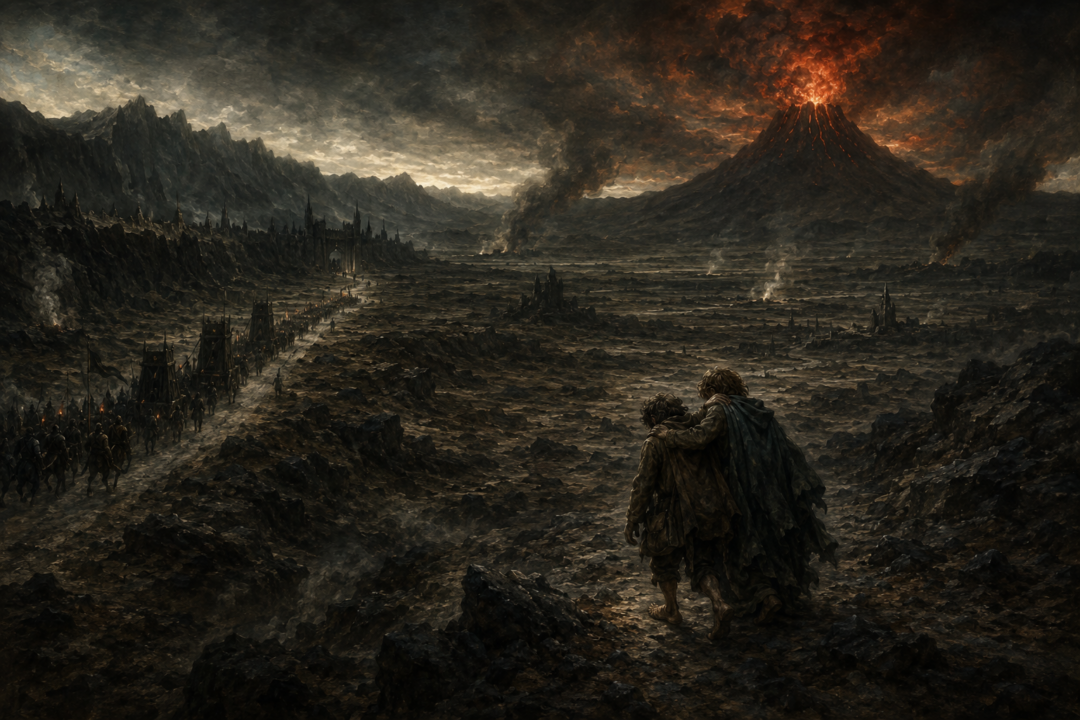
The Winding Road Is the Point
Frodo and Sam cannot follow a straight line to Mount Doom because almost every force in Mordor works against straight movement.
The Emyn Muil break the land into cliffs and gullies. The Dead Marshes provide secrecy at the cost of speed. The Black Gate seals the northern entrance. The Ephel Dúath form a mountain wall. Minas Morgul controls the obvious western pass. Cirith Ungol provides a hidden alternative only through enormous danger. Inside Mordor, roads and troop movements belong to the Enemy. Finally, the Ring itself turns the last miles into torment.
Yet there is a deeper strategic truth beneath all of this.
If Frodo could have walked directly toward Mount Doom, Sauron could have watched the same road.
The Quest survives because it moves through places armies would avoid: wilderness, marshes, hidden paths, forgotten stairs, tunnels, ravines, and finally an emptied battlefield behind Sauron's attention.
The crookedness of the route is not a flaw in the plan.
It is the plan.
The Hobbits reach the Crack of Doom because they do not travel like conquerors approaching a fortress.
They travel like two almost invisible people searching for the one path the Enemy has failed to imagine anyone would willingly take.
Sources & Notes
- https://tolkiengateway.net/wiki/Quest_of_the_Ring — Tolkien Gateway: route overview from Emyn Muil through the Dead Marshes, Cirith Ungol, Isenmouthe, and Mount Doom.
- https://tolkiengateway.net/wiki/The_Land_of_Shadow — Tolkien Gateway: Frodo and Sam’s northward detour, water shortage, enemy traffic, and forced march with Orcs.
- https://tolkiengateway.net/wiki/Plateau_of_Gorgoroth — Tolkien Gateway: the enclosed terrain, guarded passages, roads, camps, and final southward crossing.
- https://tolkiengateway.net/wiki/Mount_Doom_%28chapter%29 — Tolkien Gateway: the last approach across broken ground and ascent to the Sammath Naur.
Sources trace the hobbits’ constrained route through Mordor, including terrain, roads, armies, concealment, and detours.