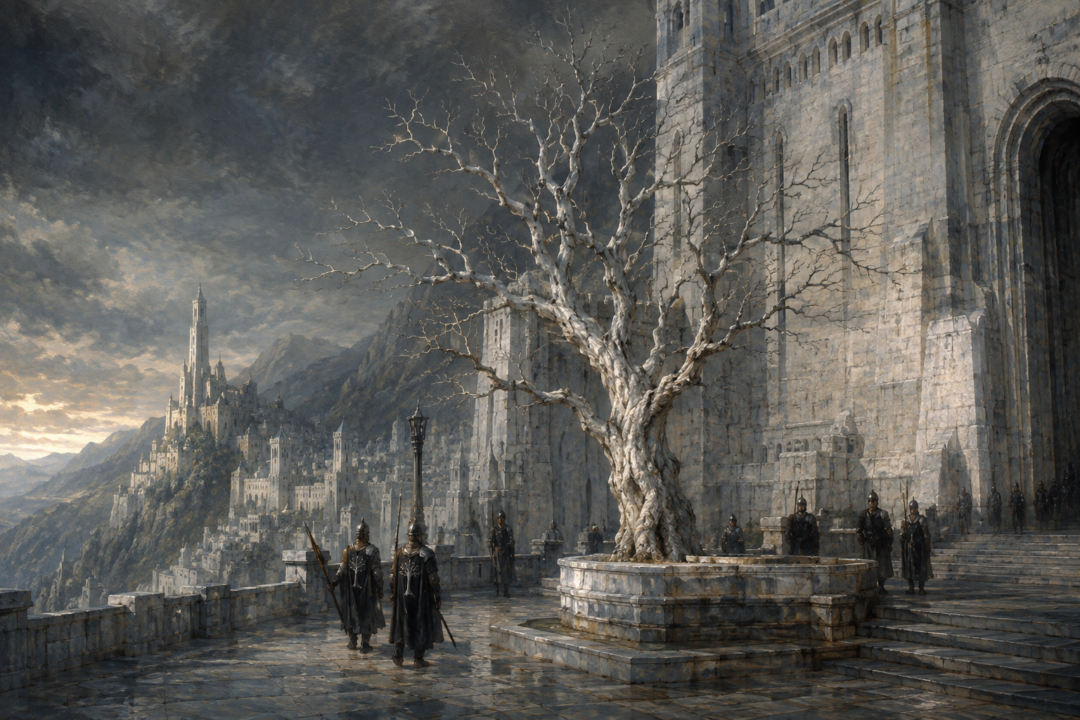
When Aragorn becomes King, one of Gondor’s most famous symbols is still standing in the Citadel of Minas Tirith: the White Tree.
But it is dead.
That detail matters. The victory over Sauron does not suddenly make the old Tree flower again. Aragorn does not heal its withered branches, and Gandalf does not awaken some hidden life within its trunk.
Instead, the dead Tree is removed.
Only then can a living White Tree take its place.
It is a small episode near the end of The Return of the King, yet it expresses something much larger about Gondor’s restoration. The new kingdom is not created by pretending that everything lost can simply be repaired. Some things have genuinely ended. The past must be honoured without being mistaken for the future.
And that is exactly what happens to the White Tree.
The Tree in Minas Tirith Was Already a Successor
The first important detail is that Gondor’s White Tree was never valuable because one particular trunk had to survive forever.
It belonged to a lineage.
The ancestry of the White Trees reaches back through the history of the Dúnedain toward the Blessed Realm. In the traditions given in The Lord of the Rings and developed further in the wider legendarium, the trees of Númenor and Gondor descend through Nimloth and earlier white trees ultimately associated with Telperion.
For Gondor, this lineage had already survived catastrophe through replacement.
The White Tree of Minas Ithil was destroyed when Sauron captured the city, but Isildur saved a seedling. After the overthrow of Sauron at the end of the Second Age, a descendant of that Tree was planted in Minas Anor in memory of Anárion.
Centuries later, that Tree died during the Great Plague. Yet a seedling survived, and King Tarondor planted another.
So replacement was not a betrayal of the White Tree’s meaning.
Replacement was how its meaning survived.
The continuity lay in descent rather than in the physical immortality of a single tree.
That distinction becomes crucial at the end of the Third Age.
Gondor Preserved a Dead Symbol for Nearly 150 Years
The later White Tree died in the year 2872 of the Third Age, around the death of the Steward Belecthor II.
No seedling could be found.
So the dead Tree remained standing in the Court of the Fountain.
It would stay there throughout the final generations of the Ruling Stewards and still be there when the War of the Ring reached Minas Tirith in 3019.
This is one of the strangest images in Gondor.
At the centre of its highest court, before the seat of its government, stood a tree that everyone knew was dead.
It was not discarded because its significance had not died with it. Gondor remained a kingdom in memory and expectation even while no King ruled it. The Stewards governed in the absence of the royal house rather than simply converting the Stewardship into a new hereditary kingship.
The dead Tree therefore fits the political condition of late Gondor with remarkable precision.
The old order has not been forgotten.
But neither is it alive.
The people preserve its form while waiting for something they cannot themselves produce.
Why Victory Does Not Revive the Old Tree
This is where the episode becomes more interesting than a simple symbol of renewal.
After Sauron falls, many wounds can begin to heal. Minas Tirith can be repaired. Lands can be reclaimed. Aragorn can restore the kingship.
But the dead White Tree cannot simply be made alive again.
The text gives no suggestion that this is even attempted.
That restraint matters.
In Middle-earth, restoration rarely means reversing history as though loss never happened. The Elves cannot restore the Two Trees after their destruction. Númenor does not rise again from the sea. Arnor does not return in precisely the form it possessed before its ruin.
Even victories leave history behind them.
The dead Tree belongs to that pattern.
Its death was real.
The return of the King does not erase the long decline that came before him. Aragorn inherits Gondor’s victories, memories, ruins, graves and failures together.
Restoration therefore requires something living that carries the old inheritance forward.
Not the resurrection of the dead trunk.
A descendant.
Gandalf Takes Aragorn Above the City
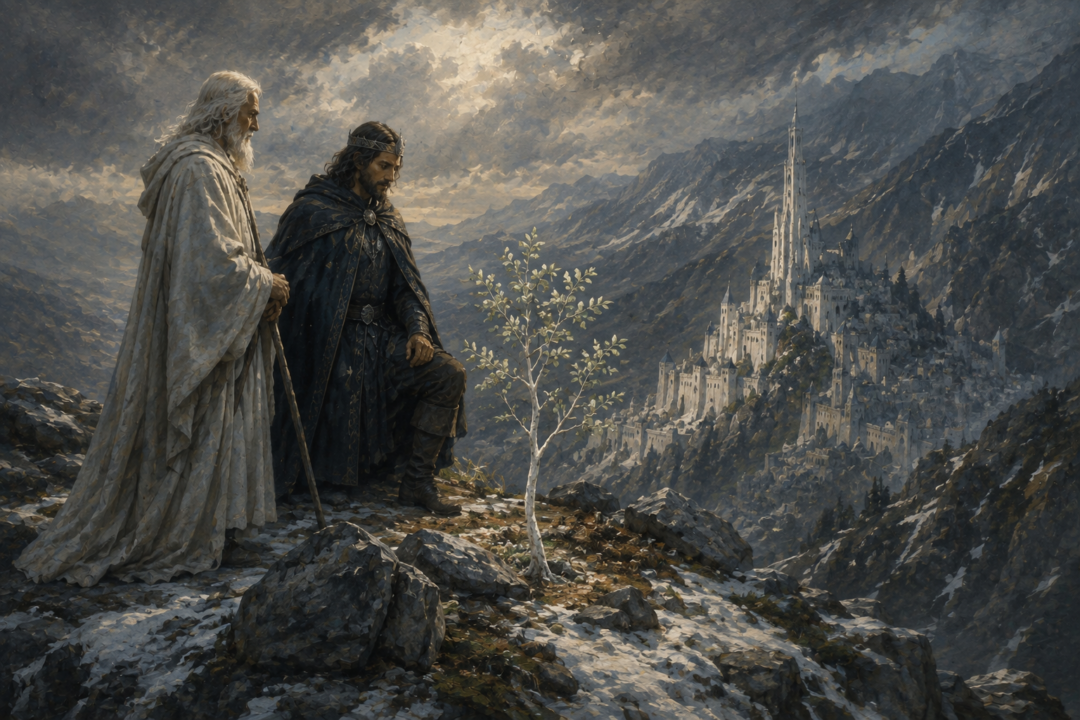
After Aragorn’s coronation, Gandalf leads him up Mount Mindolluin behind Minas Tirith.
They follow an ancient path to a high place associated with the Kings of old, a hallow that had passed from ordinary knowledge.
There Aragorn looks over his kingdom.
Yet something remains incomplete.
The White Tree in the Citadel is still withered.
Gandalf directs Aragorn’s attention toward the mountain, and among the barren stones they discover a young tree.
Aragorn immediately recognizes what its discovery may mean, and Gandalf identifies it as a descendant of the ancient line of the White Trees.
Its presence is extraordinary but not presented as the old Tree magically returning to life.
The lineage has survived elsewhere.
That is the key.
While Gondor guarded the dead Tree below, living continuity had endured unnoticed above the city.
The New Tree Was Hidden Outside the Institutions of Gondor
There is a powerful irony here.
For generations, Gondor preserved the visible symbol of its inheritance in the Citadel.
Yet the living heir of that symbol was not in the Citadel.
It was growing on Mindolluin.
The forgotten hallow had once belonged to the traditions of Gondor’s Kings, but knowledge of it had faded. The kingdom could remember the White Tree well enough to preserve its corpse while losing the knowledge that might have led to its living descendant.
One reading of the scene is therefore that Gondor’s problem is not simple forgetfulness.
It remembers enormously well.
Its weakness is that memory has become incomplete.
Minas Tirith is filled with the accumulated weight of Númenórean history. The Stewards preserve offices, customs, monuments and claims inherited from earlier ages. Yet preservation alone cannot create renewal.
The living sapling is found only when the returning King climbs beyond the ordinary life of the City and reaches a place associated with a deeper layer of its past.
The old inheritance was not false.
It had simply become larger than Gondor’s surviving knowledge of it.
Aragorn Does Not Throw the Dead Tree Away
What happens next prevents the scene from becoming a crude argument that the old must simply be destroyed.
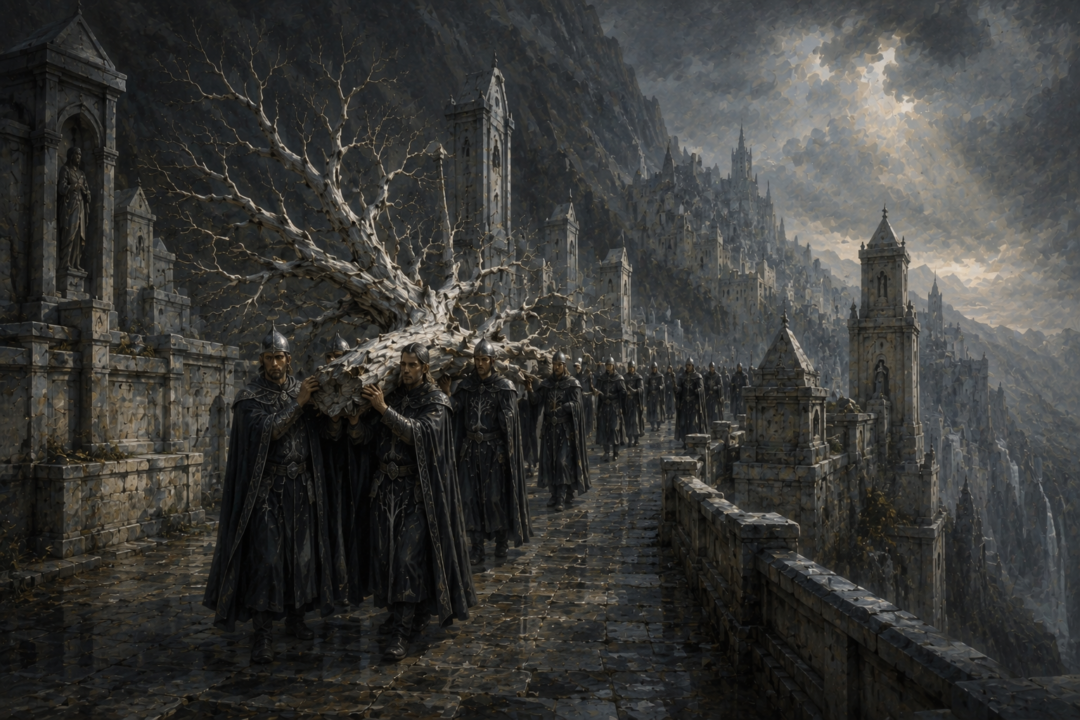
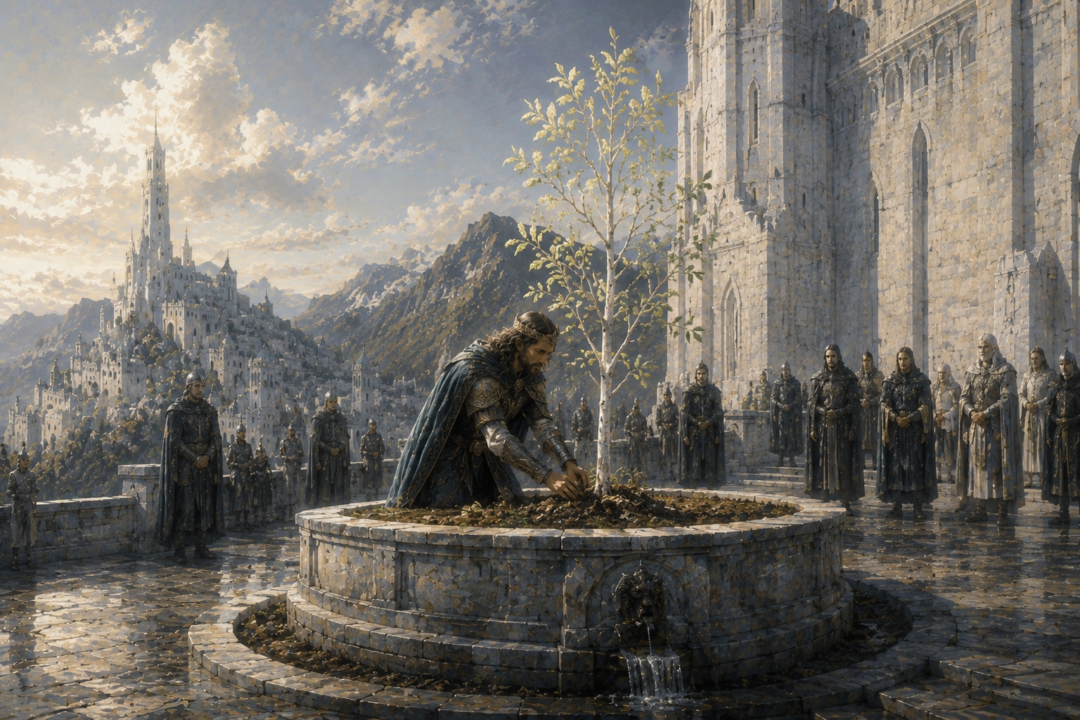
The dead Tree is removed from the Court of the Fountain.
But it is not burned or discarded.
It is carried to Rath Dínen, the Silent Street where Gondor honours its dead, and laid among the resting places of its rulers with honour.
That choice defines the entire restoration.
The old Tree cannot remain at the centre of the living kingdom because it is dead.
But precisely because it once lived and carried the inheritance of Gondor through centuries, it deserves reverence.
This creates a distinction between memory and rule.
The dead belong in the place of honoured memory.
The living belong in the centre of the kingdom.
Gondor does not need to reject its past. It needs to put the past in its proper place.
That is much harder than either worshipping it or destroying it.
The Sapling Represents Continuity Without Stagnation
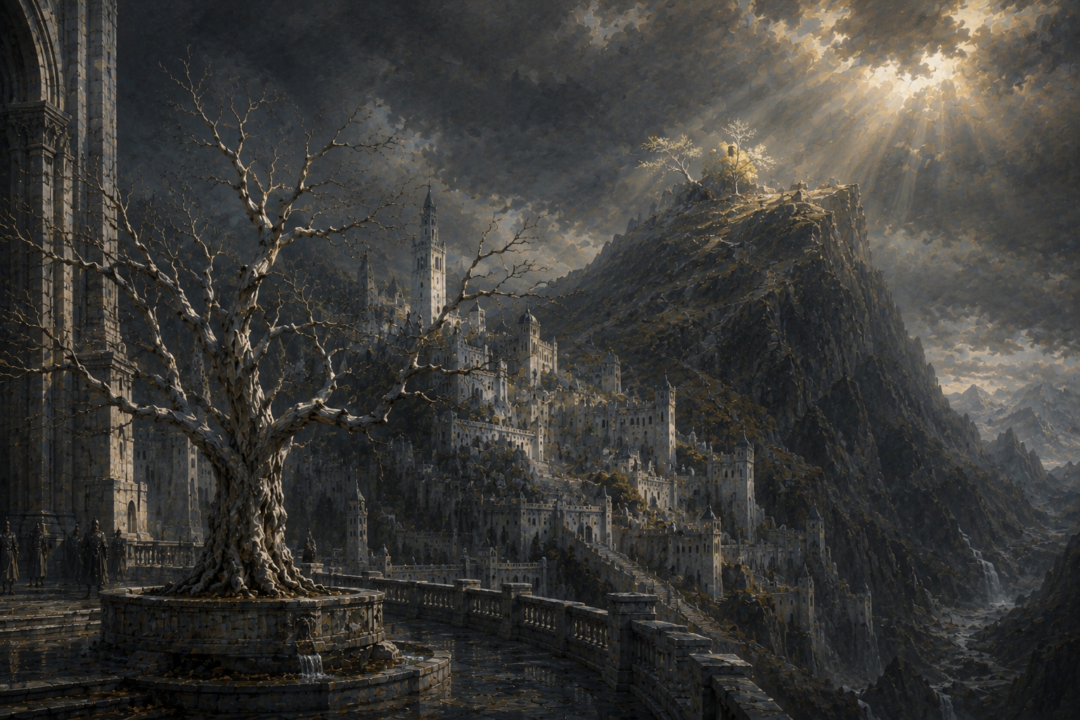
Aragorn plants the sapling beside the fountain where the dead Tree had stood.
This is not the creation of an entirely new symbol.
The young Tree belongs to the same ancient lineage.
Its significance depends precisely upon continuity.
Yet it is also new life.
That combination mirrors Aragorn’s kingship.
He does not become King because Gondor suddenly decides that monarchy would be useful. His claim reaches backward through the heirs of Isildur and the royal history of the Dúnedain.
But his reign is not merely an archaeological reconstruction of the past.
Aragorn comes out of the North after centuries in which his line has lived without Gondor’s throne. He has travelled widely, fought under other names, served both Gondor and Rohan before the War of the Ring, and finally returns openly when the long conflict with Sauron reaches its end.
The restored kingdom therefore joins inheritance with renewal.
The new White Tree does the same.
It is ancient in lineage and young in life.
The Tree Also Points Toward Arwen
The discovery occurs at another threshold in Aragorn’s life.
His kingship has been established, but his marriage to Arwen has not yet taken place.
The living Tree becomes associated in the scene with the hope that she will soon come.
This makes the restoration more than political.
A kingdom needs more than a crowned survivor.
It needs a future.
Aragorn and Arwen’s marriage joins lines of ancestry reaching deep into the Elder Days, but it also begins the royal household of the Reunited Kingdom.
Again the pattern is continuity through new life.
The past cannot simply continue unchanged. It must produce something capable of entering the future.
The White Tree is therefore especially fitting beside Aragorn at this moment. A sapling carries ancestry visibly: it exists because something came before it, yet its branches grow where the branches of its ancestors never did.
Why the Dead Tree Has to Leave
The old White Tree could have remained beside the new one.
But it does not.
Symbolically, that would have weakened the entire moment.
A dead relic still occupying the centre of the Court would suggest that Gondor could not distinguish inheritance from preservation.
Instead, the old Tree receives burial-like honour and the sapling receives the living space.
The sequence matters:
first recognition of death,
then honour for what has passed,
then planting,
then growth.
This is not restoration by denial.
It is restoration through succession.
The same principle runs quietly through much of the ending of The Lord of the Rings. The victory does not prevent the departure of the Ring-bearers. The destruction of Sauron does not stop the fading of the Elves. The Shire can be healed, but Frodo cannot simply return to the person he was before his journey.
Victory and loss can occupy the same ending.
So can continuity and change.
The White Tree Explains What Aragorn Actually Restores
It is tempting to describe Aragorn’s return as the restoration of Gondor’s old world.
The White Tree suggests something more precise.
He restores its continuity.
That is not the same thing.
The kingdom cannot travel backward into the age of Elendil, Isildur or the great ship-kings. The Third Age is ending. Much that belonged to the Elder Days is leaving Middle-earth.
Aragorn’s task is therefore not to recreate a vanished age.
It is to receive what has survived from that age and make it fruitful again.
That is why the perfect emblem of his reign is not an ancient tree suddenly made immortal.
It is a young tree with ancient roots.
The dead White Tree had done its work. For nearly a century and a half after its death, it stood as a monument to a kingdom that refused to forget what it had been.
But memory alone could take Gondor no farther.
When the King finally returned, the old Tree did not need another century of preservation.
It needed honour.
And then it needed to make room.
Because the true restoration of the White Tree was never about forcing dead wood to flower.
It was about discovering that the line was still alive.
Sources & Notes
- https://tolkiengateway.net/wiki/White_Tree_of_Gondor — Tolkien Gateway: the White Tree’s lineage, successive plantings, death in T.A. 2872, preservation, and replacement by Aragorn’s sapling.
- https://www.encyclopedia-of-arda.com/w/whitetree2.html — Encyclopedia of Arda: chronology of Gondor’s White Trees and the 147-year interval when the Dead Tree stood in Minas Tirith.
- https://thainsbook.minastirith.cz/mountains.html — The Thain’s Book: Mindolluin’s royal hallow and Aragorn’s discovery and replanting of the sapling as a sign of renewal.
- https://journals.tolkiensociety.org/mallorn/article/view/112 — Mallorn (Tolkien Society): scholarly study of the White Tree as a symbol of Númenórean kingship, continuity, loss, and renewal.
Sources cover the White Tree’s lineage and replacements, the Dead Tree’s long preservation, the Mindolluin sapling, and the motif’s connection to restored kingship.