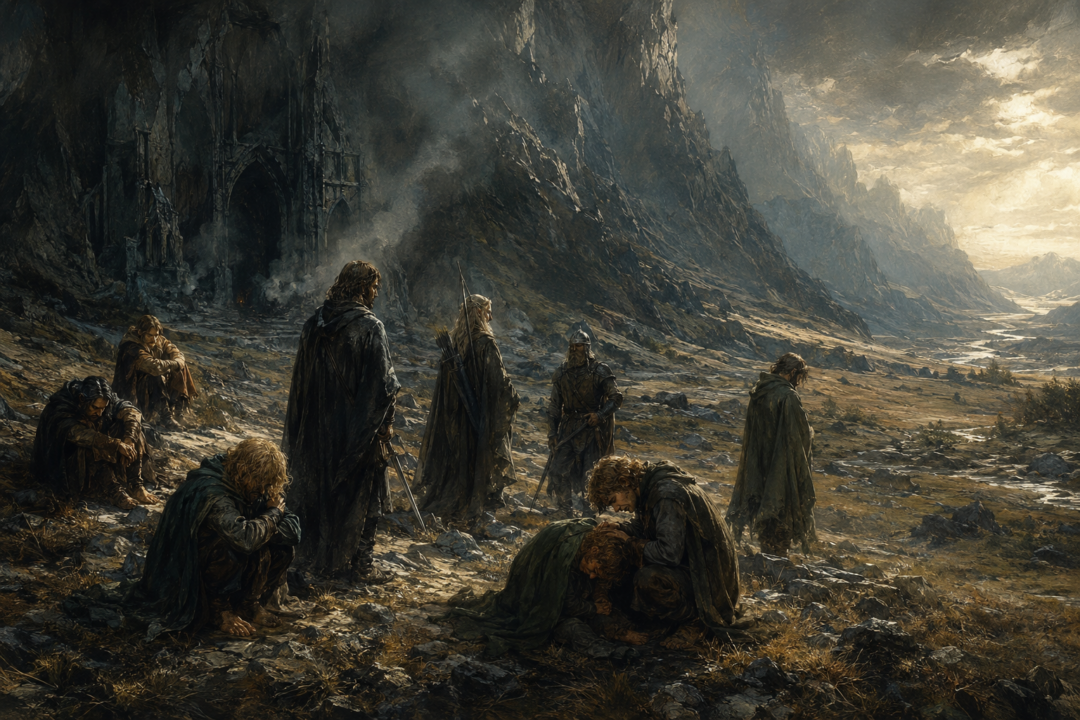
Gandalf falls from the Bridge of Khazad-dûm, and the Fellowship runs.
That sequence matters. There is no council. No formal transfer of authority. No speech declaring Aragorn the new leader. The surviving companions simply escape Moria, reach the open air of Dimrill Dale, and finally collapse beneath the weight of what has happened.
They do mourn. The text explicitly says grief overcomes them and that they weep for a long while. But the danger has not ended merely because the Balrog is gone.
Then Aragorn makes the decision that defines the next stage of the journey.
They must move.
His response can seem almost brutally fast. Gandalf was not merely a powerful companion. He had been their guide through the wilderness and the one member of the Company who understood more of their enemies, their road, and the larger struggle than anyone else.
Yet Aragorn does not wait until grief has become manageable.
He cannot.
And that is precisely why this moment tells us so much about him.
Gandalf’s Fall Does Not Leave Them Safe
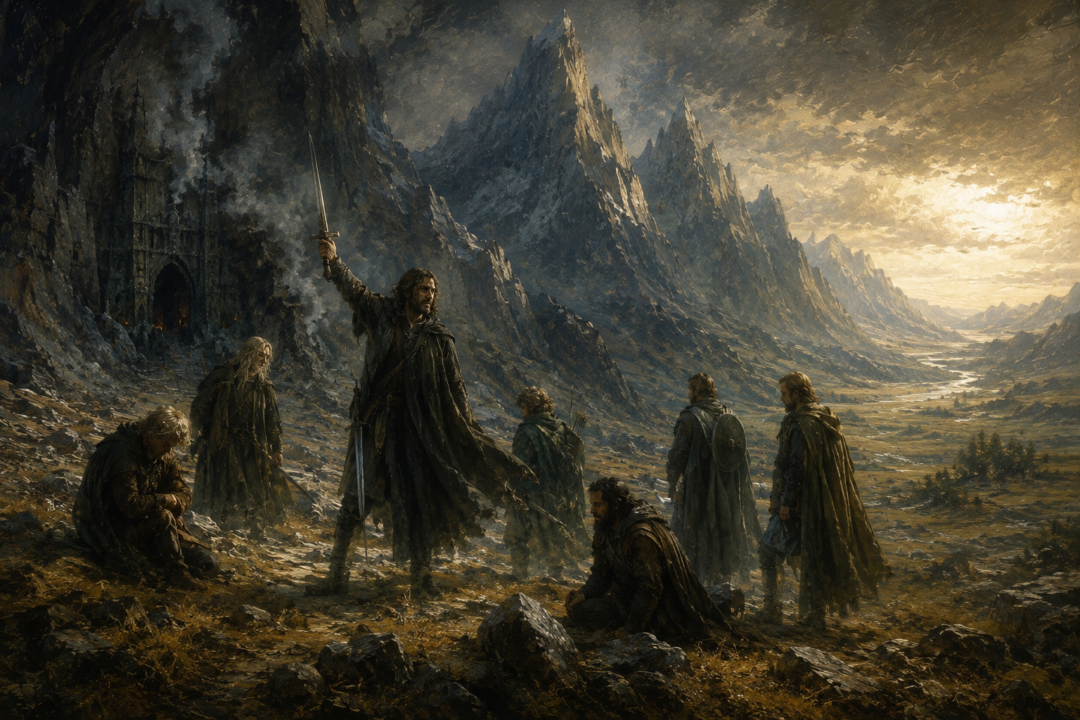
The Fellowship escapes the eastern gate of Moria around midday, but reaching daylight does not mean reaching safety.
They have just fought Orcs inside Khazad-dûm. Enemies remain behind them. Aragorn therefore has to judge their position as a Ranger and commander rather than as a grieving friend.
Dimrill Dale is exposed country beneath the mountains. The Company cannot know how quickly pursuit may emerge from Moria.
Their nearest meaningful refuge is Lothlórien.
So Aragorn's first great responsibility after Gandalf's fall is painfully practical: keep eight exhausted survivors moving before whatever inhabits or serves the darkness beneath the mountains can threaten them again.
The contrast is important.
Emotion says stop.
Survival says move.
Aragorn does not deny the first. He submits it to the second.
Aragorn Actually Does Mourn Gandalf
It would be misleading to portray Aragorn as emotionally detached.
After the escape, grief overwhelms the Company. Some stand silently; others throw themselves down. Aragorn shares their loss.
When he finally calls them onward, he first looks back toward the mountains and bids Gandalf farewell. He also remembers the warning he had given before entering Moria.
That warning is one of the strangest details in the entire episode.
Before the Company enters Khazad-dûm, Aragorn tells Gandalf that he has previously passed through the Dimrill Gate and has terrible memories of the place. More significantly, he warns Gandalf personally that if he enters Moria, he should beware.
The text never explains exactly what Aragorn sensed or expected. There is no solid basis for claiming that he knew a Balrog was there. The safest reading is simply that Aragorn possessed a powerful foreboding specifically concerning Gandalf.
After Gandalf falls, that warning becomes unbearable in retrospect.
Aragorn was afraid for him.
He went anyway.
And Aragorn followed him.
His farewell therefore carries grief mixed with the terrible knowledge that his fear proved justified.
“We Must Do Without Hope”
Aragorn's answer to the disaster is among his bleakest moments.
He asks what hope remains without Gandalf and concludes that they must continue without it.
That is not optimism.
He does not reassure the hobbits that everything will somehow work out. He does not claim Gandalf may have survived. At this point, the Company has every reason to believe that Gandalf is dead.
Aragorn accepts the apparent catastrophe completely.
And then he acts anyway.
This distinction is crucial.
Much of Aragorn's leadership is built not upon confidence that victory is guaranteed, but upon willingness to do what must be done when favorable outcomes can no longer be seen.
Immediately after Moria, that principle becomes literal.
The road remains.
Frodo remains.
The Ring remains.
Therefore the responsibility remains.
Gandalf's absence makes the Quest seem almost hopeless, but it does not make the Quest unnecessary.
Why Aragorn Becomes the Natural Leader
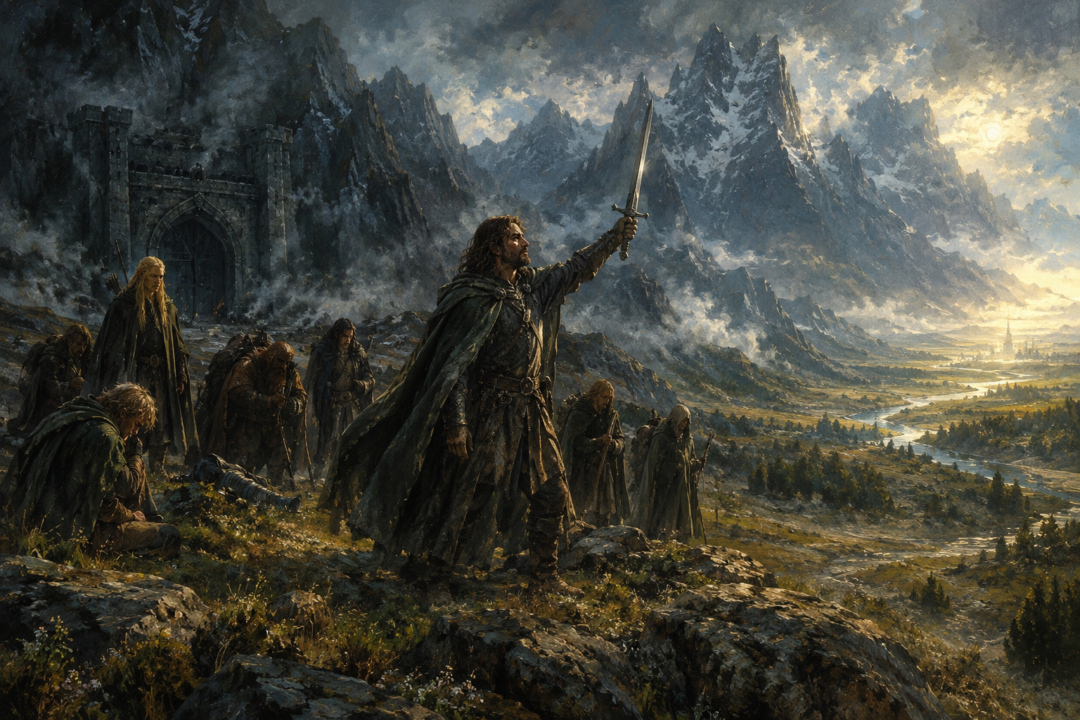
Aragorn's assumption of command is not arbitrary.
Before Moria, leadership within the Fellowship had already been somewhat fluid.
Gandalf was their chief guide, especially in matters involving the Enemy and ancient dangers. Yet Aragorn also guided the Company. During the failed attempt to cross Caradhras, Aragorn explicitly reminds Gandalf that Gandalf had followed his lead.
When Gandalf proposes Moria, the relationship reverses: Aragorn agrees to follow Gandalf's lead despite his foreboding.
This tells us something important about the Company.
It is not organized like a modern military unit with a rigid published chain of command. Authority rests heavily on knowledge, judgment, experience, and circumstances.
After Gandalf disappears, Aragorn possesses an extraordinary combination of those qualities.
He is an experienced wilderness traveler. He knows the lands west and east of the Misty Mountains. He has previously passed through Moria. He knows Lothlórien and has been there before. He is a warrior and healer, and he understands the larger purpose of the Quest.
Boromir is a formidable captain, but the journey is not primarily a Gondorian military expedition.
Frodo bears the Ring, but being Ring-bearer does not make him responsible for every tactical decision concerning the Company.
Aragorn is therefore the obvious person to guide them onward.
And he does so without ceremony.
His First Mistake as Leader Comes Almost Immediately
One detail makes the episode far more human.
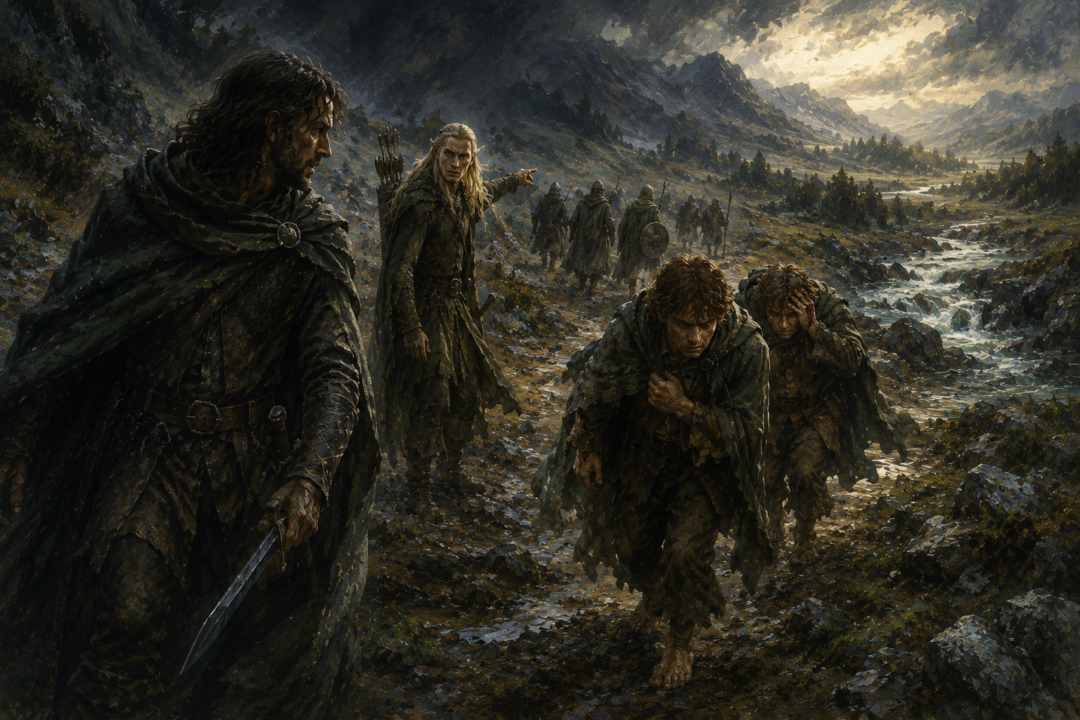
Aragorn drives the Company hard toward Lothlórien.
Too hard.
Frodo and Sam begin falling behind. Both were hurt in Moria, and Aragorn becomes so focused on speed that he temporarily forgets their injuries.
When Legolas notices them lagging, Aragorn immediately turns back. He is distressed by his own failure, acknowledging that the urgency of the day made him forget that Frodo and Sam were wounded.
It is a revealing mistake.
Aragorn's command is not presented as instant perfection.
He has just lost Gandalf. He is responsible for seven other people, the Ring-bearer among them. Enemies may still be pursuing them. He is trying to calculate distance, daylight, wounds, food, terrain, and refuge while grieving himself.
For a moment, urgency overwhelms care.
Then he corrects himself.
Aragorn and Boromir help carry the injured hobbits until the Company reaches a place where they can rest. Aragorn then tends their wounds.
The commander becomes the healer.
That combination will become increasingly important later in the story.
He Cannot Replace Gandalf — and Knows It
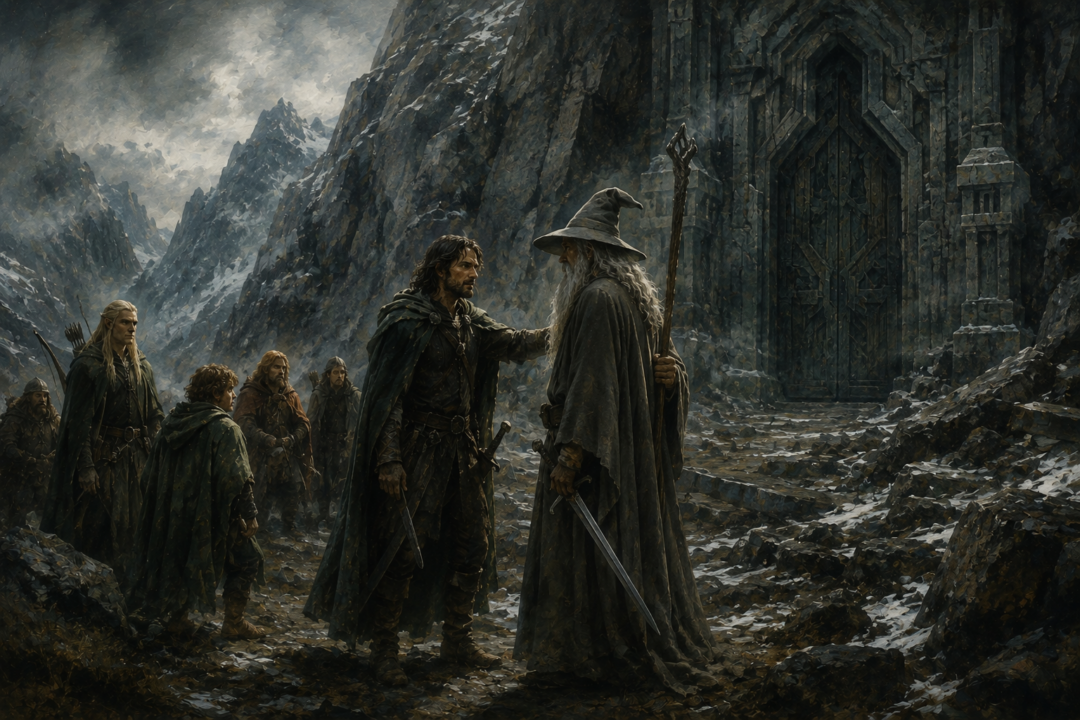
Another reason Aragorn's leadership works is that he never behaves as though becoming the guide means becoming Gandalf.
Gandalf's knowledge and role are unique.
Aragorn's response is not, “I can take his place.”
It is effectively: Gandalf is gone, and someone must decide what happens next.
That difference prevents his assumption of command from becoming a triumphal moment.
In fact, Gandalf's absence makes Aragorn's position heavier.
Before Moria, Aragorn could disagree with Gandalf, warn him, follow him, and share responsibility with him.
After Moria, many decisions fall directly onto Aragorn.
This becomes especially visible after the Company leaves Lothlórien. Gandalf had intended to advise them concerning their route, but the surviving Fellowship now faces uncertainty over whether to go toward Minas Tirith or continue toward Mordor.
Aragorn increasingly has to make choices without the person whose wisdom he trusted most.
Command is not liberation.
It is exposure.
Lothlórien Gives Them What Aragorn Cannot
Aragorn can get the Fellowship away from Moria.
He can navigate.
He can fight.
He can tend wounds.
What he cannot do on the road is give the Company enough space to absorb Gandalf's loss.
That comes in Lothlórien.
There, under the protection of Galadriel and Celeborn, the Company finally receives something impossible in Dimrill Dale: time.
The Elves lament Gandalf. Frodo hears songs made concerning him, and the Fellowship lives for a while removed from the immediate pressure of pursuit.
This makes Aragorn's decision outside Moria look less like the rejection of mourning and more like its postponement.
There are places where grief is possible.
An exposed valley beneath the gates of Moria is not one of them.
Aragorn's task is to get his companions somewhere they can afford to grieve.
The Leadership Aragorn Will Need Later
The pattern established after Moria repeats throughout Aragorn's story.
Again and again, catastrophe does not give him the luxury of stopping.
At the breaking of the Fellowship, he faces another impossible situation: Frodo and Sam have departed toward Mordor, Boromir is dying, and Merry and Pippin have been captured by Orcs.
Once again, grief and decision arrive together.
Aragorn mourns Boromir, but he must still choose a road.
Later, war will force the same burden upon rulers, captains, and ordinary soldiers across Rohan and Gondor.
The world does not pause for private sorrow.
Yet the answer is never that sorrow is meaningless.
The answer is that duty sometimes determines when sorrow may be given its full voice.
That distinction is central to Aragorn.
Aragorn Does Not Lead Because He Feels No Grief
It is tempting to read the escape from Moria as the moment Aragorn proves that he is stronger than everyone else.
The text gives us something subtler.
He is grieving.
He has lost hope.
He has just watched his own warning concerning Gandalf come true.
He soon makes a mistake because the pressure of events is overwhelming.
And still he gets everyone moving.
That is the real significance of his command after Moria.
Aragorn does not wait to become emotionally ready for leadership.
No one grants him that time.
He takes responsibility while wounded by the same loss as everyone following him.
The Fellowship does not need someone untouched by Gandalf's fall.
It needs someone who can look back at the dark gate, mourn the friend who will not emerge from it, and then turn toward the road.
Because Frodo is still carrying the Ring.
Because Lothlórien is still miles away.
Because danger is still behind them.
And because, even when hope appears to have vanished, there is still much to do.
Sources & Notes
- https://tolkiengateway.net/wiki/Aragorn
- https://tolkiengateway.net/wiki/Gandalf
- https://tolkiengateway.net/wiki/Fellowship_of_the_Ring
- https://tolkiengateway.net/wiki/Bridge_of_Khazad-d%C3%BBm
References for Aragorn’s leadership, Gandalf’s fall, Moria, and the Fellowship.