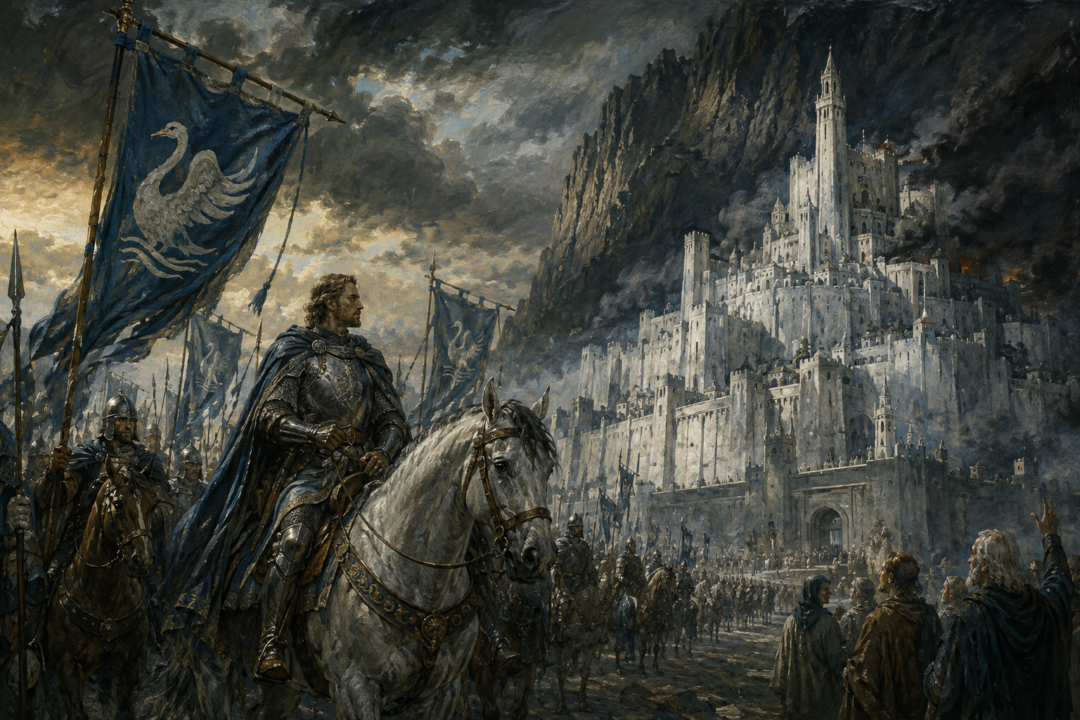
When Prince Imrahil rides into Minas Tirith before the great siege, he does not arrive as the man destined to save Gondor. He carries no reforged sword of ancient kingship, no secret claim to the throne, and no prophecy about his future.
He simply brings men.
From Dol Amroth come hundreds of soldiers and a company of knights, one of the strongest contingents sent by Gondor’s southern fiefs to defend the capital. Yet Imrahil’s importance soon becomes far greater than the troops behind him. Within days, Denethor is dead, Faramir is gravely wounded, the city has nearly fallen, and Aragorn has arrived without yet formally claiming the crown.
For a brief and extraordinarily dangerous interval, Gondor’s political order is almost suspended.
And Imrahil is standing in the middle of it.
That wartime role explains why the Prince of Dol Amroth matters so much to the kingdom that emerges afterward. He is not merely another captain who survives the War of the Ring. He becomes one of the crucial links between the old Gondor of the Stewards and the restored monarchy of King Elessar.
Dol Amroth Arrives When Gondor Is Running Out of Strength
The arrival of the forces from Gondor’s fiefs in The Return of the King is deliberately bittersweet.
Minas Tirith needs reinforcements desperately, but fewer come than expected because the southern lands face threats of their own. Among those who do answer the summons, Dol Amroth provides a particularly formidable force: seven hundred men-at-arms and a company of knights under Prince Imrahil.
The Prince immediately stands apart.
He belongs to one of Gondor’s great hereditary houses, ruling the coastal principality of Dol Amroth in Belfalas. His family is also closely connected to the ruling Stewards. His sister Finduilas had married Denethor, making Imrahil the maternal uncle of Boromir and Faramir.
That relationship matters enormously once the siege begins.
Imrahil is therefore not an outsider arriving to exploit Gondor’s crisis. He is already bound to its ruling family, its military defense, and one of its most powerful provinces.
Then the existing leadership collapses.
The Pelennor Reveals More Than Imrahil’s Courage
Imrahil is repeatedly placed near the center of command during the Battle of the Pelennor Fields.
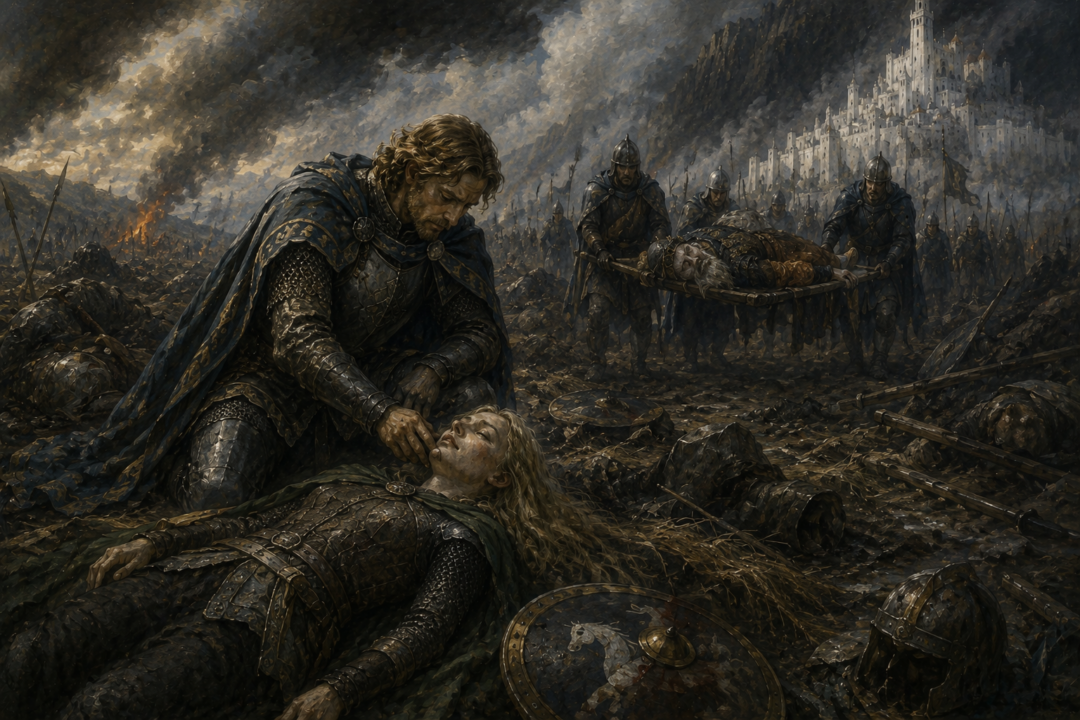
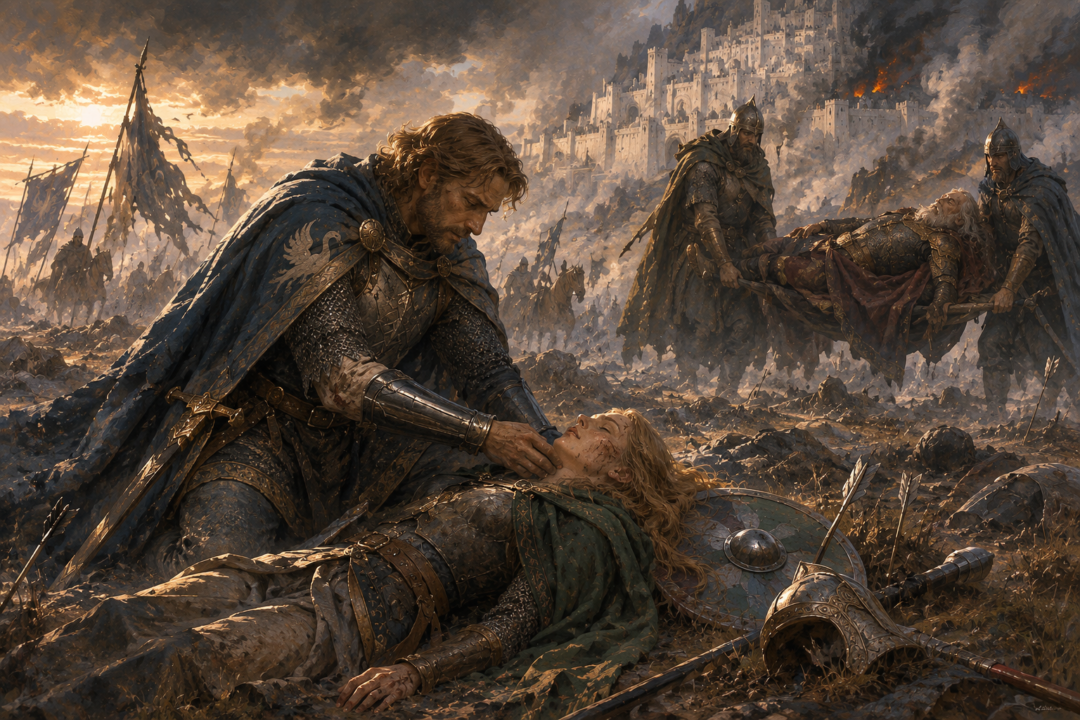
After Théoden falls and Éowyn is found apparently lifeless, it is Imrahil who notices that she is still breathing. The moment is small compared with the enormous events around it, but characteristic: he remains observant and controlled while armies and rulers are collapsing around him.
Later, when the Rohirrim and Gondorians are hard pressed, Imrahil leads the men of Minas Tirith out from the city.
Then Aragorn arrives from the south.
The victory that follows is not portrayed as the achievement of one commander alone. Aragorn, Éomer, and Imrahil emerge as three major military leaders of the surviving western forces. That pattern continues after the battle.
This is significant because the War of the Ring is simultaneously destroying an old political order.
Théoden dies.
Denethor dies.
Boromir is already dead.
Faramir lies dangerously ill.
Éomer suddenly becomes King of Rohan in the middle of battle.
Aragorn is the heir of Isildur, but has not yet been crowned.
Amid that extraordinary turnover, Imrahil represents continuity.
He was a legitimate prince before the crisis began, remains one throughout it, and possesses both soldiers and recognized authority when other institutions are failing.
The Most Dangerous Moment Comes After Victory
The destruction of Sauron can make Gondor’s political transition look inevitable in retrospect.
It was not.
Before the Ring is destroyed, Aragorn deliberately avoids simply marching into Minas Tirith and declaring himself king. After the Pelennor victory he remains outside the city, even though his ancestry and deeds give him an extraordinary claim.
The problem is constitutional as much as personal.
Denethor is dead, but Faramir lives. Faramir is therefore the Steward, though he is too sick to exercise his office.
Someone must govern.
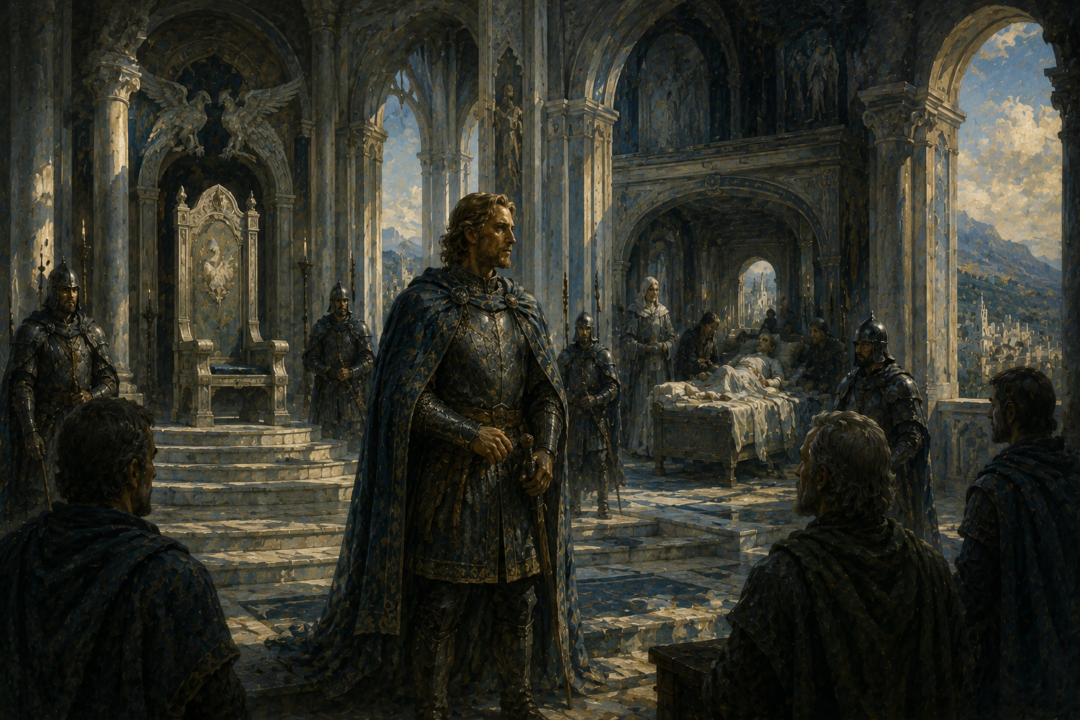
In The Houses of Healing, Aragorn recognizes this situation and says that Imrahil must rule the City until Faramir awakens.
For a brief period, then, the Prince of Dol Amroth occupies the gap between two ages of Gondor.
That may be Imrahil’s most politically important wartime function.
He does not seize the throne. He does not attempt to preserve the Stewards’ authority against Aragorn. Nor does he pretend that Aragorn’s claim automatically erases Gondor’s existing institutions.
Instead, he keeps legitimate government functioning until the rightful Steward can act.
That restraint is as important as military courage.
Imrahil Helps Make Aragorn’s Kingship a Restoration, Not a Conquest
Aragorn’s return could easily have been politically disruptive.
For nearly a thousand years, Gondor had been governed by Stewards. The population of Minas Tirith had never known a king. Aragorn arrives during a military emergency at the head of victorious troops, carrying the symbols of Elendil’s line.
Yet the restoration is handled through recognition rather than naked force.
Imrahil contributes to that process.
During the Last Debate, he openly treats Aragorn as his liege and is prepared to follow him. But he simultaneously remembers his responsibility for Minas Tirith and argues that the City cannot simply be stripped of defenders.
That combination reveals something essential about him.
Imrahil accepts Aragorn without becoming politically passive.
He can acknowledge a king and still give independent counsel.
That is precisely the kind of nobleman a restored monarchy needs.
Aragorn does not inherit an empty country. He inherits an ancient realm containing powerful families, provincial traditions, military commands, and institutions formed during centuries without kings. Stable restoration requires those structures to be incorporated rather than discarded.
Imrahil embodies that continuity.
The Last Debate Shows the Government That Is Emerging
After the Pelennor, the Captains of the West face an almost impossible decision.
They know they cannot overthrow Sauron by conventional military strength. Their march on the Black Gate is ultimately a diversion intended to draw Sauron’s attention away from the Ring-bearer.
Imrahil participates in that decision at the highest level.
He is not merely ordered eastward by Aragorn. He is one of the captains involved in deciding what the West should do.
And when the army finally marches, Imrahil goes with it.
This matters because his allegiance to Aragorn is demonstrated before victory is certain.
It is easy to recognize a king after Barad-dûr has fallen.
Imrahil follows Aragorn toward the Morannon while Sauron still possesses overwhelming military power and the western captains fully understand that their expedition may end in destruction.
His support therefore carries political weight after the war. It was not simply accommodation with the victor.
It had already been tested when defeat remained entirely possible.
Faramir and Imrahil Give the New King Something He Desperately Needs
After Aragorn’s coronation, Gondor does not suddenly become a centralized realm populated only by people personally loyal to him.
The restored kingdom needs experienced leaders.
Faramir becomes Prince of Ithilien while retaining the hereditary office of Steward. Imrahil remains Prince of Dol Amroth. Later traditions preserved in material associated with Gondor describe the Prince of Dol Amroth and the Steward as leading figures under the King.
The political logic is clear even without overstating details the narrative does not explicitly describe.
Faramir provides continuity with the Stewardship.
Imrahil provides continuity with Gondor’s great provincial nobility.
Both have proven themselves during the war.
And both accept Elessar.
That combination dramatically reduces the danger inherent in regime change. The new King does not need to destroy the previous ruling elite to establish himself. Important members of that elite become pillars of the restored kingdom instead.
Imrahil is particularly useful because he possesses authority independent of the Steward’s house while also being closely related to it.
He can stand beside Faramir without simply being Faramir’s subordinate.
Dol Amroth Also Becomes a Bridge to Rohan
Imrahil’s significance extends beyond Gondor.
During the aftermath of the war, he and Éomer become friends. Later, Éomer marries Imrahil’s daughter Lothíriel.
The marriage should not be reduced to a political treaty; the texts do not describe it as a calculated diplomatic arrangement. But its consequences plainly strengthen the already close relationship between the ruling houses of Rohan and Dol Amroth.
This creates an extraordinary web around the restored throne.
Éomer is Aragorn’s ally and fellow commander.
Faramir, Imrahil’s nephew, marries Éomer’s sister Éowyn.
Éomer marries Imrahil’s daughter Lothíriel.
The houses of Rohan, Ithilien, and Dol Amroth therefore become connected by both wartime friendship and marriage.
The alliance between Gondor and Rohan had been founded centuries earlier through the Oath of Eorl. After the War of the Ring, that alliance is no longer merely an ancient obligation preserved in ceremony. Its leading families have fought together, suffered together, and become kin.
Imrahil sits remarkably close to the center of that network.
His Greatest Contribution May Be That He Never Tries to Become More
There is a striking absence in Imrahil’s story.
He never exploits Gondor’s weakness.
Consider what he possesses during the crisis: noble ancestry, an important hereditary principality, military forces loyal to his command, kinship with the Stewards, popularity among Gondorian soldiers, and temporary authority in Minas Tirith.
In a different kind of history, those ingredients might produce a claimant.
Instead, Imrahil supports the legitimate Steward and then the returning King.
That does not make him politically unimportant.
It makes him more important.
Stable kingdoms depend not only upon powerful rulers but upon powerful people who accept limits. Imrahil repeatedly demonstrates that kind of loyalty without surrendering his judgment.
He commands when command is required.
He advises when counsel is required.
He yields authority when legitimate authority returns.
And when Aragorn asks the West to gamble everything at the Black Gate, Imrahil goes with him.
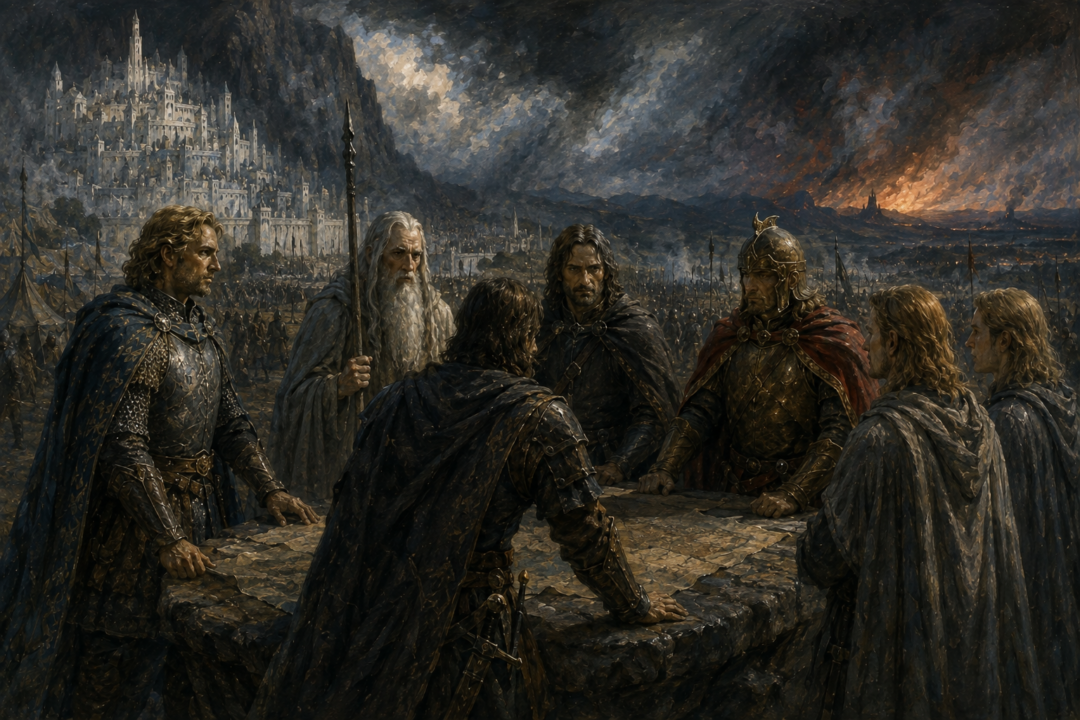
The Prince Who Helps Gondor Survive Its Change of Age
The War of the Ring does more than defeat Sauron.
It transforms Gondor.
The long rule of the Stewards ends. The kingship returns. Ithilien must be reclaimed. Alliances must be renewed. Armies must still defend the realm against enemies remaining in the East and South.
Aragorn is the central figure in that restoration, but kings do not rebuild kingdoms alone.
Imrahil has already demonstrated nearly every quality the new order requires before that order even exists: military competence, provincial authority, loyalty to Gondor’s institutions, acceptance of Aragorn, friendship with Rohan, and the ability to govern during a constitutional emergency.
That is why his wartime role matters so much.
Imrahil does not merely survive the passing of the Third Age.
For a few crucial days, while a Steward lies between life and death and an uncrowned king waits outside the walls, the Prince of Dol Amroth helps hold Gondor together long enough for the next age to begin.
Sources & Notes
- https://tolkiengateway.net/wiki/Imrahil
- https://tolkiengateway.net/wiki/Dol_Amroth
- https://tolkiengateway.net/wiki/Gondor
- https://tolkiengateway.net/wiki/Reunited_Kingdom
References for Imrahil, Dol Amroth, Gondor, and the restored kingdom.