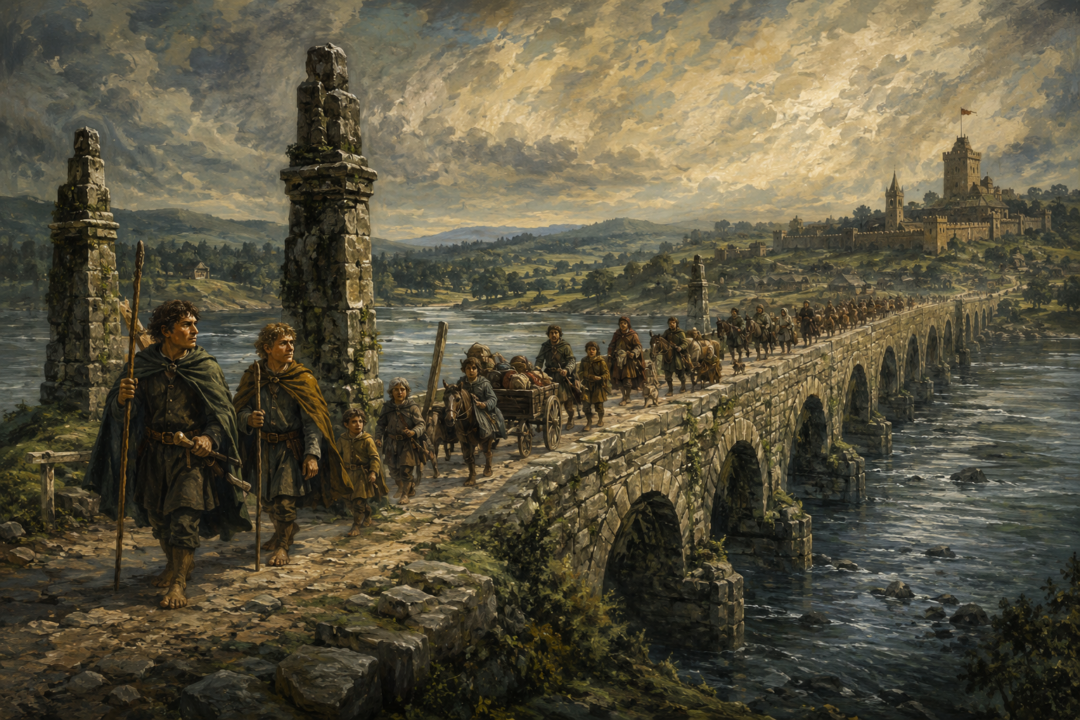
The Brandywine Bridge looks like an ordinary piece of geography: an old stone crossing carrying the East Road over the river at the edge of the Shire. Yet by the Fourth Age, it has become something much more unusual.
It is the place where a king stops.
That matters because King Elessar is not prevented from entering by an enemy, a wall, or a lack of authority. He remains the protector of the Shire. The Hobbits themselves remember him as their King. Yet after issuing a law that Men are not to enter the Shire, Elessar obeys that restriction himself.
When he eventually travels north, he comes only as far as the Brandywine Bridge.
Calling the bridge a “constitutional boundary” requires some care. Middle-earth does not possess a modern written constitution for the Reunited Kingdom, and the texts never use that phrase. But in the broader sense of a boundary defined by political authority, law, custom, and limits upon rulers, the description fits remarkably well.
The bridge begins as royal infrastructure. It becomes the Shire's frontier. It is abused as a checkpoint under Saruman's regime. Finally, under Elessar, it becomes the place where royal power deliberately refuses to cross.
The Bridge Was Older Than the Shire
The Hobbits did not build the great bridge over the Brandywine.
In the Prologue to The Lord of the Rings, the crossing is remembered by its older name, the Bridge of Stonebows, and as a work dating from the days when the North-kingdom was powerful. The exact date of its construction is not given.
This immediately places the Shire inside a much older political landscape.
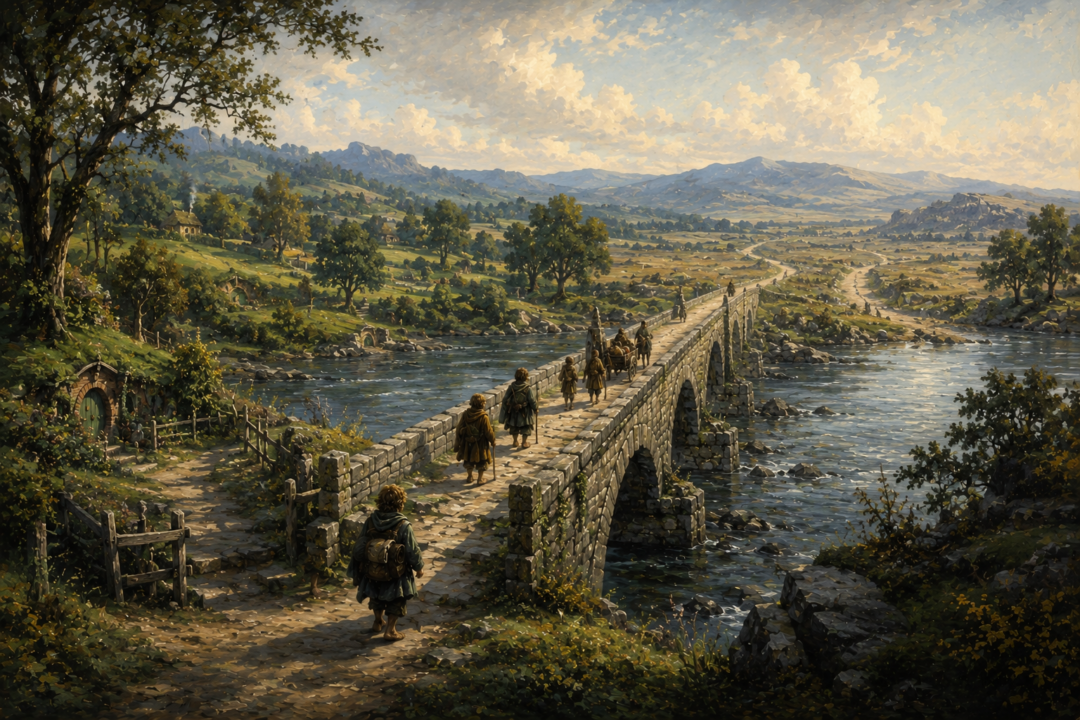
In Third Age 1601, the brothers Marcho and Blanco led Hobbits westward from Bree. They crossed the Baranduin and received permission from King Argeleb II at Fornost to settle the lands beyond it. Their obligations were strikingly modest: they were to acknowledge the king's lordship, speed his messengers, and maintain the bridges and roads.
The Shire therefore did not begin as an independent country created out of empty political space. Its settlement occurred under royal authority.
The bridge embodied that relationship.
It was inherited infrastructure belonging to an older order, and maintaining it was part of the arrangement by which the Hobbits occupied their new homeland.
Then the North-kingdom disappeared.
The Hobbits remained.
The Border Survived the Kingdom That Created It
This is one of the great political ironies of the Shire.
The kings vanished, but Hobbit institutions continued.
The Shire retained the office of Thain as a memory of royal government. Its people maintained their own local arrangements. They became so accustomed to governing their affairs without visible kings that the ancient monarchy gradually passed into legend.
Yet the geography of the vanished kingdom remained beneath their feet.
The East Road still ran through the country. The Bridge of Stonebows still crossed the river. The eastern end of the bridge marked the Shire's eastern boundary in its original extent.
Buckland complicates the map. Centuries after the Shire's foundation, Gorhendad Oldbuck crossed the Brandywine and established himself east of the river, founding the community that became Buckland. Buckland was consequently an Eastmarch beyond the old river boundary, with its own distinctive character and the protective High Hay against the Old Forest.
So the Brandywine was never a perfectly simple frontier in Hobbit life.
Politically and historically, however, the Great Bridge remained immensely significant. It was the great eastern approach to the Shire along the Road.
Anyone arriving from Bree and the wider world by that route encountered the bridge before the heartlands of Hobbit society.
That made it more than transportation.
It was a threshold.
Saruman Shows What a Border Looks Like When Power Goes Wrong
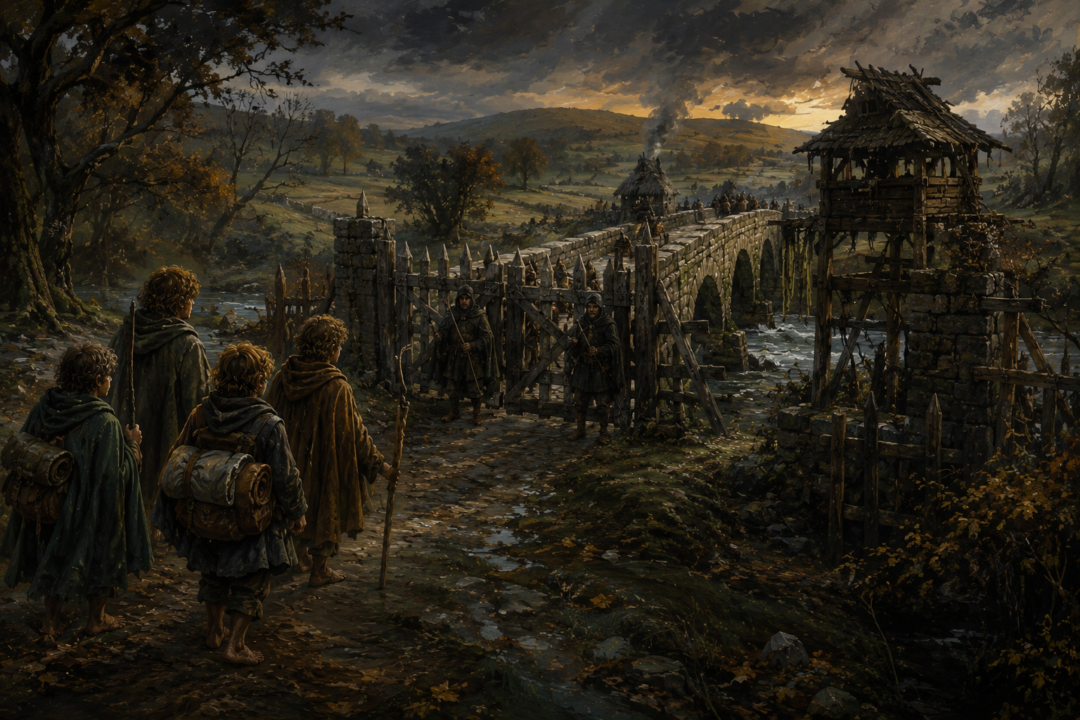
The importance of the bridge becomes brutally clear when Frodo, Sam, Merry, and Pippin return home after the War of the Ring.
They do not find the familiar open crossing of earlier days.
Under the regime established by Saruman's followers, gates have been erected across the bridge. Rules govern passage. Shirriffs and gatekeepers enforce an intrusive system of restrictions.
The scene is deliberately small compared with the wars the Travellers have survived. There are no Nazgûl or armies waiting on the bridge.
Instead there are petty regulations backed by coercion.
That is precisely why the episode matters.
Saruman's domination of the Shire does not merely destroy trees and seize property. It corrupts ordinary structures of communal life. Roads, inns, food, work, trade, and movement become subject to centralized interference.
The bridge therefore demonstrates a crucial distinction: a boundary can protect a community, but it can also become an instrument for controlling that community.
The physical object is almost the same.
The moral order behind it is completely different.
Under Saruman, the gates are designed to make Hobbits obedient.
Under Elessar, the later restriction is designed to prevent outsiders from intruding upon them.
Elessar Creates a Different Kind of Frontier
The decisive change comes after the War.
Appendix B records that in Shire Reckoning 1427, King Elessar issues an edict forbidding Men from entering the Shire and makes the Shire a Free Land under the protection of the Northern Sceptre.
Those words establish an unusual political arrangement.
The Shire is protected by the restored northern monarchy, but Men are excluded from entering it.
The exact constitutional implications of the term “Free Land” are not fully explained. It would therefore go beyond the text to construct a detailed legal system around the phrase or claim that the Shire became an entirely sovereign state in the modern sense.
What is clear is more interesting anyway.
Royal authority is being used to preserve Hobbit autonomy rather than absorb it.
Elessar's restored kingdom could have meant the return of direct royal presence to lands that had once belonged to Arnor. Instead, one of his recorded acts concerning the Shire is to establish a legal protection against intrusion.
The new kingdom does not simply recreate the old kingdom.
It remembers what history has produced during the centuries in between.
The Most Important Person Bound by the Law Is the King
The strongest evidence for the meaning of the edict comes later.
The account of the northern Dúnedain in Appendix A says that when the King comes north, the people of the Shire are glad, but he does not enter their land. Crucially, he binds himself by the law he has made concerning the passage of the Big People.
This transforms the edict from a rule imposed upon ordinary Men into a statement about kingship itself.
Elessar could presumably have treated himself as the exception. He is the author of the edict and the sovereign whose sceptre protects the Shire.
Instead, the King accepts his own boundary.
That is the point at which the Brandywine Bridge acquires something resembling constitutional significance.
The law is not merely something the ruler commands others to obey.
It also shapes the ruler's own conduct.
This is not modern constitutional government, and the texts do not give us enough information to define the legal mechanics behind it. But the moral principle is unmistakable: legitimate authority can express itself through restraint.
The King proves his protection of the Shire partly by refusing to enter it.
Why the Meeting at the Bridge Matters
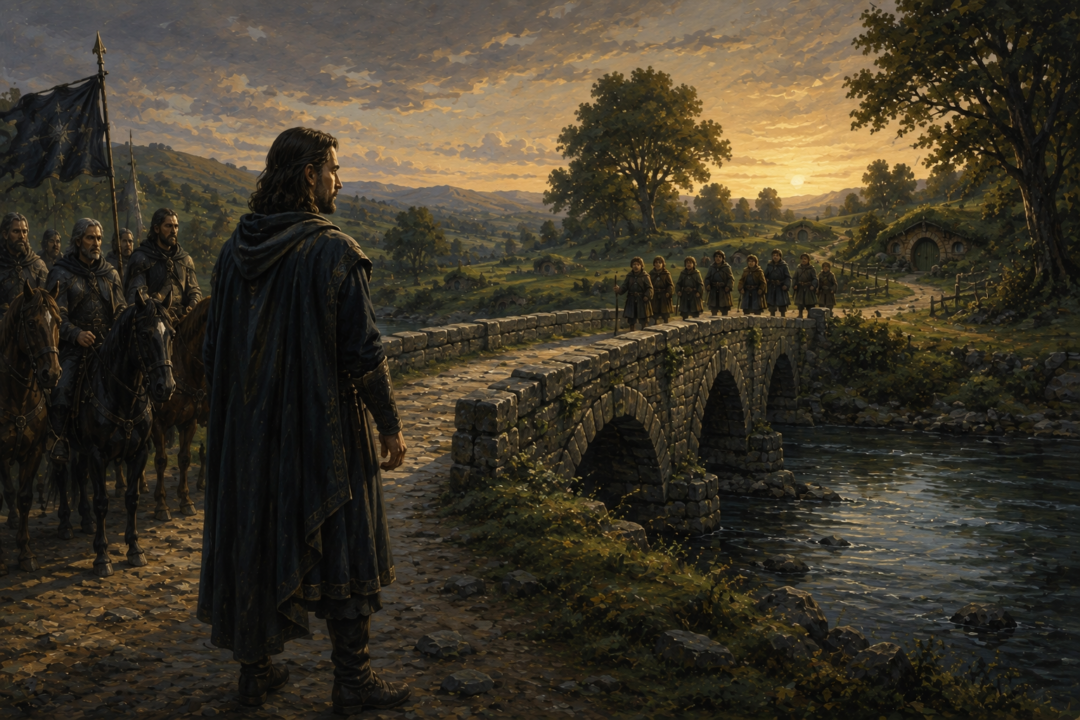
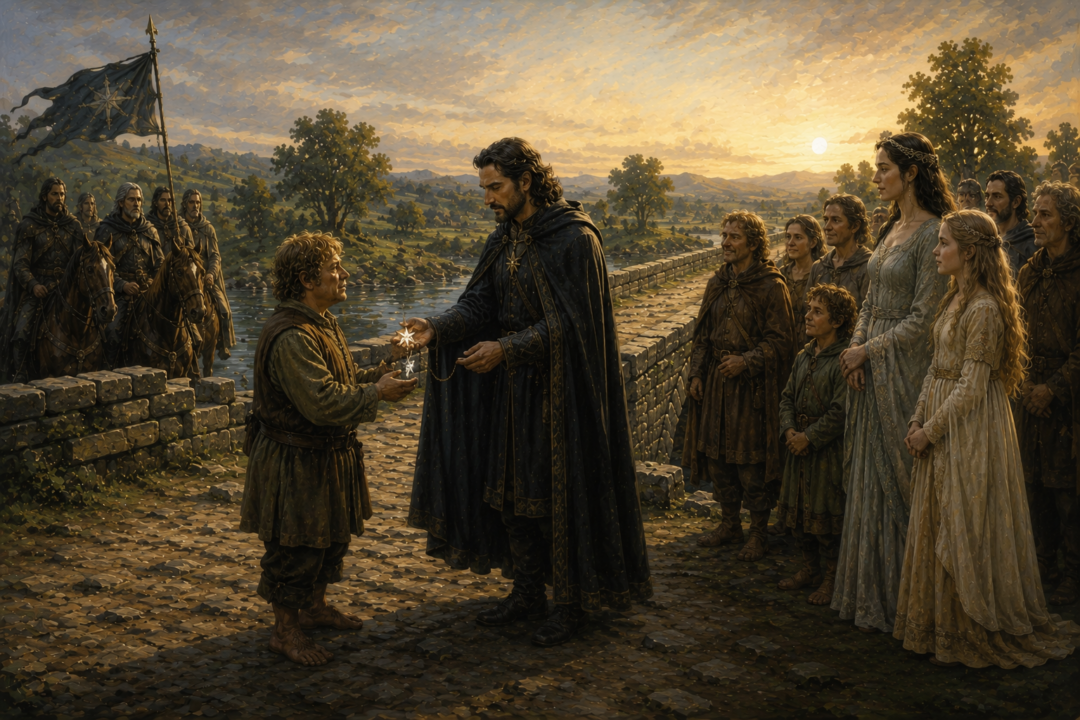
In Shire Reckoning 1436, nine years after the edict, Elessar travels north and stays for a time near Lake Evendim.
Then he comes to the Brandywine Bridge.
There he meets his friends.
The location is unlikely to feel accidental when read beside the earlier edict and the statement that the King obeys his own law. The bridge is the natural meeting place between two political worlds that remain connected without being collapsed into one another.
Elessar does not need to enter Hobbiton to demonstrate friendship with the Hobbits.
The Hobbits do not need to reject the King in order to preserve their freedom.
At the bridge, both relationships can exist simultaneously.
The Shire can acknowledge a king while retaining a protected sphere of its own.
The King can exercise sovereignty while accepting a limit on his own physical presence.
That balance becomes even clearer when Appendix B records another development. In Shire Reckoning 1434, Elessar makes the Thain, the Master of Buckland, and the Mayor Counsellors of the North-kingdom.
The relationship is therefore not isolation.
Hobbit leaders can participate in the restored northern political order. Hobbits can cross outward. Friendship, counsel, travel, and allegiance continue.
What is restricted is the unilateral movement of Men into the Shire.
The boundary is protective, not a severing of relations.
The Bridge Reverses the Meaning of Power
There is a beautiful historical symmetry here.
Long before the War of the Ring, Hobbits crossed this bridge because a king permitted them to settle beyond it.
More than fourteen centuries later, another king stands at the same threshold and refuses to cross because he has protected the land beyond it from Men.
The first royal act associated with the Shire opens a homeland.
The later royal act protects that homeland from intrusion.
Between those moments lies the entire political history of the Hobbits: settlement, forgotten kingship, self-government, hidden protection by the Rangers, invasion by Saruman's servants, liberation, and finally recognition by the restored monarchy.
The stone bridge survives every transformation.
Its meaning changes because the nature of authority changes around it.
The Quietest Victory of the Return of the King
The return of the King could easily have meant expansion.
Arnor had once ruled the lands in which the Shire was founded. Elessar is heir to that northern kingship. Roads are reopening, order is returning to Eriador, and Annúminas again becomes associated with royal presence.
Yet the restored monarchy does not erase the peculiar society that developed during its long absence.
It protects it.
That may be the deepest reason the Brandywine Bridge matters in the Fourth Age.
The boundary is not ultimately defined by fear of the King. It is made meaningful by the King's willingness to stop.
Saruman puts gates on the bridge because he wants power over those living beyond them.
Elessar remains outside because his power no longer needs to prove itself by crossing every frontier.
The difference between those two uses of authority is enormous.
One turns a bridge into a checkpoint.
The other turns it into a promise.
And so an ancient piece of stonework inherited from the North-kingdom becomes one of the quietest symbols of the new age: a place where the restored King demonstrates that lawful rule can include the decision not to enter.
The Bridge of Stonebows once carried the Hobbits into their country.
In the Fourth Age, it helps guarantee that the country remains theirs.
Sources & Notes
- The Encyclopedia of Arda, “Brandywine Bridge” — https://www.glyphweb.com/arda/b/brandywinebridge.html
- The Encyclopedia of Arda, “Shire” — https://www.glyphweb.com/arda/s/shire.html
- The Encyclopedia of Arda, “Buckland” — https://www.glyphweb.com/arda/b/buckland.html
Reference entries document the people, places, events, and objects directly discussed in this article.