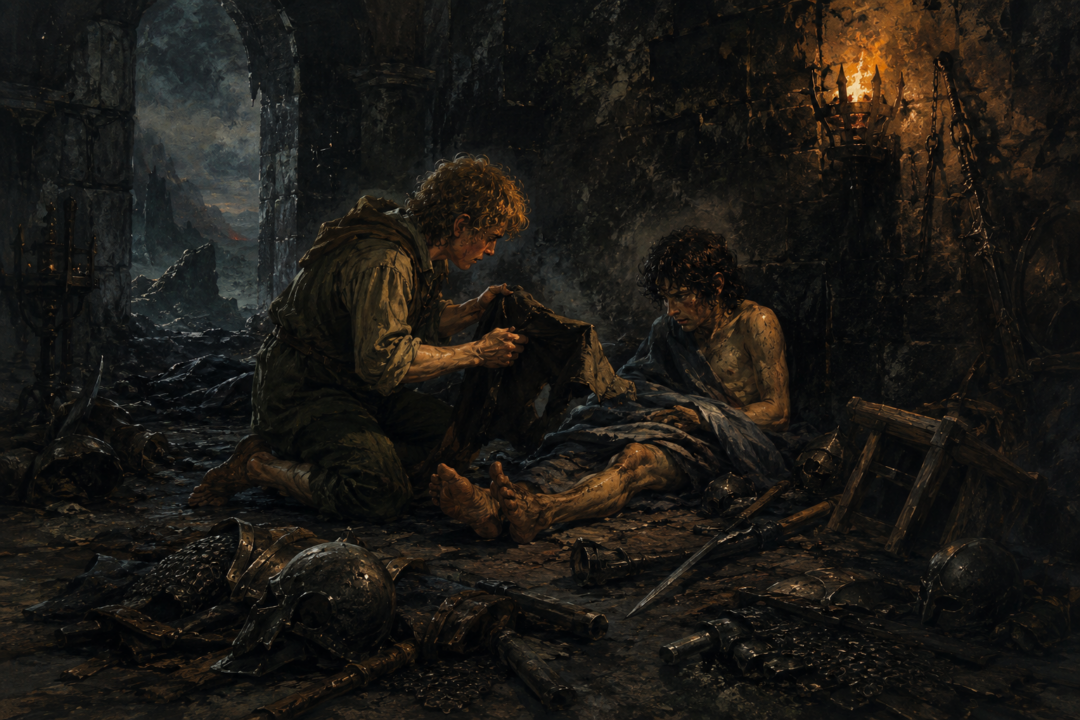
When Sam finds Frodo in the Tower of Cirith Ungol, one of the first practical problems is almost absurdly ordinary: Frodo has no clothes.
The Orcs have stripped him. His possessions have been searched, divided, fought over, and carried away. The mithril coat that Bilbo gave him is gone. His grey Elven cloak and its brooch are gone. Even objects associated with the two hobbits have fallen into enemy hands.
In almost any other adventure, this would be a humiliating inconvenience.
In Mordor, it becomes intelligence.
Frodo’s missing clothing creates two different dangers at once. First, it leaves evidence that can travel through Sauron’s military system. Second, it forces Frodo and Sam to disguise themselves in enemy equipment, which helps them cross Mordor but also places them inside the machinery of Sauron’s army.
Most importantly, the captured possessions eventually reach the Black Gate, where Sauron attempts to turn them into psychological weapons against Gandalf and the Captains of the West.
Yet the episode contains a remarkable irony. Mordor possesses genuine evidence, but interprets it incorrectly. Sauron learns that an extraordinary Hobbit has entered his country. He still does not understand why.
The Evidence Leaves Cirith Ungol
The danger begins before Sam even reaches Frodo.
Inside Cirith Ungol, the Orcs of the tower and the Morgul company quarrel over the prisoner and his possessions. Frodo’s mithril coat is particularly important because of its extraordinary value. The dispute becomes part of the violent conflict that destroys most of the Orc garrison.
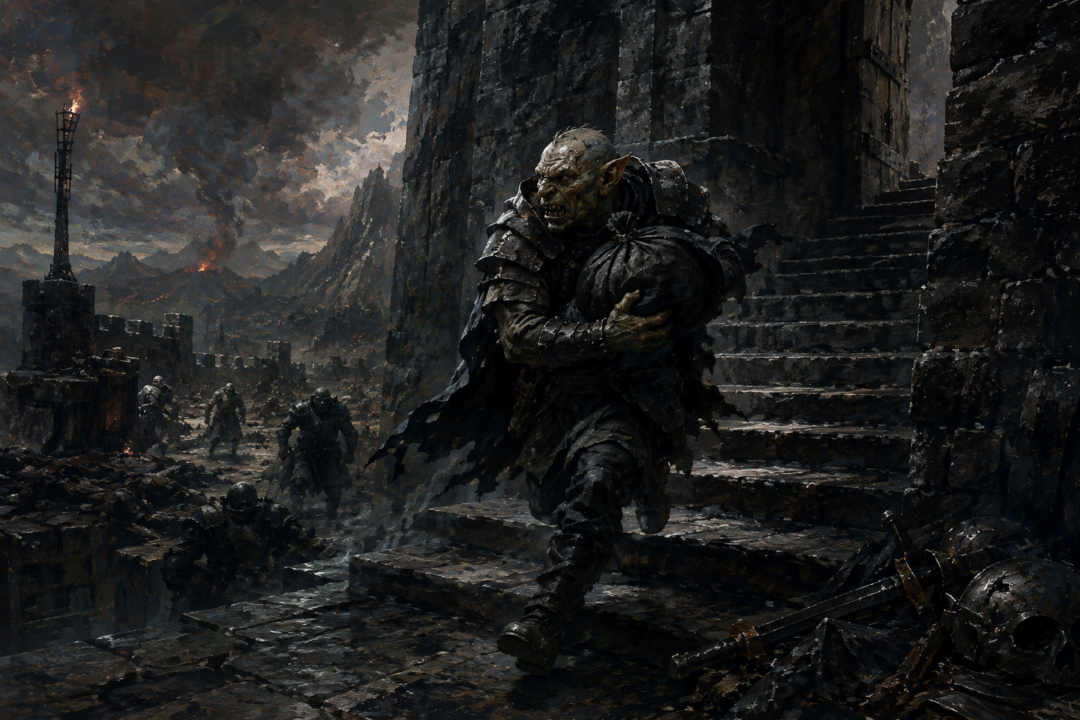
But Shagrat, captain of the tower, survives.
Sam sees him escaping with a black bundle. The narration ominously observes that if Sam had understood the grief Shagrat’s escape would cause, he might have been overwhelmed by it.
That bundle matters because Frodo’s belongings do not disappear into some forgotten Orc store-room. They move upward through Mordor.
By the time the Host of the West reaches the Black Gate, Sauron’s representative possesses several unmistakable tokens connected with the secret journey: the mithril coat Frodo had worn, a grey Elven cloak with its brooch, and the sword Sam had carried.
The enemy has acquired physical evidence of an intrusion.
That is a genuine strategic problem.
Frodo Has Left a Trail Without Meaning To
Until Cirith Ungol, secrecy is the quest’s greatest protection.
The entire plan depends upon Sauron failing to imagine that his enemies intend to destroy the Ring. He expects powerful opponents to desire it, claim it, and ultimately use it against him. His attention therefore turns naturally toward figures such as Aragorn and toward the military challenge developing in the West.
Frodo succeeds because he is operating outside that expectation.
But the objects taken from him begin to reveal pieces of the hidden story.
A mithril coat is no ordinary possession. An Elven cloak links its wearer with the Elves. A blade associated with the West adds another suggestive connection. The prisoner himself is a Hobbit from the Shire, a land Sauron’s servants have already had reason to investigate during the hunt for the Ring.
Put together, these objects demonstrate that the intrusion is not random.
The Mouth of Sauron explicitly interprets the collection as evidence of a conspiracy.
That conclusion is correct.
What Mordor does not understand is the nature of the conspiracy.
Sauron Has the Clues but Not the Answer
This is one of the sharpest examples of incomplete intelligence in the War of the Ring.
Sauron’s servants know that someone from the Shire has entered Mordor carrying remarkable equipment connected with several of his enemies. They know that this individual has reached the fortress guarding one of the secret approaches into the Black Land.
What they apparently do not know is the one fact that matters most.
They do not know that Frodo is carrying the One Ring toward Mount Doom.
The Ring itself was not among Shagrat’s trophies because Sam had taken it from Frodo after Shelob’s attack. Sam still possessed it while entering the tower, and he returned it to Frodo after the rescue.
This creates an extraordinary imbalance between evidence and interpretation.
Sauron receives Frodo’s clothing and equipment but not the Ring. He therefore has proof of infiltration without proof of the true objective.
The texts strongly support the idea that Sauron continues to misunderstand his enemies’ strategy. His fear remains focused on the possibility that a powerful opponent will claim the Ring. The march of Aragorn and the Captains toward the Black Gate reinforces precisely the interpretation Sauron is already inclined to believe.
Frodo’s captured possessions are dangerous clues, but they do not break that fundamental misconception.
Sam Turns the Disaster Into a Disguise
Meanwhile, Frodo has an immediate problem.
He cannot simply walk out of Cirith Ungol unclothed.
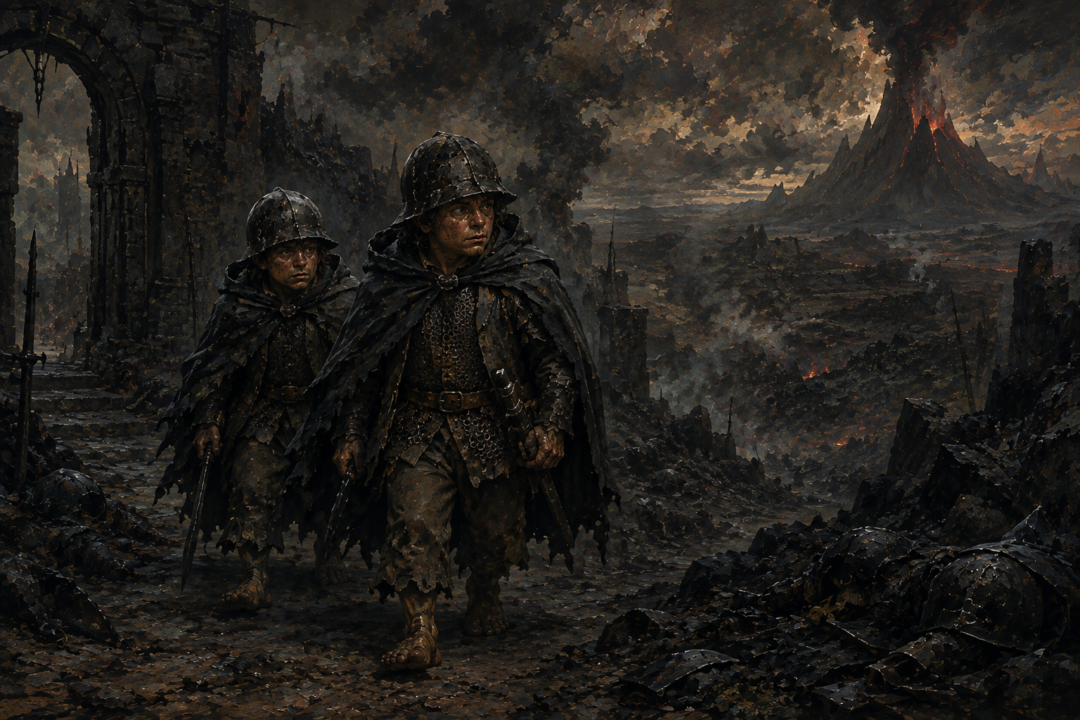
Sam searches the tower for equipment small enough to use. Frodo reluctantly puts on Orc garments: rough breeches, a dirty leather tunic, mail, a belt and weapon, a helmet, and a black cloak. Sam similarly conceals himself beneath Orc gear.
The result is not a perfect disguise. Sam jokes about how much would have to change before Frodo truly resembled an Orc. Their faces and bodies can still betray them.
But at a distance, covered in Mordor’s equipment, they no longer advertise themselves as two Hobbits walking through enemy territory.
The loss of Frodo’s clothes has therefore created a strange tactical reversal.
The enemy strips away the travellers’ original appearance, and Sam replaces it with the appearance of the enemy.
For a time, that helps them.
Yet wearing Orc gear introduces another danger: if they look like members of Sauron’s forces, Sauron’s forces may treat them accordingly.
The Disguise Almost Traps Them
That is exactly what happens.
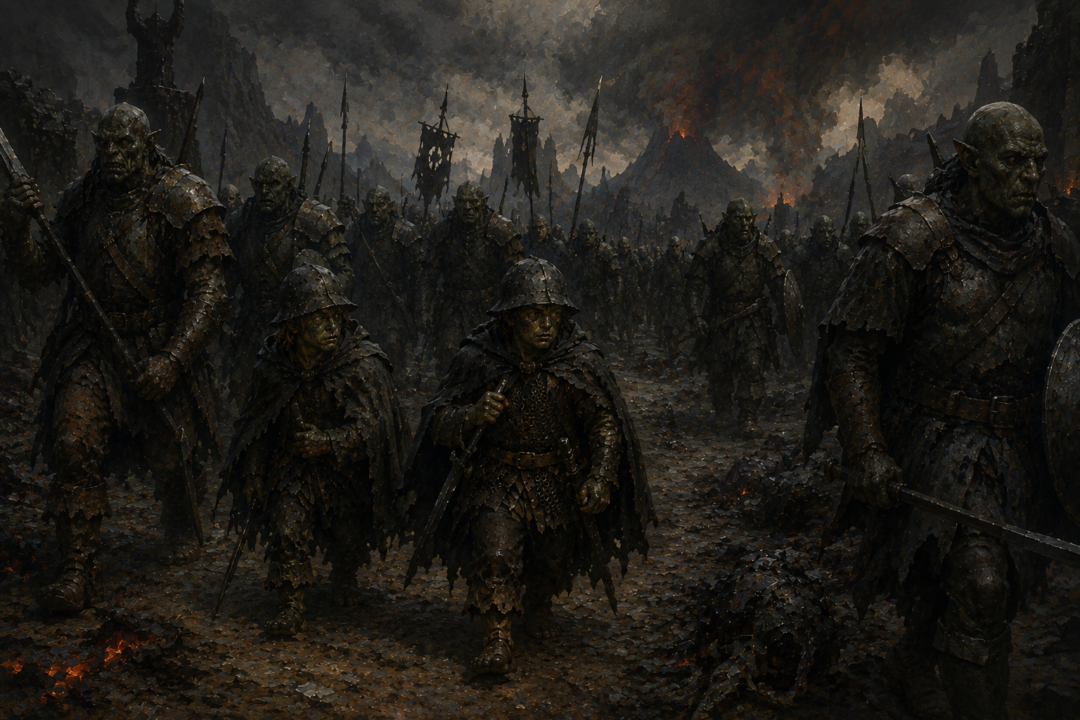
As Frodo and Sam move through Mordor, they encounter an Orc company commanded by an officer who assumes that the disguised hobbits are stragglers.
Their camouflage works too well.
Instead of being challenged as foreign intruders, they are forced into the marching company.
This is a dangerous moment because Frodo and Sam cannot behave indefinitely like ordinary Orc soldiers. They are exhausted, undersized, unfamiliar with military procedure, and desperately trying to move toward Mount Doom rather than wherever the company has been ordered.
The disguise has changed the nature of the threat.
Without it, discovery might mean immediate capture.
With it, they risk being absorbed into Mordor’s military system.
They eventually escape amid confusion, but the incident shows why their clothing is not merely visual detail. In Mordor, clothing communicates allegiance. Once Frodo and Sam wear the uniform of the enemy, they inherit some of the obligations attached to it.
The Captured Clothes Become a Weapon at the Black Gate
The greatest strategic consequence occurs far from Frodo himself.
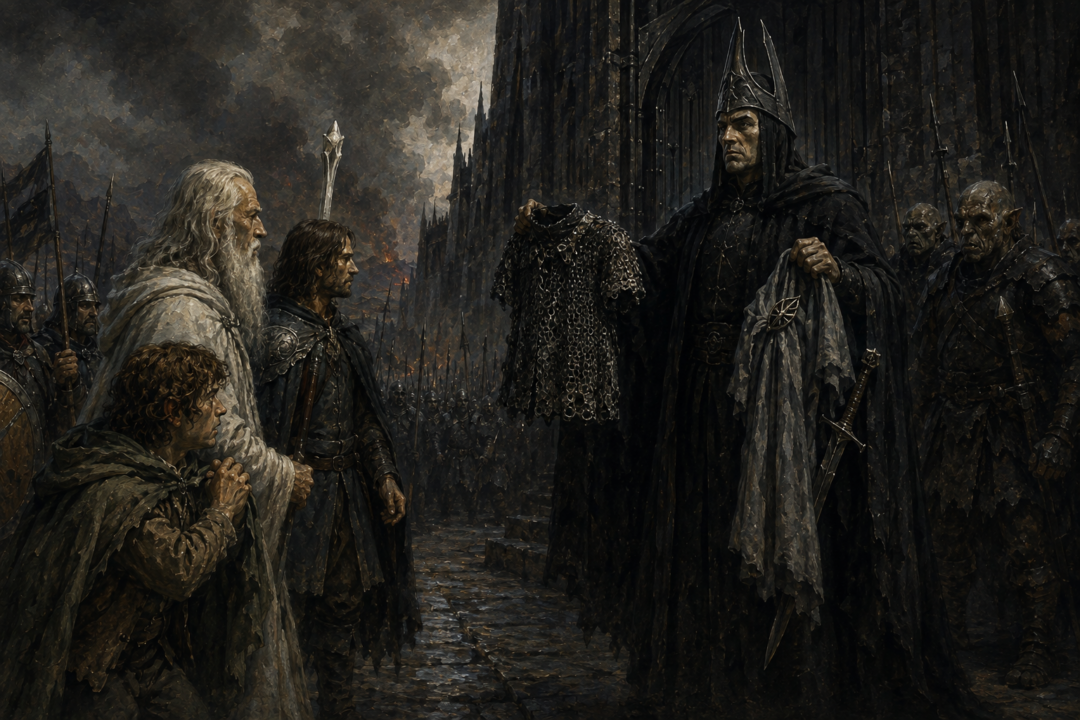
When Gandalf, Aragorn, and the remaining Captains approach the Black Gate, the Mouth of Sauron comes out to negotiate. He produces the captured objects.
The effect is devastating.
Those who recognize them immediately fear the worst. Pippin’s reaction even confirms to the Mouth that the objects are meaningful to the Western leaders.
Sauron’s messenger then exploits that fear.
He presents the captured Hobbit as a spy and threatens a terrible fate for him unless the West accepts Sauron’s terms. The demands would effectively destroy meaningful resistance: Gondor and its allies would be forced into submission while Sauron secured overwhelming political control.
The possessions have therefore travelled through several stages of strategic value.
They begin as loot.
They become intelligence.
Finally, they become instruments of coercion.
The irony is that the threat rests upon false assumptions. Frodo is no longer a prisoner. Sam has rescued him. Both Hobbits are already moving through Mordor.
The Mouth possesses the evidence of yesterday’s situation while pretending it proves the situation of today.
Gandalf refuses to surrender.
Gandalf Notices What the Enemy Does Not Know
The confrontation also exposes the limits of Sauron’s knowledge.
The Mouth can display Frodo’s possessions and identify them as signs of conspiracy, but Gandalf understands their history better than he does.
That distinction matters.
Sauron has captured objects without capturing their full meaning.
Even more importantly, his messenger’s claims do not demonstrate possession of the Ring. The enemy knows enough to frighten the Captains, but not enough to reveal that the central secret has been discovered.
Gandalf cannot know everything that has happened to Frodo, yet he does not allow fear to dictate his response.
This becomes another quiet victory of judgment over panic.
Had the Captains surrendered because of the tokens, Sauron could have gained an enormous strategic victory using evidence that was both authentic and misleading.
The Smallest Loss Can Matter in a War of Secrecy
Frodo losing his clothes sounds insignificant beside the destruction of armies, the siege of Minas Tirith, or the confrontation at the Black Gate.
But the quest of the Ring is not primarily protected by armies.
It is protected by secrecy.
That makes possessions dangerous.
A cloak can reveal an Elven connection. A rare coat of mail can prove that the captured traveller is no ordinary wanderer. A familiar sword can identify companions. Objects can survive when their owners escape, and those objects can be carried to people capable of drawing conclusions from them.
Cirith Ungol comes frighteningly close to giving Sauron enough pieces to understand what is happening inside his own realm.
But “close” is not enough.
The Enemy sees the evidence through the assumptions he already holds. Frodo becomes, in his understanding, a spy connected to a wider conspiracy rather than the bearer of the weapon upon which Sauron’s power depends.
So Frodo’s missing clothes really do become a strategic risk.
They expose his presence. They provide intelligence. They nearly compromise the Western leaders through fear. They force him into a dangerous disguise and briefly entangle him in the movement of Sauron’s troops.
Yet they also reveal one of the central weaknesses in Sauron’s position.
He can seize Frodo’s possessions.
He can catalogue the evidence.
He can recognize a conspiracy.
But until the final moments, he cannot imagine the truth.
Sources & Notes
- The Encyclopedia of Arda, “Frodo Baggins” — https://www.glyphweb.com/arda/f/frodobaggins.html
- The Encyclopedia of Arda, “Cirith Ungol” — https://www.glyphweb.com/arda/c/cirithungol.html
- The Encyclopedia of Arda, “Tower of Cirith Ungol” — https://www.glyphweb.com/arda/t/towerofcirithungol.html
Reference entries document the people, places, events, and objects directly discussed in this article.