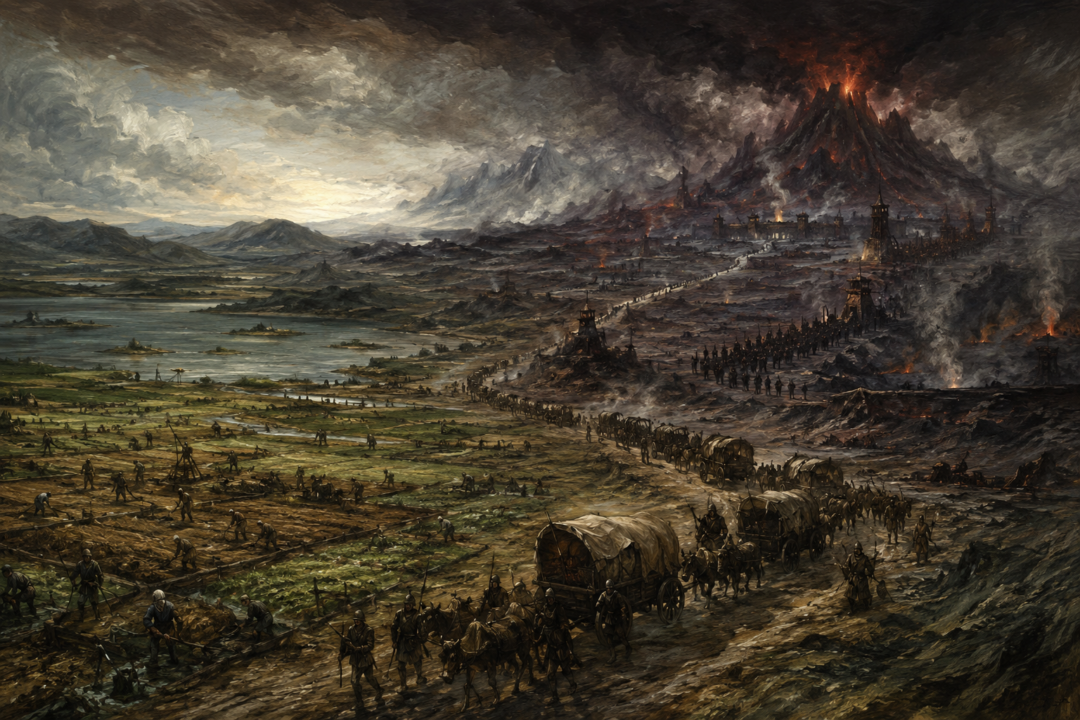
When Sam Gamgee finally looked across the interior of Mordor, he noticed a problem that is easy to miss beneath the spectacle of Barad-dûr and Mount Doom.
Where was the food?
The northern heart of Sauron’s realm was filled with armies, camps, mines, forges, roads, fortifications, and countless servants of war. Yet the land Frodo and Sam could see was blasted and hostile. An army might march through such a country. It could not easily live off it.
The answer reveals something important about Mordor. Sauron’s military power did not rest on Orcs and fortresses alone. Behind the armies stood an organized system of agriculture, forced labour, tribute, transport, and roads stretching far beyond the battlefield.
Mordor was not merely a wasteland.
It was a war machine with a supply network.
The Problem Hidden Behind Sauron’s Vast Armies
The War of the Ring presents Sauron as possessing enormous military resources. His forces include Orcs and Trolls, but also Men drawn from lands to the east and south. Armies gather inside Mordor before being sent against Gondor, while other forces operate on distant fronts.
All of those soldiers had to be sustained.
The narrative makes this problem explicit when Sam surveys the enemy concentrations in northern Mordor. Seeing so many troops, he reasons that there must be water and food somewhere to support them.
He is correct.
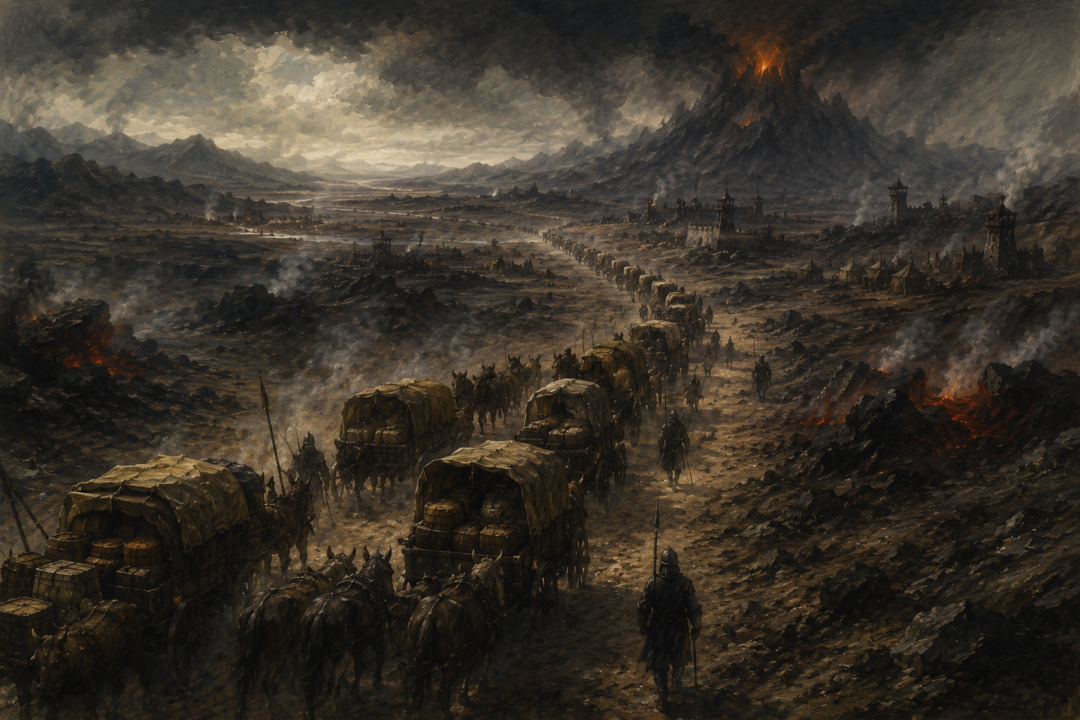
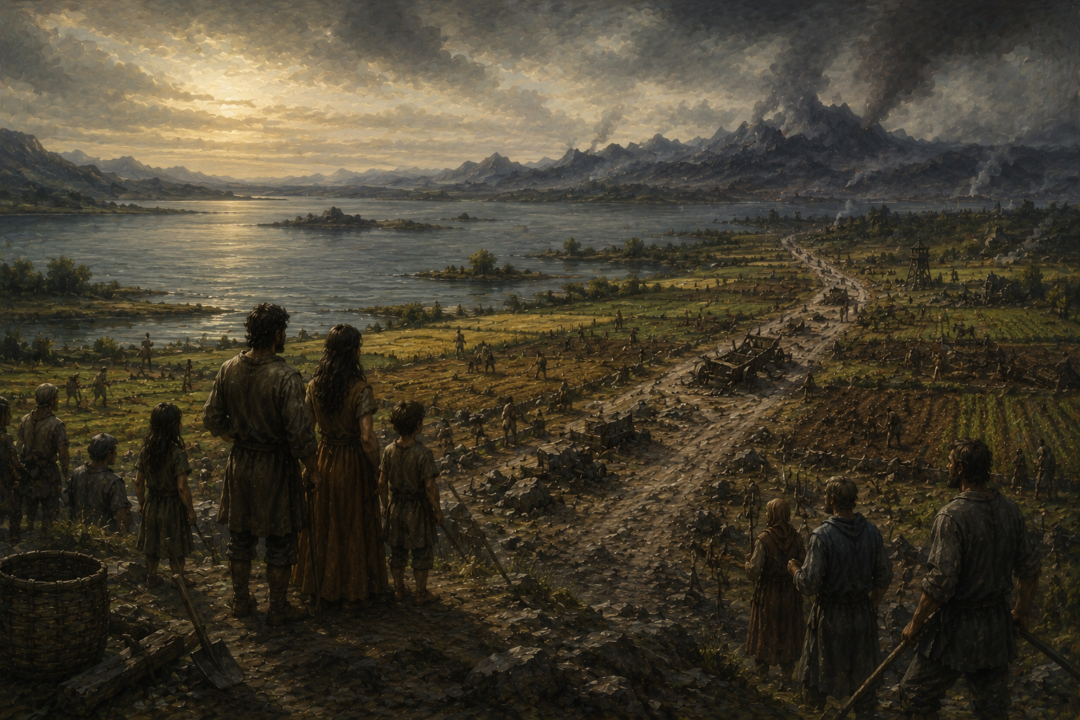
The explanation given in “The Land of Shadow” is unusually revealing. Far to the south lay great fields around the dark waters of Lake Núrnen, worked by slaves. Roads also ran east and south toward lands under Sauron’s power, and along them came wagon-trains carrying goods, plunder, and new captives.
That short description transforms the way Mordor should be imagined.
The visible army was only the final product.
Behind it stood fields, labourers, wagons, roads, soldiers assigned to transport, and subject territories beyond Mordor itself.
Nurn Was the Agricultural Counterpart to Gorgoroth
Frodo and Sam experience primarily the northwestern part of Mordor: the Plateau of Gorgoroth and the lands around Orodruin.
This is the Mordor most readers remember—a country of ash, fumes, slag, pits, thorns, and poisoned desolation.
But Mordor was much larger.
Southward lay Nurn and Lake Núrnen. The text specifically identifies this region with extensive slave-worked fields. Whatever crops were cultivated there, the important canonical point is clear: these lands contributed to maintaining Sauron’s forces.
That created a grim division within Mordor.
The northern regions were associated with mines, forges, military camps, and the gathering of armies. Farther south were agricultural lands worked under coercion.
One region helped produce weapons and assemble soldiers.
Another helped keep those soldiers alive.
The contrast is deliberate and revealing. Sauron had concentrated much of his military power in a landscape poorly suited to feeding the population gathered there. The productive regions therefore had to be connected to the military regions.
That is where roads became indispensable.
Roads Turned Nurn’s Food into Military Power
A field beside Lake Núrnen was useful to Sauron only if its produce could reach the places where his armies were stationed.
This is the logistical reality beneath the story.
Large concentrations of troops consume resources continuously. Food produced many miles away must be transported. Equipment must be moved. Replacement supplies must arrive. Captives and labourers must be transferred to wherever they are required.
The text does not provide a detailed administrative blueprint for this system, and it would be wrong to invent one. But it does give us the essential pieces: agricultural production in southern Mordor, great roads, wagon-trains, and military concentrations in the north.
From those facts, the function of the roads is clear.
They connected production to consumption.
Sauron could mass forces around the approaches to northern Mordor because those forces did not have to depend entirely on what the surrounding ground could provide. Resources could be moved toward them from elsewhere.
The roads were therefore part of Sauron’s military strength just as surely as the walls of the Morannon or the furnaces of Mordor.
Mordor Also Drew Resources from Beyond Its Borders
Nurn was not the whole answer.
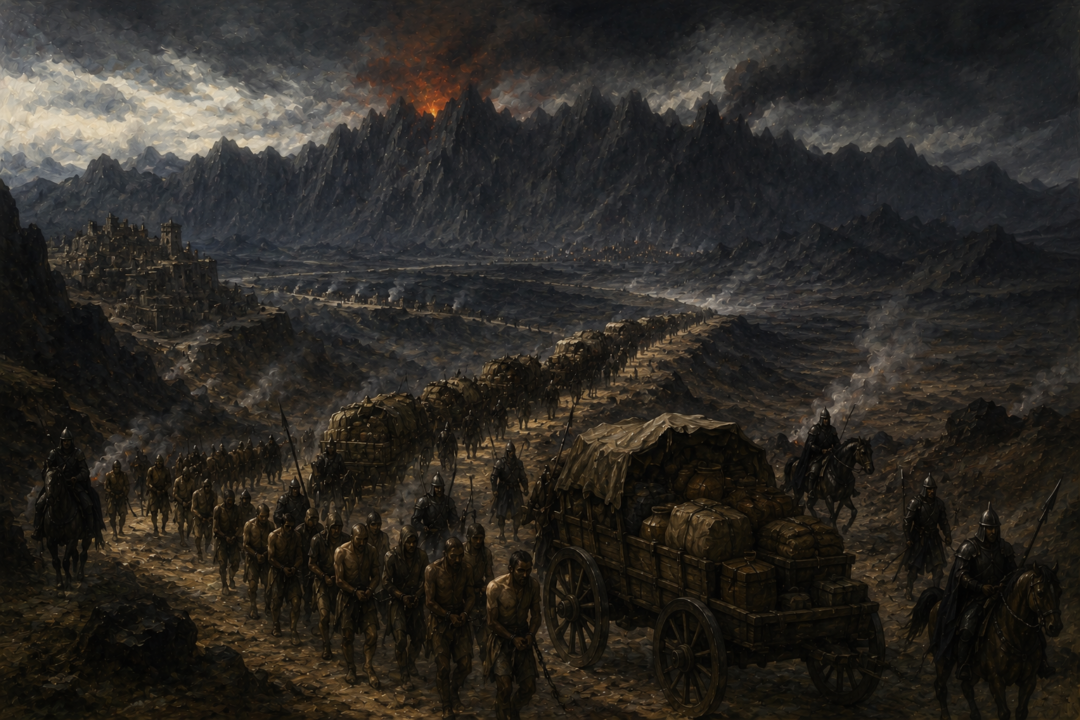
The same passage describing the slave-worked fields also mentions great roads extending east and south into tributary lands.
This matters because it shows that Mordor’s war economy extended beyond Mordor itself.
The exact political status of every eastern or southern land involved is not laid out in detail, so we should not imagine a precisely mapped imperial administration where the texts give us none. What is explicit is that some lands were tributary to Sauron and that soldiers of the Dark Tower brought wagon-trains from them.
Those trains carried goods and booty as well as fresh slaves.
Mordor therefore consumed resources extracted from subject territories beyond its mountains.
The distinction between ordinary goods and booty is significant. It suggests that Sauron’s system was not based on a single source of supply. Some resources came from organized production within Mordor; others arrived from lands outside it, whether through imposed obligations or violent seizure.
The armies seen in the north were sustained by a much wider world of domination.
Why Wagons Explain the Importance of the Roads
The reference to long wagon-trains is especially important.
Wagons require usable routes.
An individual soldier can scramble over difficult ground. Pack animals can negotiate paths unsuitable for carts. But repeated movement of heavily laden wagons demands something more reliable.
That does not mean every Mordor road was a perfectly engineered highway. The texts do not give enough information to claim that. But they repeatedly present roads as major features of Sauron’s military landscape.
Frodo and Sam encounter this infrastructure directly.
Roads connect camps and strongholds. The Morgul-road leads toward the heart of Sauron’s realm. A road from Durthang descends toward the Isenmouthe. Inside Mordor, troop movements are channelled through routes that bind fortified positions and assembly areas together.
Seen alongside the wagon-trains arriving from tributary lands, the pattern becomes clear.
Sauron did not merely possess armies.
He possessed the infrastructure necessary to move armies and the resources supporting them.
The Roads Also Moved Human Beings
There is a darker side to this network.
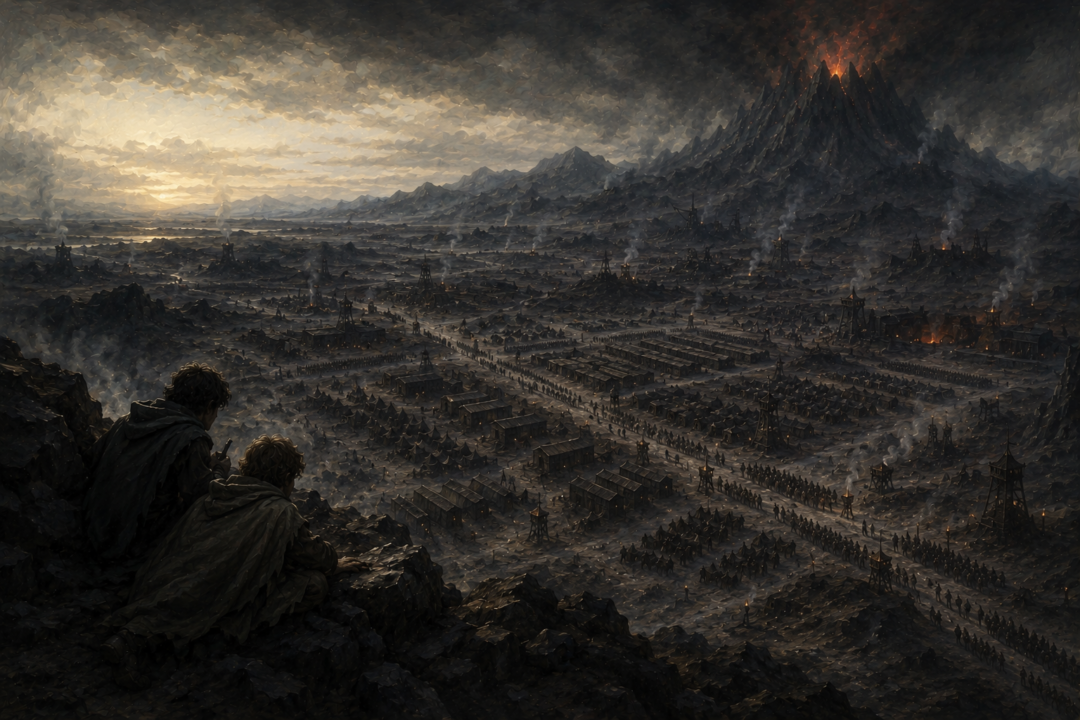
The roads did not carry only food and material.
They carried slaves.
This is one of the clearest reminders that Mordor’s logistical system depended on domination of people as well as territory. The fields of Nurn were slave-worked, and additional captives were brought into Mordor from outside.
The same infrastructure that supplied soldiers therefore also replenished the coerced labour behind Sauron’s power.
That connection is essential.
Food production, military expansion, tribute, plunder, and slavery were not separate features of Mordor. The text places them together as parts of the same system.
Conquest produced captives and resources.
Roads carried them into the Dark Lord’s realm.
Forced labour helped sustain the military power that enabled further conquest.
The machinery fed itself.
Why the Northern Wasteland Could Hold Such Huge Forces
This also resolves the apparent contradiction Sam notices.
How could so many troops gather in such an awful place?
Because the immediate landscape was not required to support them by itself.
Northern Mordor could function as a military and industrial centre precisely because other regions performed different roles. Food could come from the slave-worked south. Goods could come from tributary territories. Roads could funnel those resources toward camps, fortresses, mines, and mustering grounds.
This does not mean every logistical detail is explained. We are never given inventories, crop yields, transport schedules, or exact road maps.
But we do not need them.
The narrative deliberately supplies enough information to establish that Sauron’s armies possessed an economic and agricultural foundation.
The wasteland around Mount Doom was only the terrifying surface.
The system beneath it was larger.
Sauron’s Greatest Strength Created a Hidden Vulnerability
There is an irony here.
The larger Sauron’s armies became, the more they depended on the machinery that sustained them.
A small band can sometimes survive from what it carries or finds. A vast host concentrated in a barren military zone cannot do so indefinitely. Its size creates enormous demands for food, water, equipment, transport, and organization.
Sauron’s answer was centralization and control.
Fields were worked for his armies. Tributary territories supplied his realm. Captives were turned into labour. Roads directed resources toward the centres where he wanted power concentrated.
This made Mordor formidable.
But it also means that Sauron’s apparent self-sufficiency was an illusion. The Black Land depended upon productive countryside, conquered peoples, functioning transport routes, and forced labour.
Barad-dûr stood at the centre of a system whose reach extended far beyond its foundations.
The Fate of Nurn Reveals What Mordor Had Really Been
After Sauron’s defeat, the treatment of Nurn provides a final revealing detail.
King Elessar freed the slaves of Mordor and granted them the lands around Lake Núrnen.
That act matters because it reverses the purpose for which those lands had been used.
Under Sauron, the fields existed within a system designed to sustain his power. Their inhabitants worked under slavery while the produce of the land supported armies gathered for conquest.
After his fall, those same lands were given to the people who had been enslaved there.
The agricultural foundation of the Dark Lord’s military machine became their own country to possess.
It is a fitting end to one of the least visible parts of Sauron’s power.
The armies at the Black Gate were terrifying. The towers, furnaces, siege engines, and Orc-hosts were the things his enemies could see.
But armies do not survive on terror.
Somewhere behind every spear carried into Gondor stood fields being worked, wagons moving along roads, supplies arriving from distant lands, and people forced to sustain a war they did not choose.
That is why Mordor needed Nurn.
And that is why it needed the roads.
Sauron’s empire was not powerful merely because it could destroy.
It was powerful because it had organized whole lands to keep destruction moving.
Sources & Notes
- The Encyclopedia of Arda, “Nurn” — https://www.encyclopedia-of-arda.com/n/nurn.html
- The Encyclopedia of Arda, “Mordor” — https://www.encyclopedia-of-arda.com/m/mordor.html
- The Encyclopedia of Arda, “Cirith Gorgor” — https://www.encyclopedia-of-arda.com/c/cirithgorgor.html
Reference entries document the characters, places, events, and textual details discussed in this article.