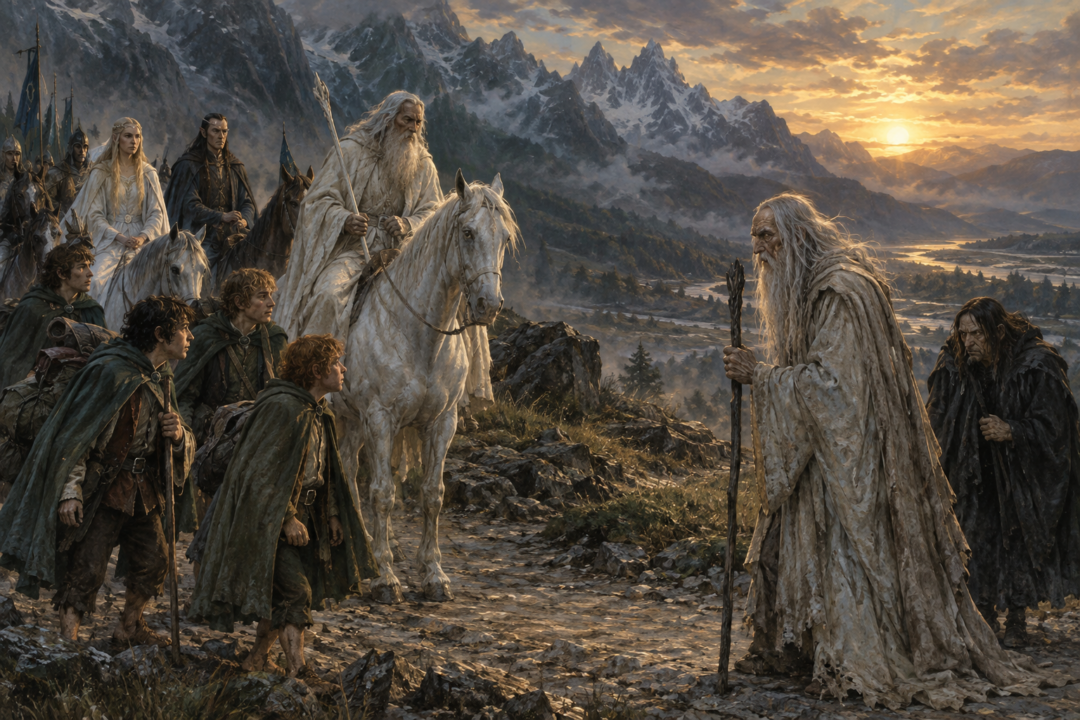
Saruman is no longer lord of Isengard when Gandalf meets him for the last time on the open road. Orthanc has been taken from his control. His armies are gone. His staff has been broken. Sauron has fallen. The once-formidable head of the White Council is reduced to a ragged wanderer with Gríma Wormtongue trailing miserably behind him.
Yet Saruman is travelling north.
For a reader who knows what happens next, the danger seems obvious. North lies Eriador. North-west lies the Shire. Saruman already knows more about hobbits than he once admitted, and the pipe-weed discovered at Isengard has revealed that his dealings with the Shire began long before his defeat.
So why does Gandalf let him continue?
The answer is more complicated than Gandalf simply underestimating an enemy. At this point in The Lord of the Rings, Gandalf's entire role in Middle-earth is changing. Saruman is dangerous, but not in the way he once was. More importantly, Gandalf does not actually know that Saruman intends to seize the Shire when they meet him.
And by the time Gandalf does understand where Saruman's malice has gone, he makes one of the most important decisions in the story: the hobbits must face it themselves.
Gandalf Does Not Know Saruman's Destination
The first distinction is crucial.
When Gandalf's company overtakes Saruman and Wormtongue in "Many Partings," Gandalf directly asks where Saruman is going. Saruman refuses to give him a useful answer. Eventually he claims only that he is seeking a way out of the realm of the restored King.
Gandalf actually tells him that he is going the wrong way.
Nothing in this conversation establishes that Gandalf knows Saruman is heading specifically for the Shire.
The reader receives hints, however.
Saruman bitterly speaks to the hobbits about returning home and finding matters in the Southfarthing less pleasant than they expect. He also asks for pipe-weed. These details are especially ominous because Merry and Pippin had previously discovered barrels of Longbottom Leaf at Isengard.
Sam notices the warning. He dislikes Saruman's reference to the Southfarthing.
But suspicion is not knowledge. Saruman never announces that he intends to take control of the Shire, and Gandalf never states at this stage that he has discovered such a plan.
Indeed, Saruman may not yet have possessed a detailed plan in exactly the form later encountered by the returning hobbits. The text establishes his earlier interest and connections there, but it does not give us a complete chronology of every decision behind the Scouring. Claims about precisely when Saruman decided upon each stage of his revenge therefore have to remain cautious.
What Gandalf does know is that Saruman remains capable of harm.
Gandalf Has Already Warned That Saruman Is Still Dangerous
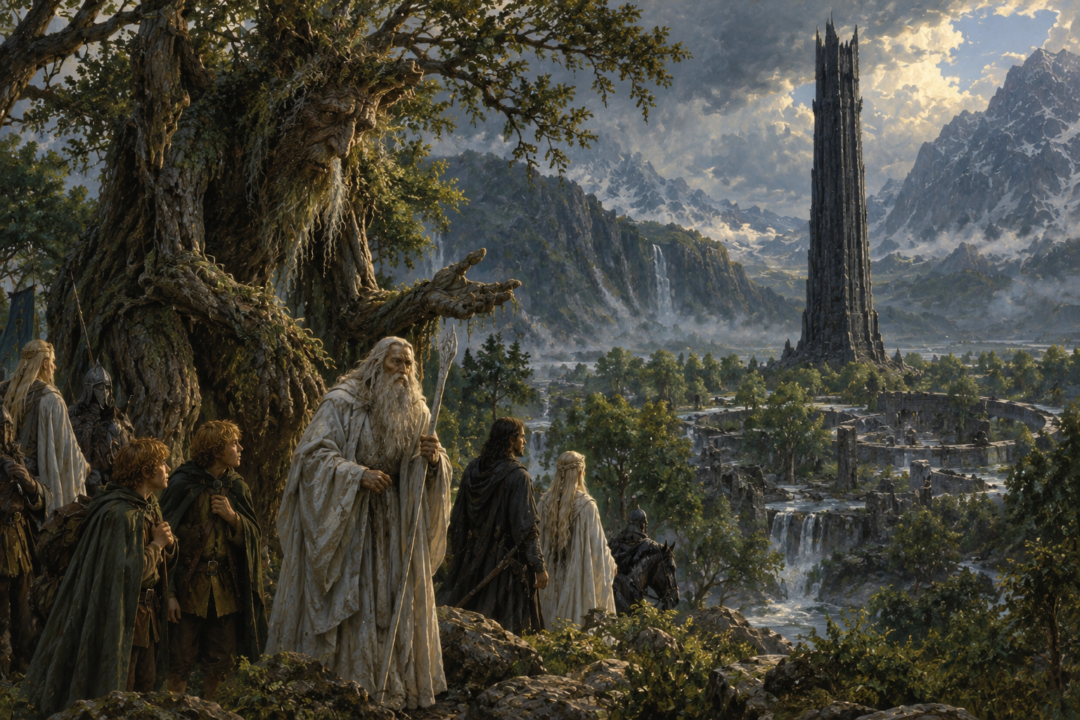
When the travellers reach Isengard, Treebeard reveals that he allowed Saruman and Wormtongue to leave Orthanc.
Gandalf is not pleased.
Treebeard had come to pity the diminished wizard. Saruman seemed withered, miserable, and largely powerless. But Gandalf immediately recognizes the problem: Saruman still possesses his extraordinarily persuasive voice.
Gandalf therefore judges that Saruman may still be able to cause what he calls "mischief" in a diminished, meaner form.
That prediction is extraordinarily accurate.
Saruman can no longer rival Sauron. He cannot rebuild the military power of Isengard. He cannot challenge Aragorn's new kingdom. Gandalf has broken his staff and cast him from the order. His great political ambitions have collapsed.
But losing the power to dominate kingdoms does not mean losing the power to hurt people.
Saruman's evil becomes smaller because Saruman himself has become smaller.
That distinction explains much of what follows.
The Great War Is Over, but Saruman's Malice Is Not
Earlier in the story, Saruman represents a strategic threat to the entire West.
His Uruk-hai march against Rohan. Isengard becomes an armed industrial power. He attempts to obtain the One Ring. His actions affect the balance of the War of the Ring itself.
That Saruman no longer exists by the time Gandalf meets him on the road.
What remains is a defeated figure driven increasingly by resentment.
This is why Gandalf does not treat the encounter like the pursuit of a fugitive warlord. Galadriel explicitly makes clear that the company has not been hunting Saruman. They have other concerns, and their meeting is accidental in the sense that they overtake him while travelling.
Even then, their response is not vengeance.
They offer him help.
Gandalf reminds Saruman that had he remained at Orthanc, Aragorn would have dealt with him with wisdom and mercy. Galadriel offers him another opportunity to turn away from the path he has chosen.
Saruman refuses.
This matters because Gandalf's purpose has never been simply to destroy enemies once they cease to be immediate threats. Saruman is repeatedly given opportunities to abandon his pride. He repeatedly chooses not to.
The road north becomes another such choice.
Why Gandalf Does Not Simply Arrest Him
There is also a larger political change hidden in Gandalf's conversation with Saruman.
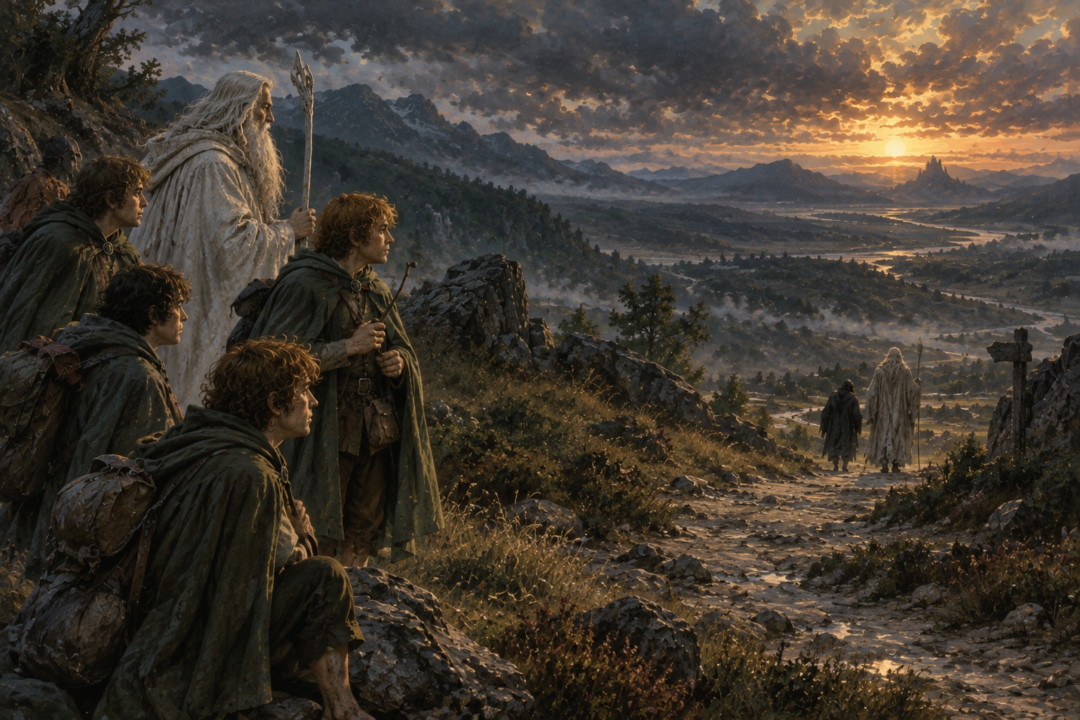
Gandalf tells him that the time of his own labours is drawing to an end and that the King has now taken up the burden.
This is one of the quietest but most important transfers of authority in the final chapters.
Gandalf's task was connected to the struggle against Sauron. He was sent to encourage resistance to the Shadow, not to become the permanent ruler or policeman of Middle-earth. With Sauron defeated and Aragorn enthroned, the peoples of the West must increasingly govern their own affairs.
Saruman ironically belongs to that transition too.
Gandalf does not intend to replace Sauron with endless supervision by the victorious Wizard.
The Third Age is ending.
Men, hobbits, and the restored kingdoms must increasingly carry responsibilities that figures such as Gandalf once helped them bear.
And nowhere is this principle demonstrated more clearly than in the Shire.
At Bree, Gandalf Finally Connects Saruman to the Trouble
The situation becomes much clearer when Gandalf and the hobbits reach Bree.
Barliman Butterbur tells them that the surrounding country has suffered disorder. There are suspicious Men abroad, travel has become dangerous, and news from the Shire is troubling. The shortage of pipe-weed provides another clue.
Now Gandalf explicitly connects the problem with Saruman.
He reminds the hobbits that Saruman had taken an interest in the Shire even before Mordor did.
At this point Merry naturally assumes that Gandalf will help them put everything right.
Gandalf refuses.
Not because he thinks nothing is wrong.
Precisely the opposite: he now understands enough to know that something is wrong and that Saruman lies behind it.
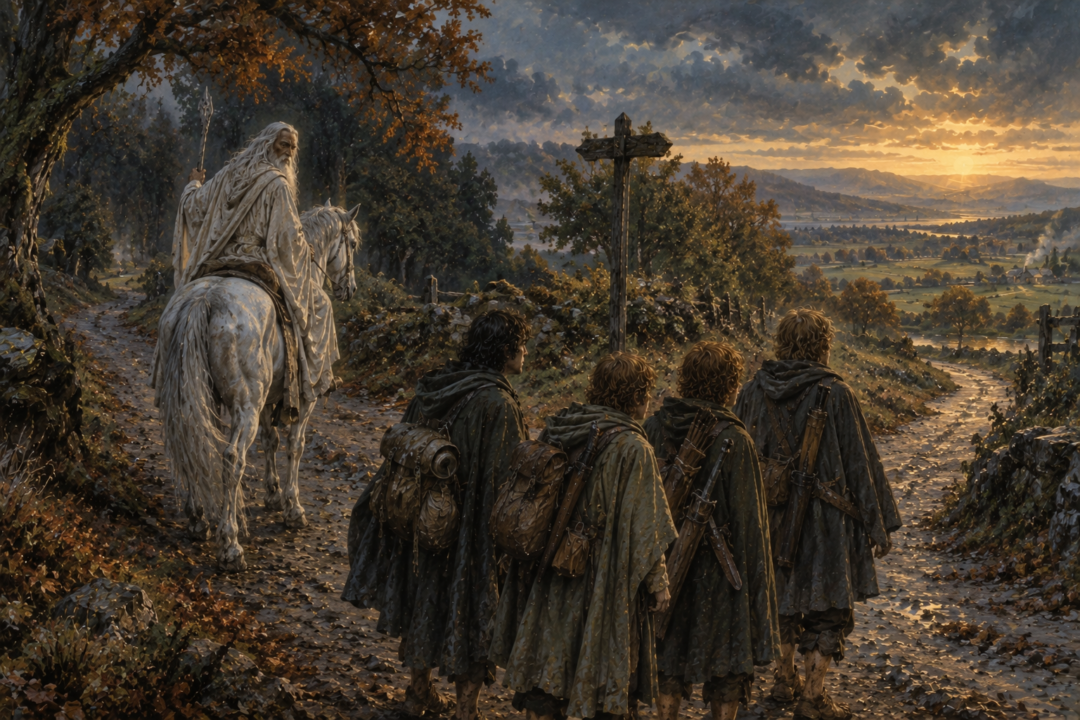
Yet he tells the four hobbits that they must settle the Shire's affairs themselves.
This is the real answer to the question.
The Hobbits Have Become What the Shire Needs
When Frodo, Sam, Merry, and Pippin first leave home, they are almost completely unprepared for political violence.
By the time they return, that is no longer true.
Merry has ridden with the Rohirrim and fought in the Battle of the Pelennor Fields. Pippin has served in the Guard of the Citadel and stood in the battle before the Black Gate. Sam has crossed Mordor and temporarily borne the Ring. Frodo has carried the Ring into the heart of Sauron's realm and endured wounds that will never entirely heal.
Their growth is not merely martial.
They have encountered kingship, tyranny, loyalty, despair, mercy, command, and sacrifice.
Gandalf recognizes this before they do.
His refusal to accompany them into the Shire is therefore not abandonment. He believes they no longer require him to solve their problems.
The events that follow prove him right.
Merry and Pippin organize resistance. Sam helps rally the hobbits. Frodo exercises a different kind of authority, repeatedly trying to prevent needless killing and revenge.
The four travellers bring home different lessons from the wider war.
Without Gandalf standing above them, those lessons finally become their own.
Saruman's Last Defeat Has to Be Different
There is another reason Gandalf's absence matters.
If Gandalf entered the Shire and personally defeated Saruman, the conclusion would merely repeat an earlier victory.
Gandalf has already overcome Saruman.
At Isengard, Saruman tries to manipulate Théoden's company through his voice. Gandalf resists him, breaks his staff, and casts him from the order.
Nothing essential would be proved by doing it again.
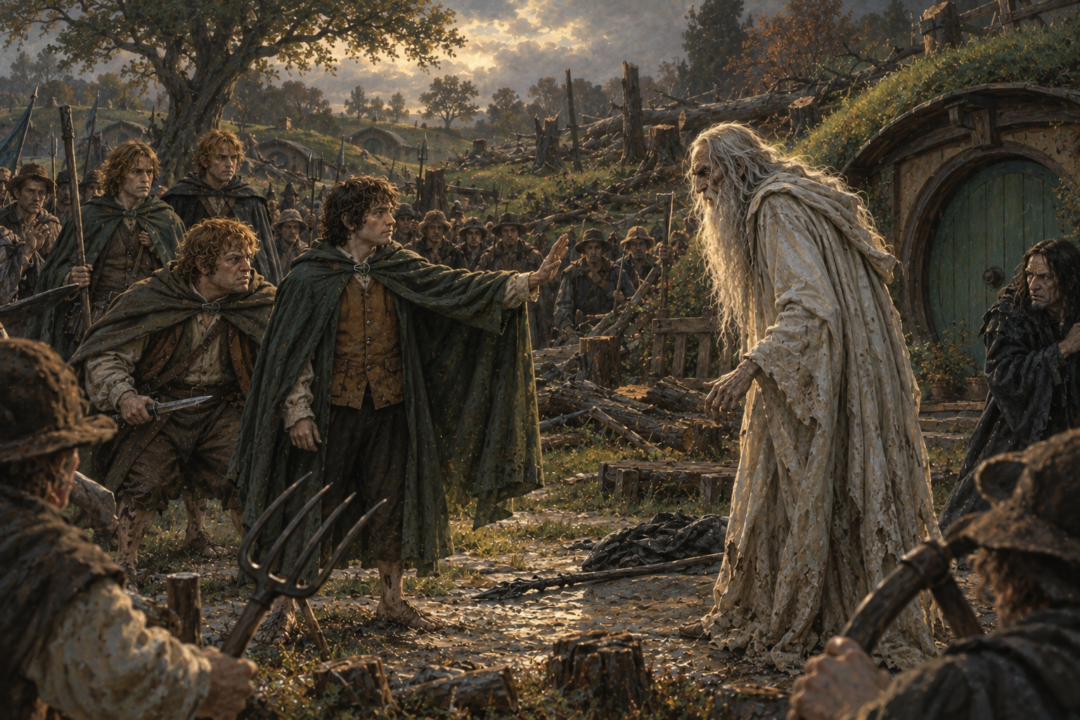
The Scouring instead reveals how far Saruman has fallen and how far the hobbits have risen.
Saruman once dreamed of possessing the One Ring and ruling Middle-earth. His final dominion is a frightened, damaged Shire controlled through petty regulations, intimidation, hired Men, destruction, and spite.
And the people who defeat him are the very Halflings he once regarded as insignificant.
There is a deliberate moral reversal in that outcome.
Power has made Saruman smaller.
Hardship has made the hobbits greater.
Frodo Achieves Something Gandalf Cannot Do for Him
The deepest victory does not occur at the Battle of Bywater.
It occurs at Bag End.
When Saruman is finally confronted, Frodo refuses to have him killed. Even after Saruman attempts violence against him, Frodo still prevents Sam from striking him down.
Saruman recognizes that Frodo has changed.
This is not the innocent hobbit who left Bag End. Frodo's mercy now comes from terrible experience. He has seen what domination, hatred, and possession do to the mind. His refusal to imitate Saruman is therefore one of the final consequences of the Ring quest.
Gandalf could have protected Frodo from this confrontation.
But he could not have made Frodo's choice for him.
That distinction is essential.
Throughout The Lord of the Rings, Gandalf guides, warns, counsels, and sometimes intervenes with immense power. But the decisive moral choices repeatedly belong to others.
Bilbo chooses pity.
Frodo accepts the burden.
Sam returns to Frodo.
Aragorn accepts his inheritance.
And finally the hobbits choose what kind of Shire will emerge from Saruman's ruin.
Gandalf's Journey Is Ending
Gandalf eventually leaves the hobbits before they enter the Shire because he intends to visit Tom Bombadil.
His explanation makes the larger meaning explicit: his days of constant movement and intervention are ending.
That does not mean every evil has vanished.
The defeat of Sauron never promised a world without cruelty, loss, or bad choices. What has changed is who must answer those problems.
The great supernatural struggle of the Third Age is passing away. Aragorn governs the reunited kingdom. The hobbits defend and restore their own land. Gandalf increasingly withdraws from the affairs he once helped direct.
Saruman's journey north therefore becomes the final test of that transition.
Gandalf sees a defeated enemy who can still cause petty harm. He offers him mercy rather than hunting him down. Later, when evidence points unmistakably toward trouble in the Shire, Gandalf still does not rush in to rescue it.
He trusts the hobbits.
That trust is vindicated.
Saruman reaches the Shire believing he has found one last place where he can exercise power over people weaker than himself. Instead, he encounters the people his old arrogance never taught him to understand.
The four hobbits who return are not the four who departed.
That is why Gandalf does not need to turn back.
The final victory over Saruman is no longer his to win.
Sources & Notes
- Tolkien Gateway, “Many Partings” — https://tolkiengateway.net/wiki/Many_Partings
- Tolkien Gateway, “Homeward Bound” — https://tolkiengateway.net/wiki/Homeward_Bound
- Tolkien Gateway, “The Scouring of the Shire” — https://tolkiengateway.net/wiki/The_Scouring_of_the_Shire
These secondary reference entries identify the relevant Tolkien texts and document the characters, events, and objects discussed. Explanations of motives and practical consequences remain interpretation unless explicitly stated in the cited texts.