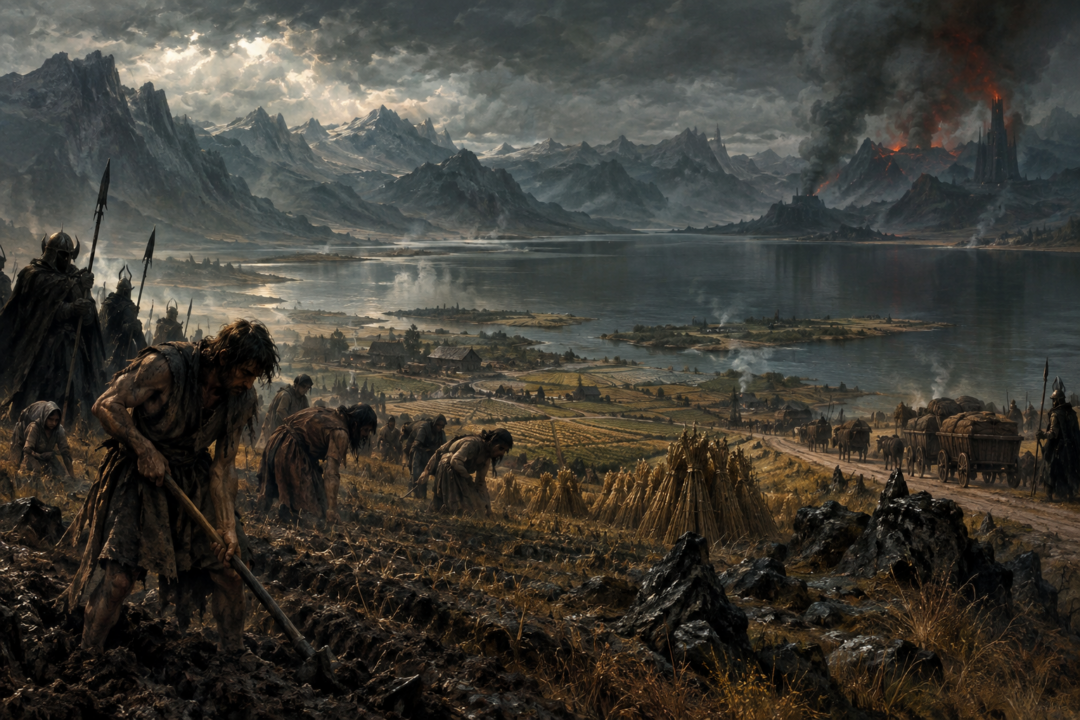
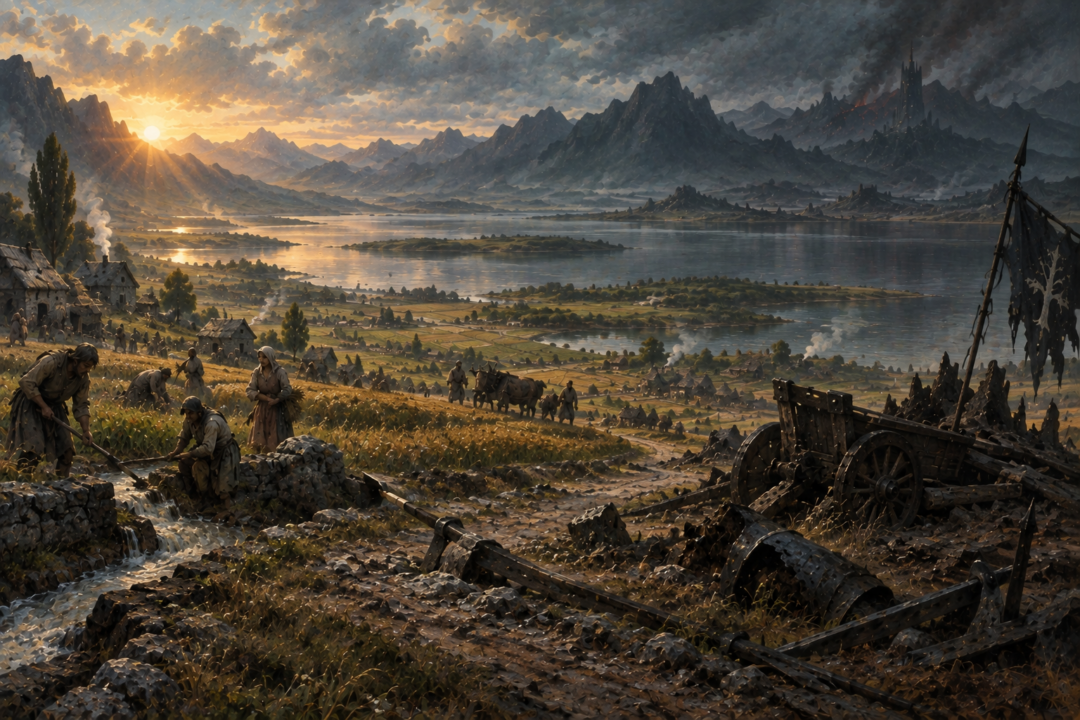
When most readers picture Mordor, they picture ash, fire, barren rock, and the terrible plain beneath Mount Doom. Yet far to the south of Sauron’s fortress lay another Mordor: a country of cultivated fields surrounding the dark waters of the inland Sea of Núrnen.
Those fields reveal something uncomfortable about the Dark Lord’s empire. Mordor could not live on terror alone.
Its armies had to eat.
And behind the Orc-hosts, fortresses, furnaces, and marching columns was a population almost invisible in the main story: slaves forced to work the agricultural lands of southern Mordor.
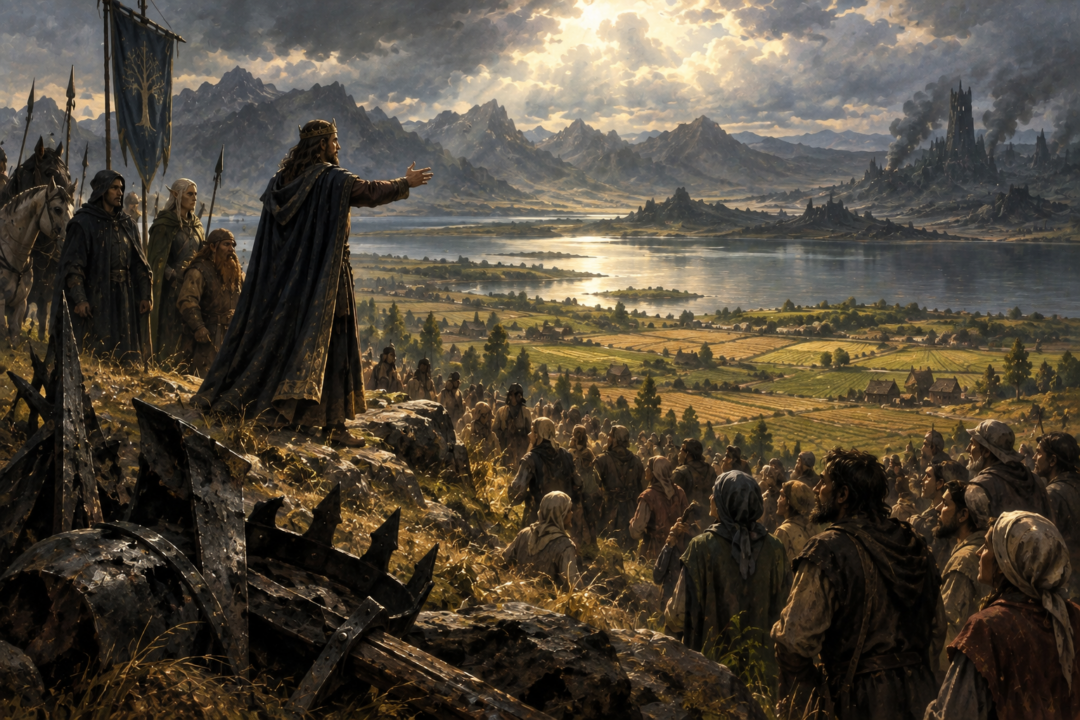
After Sauron falls, Aragorn does something remarkable. He does not simply free these people and absorb their territory into his restored kingdom. He gives them the lands around Núrnen “to be their own.”
It is only a brief sentence in The Return of the King, but it says a great deal about the difference between defeating Sauron and actually undoing Sauron’s world.
The Mordor Frodo and Sam Never See
Frodo and Sam cross the northwestern part of Mordor, through some of its most devastated country. Their experience is therefore naturally dominated by Gorgoroth: slag-heaps, fumes, dust, pits, fortifications, roads, and the shadow of Orodruin.
But the narrator deliberately reminds us that their experience is incomplete.
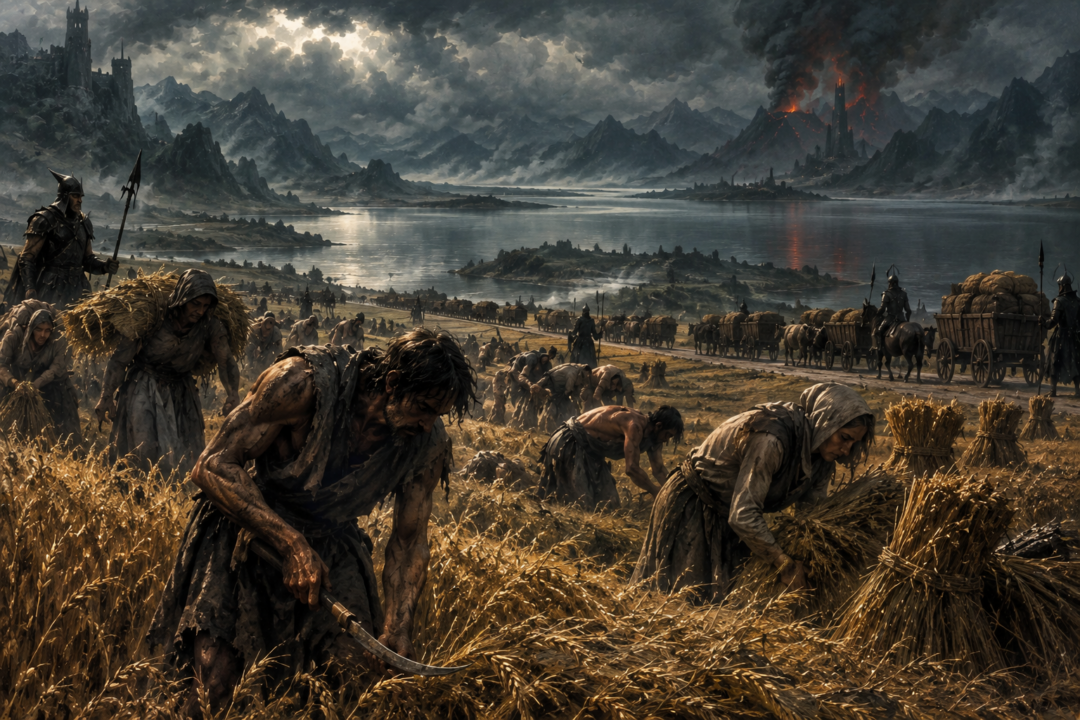
In “The Land of Shadow,” while Sam worries about food, we are told that neither hobbit knows about the “great slave-worked fields” farther south beside the dark waters of Lake Núrnen.
This is one of the most important glimpses we receive of Mordor as a functioning realm rather than simply an evil wasteland.
Sauron maintained enormous armies. Those armies required supplies on an enormous scale. Southern Mordor provided at least part of that supply through cultivated land worked by slaves. Roads also stretched eastward and southward into tributary lands, carrying goods, booty, and additional captives into Sauron’s domain.
The contrast is deliberate and grim.
Gorgoroth is where Sauron concentrates war.
Núrnen helps make that war possible.
The soldiers at the Black Gate exist partly because unseen people elsewhere are being forced to feed them.
Núrnen Was Mordor’s Agricultural Heartland
The Sea of Núrnen lies in southern Mordor, far from the Plateau of Gorgoroth. Maps of Middle-earth show rivers descending toward the inland sea, making this region geographically unlike the volcanic wasteland nearer Mount Doom.
The text does not give us a detailed agricultural survey of Nurn, and we should not invent one. What it does establish clearly is enough: there were extensive fields there, and slaves worked them.
That matters because it changes the usual image of Sauron’s power.
His dominion was not sustained only through supernatural terror or armies of Orcs. It also possessed an economic machinery of conquest. Tributary regions supplied goods. Soldiers carried booty. Captives were transported into Mordor. Agricultural labor supported military power.
Núrnen therefore exposes the hidden cost behind Barad-dûr.
Every fortress requires food. Every army consumes resources. Sauron’s answer was not merely organization but domination: conquered or subjected peoples could be converted into resources for further conquest.
The slaves beside Núrnen were trapped inside that system.
And this helps explain why Aragorn’s treatment of the region after the war is so significant.
Aragorn Does More Than Set the Slaves Free
After Aragorn is crowned King Elessar, The Return of the King briefly records several of his judgments concerning the defeated peoples.
The sequence is revealing.
Easterlings who surrendered are pardoned and sent away free. Peace is made with the peoples of Harad. Then the slaves of Mordor are released, and Aragorn gives them the lands around Lake Núrnen “to be their own.”
The text does not provide a speech explaining his reasoning. We should therefore be cautious about assigning Aragorn motives that are never explicitly stated.
But his action itself is unmistakable.
Freedom is accompanied by land.
He does not merely open the gates of Mordor and tell the former slaves that they may leave. The very territory in which their labor had been exploited becomes theirs.
That distinction is enormous.
Under Sauron, they worked Núrnen for another master.
After Sauron, they possess the land themselves.
The machinery of exploitation is not simply placed under new management. Its basic relationship is reversed.
Why Not Simply Give Núrnen to Gondor?
From the perspective of conquest, Aragorn might appear to have had other options.
Gondor had ancient reasons to fear Mordor. After Sauron’s first overthrow at the end of the Second Age, Gondor maintained fortresses to watch the land and prevent evil from returning. By the end of the Third Age, Mordor had become the center of the power that nearly destroyed Gondor.
A victorious king could easily have treated useful territory inside the defeated enemy’s realm as a strategic possession.
But that is not what the narrative records.
The lands around Núrnen are given to the freed slaves themselves.
It would go beyond the text to describe this in modern political terms or to claim that we know precisely what constitutional relationship, if any, the new community had with Aragorn’s Reunited Kingdom. The story simply does not tell us.
What it does tell us is stronger than speculation: the land was to be “their own.”
That phrase sharply distinguishes Aragorn’s kingship from Sauron’s domination.
Sauron gathers land, labor, goods, and people toward himself.
Aragorn can relinquish possession.
The People Aragorn Frees Are Mysterious
One question cannot be answered confidently: who exactly were the slaves of Núrnen?
The text says that roads led east and south toward tributary lands and that Sauron’s soldiers brought back goods, booty, and “fresh slaves.” This strongly establishes that captives were being imported into Mordor from beyond its borders.
But we are not given a complete account of their origins, ethnic identities, numbers, or how long particular communities had lived around Núrnen.
We should therefore resist attempts to turn them into a precisely defined people that the text never describes.
There is evidence elsewhere that slavery within Sauron’s wider war-machine included Men. When Aragorn, Legolas, and Gimli arrive at Pelargir, slaves chained to the oars of the Corsairs are liberated, and Gimli later explains that among those released were people of Gondor captured in raids.
That does not prove that the population around Núrnen had the same origins. It simply confirms that human captivity and forced labor were real components of the enemy’s power.
The inhabitants of Núrnen remain largely anonymous.
Perhaps that anonymity is part of why Aragorn’s judgment feels so striking. These are not famous heroes being rewarded for great deeds. They are people whose suffering mostly happened outside the view of the Fellowship.
They still receive justice.
The Decision Fits a Larger Pattern After Sauron’s Fall
Aragorn’s settlement at Núrnen does not stand alone.
His early reign is marked by an attempt to end wars rather than merely transfer victory from one side to another.
The surrendered Easterlings are pardoned. Peace is made with Harad. Later traditions concerning Aragorn’s reign make clear that the new king still has enemies to fight, so the ending is not presented as an instant disappearance of all conflict.
But the immediate aftermath of Sauron’s defeat is not indiscriminate vengeance.
That matters because the peoples who fought for Sauron were not all presented as identical to Sauron himself.
One of the most memorable examples comes when Sam sees a dead warrior from the South and wonders about the man’s name, where he came from, and whether he truly wanted to leave his home to fight.
Sam cannot answer those questions.
Neither can the reader.
The moment introduces moral uncertainty into what could otherwise become a simple division between victorious West and defeated East.
Aragorn’s postwar judgments reflect a similar refusal to make destruction the automatic answer to defeat.
Núrnen Turns Sauron’s System Inside Out
There is a powerful irony in what happens to southern Mordor.
Sauron organized Núrnen to sustain his military power. Its fields existed within an imperial system in which the labor of captives helped feed the armies that enforced their captivity.
Then the Ring is destroyed.
Barad-dûr falls.
Sauron’s centralized domination collapses.
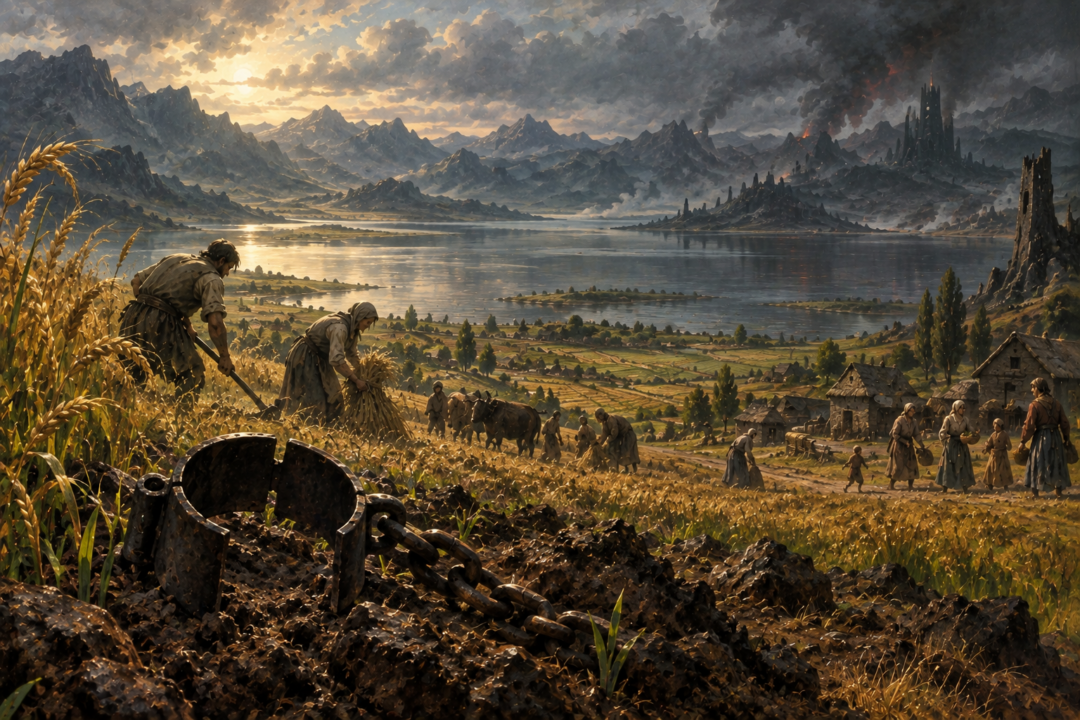
And the people at the bottom of that system inherit the land they had been compelled to work.
The fields remain, but their purpose changes.
This is not something the narrative describes in detail. We are never shown the first free harvest beside Núrnen, the organization of settlements, or the former slaves deciding whether to remain or return to distant homelands. Tolkien leaves those questions unanswered.
But the reversal stated in the text is already profound.
Sauron treats people as instruments.
Aragorn gives them the possibility of becoming possessors of their own lives and land.
Aragorn’s Victory Is Defined by What He Refuses to Become
The destruction of the Ring removes Sauron, but the moral challenge of victory remains.
The victors now possess overwhelming power over defeated enemies, surrendered soldiers, disputed territories, and former slaves. They must decide what victory means.
That is where Núrnen becomes more important than its brief appearance suggests.
Aragorn could have replaced the Dark Lord’s authority with the authority of Gondor. Instead, at least in this region, the text emphasizes liberation and possession by the formerly enslaved.
This does not mean Aragorn abandons kingship, warfare, law, or punishment. His reign is not presented as politically effortless. Nor does the text give us enough information to reconstruct exactly how Fourth Age Mordor was governed.
But at Núrnen the symbolic contrast is exceptionally clear.
Sauron’s power moves inward. Everything is drawn toward the center: armies, tribute, slaves, treasure, obedience, fear.
Aragorn’s first judgments move differently. Prisoners are released. Former enemies are pardoned. Peace is offered. Land is given away.
The returning king proves his authority partly through his willingness not to possess everything he could claim.
The Quietest Victory in Mordor
The greatest visible victory in Mordor is the fall of Barad-dûr.
The quieter victory happens farther south.
For years, perhaps generations in some cases, people labored beside the dark waters of Núrnen so that Sauron’s armies could march. They were part of the hidden structure beneath the Dark Lord’s seemingly limitless military strength.
Then that structure was broken.
Aragorn did not merely remove their chains. He gave them the lands around the inland sea to be their own.
We are not told what became of their descendants. We do not know what settlements arose there, what languages were spoken, or whether every freed captive chose to remain.
Those silences should remain silences.
What we do know is enough.
In the final pages of the War of the Ring, Mordor produces one last reversal. A land organized around domination becomes, in at least one corner, the possession of those who had suffered under it.
The fields that once fed Sauron’s armies belonged at last to the people who worked them.
Sources & Notes
- Tolkien Gateway, “Nurn” — https://tolkiengateway.net/wiki/Nurn
- Tolkien Gateway, “Sea of Núrnen” — https://tolkiengateway.net/wiki/Sea_of_N%C3%BArnen
- Tolkien Gateway, “The Steward and the King” — https://tolkiengateway.net/wiki/The_Steward_and_the_King
These secondary reference entries identify the relevant Tolkien texts and document the characters, events, and objects discussed. Explanations of motives and practical consequences remain interpretation unless explicitly stated in the cited texts.