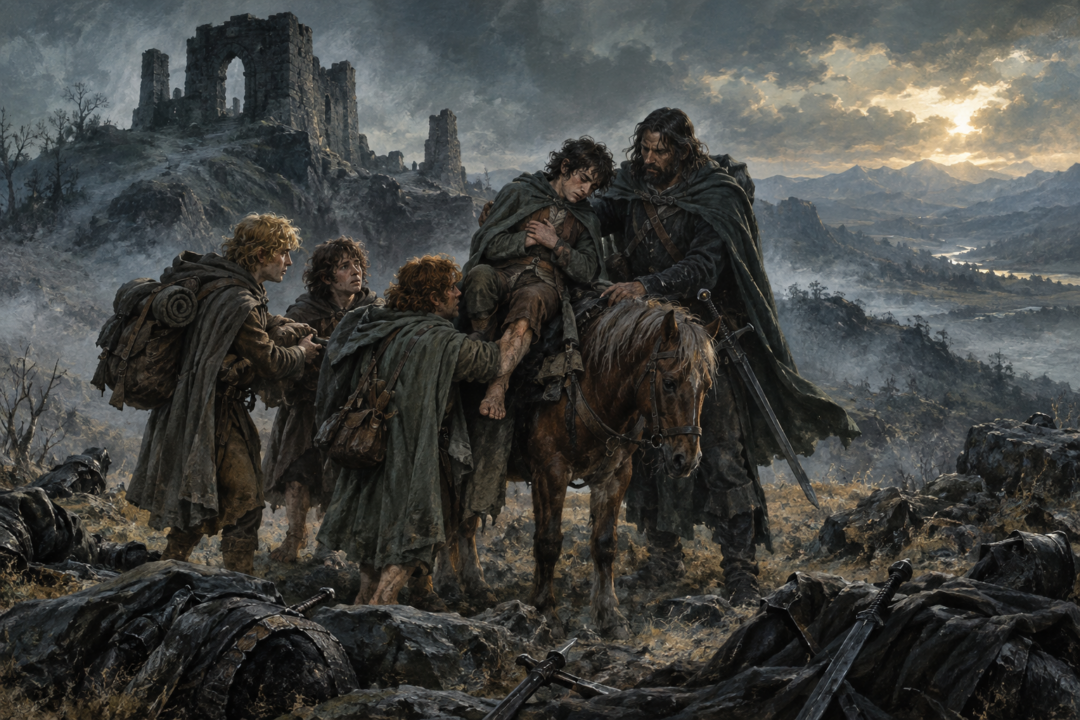
Before the Black Riders attack at Weathertop, Aragorn gives the hobbits a grim estimate. On his own feet, in fair weather and without misfortune, he could reach the Ford of Bruinen in about twelve days. With four hobbits, avoiding the Road because of the Nazgûl, he expects the journey to take at least a fortnight.
Then the misfortune arrives.
On the night of October 6, Frodo is stabbed in the left shoulder by the Witch-king’s Morgul-knife. By morning he cannot walk. His arm is useless, an unnatural cold is spreading through him, and Aragorn knows that his wilderness medicine can offer only limited relief.
From that moment, the journey to Rivendell becomes something stranger than a simple race. Frodo’s wound simultaneously forces the company to travel more carefully and gives them less time in which to arrive.
The result can be seen in almost every part of their daily routine: when they start, where they walk, what terrain they avoid, how often they rest, what they carry, where they camp, and eventually how brutally they push themselves.
The Morning After Weathertop Changes Everything
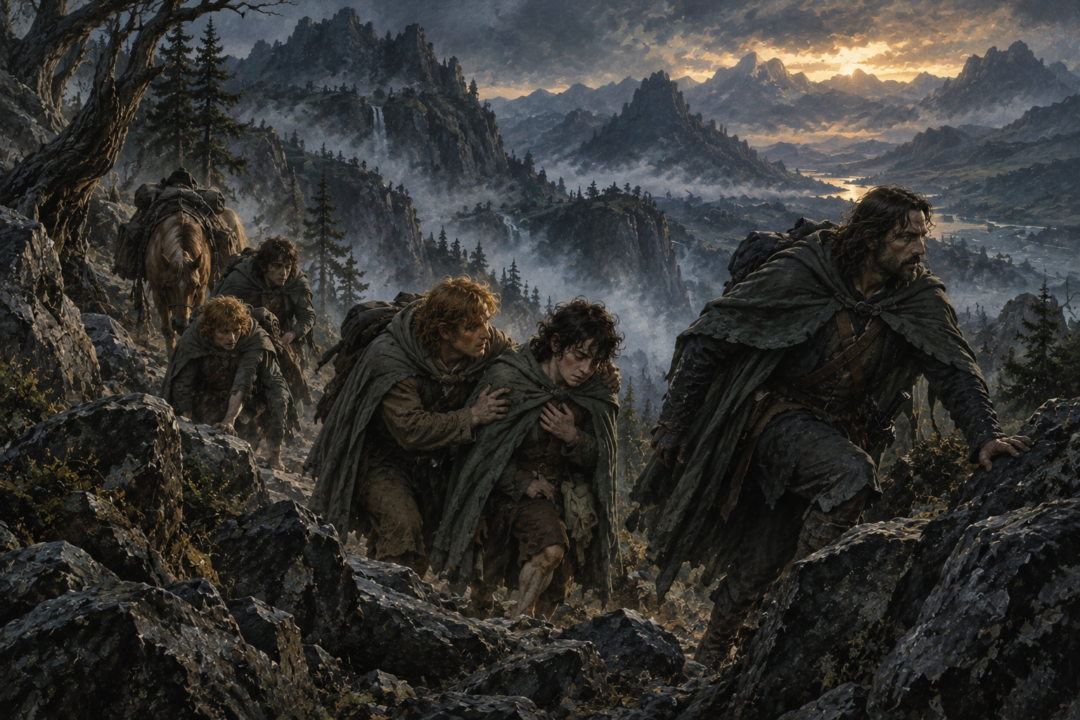
Aragorn treats Frodo with athelas after the attack. It eases some of the pain and cold, but it does not restore the use of his arm. Frodo becomes too weak even to stand.
That immediately changes the mechanics of the march.
The others divide most of the baggage among themselves and put Frodo on Bill the pony. Bill had originally been purchased at Bree largely because the hobbits needed a pack animal. Now the pony becomes essential transport for the wounded Ring-bearer.
That means the healthy travellers must absorb more of the load.
It also means the party can no longer move through country based solely on what is safest from pursuit. Frodo’s condition becomes part of Aragorn’s route planning.
They leave as soon as full daylight permits, but their movement is described as slow and cautious. They head south, cross the Road, and seek more wooded country.
There is a practical reason for wanting trees beyond concealment: fuel.
Aragorn says Frodo must be kept warm, especially at night. Fire, despite the danger that a visible camp can present, now has medicinal value as well as offering some protection against the Riders.
A wound has altered even the logic of their campsites.
Aragorn Has Two Conflicting Problems
The group now faces a contradiction.
Frodo is the person least capable of enduring a forced march, yet Frodo is also the reason a forced march is becoming necessary.
Aragorn does not fully understand every detail of the Morgul wound, but he knows that an evil beyond his healing skill is at work. Later, the danger becomes clearer: the broken fragment of the knife is working inward, and Frodo is being drawn toward the wraith-world.
So resting until Frodo recovers is not an option.
He is not recovering.
Every day spent on the road allows the wound to worsen.
Yet simply increasing their speed is impossible. Frodo has to ride. Difficult terrain can force him off the pony. Cold and rain aggravate his suffering. The other hobbits are carrying additional baggage. And because the Nazgûl may be watching the Road, the shortest and easiest route cannot always be used safely.
The schedule therefore becomes a compromise between two kinds of danger: move too slowly and Frodo may be lost to the wound; move too aggressively and the exhausted party may be unable to continue at all.
They Alter the Route for Frodo
One of the most revealing details comes when the travellers enter the rough country west of Rivendell.
The hills close around them, and their progress becomes difficult. They must pick their way through fallen trees, rocks, narrow valleys, and pathless ground.
The text specifically indicates that they avoid climbing as long as they can partly for Frodo’s sake.
That is a small sentence with large consequences.
A healthy company led by Aragorn might choose a route according to distance, concealment, water, or tactical advantage. This company must also ask whether a wounded hobbit and a pony can physically cross it.
Eventually the landscape gives them no choice.
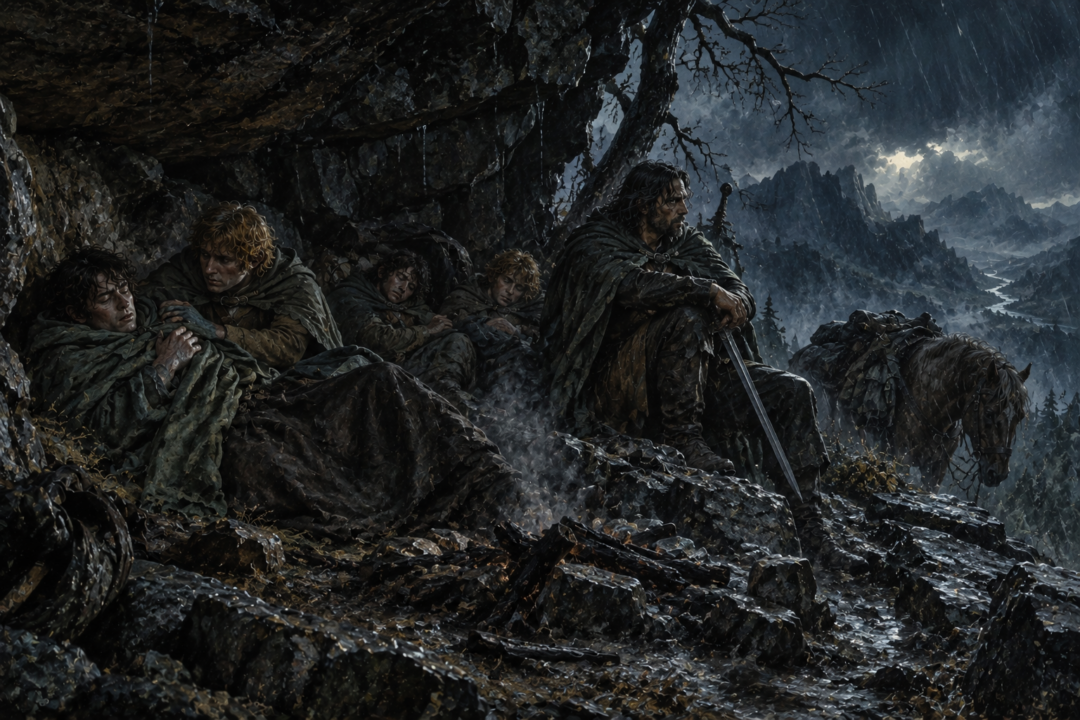
Faced with a high ridge, they attempt the climb. Frodo has to dismount and struggle upward on foot. The others are already burdened, and even getting Bill through the terrain becomes difficult.
By the time they reach the top, the light is nearly gone and everyone is exhausted. Frodo collapses shivering, his arm lifeless and his surroundings becoming shadowy.
Merry says they cannot continue.
Aragorn agrees.
This is important because Aragorn desperately wants to press onward specifically because of Frodo’s wound. Even so, there is a physical limit beyond which urgency cannot extend the marching day.
Bad Weather Becomes More Expensive
Rain would have been miserable under any circumstances. With Frodo wounded, it becomes dangerous.
After days among the hills, the weather turns wet. The company is soaked, and one night they cannot get a fire burning.
For Frodo, this matters more than simple discomfort.
The cold and wet increase the pain of his wound, and the deadly chill associated with it prevents him from sleeping properly. Rest therefore becomes less restorative even when the party stops moving.
This creates another hidden cost in the schedule.
A night's halt does not necessarily mean a night's recovery.
Meanwhile, route-finding causes further difficulty. The company drifts too far north, and Aragorn has to scout the country before deciding how to correct their course. He worries that continuing north toward the Ettendales would take too long, particularly because their food will not last.
Nearly ten days after Weathertop, provisions are already becoming a serious concern.
The wound has turned time itself into a resource.
The Party Does Not Simply March Faster
It would be misleading to describe the entire post-Weathertop journey as a continuous forced march.
For much of it, the opposite is true.
They move slowly through difficult country. They make route changes. Frodo rides because he cannot walk normally. They avoid climbs when possible. Weather interferes with their camps. Aragorn sometimes has to scout. Exhaustion repeatedly determines when they stop.
What changes is not simply their speed.
It is the priority governing the schedule.
Before Weathertop, the chief problem is avoiding the Nazgûl while reaching Rivendell. After Weathertop, every decision must balance pursuit against Frodo’s steadily worsening condition.
Then Glorfindel arrives, and that balance changes again.
Glorfindel Turns the Journey Into a Forced March
Glorfindel finds the travellers on October 18.
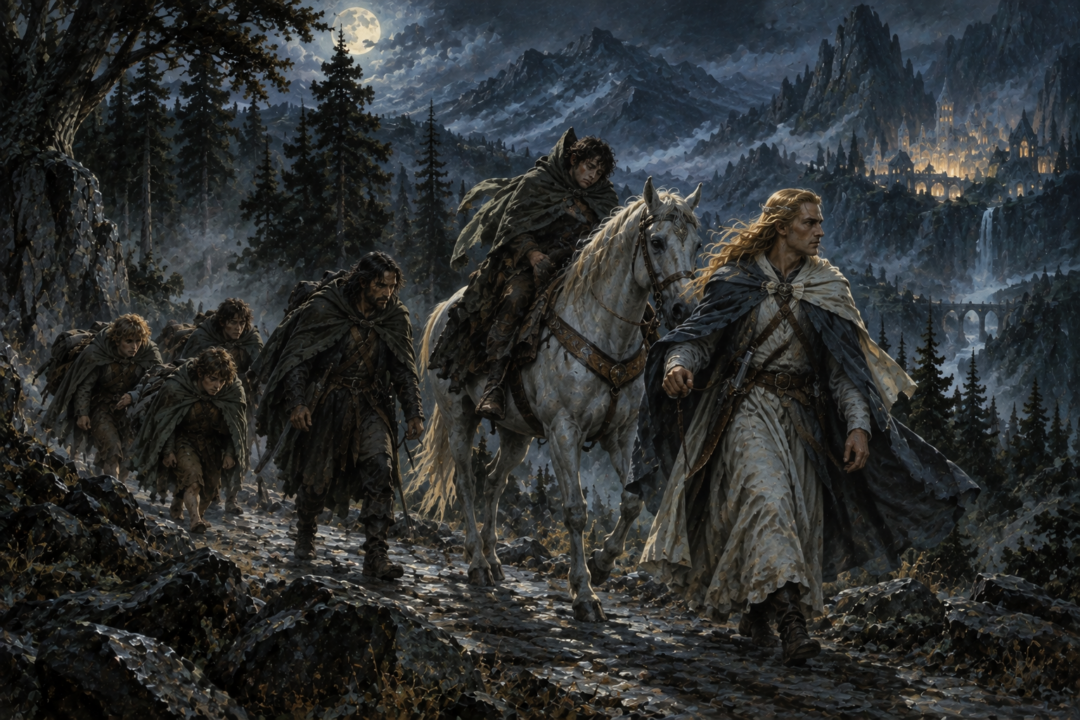
By then Frodo is dangerously weak. Glorfindel examines the wound and understands the urgency. He places Frodo on his own horse, Asfaloth, giving the Ring-bearer a mount capable of carrying him rapidly forward if the Riders appear.
The rest of the company does not receive the same advantage.
They still have to walk.
Now, however, Glorfindel drives them onward with extraordinary urgency.
They continue through the night until the hobbits are utterly exhausted. When they finally stop, they fall asleep almost immediately. Glorfindel keeps watch and wakes them after rather less than five hours of rest.
He gives them a strengthening drink, they eat their dwindling food, and they resume the Road.
During the next day's march, Glorfindel permits only two brief halts.
They cover almost twenty miles before nightfall.
This is the clearest answer to what Frodo’s wound ultimately does to the marching schedule. Once a powerful guide from Rivendell reaches them and the easier Road can be used, the need to save Frodo overrides normal comfort and rest.
The healthy members of the company are effectively spending their remaining strength to buy Frodo time.
Eventually even that fails. At nightfall the hobbits are stumbling with exhaustion and cannot continue. The following morning they are still weary when they set out again.
The wound has created a schedule that their bodies can barely sustain.
Fourteen Days Between Knife and Ford
Frodo is wounded on October 6 and reaches the Ford of Bruinen on October 20.
That is fourteen days.
There is an interesting irony here. Before the attack, Aragorn had estimated that the company had at least a fortnight to travel because they would probably be unable to use the Road. The actual interval from the stabbing to the Ford is also a fortnight.
That does not mean the wound made no difference to their travel time. Aragorn's earlier figure was an estimate, not a fixed itinerary, and the circumstances changed repeatedly.
Instead, the similarity highlights how precarious the journey becomes.
Frodo cannot simply be carried rapidly east in a straight line. The travellers must hide, negotiate difficult country, accommodate a pony, find suitable camps, endure rain, correct their course, conserve dwindling provisions, and avoid the Riders.
Only during the final stage, with Glorfindel guiding them and the Ford drawing near, does the schedule become an unmistakable forced march.
And even then the pursuit catches them.
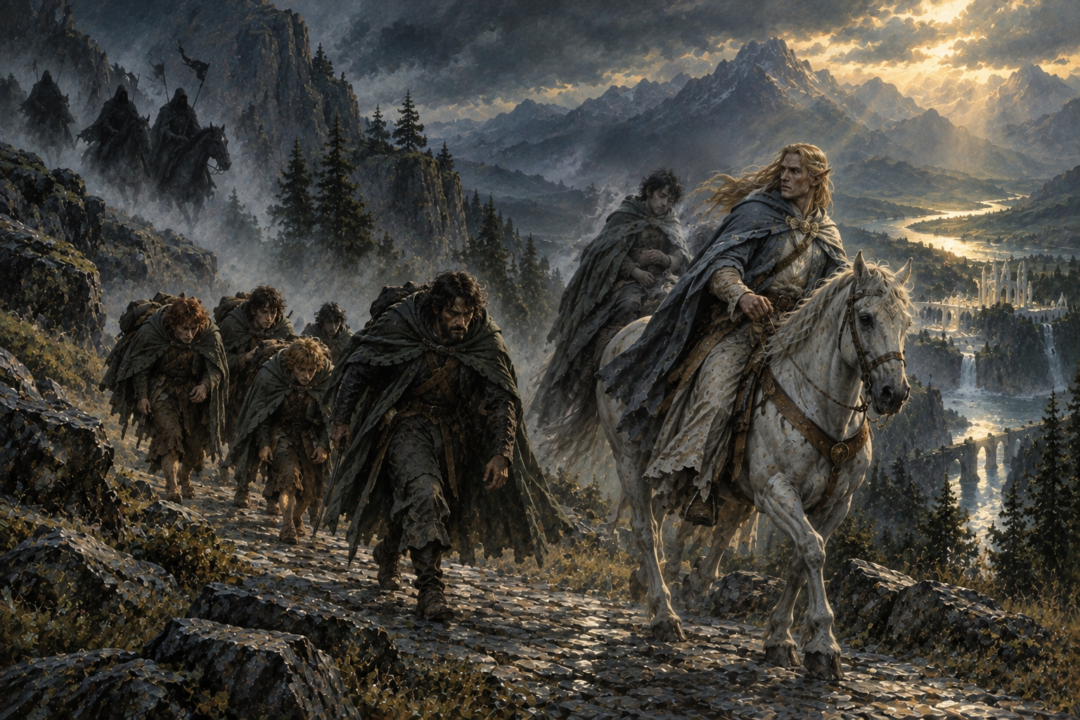
The Wound Turns Travel Into a Countdown
The Morgul wound does more than injure Frodo. It changes the meaning of every mile.
Before Weathertop, distance is primarily a geographical problem. Rivendell is far away, the Road is dangerous, and the hobbits are inexperienced travellers.
After Weathertop, distance becomes a countdown.
Warmth matters because Frodo is cold. Terrain matters because he may not be able to ride across it. Rest matters because his companions are being pushed toward exhaustion. Food matters because delays are consuming their supplies. Speed matters because the wound is worsening.
Yet excessive speed can itself destroy the party's ability to continue.
That is why the flight to the Ford feels so desperate even before the Nazgûl finally appear. The Riders are not the only pursuers anymore.
Something is already travelling with the company, hidden inside Frodo's shoulder.
Every evening they stop because they must.
Every morning they leave because they cannot afford not to.
And by the final days, the entire rhythm of the journey has become a struggle to reach Rivendell before Frodo reaches a point from which Aragorn fears he cannot return.
Sources & Notes
- Tolkien Gateway, “Flight to the Ford” — https://tolkiengateway.net/wiki/Flight_to_the_Ford
- Tolkien Gateway, “Morgul-knife” — https://tolkiengateway.net/wiki/Morgul-knife
- Tolkien Gateway, “Glorfindel” — https://tolkiengateway.net/wiki/Glorfindel
These secondary reference entries identify the relevant Tolkien texts and document the characters, events, and objects discussed. Explanations of motives and practical consequences remain interpretation unless explicitly stated in the cited texts.