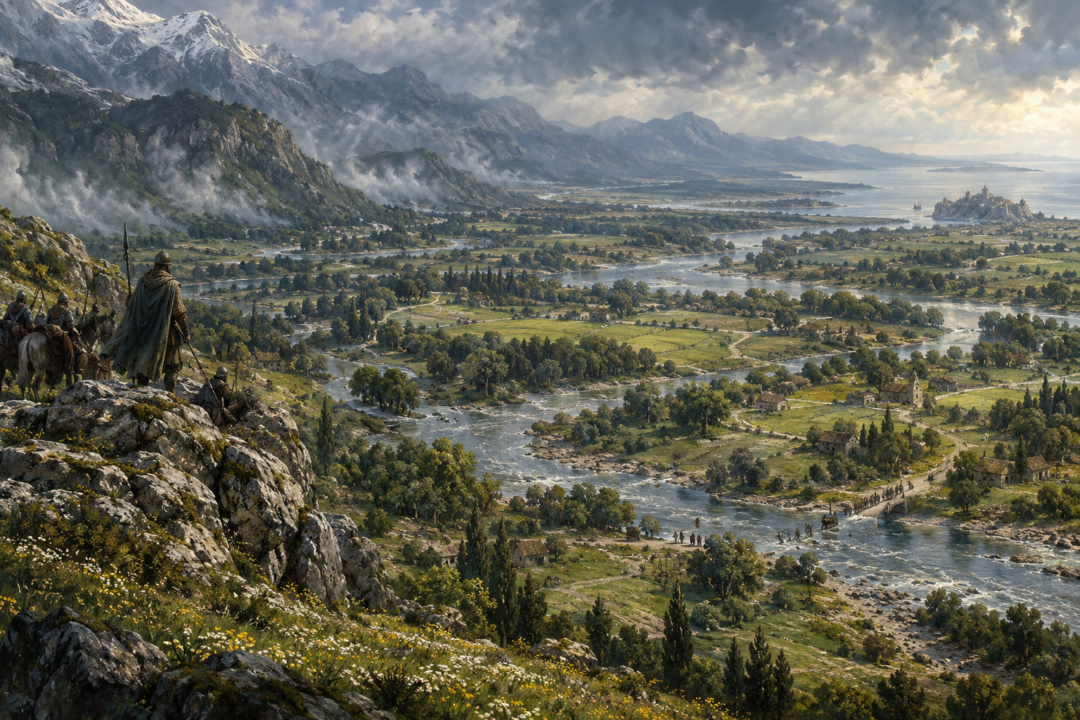
When Aragorn’s desperate road through southern Gondor reached Linhir, the war was already waiting at the river.
Men of Lamedon were fighting at the fords of the Gilrain against enemies from Umbar and Harad who had come inland by water. Beyond them lay Lebennin, Pelargir, the Corsair fleet, and ultimately the road to Minas Tirith. The scene is brief, but it reveals something important about southern Gondor: its rivers were neither simple defenses nor simple highways.
They could obstruct an army moving across the country. They could also carry an enemy deep into Gondor.
And when Minas Tirith desperately needed reinforcements, those same waterways helped turn Lebennin into a battlefield that Gondor could not safely strip of defenders.
Lebennin Was a Land Defined by Water
Lebennin literally belongs to its rivers. It is remembered as the land of the Five Streams, lying south of the White Mountains and toward the lower Anduin.
The five rivers associated with it are the Erui, Sirith, Celos, Serni, and Gilrain. Their precise relationships matter. The Celos joins the Sirith, while the Sirith reaches the Anduin at Pelargir. Farther west, the Gilrain meets the Serni near Linhir before the waters run toward the Bay of Belfalas.
In The Return of the King, Legolas sings of “fair Lebennin” and its swift streams, green fields, and flowers. It is an image of fertility rather than war.
Yet the military implication of such geography is easy to miss.
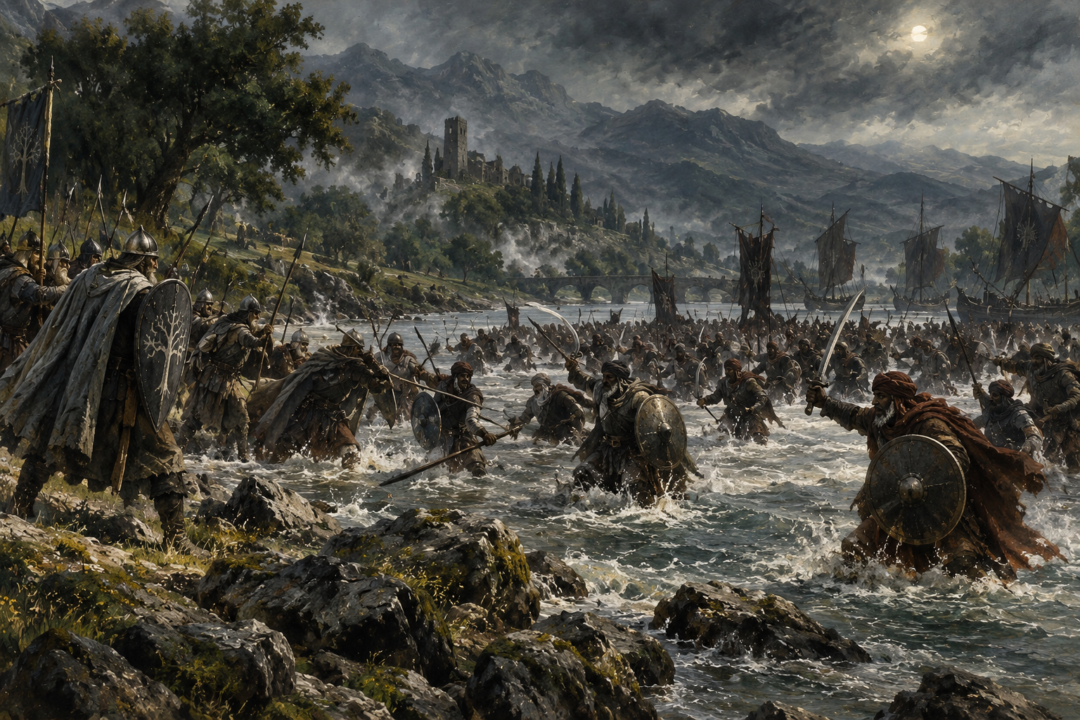
An army moving east or west through southern Gondor had to reckon repeatedly with flowing water. Rivers concentrate movement around usable crossings. Fords therefore become places where relatively small forces can contest an advance, as the fighting at Linhir demonstrates directly.
But Lebennin’s rivers did something more dangerous: several belonged to a wider system opening toward the sea.
That gave Gondor’s enemies another direction from which to come.
Linhir Shows the Problem in Miniature
Aragorn’s march after the Paths of the Dead provides the clearest example.
After summoning the Dead at Erech, he and the Grey Company rode through southern Gondor toward Pelargir. Gimli later recounts that they crossed the Ciril and Ringló before reaching Linhir, above the mouth of the Gilrain.
There they found a battle already underway.
Men of Lamedon were contesting the fords against forces from Umbar and Harad. Crucially, these enemies had not simply marched overland into that position. The text says they had sailed up the river.
That detail transforms the strategic picture.
A river that might hinder an invading land army could become an avenue for a maritime enemy. The defenders could not assume that water protected their flank. If hostile vessels could enter suitable lower reaches and put troops ashore, the coastline and river mouths became gateways into the interior.
At Linhir, river and road therefore collided. Gondor needed the crossing to move forces through the region, while its enemies could use the waterway to reach and threaten that crossing.
The Gilrain was simultaneously obstacle, defensive position, and invasion route.
The Corsairs Forced Gondor to Fight South as Well as East
The larger crisis was the fleet of Umbar.
Minas Tirith faced Mordor from the east, but Gondor could not simply concentrate every available warrior around the White City. The southern fiefs were threatened by the Corsairs, and the reinforcements arriving in Minas Tirith were consequently far fewer than hoped.
When the forces of the Outlands enter the city, the narrative repeatedly emphasizes their inadequate numbers. Anfalas sends a varied and lightly equipped force. Lamedon contributes only a few hillmen without their captain. The fisher-folk of the Ethir send only a hundred or more who can be spared from their ships.
The implication is explicit in the discussion surrounding their arrival: the southern threat is keeping strength away from Minas Tirith.
Lebennin itself does not appear among the arriving contingents.
It would be too strong to claim that the five rivers alone caused this shortage. The texts do not say that. The decisive strategic problem was the Corsair attack upon southern Gondor.
But Lebennin’s watery geography helped determine the form that attack could take.
The enemy possessed ships. Southern Gondor possessed coasts, river mouths, ports, and navigable approaches. That combination forced defenders to guard places far from the Pelennor.
Pelargir Was the Key Because River and Sea Met There
At the heart of this system stood Pelargir.
Pelargir was one of Gondor’s great havens, situated where the Sirith entered the Anduin. The Anduin then continued southward toward its mouths and the Bay of Belfalas.
For a maritime enemy, this made Pelargir enormously dangerous in hostile hands. The Corsairs did not merely threaten an isolated coastal settlement. Their fleet occupied a position connected directly to the Great River running north toward Minas Tirith.
Aragorn understood the importance of the haven.
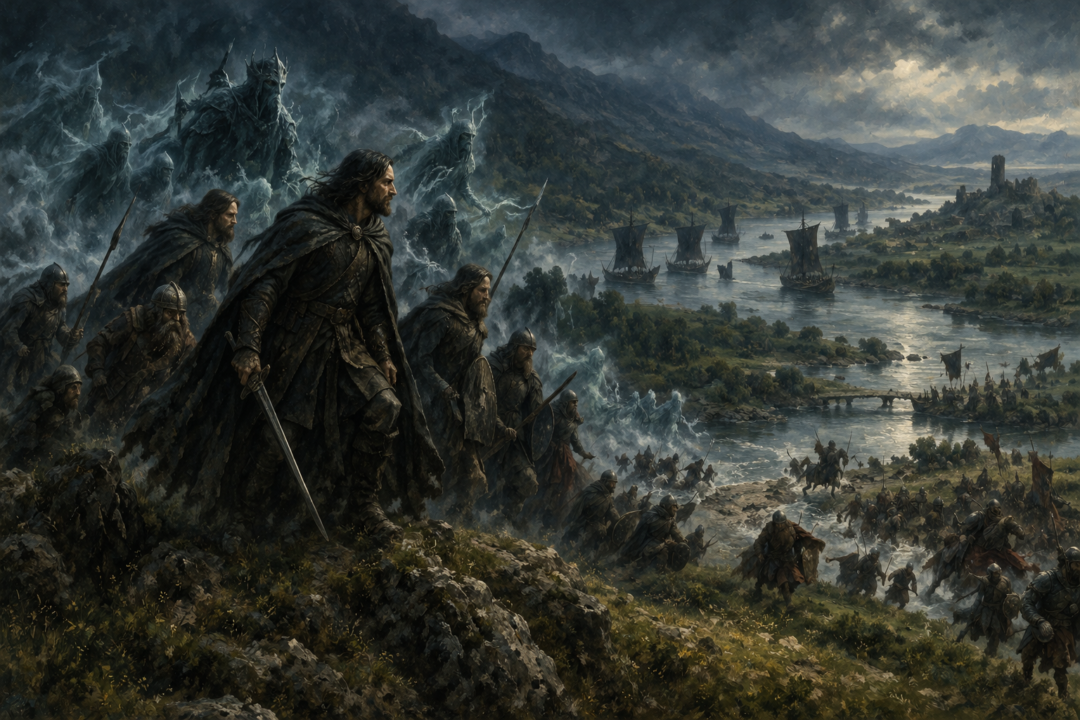
At Linhir he ordered Angbor of Lamedon to gather his people and follow, saying that he would need them at Pelargir. Aragorn and the Dead then crossed into Lebennin and drove the enemy before them.
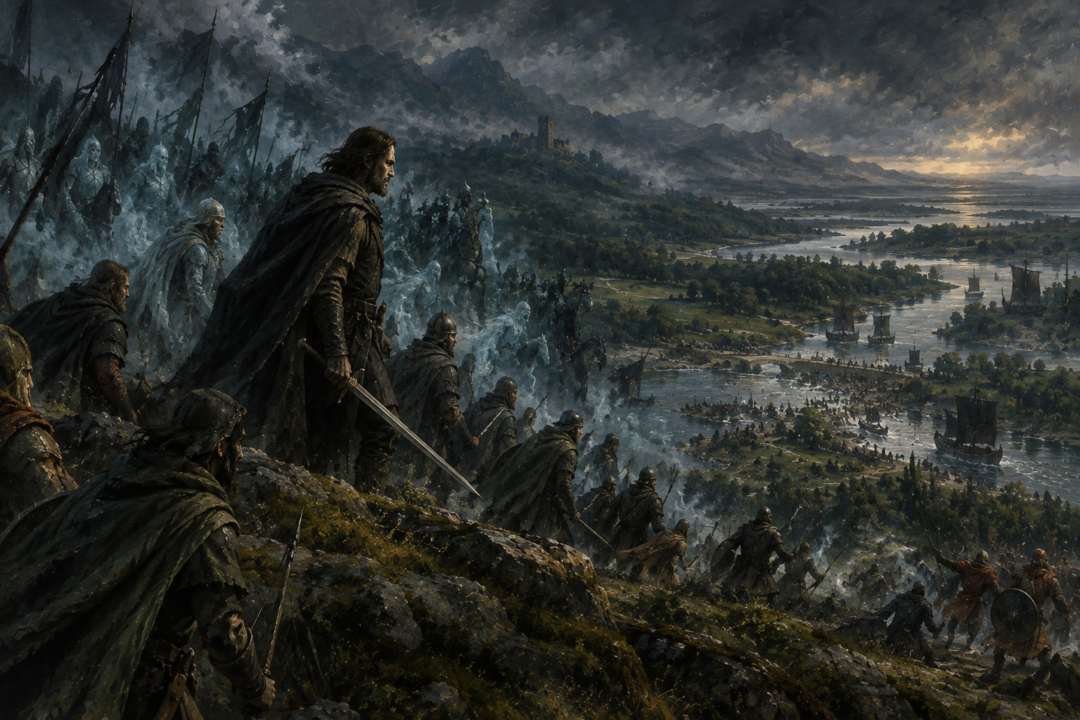
At Pelargir the Shadow Host broke the resistance of the Corsairs. Aragorn seized their ships, and only after the enemy fleet had been neutralized did he release the Dead from their oath.
This reverses the entire strategic meaning of southern Gondor’s waterways.
Before Pelargir fell to Aragorn, the water network helped the Corsairs threaten Gondor.
Afterward, that same network became Gondor’s fastest route to salvation.
Rivers Slowed Reinforcement Before They Accelerated It
There is a revealing irony in Aragorn’s journey.
His overland march had to cross river after river. Gimli specifically remembers the Ciril and Ringló, followed by the contested Gilrain at Linhir. Each crossing represented a geographical constraint, even though the supernatural terror of the Dead prevented most ordinary resistance from seriously delaying Aragorn’s company.
For a conventional army, the difficulty could have been much greater.
Tolkien never gives us a technical campaign study of Lebennin’s crossings, so it would be speculation to assign exact delays or defensive strengths to every river. But Linhir establishes the underlying rule clearly enough: crossings could be fought over.
Then Aragorn reached Pelargir and changed modes of movement entirely.
Instead of continuing north by road with every available warrior, he captured the Corsair fleet and sailed up the Anduin.
The obstacle became the road.
Even the Anduin Was Not an Effortless Highway
The captured ships did not solve every problem.
Aragorn calculated the distance from Pelargir to the Harlond at forty-two leagues and believed they had to reach the landings the following day or fail. The urgency was extreme.
At first, progress was painfully difficult.
The ships were travelling upstream. Gimli recalls that the freed men laboured at the oars, but the fleet moved slowly against the current and initially lacked helpful wind.
This is another important corrective to any simplistic picture of Gondor’s rivers.
Water transport could move large numbers of men rapidly compared with a desperate overland march, particularly once Aragorn possessed an existing fleet. But rivers imposed their own conditions: current, wind, suitable vessels, crews, and control of the route all mattered.
Only when a fresh wind came from the Sea did Aragorn’s fleet gain the speed needed for its final approach.
Lebennin’s waterways were therefore strategic infrastructure, but infrastructure that neither side could simply command by wishing it so.
The Liberation of Lebennin Released the Strength Minas Tirith Needed
After the Corsairs were defeated, something else happened.
Men began to gather.
Gimli says that captives and enslaved Gondorians were freed, while men from Lebennin and the Ethir assembled. Angbor also arrived with horsemen from Lamedon.
This is the strategic turning point.
Earlier, southern Gondor’s manpower had been pinned by the maritime threat. Once Aragorn destroyed that threat at Pelargir, local strength could be redirected.
The captured fleet then carried men north.
That distinction matters because Aragorn did not simply arrive at Minas Tirith with the small Grey Company and the Dead. The Dead were released after fulfilling their oath at Pelargir. The force sailing north consisted of living men, transported aboard the enemy’s captured ships.
The southern front had ceased to consume Gondor’s strength and had begun supplying it.
The Black Sails Reveal Gondor’s Worst Fear
When the ships finally appeared during the Battle of the Pelennor Fields, their black sails initially caused despair among Gondor’s defenders.
The reason was obvious.
A Corsair fleet sailing up the Anduin would mean that the southern defenses had failed. Lebennin, the Ethir, and the lands behind Minas Tirith could be assumed lost or overrun. The Enemy would then be arriving from the south while Mordor crushed the city from the east.
Instead, Aragorn unfurled the standard of the Kings.
The visual reversal works because the strategic danger had been so real.
The same ships intended to exploit Gondor’s river system now carried Gondor’s reinforcements.
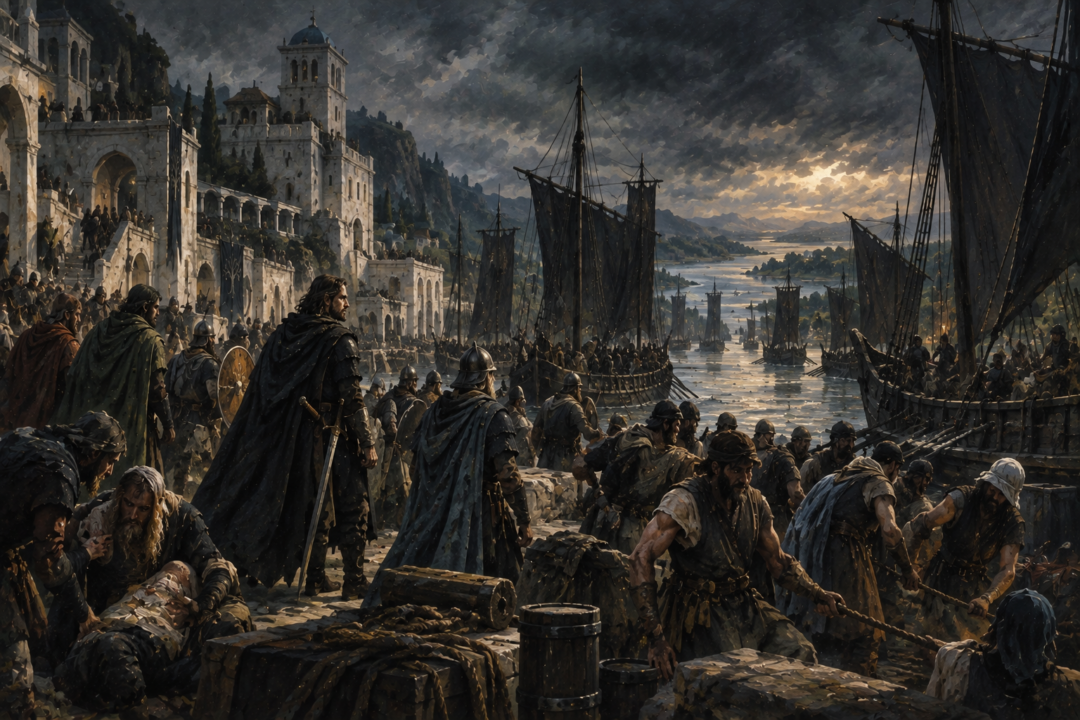
Lebennin Was Both Shield and Door
Lebennin’s five streams made it beautiful, fertile, and geographically distinctive. In wartime, however, water created contradictions.
A river could impede an army but admit ships.
A ford could protect a province but also become a place an enemy deliberately attacked.
A great river could expose Gondor’s interior to maritime invasion, yet once the fleet was captured it could carry reinforcements toward Minas Tirith faster than an exhausted army could reasonably march.
That is why the fighting in southern Gondor matters far beyond Pelargir.
The Battle of the Pelennor Fields was not saved merely by what happened outside Minas Tirith. Its outcome was also shaped by a struggle over movement hundreds of miles to the south: who controlled the crossings, who controlled the havens, and above all who controlled the ships upon the water.
Lebennin’s rivers did not choose the victor.
But they determined the paths by which both danger and deliverance could come.
Sources & Notes
- Tolkien Gateway — Lebennin: the fief’s boundaries, Five Streams, Pelargir, and Aragorn’s advance against the Corsairs and Haradrim. https://tolkiengateway.net/wiki/Lebennin
- Tolkien Gateway — Linhir: the fords of the Gilrain where Lamedon’s men fought forces from Umbar and Harad that had sailed upriver. https://tolkiengateway.net/wiki/Linhir
- Tolkien Gateway — Pelargir: Gondor’s principal Anduin harbor, the Corsair fleet assembled there, and Aragorn’s capture of its ships. https://tolkiengateway.net/wiki/Pelargir
Sources on Lebennin’s river geography, the fighting at Linhir’s fords, and Pelargir’s role as Gondor’s Anduin harbor during the Corsair threat.