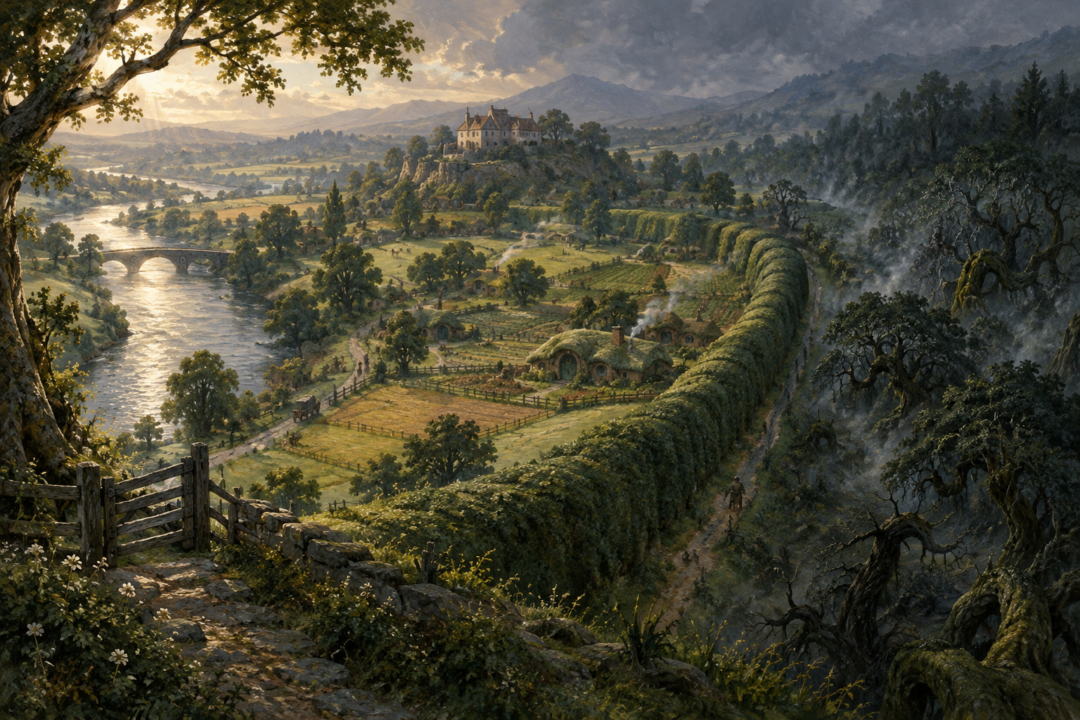
The High Hay looks, at first, like an unusually ambitious piece of hobbit gardening.
It was anything but.
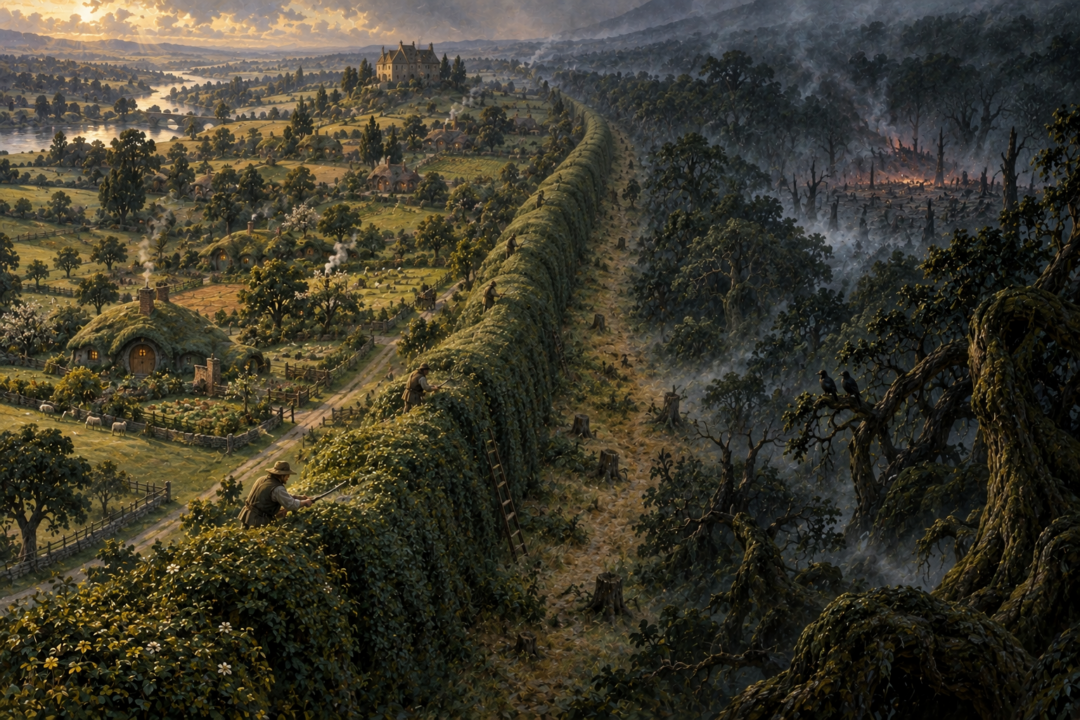
More than twenty miles of thick, carefully tended hedge curved from the Brandywine Bridge southward to Haysend, separating the inhabited lands of Buckland from the Old Forest. By the time Frodo came to Crickhollow, the barrier had stood for generations. Yet its importance is easy to miss. The Hedge was not simply protection from dangerous trees. It was the physical consequence of a much older decision: hobbits had crossed the traditional eastern boundary of the Shire and established a settlement in land pressed between a river and an ancient forest.
Buckland therefore developed differently from the comfortable heartlands farther west. Settlement created exposure. Exposure demanded defence. Defence produced guarded entrances, maintained boundaries, cleared ground, and habits that seemed distinctly un-Shire-like.
The High Hay is one of Middle-earth’s clearest small-scale examples of expansion turning into frontier policy.
Buckland Began by Crossing a Boundary
The geography matters.
The Brandywine had originally marked the Shire’s eastern boundary. Gorhendad Oldbuck crossed that river, established Brandy Hall, changed his family name to Brandybuck, and became master of what the narrative describes as virtually a small independent country.
As the Brandybuck family and its dependants multiplied, settlement spread around Brandy Hall. Buckland became a densely inhabited strip between the Brandywine and the Old Forest.
That distinction is crucial. Buckland was described as a colony from the Shire rather than simply another ordinary district within the Four Farthings. Even culturally, the old Shire regarded Bucklanders as somewhat peculiar and almost foreign, despite their being fundamentally much like other hobbits.
Their geography had changed their circumstances.
West of the river lay the familiar Shire. Eastward stood the Old Forest. Buckland existed in the narrow space between them.
The settlement had crossed a natural and historical boundary, but it had not escaped the consequences of having done so.
The Eastern Frontier Was Originally Open
The text explicitly tells us that Buckland was originally unprotected on its eastern side.
That is a revealing detail because it means the High Hay was not necessarily part of the settlement’s first design. The barrier came afterward. It had been planted “many generations” before Frodo’s journey, but the precise date of its creation is never given.
What is clear is the sequence.
First came settlement beyond the Brandywine. Then came an enduring need to defend the settlement’s exposed eastern edge.
The resulting High Hay was enormous by hobbit standards. It stretched well over twenty miles, looping from near the Brandywine Bridge down toward Haysend, where the Withywindle emerged from the Old Forest and joined the Brandywine.
Nor was this a neglected country hedge that happened to become large. It was constantly tended and had become thick and tall.
That continuous maintenance matters. A living barrier requires labour across generations. Whatever the exact arrangements for maintaining it, the Hedge represents a permanent communal response to the geography of Buckland.
The Bucklanders had effectively converted the edge of their settlement into a defended frontier.
The Old Forest Was Not a Passive Neighbour
Why was such a frontier necessary?
Because the Old Forest was not merely wilderness in the ordinary sense.
Merry explains that things within it seem more alive and aware than things in the Shire. Trees watch strangers. Some may drop branches, thrust out roots, or grasp with trailing growth. At night, Merry had heard what seemed like trees whispering and communicating with one another.
He also recounts a much more serious confrontation.
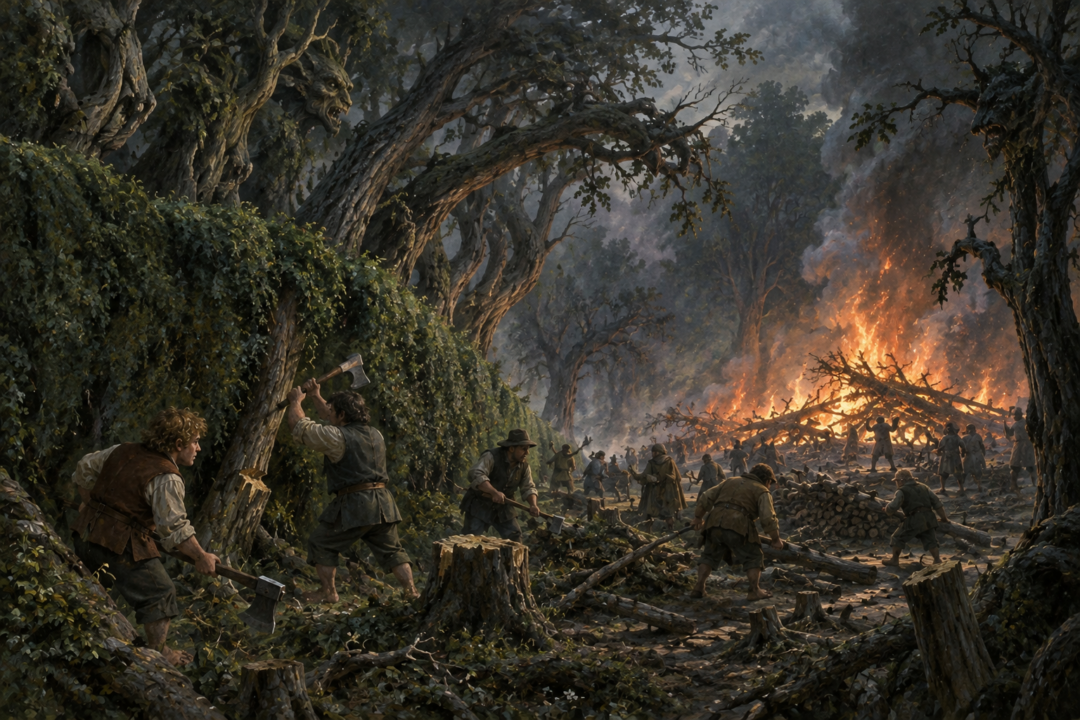
Long before Frodo’s journey, trees came against the High Hay, planting themselves close beside it and leaning over the barrier. The Bucklanders responded violently. They cut down hundreds of trees, made a great bonfire, and burned a long strip of ground east of the Hedge.
The trees withdrew from the attack.
Their hostility did not disappear.
This is what makes the High Hay more complicated than a simple defensive wall. The Bucklanders were protecting their homes, but their defence also involved pushing the Forest back from the boundary. The result was not reconciliation but an armed equilibrium of sorts: maintained hedge on one side, hostile woodland on the other, with cleared ground marking the memory of an earlier confrontation.
The frontier had become contested space.
The Bonfire Glade Was the Scar of the Conflict
The clearest reminder of that struggle survived inside the Forest.
When Merry led Frodo, Sam, and Pippin through the Old Forest, they encountered the open place associated with the great burning. It remained treeless, filled instead with rough grass, nettles, thistles, and other plants.
The place was not simply scenic background. It was the physical aftermath of Buckland’s earlier response to the Forest.
There is an important moral complexity here.
The text does not present the Bucklanders as malicious conquerors. They were defending inhabited land against trees that, according to Merry’s account, had actively pressed against their Hedge. Yet the Forest’s hostility also exists in a world where ancient woods possess memories and wills beyond ordinary human or hobbit understanding.
One reading, therefore, is that the Buckland frontier became a cycle of mutual encroachment and retaliation. Hobbits settled against an ancient wood, established a boundary, the trees challenged that boundary, and the hobbits answered by cutting and burning.
Neither side thereafter regarded the other neutrally.
The Hedge preserved peace precisely because the relationship was not peaceful.
A Border Needs Gates, Guards, and Decisions
The High Hay did more than separate landscapes. It controlled movement.
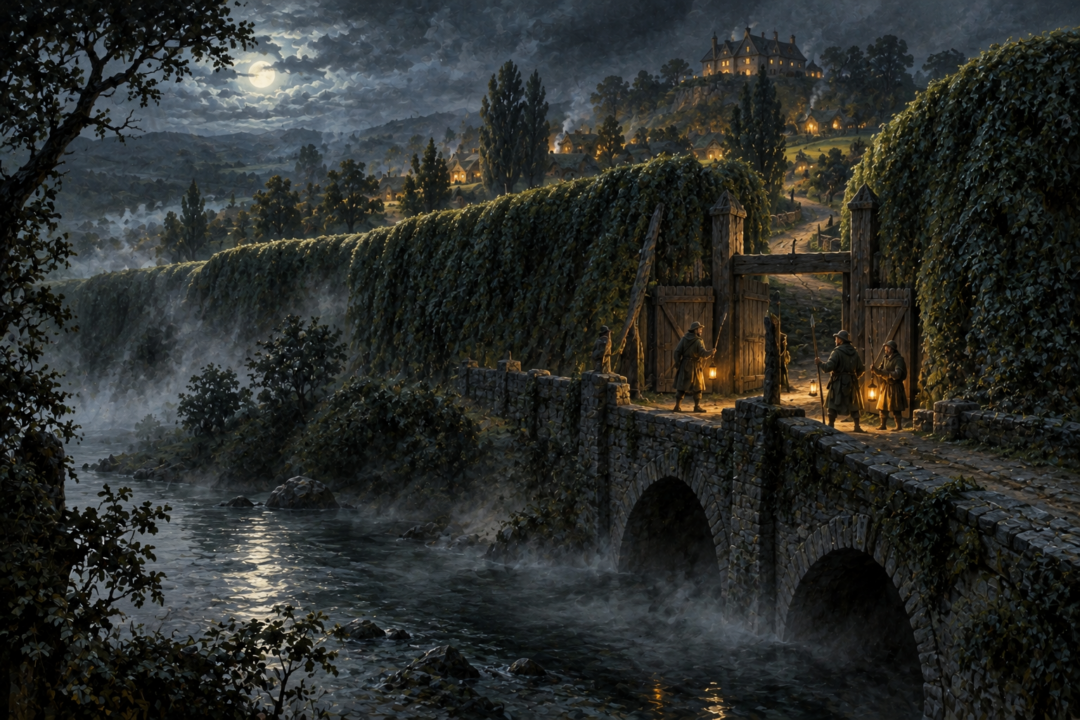
At its northern end, where the Hedge approached the Brandywine near the Bridge, stood the North-gate. During Frodo’s flight, Merry explains that guards were stationed there and would attempt to prevent suspicious strangers from entering, especially at night. Messages could be sent to the Master of the Hall when necessary.
That is remarkably organised for a society usually associated with postmen, gardeners, inns, and local officials rather than military frontiers.
The Bucklanders were not maintaining a great standing army. Merry openly acknowledges that Buckland could not withstand a determined attack for long.
But they possessed something subtler: border procedure.
There was a physical barrier. There was a controlled entrance. There were guards. There was recognised local authority. Suspicious travellers could be delayed while the Master was consulted.
The High Hay had transformed geography into administration.
Settlement had created a frontier, and the frontier had created rules.
Even Private Passage Was Controlled
The Hedge was not completely sealed.
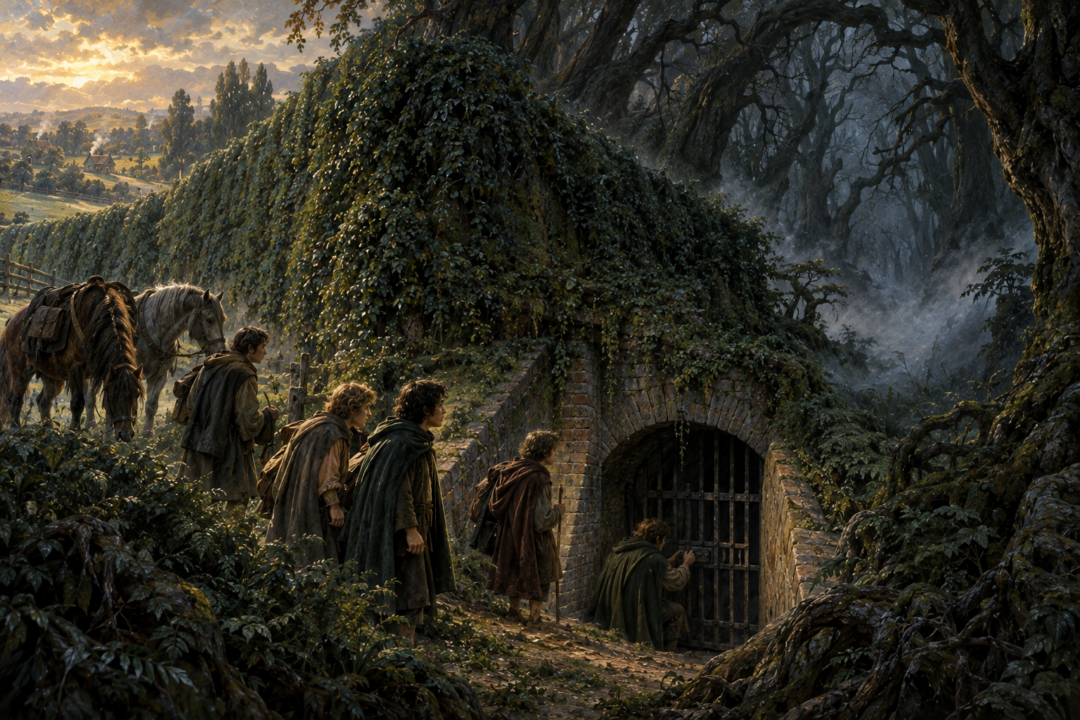
Near Crickhollow, Merry knew another way through: a brick-lined tunnel passing beneath the Hedge. On the Forest side stood a substantial barred gate, which Merry could unlock.
That detail shows that the Bucklanders had not simply abandoned everything east of their barrier. Some of them still entered the Old Forest, though such journeys were unusual enough to carry an air of danger.
The distinction is important.
A frontier does not have to mean absolute isolation. It can mean controlled permeability.
The High Hay allowed Buckland to decide where ordinary life ended and deliberate risk began. Crossing it was not like strolling from one Shire field into another. The architecture itself made the transition explicit: road, cutting, tunnel, gate, then the open strip before the trees.
For Frodo’s company, passing beneath the Hedge feels almost like leaving one political and psychological world for another.
Behind them stands cultivated Buckland.
Ahead waits something older.
Buckland Changed Because the Frontier Never Entirely Became Safe
The High Hay succeeded, but only partially.
The narrative explicitly warns that it was not complete protection. The Old Forest approached the Hedge closely in many places. Bucklanders also locked their doors after dark, a practice noted as unusual elsewhere in the Shire.
That small domestic habit may reveal more about frontier life than the twenty-mile Hedge itself.
The border had entered the household.
Generations of living beside the Forest had taught Bucklanders that safety could not simply be assumed after sunset. Their behaviour distinguished them from hobbits living deeper inside the Shire’s protected landscape.
And other dangers could use the same geography.
When the Nazgûl later struck Buckland, the North-gate’s guards could not stop them. The Riders swept through the defenders and continued their pursuit.
The episode confirms Merry’s earlier assessment: Buckland possessed organised precautions, not impregnable fortifications.
The Hedge could manage ordinary insecurity.
It could not stop the full power of the wider war once that war arrived.
The High Hay Was the Price of Expansion
Buckland’s story contains a quiet contradiction.
Hobbits are famously attached to home, continuity, cultivated land, and familiar boundaries. Yet Buckland itself existed because hobbits crossed one.
Gorhendad Oldbuck went beyond the Brandywine. His descendants flourished. Brandy Hall expanded. Houses and villages spread through the narrow country east of the river.
But settlement brought responsibility for the new edge they had created.
The High Hay was therefore more than a defence against strange trees. It marked the point where expansion ceased to be an adventurous act by one family and became a permanent obligation inherited by generations.
Someone had to tend the Hedge.
Someone had to watch the gate.
Someone had to decide who could pass.
Someone had to live with the Forest immediately beyond it.
That is why Buckland feels subtly different from Hobbiton despite remaining thoroughly hobbitish. Its people inhabited the margin between settled country and a world that refused to become ordinary.
The Brandywine had once been the boundary.
The Brandybucks crossed it.
Then, facing the Old Forest, they discovered that moving a border does not abolish the frontier.
It merely puts the frontier somewhere new.
Sources & Notes
- Tolkien Gateway — High Hay: Buckland’s twenty-mile defensive hedge, its guarded openings, constant upkeep, and the Bucklanders’ burning of trees east of it. https://tolkiengateway.net/wiki/High_Hay
- Tolkien Gateway — Buckland: Gorhendad Oldbuck’s settlement east of the Brandywine and the region’s status, growth, and frontier defenses. https://tolkiengateway.net/wiki/Buckland
- Tolkien Gateway — Old Forest: the forest’s relationship with Buckland, the Hedge, and the conflict created by hobbit settlement and tree-felling. https://tolkiengateway.net/wiki/Old_Forest
Sources on Buckland’s settlement beyond the Brandywine, the High Hay’s route and maintenance, and the long conflict with the Old Forest.