The Black Gate Fell — But Mordor’s Roads Did Not Become Safe Overnight
When the One Ring was destroyed, the Morannon did not simply open. It collapsed.
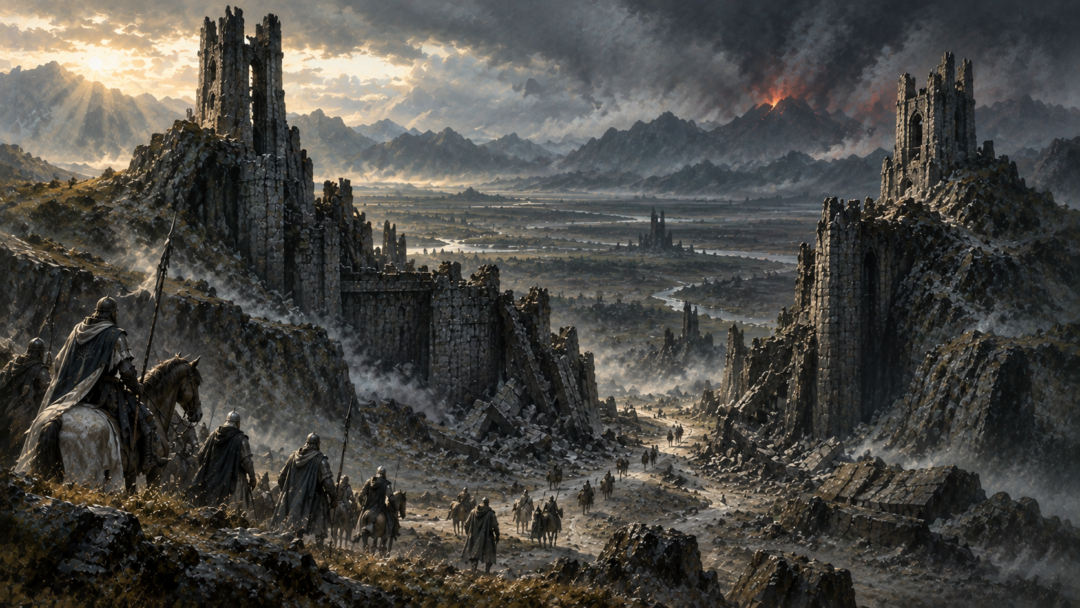
The Black Gate, its wall, and the Towers of the Teeth were caught in the ruin that followed Sauron’s fall. The great northern entrance of Mordor—the barrier that had confronted Frodo and Sam and later the Captains of the West—ceased to function as the fortified threshold of the Dark Lord’s realm.
That sounds like the end of a strategic problem. In reality, it created another.
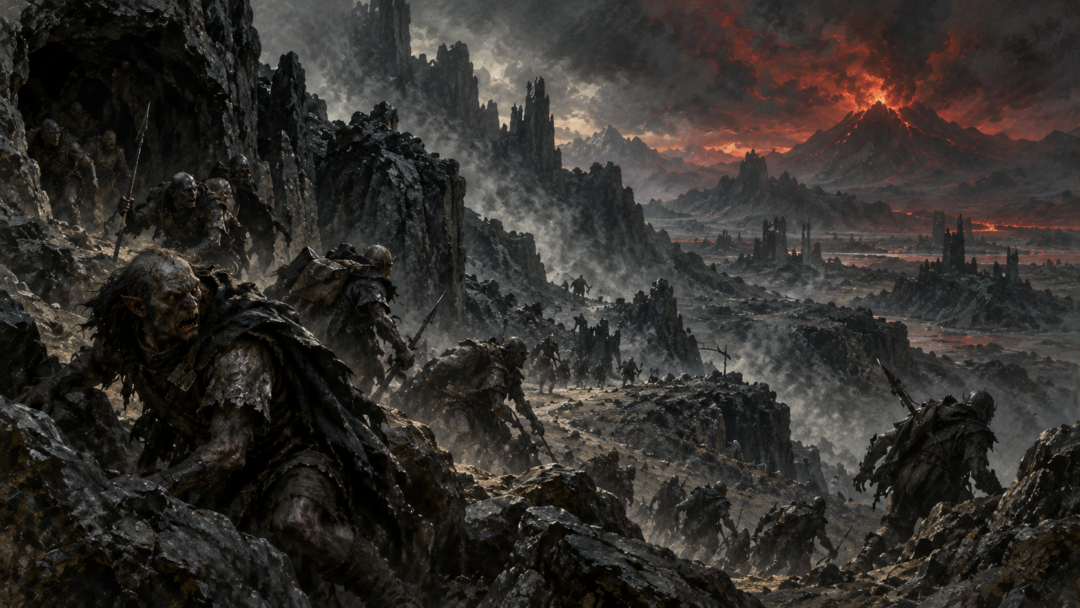
Sauron’s defeat destroyed the power commanding Mordor, but it did not erase the geography he had controlled. Roads still crossed the region. Passes still pierced its mountains. Human populations still lived in the southern lands. And some of the creatures that survived Sauron’s downfall fled rather than surrendering.
The destruction of the Morannon therefore marks something larger than the removal of a gate. It is the moment when a sealed enemy fortress became territory through which the restored kingdoms would eventually have to move, govern, watch, and distinguish between former victims and surviving threats.
The Morannon Was More Than a Door
The Black Gate guarded Cirith Gorgor, the great northwestern passage into Mordor between the Ephel Dúath and the Ered Lithui.
This mattered because Mordor was naturally fortified. Mountain ranges protected much of its western and northern boundaries, making the major passes extraordinarily important. The Morannon turned one of those openings into a military checkpoint of enormous strength.
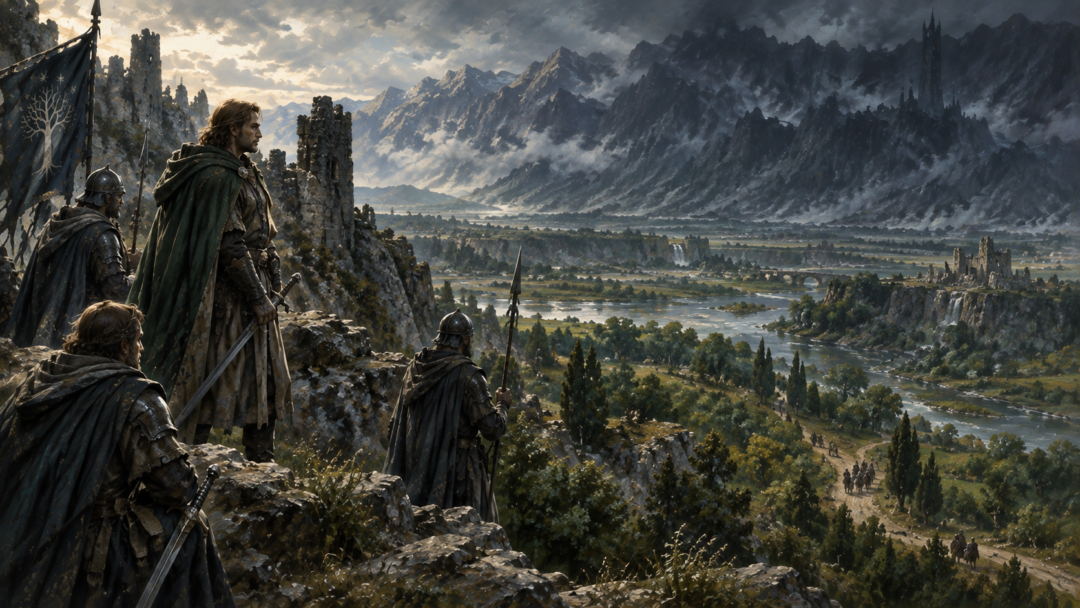
The approach itself reveals how strategically connected the place was. Near the Morannon, roads ran toward Ithilien, northward toward the Dagorlad, and eastward beneath the Ered Lithui. Beyond the gate, the way entered Udûn and continued into Mordor.
Sauron was therefore not merely guarding a symbolic entrance. He was controlling a transportation artery through which armies, supplies, messengers, and subject peoples could move.
This is why Frodo and Sam could not simply walk into Mordor there. The gate was watched too closely. Gollum instead led them toward the more secret route of Cirith Ungol.
When the Morannon fell on 25 March 3019, that system of controlled passage was shattered.
But destroying the checkpoint did not destroy the roads.
Sauron’s Fall Did Not Mean Every Enemy Vanished
The collapse of Sauron’s power was catastrophic for his armies. At the Battle of the Morannon, his forces lost the will that had bound them together. Some fled, some died, and others were overwhelmed in the disaster.
Yet the text does not say that every Orc, Troll, or hostile servant of Mordor instantly perished.
Indeed, the account of Sauron’s fall explicitly allows for survivors who fled and hid. His domination had been removed, but surviving creatures could scatter into distant places.
That distinction matters.
An organized army under a single supernatural will had ceased to exist. Scattered enemies were a different kind of danger: smaller, less capable of conquering kingdoms, but potentially difficult to locate and suppress.
It would therefore go beyond the text to imagine detailed Fourth Age campaigns clearing every cave and road in Mordor. No such comprehensive campaign is described.
But it is equally difficult to treat the fall of Barad-dûr as though every road immediately became peaceful.
The texts imply a transition from total war to the slower work of restoring order.
Mordor Contained Victims as Well as Enemies
There was another reason the victorious West could not simply treat everything beyond the ruined gate as hostile territory.
Southern Mordor contained people who had been enslaved by Sauron.
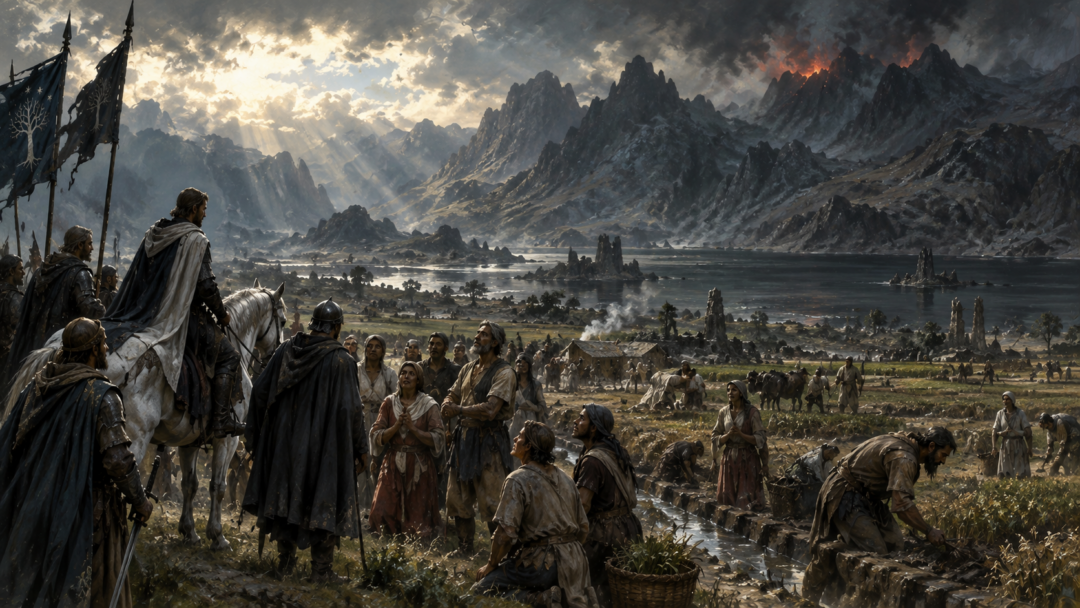
Frodo and Sam learn that the armies of Mordor were partly supplied from great slave-worked fields around the waters of Núrnen. Sauron’s realm was therefore not only a collection of fortresses and Orc-holds. It also contained an exploited agricultural population whose labor sustained his war machine.
After the victory, King Elessar freed these slaves and gave them the lands around Lake Núrnen.
That decision transforms the meaning of postwar Mordor.
The new order could not simply close the mountains and abandon everyone inside. People who had lived under Sauron now possessed lands of their own. Any restoration of security therefore had to distinguish between those who had served the Dark Lord willingly, surviving hostile creatures, defeated foreign armies, and populations who had themselves been oppressed.
The fall of the Morannon removed the wall between Mordor and the outside world.
Elessar’s settlement of Núrnen made clear that what lay beyond that wall could not be treated as one undifferentiated enemy.
The Roads Became Politically Important Again
Sauron had turned roads into instruments of domination.
His military network connected Mordor with Ithilien and with lands to the north and east. Armies from outside Mordor could be gathered into his campaigns, while the interior roads carried the resources needed to sustain them.
Once Sauron was gone, those same routes acquired a different significance.
A road that had carried an invading army could now carry representatives of the restored kingdoms. A pass once guarded against the Free Peoples could become a route through territory no longer controlled by the Enemy. Roads toward the east also mattered because the defeat of Sauron did not end Gondor’s political relationship with the peoples who had fought for him.
The later account of Elessar’s reign describes him making peace with peoples who had been enemies while also subduing others who remained hostile.
We should not turn that broad statement into a detailed map of Fourth Age patrols that the texts never provide. Still, the political implication is strong: Sauron’s empire had collapsed, but the borders and approaches around Gondor did not cease to matter.
Victory changed who controlled the roads. It did not make control unnecessary.
Gondor Had Faced This Problem Before
There is a striking historical irony at the Morannon.
The Towers of the Teeth were not originally built by Sauron.
After Sauron’s defeat at the end of the Second Age, Gondor constructed fortifications to watch Mordor and prevent evil from returning. The towers beside the Black Gate belonged to that system.
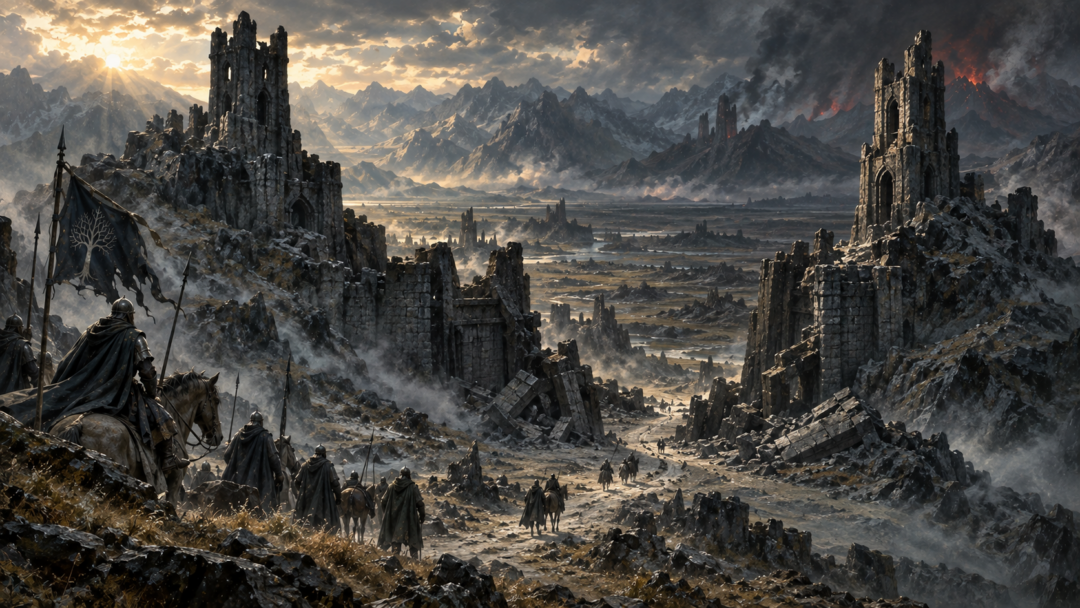
Over the long centuries, Gondor’s vigilance weakened. The Great Plague devastated the kingdom, fortresses were abandoned, and eventually Mordor was left insufficiently watched. Sauron’s servants returned, and the defensive works intended to contain his land were ultimately occupied by his own forces.
That history would have been difficult for the restored kingdom to ignore.
Mordor had already demonstrated what could happen when victory was mistaken for permanence.
The lesson of the Morannon was therefore not merely that strong walls could fall. It was that dangerous frontiers required sustained attention across generations.
The Fourth Age began with a far stronger political settlement than the declining Gondor of earlier centuries, but geography had not changed. Cirith Gorgor was still a pass. Ithilien still bordered the Mountains of Shadow. Roads still connected former enemy territory with the wider world.
Ithilien Became a Living Frontier
The restoration of Ithilien is especially important in this context.
After the war, Faramir became Prince of Ithilien. Beregond was appointed captain of his guard, the White Company, and was to dwell in Emyn Arnen in Faramir’s service.
Ithilien was not simply an abandoned battlefield being reclaimed for beauty. It occupied the land immediately west of Mordor and contained roads that had once carried Sauron’s forces toward Gondor.
Its renewal therefore had both human and strategic significance.
People could return. Settlements could recover. The land could cease being a contested wilderness between Minas Tirith and the Enemy.
Yet its location meant that restoration and security were inseparable.
The texts do not provide schedules of patrols along the old roads, so claims about specific policing arrangements would be speculation. What they do give us is a restored principality under one of Gondor’s highest lords, positioned directly beside the former realm of Sauron.
The frontier was no longer the edge of an active war.
It was still a frontier.
The Destruction of a Fortress Creates a Responsibility
This is the overlooked consequence of the Morannon’s fall.
During the War of the Ring, the problem was brutally simple: the Black Gate was closed, Mordor was hostile, and crossing its threshold meant entering Sauron’s realm.
After the Ring was destroyed, every part of that equation changed.
The gate was ruined. Sauron was gone. His armies had collapsed. His slaves were liberated. Gondor was restored under a king. Ithilien received a prince. Relations with the peoples beyond Gondor entered a new political age.
But none of this made geography disappear.
The roads remained.
So did the passes, ruined strongholds, distant lands, displaced populations, and some scattered survivors of the Enemy’s forces.
The most lore-grounded reading is therefore not that Elessar inherited a Mordor requiring endless occupation, nor that the texts describe a systematic military police state around the former Black Land. They do not.
What they show is subtler.
The destruction of the Morannon converted an enemy-controlled barrier into an open strategic problem. The Reunited Kingdom had won access to roads that had been closed or hostile for generations, but access brought obligations: guarding borders, restoring neighboring lands, dealing with surviving enemies, making peace where peace was possible, and protecting people who had previously lived beneath Sauron’s rule.
The Black Gate had been built around the idea that Mordor could be controlled through fear.
Its destruction proved that fear was finished.
What followed required something harder to maintain: order without the Dark Lord who had imposed it.
Sources & Notes
- Tolkien Gateway, “Black Gate” — locates the Morannon at Cirith Gorgor, maps the converging roads, and records its collapse after the Ring’s destruction. https://tolkiengateway.net/wiki/Black_Gate
- Tolkien Gateway, “Battle of the Morannon” — describes Sauron’s army losing direction, fleeing or surrendering, and the destruction of the Gate and Towers of the Teeth. https://tolkiengateway.net/wiki/Battle_of_the_Morannon
- Tolkien Gateway, “Nurn” — documents the slave-worked food lands in southern Mordor and King Elessar’s liberation and land grant after the war. https://tolkiengateway.net/wiki/Nurn
- Tolkien Gateway, “Mordor” — surveys the roads, passes, Gondorian watch-fortresses, postwar flight of Orcs, and settlement of freed slaves. https://tolkiengateway.net/wiki/Mordor
Sources document the Morannon’s geography and destruction, the survival and dispersal of Sauron’s forces, Mordor’s strategic fortifications, and Elessar’s liberation and resettlement of the slaves of Nurn.