How Oliphaunts Reveal a Southern World Beyond the Map
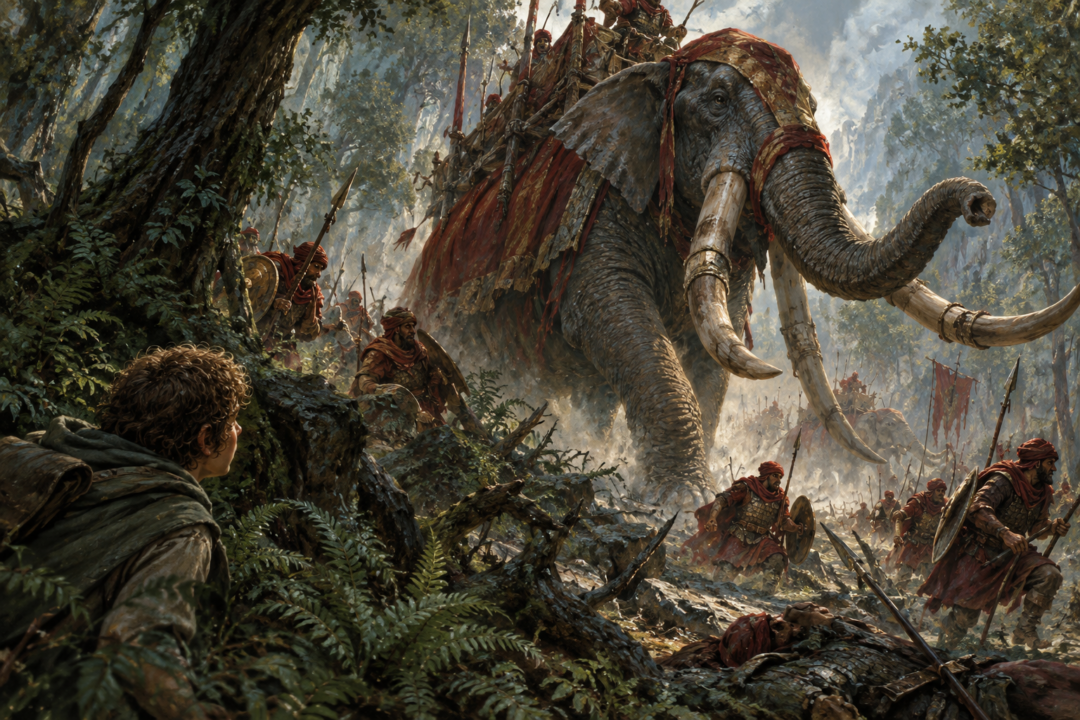
Sam Gamgee knew about oliphaunts before he ever saw one.
In the Shire they belonged to old stories: enormous southern beasts so improbable that seeing one became almost a childhood test of whether tales could be true. Then, in Ithilien, Sam watches a living Mûmak burst from the fighting between Faramir’s Rangers and a column of Haradrim.
The moment is memorable because wonder suddenly becomes real. But the Mûmak reveals something larger than Sam realizes.
That animal has reached Ithilien from the South.
By the time of the siege of Minas Tirith, Mûmakil are present in Sauron’s armies in numbers sufficient to play a significant military role. They appear amid the siege machinery and later become formidable strongpoints on the Pelennor Fields, where the horses of Rohan recoil from them.
None of this tells us exactly where the Mûmakil were bred, how their handlers trained them, what they ate on campaign, or precisely which roads carried them north. Those details are not supplied.
Yet their mere presence exposes something usually hidden beyond the narrative’s geographical horizon: Harad possessed the human organization necessary to move enormous war-beasts over great distances.
The oliphaunt is therefore more than an exotic monster.
It is evidence of an unseen logistical world.
The Map Ends Before the World Does
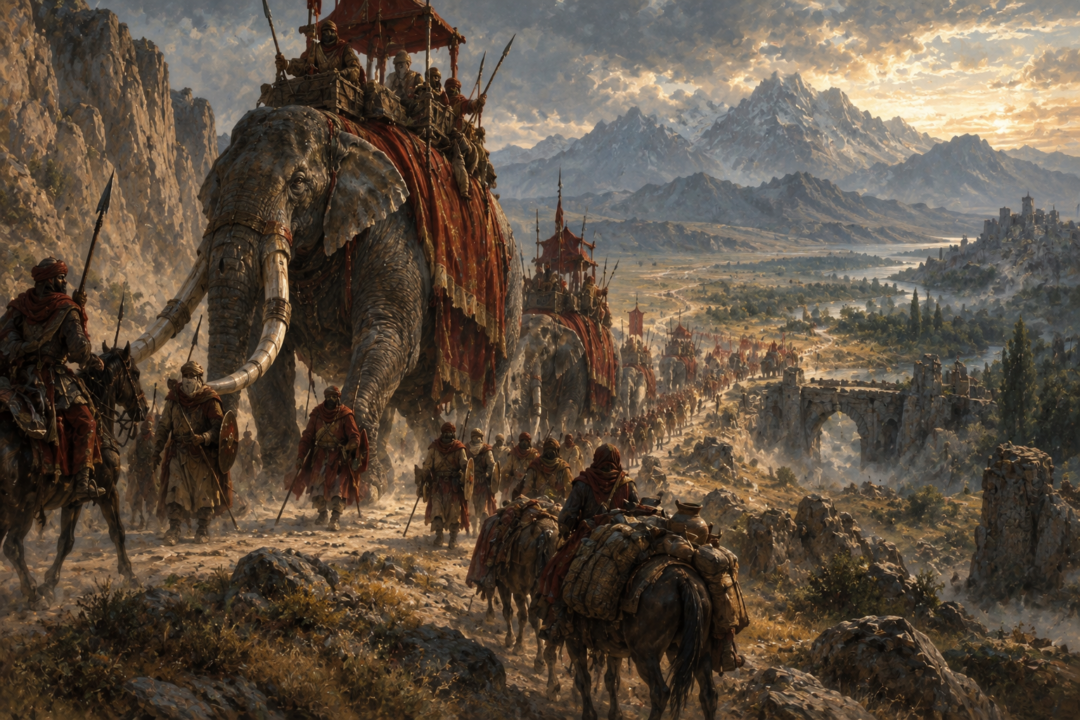
The familiar maps accompanying The Lord of the Rings naturally concentrate on the lands where the main story occurs. The Shire, Rohan, Gondor, Mordor, the Misty Mountains and the great routes of the Fellowship matter because the protagonists move through them.
Harad largely disappears southward beyond that frame.
But the narrative repeatedly reminds us that the edge of the map is not the edge of inhabited Middle-earth. There are lands farther south, and the term “Harad” itself covers a broad southern region rather than one conveniently defined state. The text distinguishes Harad and Far Harad, while Gondor’s long history includes repeated wars, alliances, conquests and rivalries involving southern peoples.
The War of the Ring brings those distant societies north.
Haradrim fight for Sauron. Corsairs operate from Umbar. Forces from Far Harad appear in the armies attacking Gondor. And among the most striking products of that southern world are the Mûmakil.
The story does not stop to provide an economic geography of Harad. It does something subtler.
It lets the consequences of that geography walk onto the battlefield.
A Mûmak Cannot Simply Appear in Ithilien
Sam’s first Mûmak is encountered during the passage of a Haradrim force through Ithilien.
That location matters.
The Southrons are not defending their homeland. They are already far enough north to be moving through territory contested by Gondor on their way toward Sauron’s war. Whatever their exact point of origin, their soldiers and beasts have completed a substantial journey before Sam ever sees them.
For ordinary troops, long-distance campaigning already requires organization: food, water, replacement equipment, routes, command and some means of maintaining a marching force.
A Mûmak magnifies the problem.
The text never gives us its daily requirements, and applying modern elephant logistics too literally would risk importing facts that Tolkien never established for these fictional creatures. But the underlying inference is unavoidable. A gigantic living animal must be kept alive while travelling.
It must be controlled.
It must be accompanied by people who know how to handle it.
And if it is prepared for war, its equipment must also travel with it or be supplied along the route.
The narrative never shows us the support system directly. The successful arrival of the animal shows that some support system existed.
The Haradrim Had Mastered More Than Taming
At the Pelennor Fields, the Mûmakil are not merely wild creatures driven toward an enemy.
They are integrated into warfare.
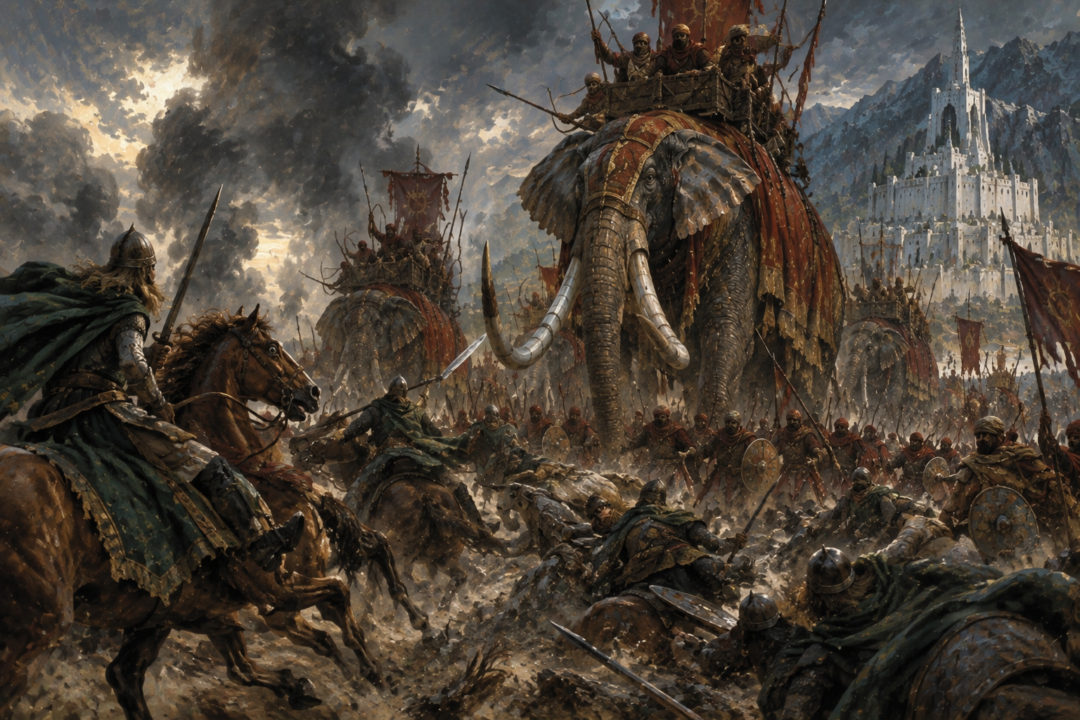
The great beasts bear elaborate trappings, and fighting men use them as elevated positions. During the battle, the Haradrim gather around the Mûmakil, which become formidable centres of resistance because the horses of Rohan will not approach them.
This implies generations of practical knowledge rather than improvisation on the eve of battle.
Someone had to capture or breed such creatures. Someone had to tame them. Handlers had to understand their behaviour. Warriors had to learn how to operate around them. Equipment had to be fitted to bodies of extraordinary size.
The texts do not explain how any of those institutions worked, so it would be too strong to imagine a specific royal Mûmak corps, breeding bureaucracy or network of dedicated depots.
But organized expertise is a reasonable inference from organized battlefield use.
That distinction matters. Tolkien gives us the visible result, not the administrative mechanism.
The result is impressive enough.
The North-South Road Was More Than Scenery
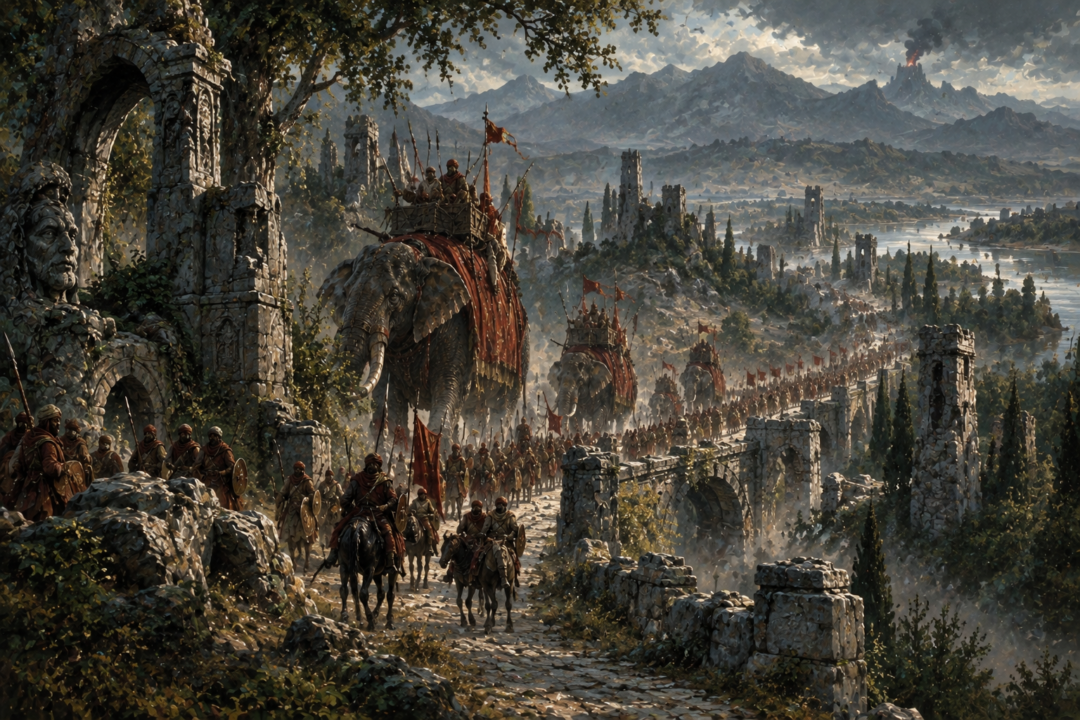
Frodo and Sam encounter another clue while travelling through Ithilien: the great road running through the region toward the crossings of the Anduin and the approaches to Mordor.
The geography of Ithilien is not simply wilderness. It is the remains of a frontier that once belonged securely to Gondor, crossed by roads whose strategic importance survives even after the land has become dangerous.
The Haradrim use this corridor during the War of the Ring.
That makes the Mûmak’s journey easier to understand without requiring us to invent unknown highways deep in Harad. We cannot reconstruct its complete route. We can say that, once the southern host reaches the known theatre of war, substantial routes connect its advance toward Mordor and Gondor.
Roads are among the quiet foundations of military power in Middle-earth.
Armies cannot exist only at their destinations.
They must reach them.
The sight of a Mûmak in Ithilien turns an ancient road into evidence of continental movement.
Minas Tirith Reveals the Scale
The siege of Gondor makes the logistical implication even stronger.
Mûmakil reach the battlefield outside Minas Tirith as part of an enormous multinational host. Haradrim are only one component of Sauron’s forces, alongside Orcs, Easterlings, Variags of Khand and other troops.
The Haradrim alone outnumber the six thousand Riders who reach the Pelennor by roughly three to one.
Not every Haradrim warrior came with a Mûmak, of course, and the text gives no exact count of the beasts. But their deployment is substantial enough to affect the course of the battle.
When the Rohirrim attack, the Mûmakil become obstacles cavalry cannot easily overcome. Horses refuse to face them, and enemy soldiers rally around the great animals.
This is what makes their southern journey strategically important.
Harad has not merely delivered exotic creatures for spectacle. It has transported a military capability hundreds of miles into the northern war theatre and kept that capability functional until the decisive battle.
Even Sauron Needed Other Peoples’ Strength
There is also an important limit to what the oliphaunts tell us.
They should not simply be described as products of Mordor.
They are Mûmakil of Harad, associated with the Haradrim who fight beside Sauron. Their presence illustrates how much Sauron’s war depends upon forces drawn from outside Mordor itself.
His coalition reaches east and south.
That means the assault on Gondor is supported by resources, populations and military traditions extending far beyond the immediate lands surrounding Barad-dûr.
Sauron can dominate, intimidate and coordinate these peoples, but the distinctive capabilities they bring are not necessarily invented by him.
The Haradrim bring their own warriors, arms, standards and Mûmakil into his war.
Seen this way, the Pelennor is the collision point of several different military worlds.
Rohan brings a society profoundly shaped by horses.
Gondor brings fortified cities, disciplined soldiers and the surviving institutions of an ancient kingdom.
Harad brings, among other forces, war-beasts that northern cavalry cannot readily confront.
The battle is partly a clash of logistical traditions.
The Missing Infrastructure of Harad
What lies behind the Mûmakil?
We do not know.
That is precisely where careful interpretation must stop short of invention.
The texts do not describe southern stables large enough for them, specialized roads, fodder stations, veterinary traditions, breeding grounds or transport schedules. Nor do they establish whether every Mûmak involved in the War of the Ring originated in Far Harad rather than some nearer southern region.
What they establish is the outcome.
Large war-beasts existed in Harad.
The Haradrim could tame them.
They could equip them.
They could integrate warriors with them.
And they could bring them north into Gondor’s war.
From those facts, a broader logistical structure is implied even though its precise form remains unknown.
That is one of the strengths of Middle-earth’s world-building. Whole societies can be suggested through the objects, soldiers and animals that emerge from them.
Sam Sees More Than an Oliphaunt
To Sam, the Mûmak is the astonishing confirmation of an old Shire rhyme.
To Faramir’s Rangers, it is part of an enemy column.
To the Rohirrim on the Pelennor, its kind becomes something much more frightening: a living barrier their horses cannot willingly challenge.
But from another angle, every Mûmak is also a piece of geographical evidence.
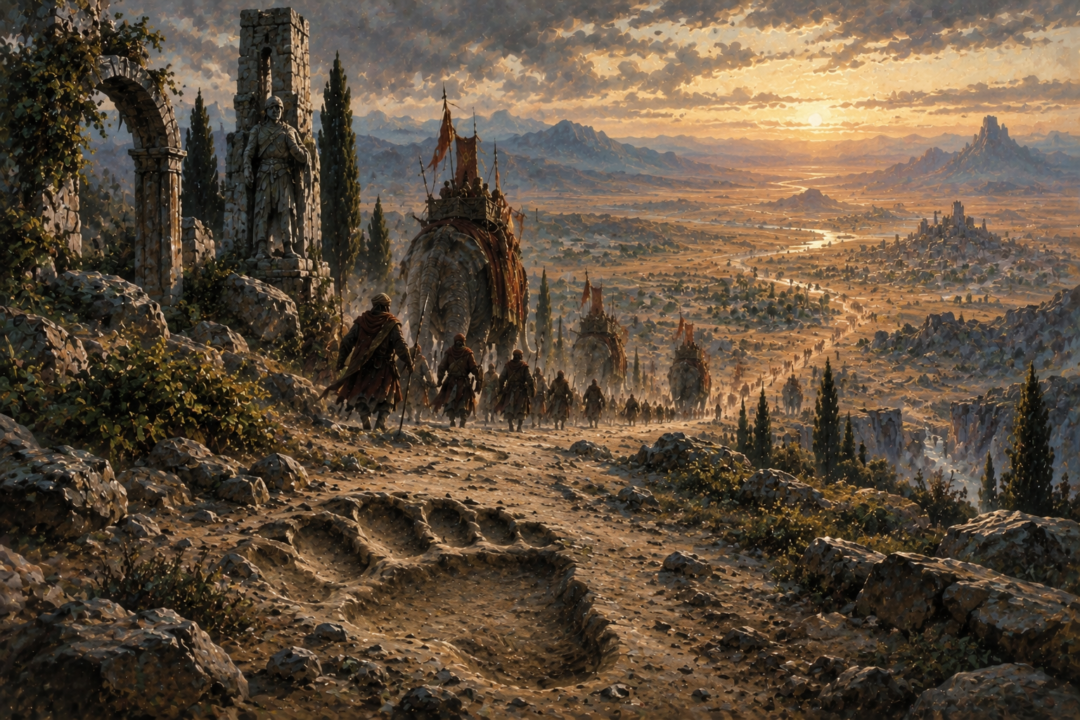
Behind it lie handlers we never meet, places we never visit and systems the narrative never pauses to explain. Somewhere beyond Gondor’s southern horizon were communities capable of maintaining these creatures and turning them into instruments of war. Between those lands and the Pelennor stretched routes capable of carrying armies north.
The familiar map shows us where the story happens.
The oliphaunts remind us how much of the world exists outside it.
Their enormous footprints lead southward beyond the page—and toward a Middle-earth whose roads, peoples and economies remain mostly unseen, but not entirely unknowable.
Sources & Notes
- Tolkien Gateway — Mûmakil https://tolkiengateway.net/wiki/M%C3%BBmakil
- Tolkien Gateway — Harad https://tolkiengateway.net/wiki/Harad
- Tolkien Gateway — Haradrim https://tolkiengateway.net/wiki/Haradrim
These reference entries document the mûmakil, Harad, and the Haradrim who brought them north in war. The discussion of transport, provisioning, and off-map logistics is reasoned interpretation from those facts.