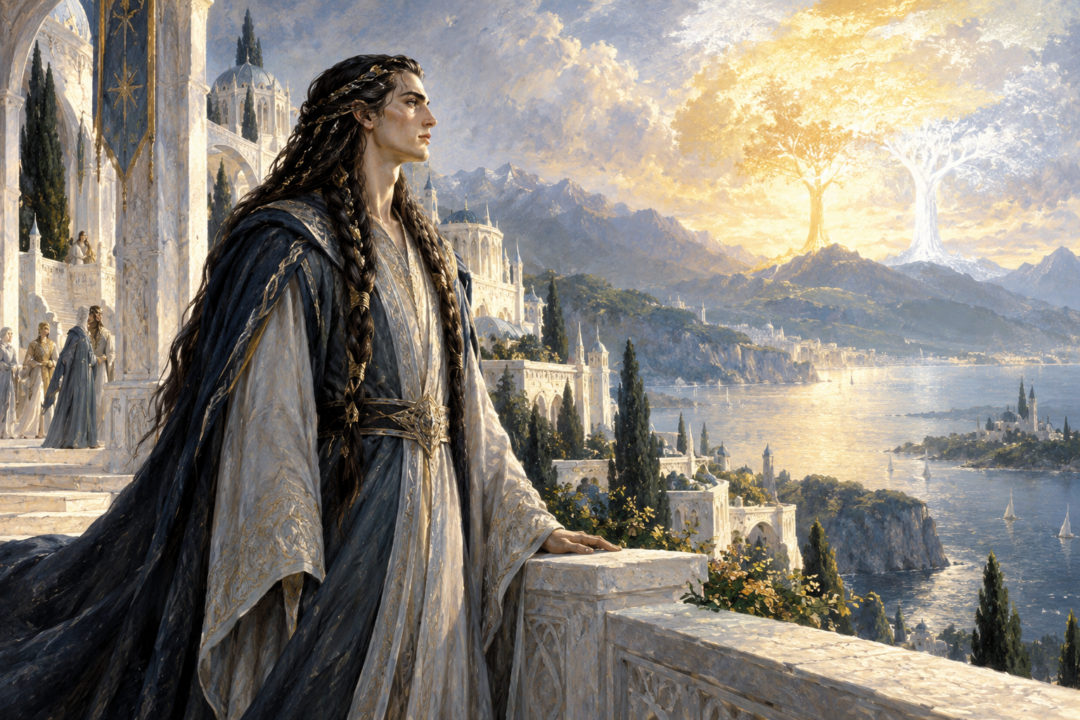
Fingon Was Not the Name He Grew Up With in Aman
Fingon is one of the most recognizable names of the First Age: the prince who crossed the Grinding Ice, rescued Maedhros from Thangorodrim, ruled the Noldor after Fingolfin, and died amid the ruin of the Nirnaeth Arnoediad.
Yet there is an easily missed detail hidden inside that familiar name.
The Elf we call Fingon was not born in Aman under the name Fingon.
In the late linguistic material concerning the descendants of Finwë, his Quenya father-name is Findekáno. “Fingon” belongs to the linguistic world that the Exiled Noldor entered after returning to Middle-earth. It is a Sindarinized form shaped for life in Beleriand.
That distinction matters because the change was not merely cosmetic. The Noldor crossed the Sea carrying the language and names of Aman, but they entered a country already inhabited by Elves whose speech had developed differently during the long separation of the Eldar.
Findekáno becoming Fingon is therefore a tiny record of something enormous: exile changed even the words by which the Noldor knew one another.
In Aman, He Was Findekáno
The late essay usually called The Shibboleth of Fëanor, preserved in The Peoples of Middle-earth, gives the names of Fingolfin's children in their Quenya forms.
His eldest son is Findekáno.
The name was given by his father. Its first element is connected with findë, referring to hair, while káno carries the sense of a commander or one who calls or commands. The beginning of the name also echoed the ancestral name Finwë.
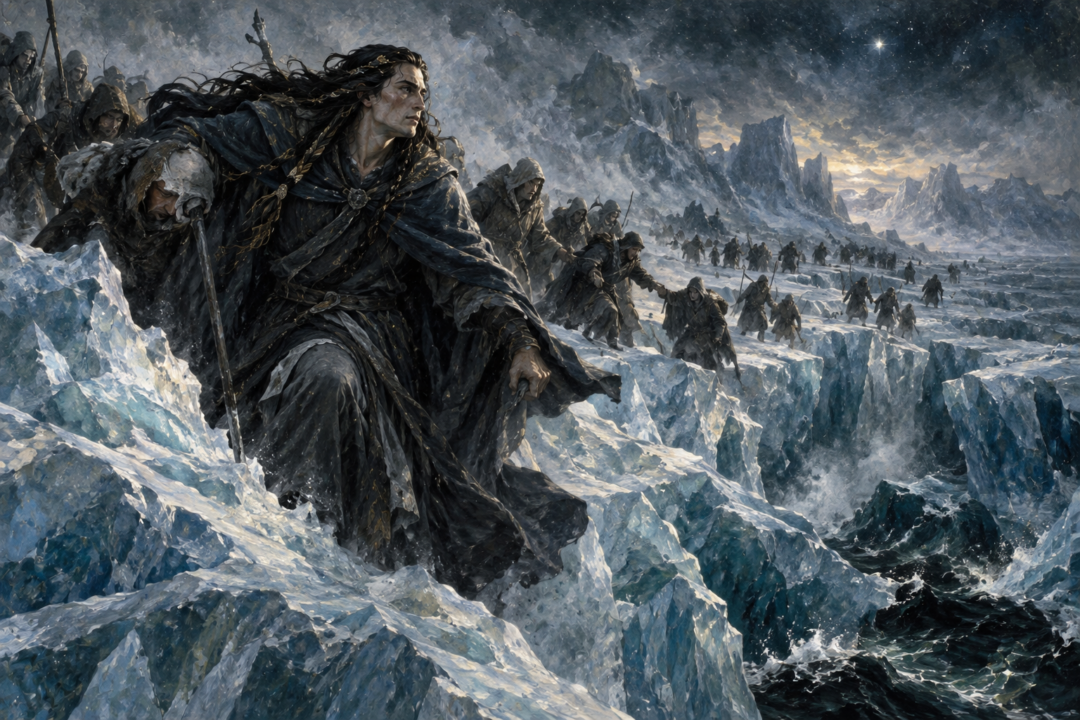
That association was particularly appropriate because Findekáno had long dark hair worn in great plaits braided with gold.
This is one of those rare linguistic details that suddenly makes a remote First Age figure visually immediate. Before he was the king standing beneath the shadow of Angband, Findekáno was a prince of the House of Finwë whose very name belonged to his family, appearance, and native language.
“Fingon” should therefore not simply be projected backward as though nothing changed between Tirion and Beleriand.
It represents a later linguistic environment.
Why Findekáno Became Fingon
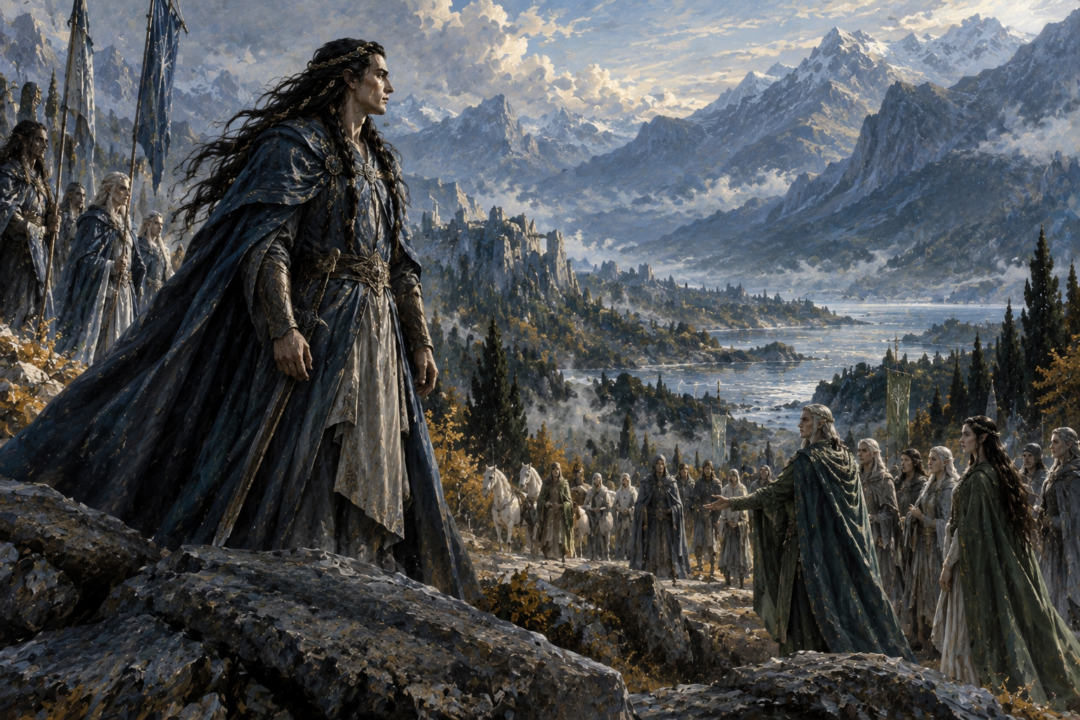
When the Noldor returned to Middle-earth, they encountered the Sindar of Beleriand.
The two peoples were related, but their languages had developed separately. The Exiles spoke Quenya; the Sindar spoke Sindarin.
The Noldor proved quicker at learning Sindarin than the Sindar were at learning Quenya, and Sindarin increasingly became the language used by the Exiles in ordinary life in Beleriand. Later, after Thingol learned more of the Kinslaying at Alqualondë, he forbade the use of the Exiles' tongue among his people. The Silmarillion says that Quenya thereafter ceased to be the everyday speech of the Exiles, surviving as a language of lore and in use among Noldorin lords.
The Sindarinization of personal names belongs to this broader linguistic transformation, though it should not be reduced solely to Thingol's prohibition.
The late linguistic writings describe the adaptation of Noldorin names into Sindarin forms as deliberate. The Exiles themselves adjusted names to the linguistic environment in which they now lived.
Thus Findekáno became Fingon.
This is not simply the natural evolution of one word across centuries inside a single language. It is the reshaping of a Quenya personal name into a form suitable for Sindarin speech.
The distinction is important.
Fingon is not merely a convenient English-language shortening of Findekáno. Within the imagined linguistic history of Middle-earth, it belongs to another language and another phase of his life.
The Meaning Did Not Transfer Neatly
There is another subtlety.
It is tempting to assume that a Sindarinized name must be an exact translation of the original Quenya name. But that is not necessarily what happened.
The late discussion of Findekáno/Fingon treats the Sindarin form as an adaptation of the original name. The sound and shape mattered, and such adapted names did not always reproduce the original semantic structure with perfect precision.
That tells us something about how these names should be read.
The purpose was not always to ask, “How would a Sindar translate every element of this Quenya name?”
Instead, the Noldor could create a name that sounded appropriate in Sindarin while remaining recognizably connected to the older form.
Findekáno and Fingon therefore belong together, but they are not simply interchangeable labels detached from history.
One belongs naturally to the Quenya-speaking world from which Fingolfin's son came.
The other belongs to Beleriand.
Fingon Was Part of a Larger Pattern
The change becomes clearer when we look at Fingon's family.
His brother Turukáno becomes Turgon.
Their father presents an even more complicated case. His Quenya name was Ñolofinwë—often written Nolofinwë when the distinction represented by initial ñ is not shown—while the familiar Fingolfin is a Sindarin form associated with his name and ancestry.
Elsewhere among the Noldorin princes, the same broad process gives readers many of the forms that dominate the published First Age narratives.
This means that a reader encountering The Silmarillion largely meets the Exiles through names appropriate to Middle-earth rather than always through the names that would have characterized their earlier lives in Aman.
The familiar map of the First Age is therefore linguistic as well as geographical.
Crossing into Beleriand changes the vocabulary of the story.
Arakáno Reveals the Boundary
Perhaps the most revealing comparison is Fingon's younger brother Arakáno, a son of Fingolfin who appears in late material but not in the published Silmarillion narrative.
In that late conception, Arakáno crossed the Helcaraxë with his father's people but was killed soon after their arrival in Middle-earth, in the first fighting of Fingolfin's host.
The Sindarin form Argon exists, but the circumstances surrounding the names make him an illuminating contrast with his brothers.
Findekáno lived on in Beleriand as Fingon.
Turukáno lived on in Beleriand as Turgon.
Arakáno's life ended before he could truly become part of the established Noldorin society of Beleriand in the same way. The Sindarin form Argon therefore belongs to the later linguistic presentation or remembrance of him rather than demonstrating that he personally lived for years under that name.
This should not be turned into an absolute mechanical rule about exactly when every Elf changed names. The surviving writings do not provide that kind of administrative chronology.
But the pattern is striking.
A Sindarinized name can tell us something about the world in which an Exile's identity was being expressed.
The Name Marks an Exile
That gives “Fingon” a quiet significance.
Findekáno belongs to the Blessed Realm: to the House of Finwë before its destruction, to the light of the Trees, and to the Quenya-speaking society of the Noldor.
Fingon belongs to what came afterward.
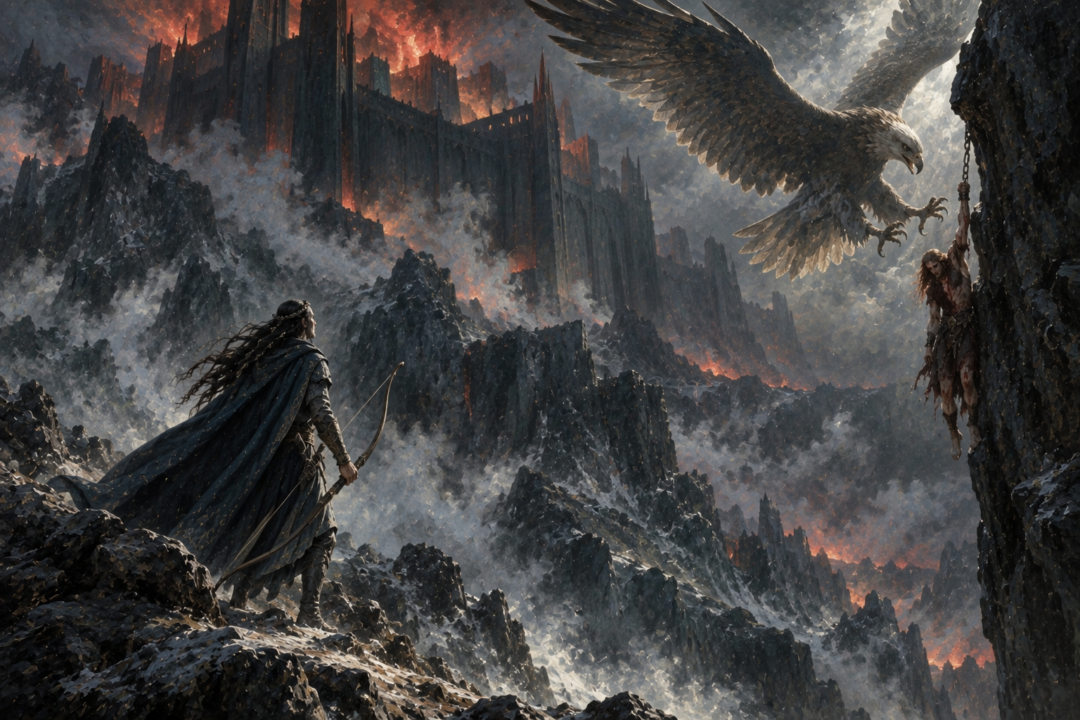
He is Fingon in the world of Mithrim and Hithlum. Fingon rides beneath the mountains of the north. Fingon rescues Maedhros from Thangorodrim. Fingon becomes High King after the death of Fingolfin. Fingon finally stands in the catastrophic battle later called the Nirnaeth Arnoediad.
The linguistic transition almost maps onto the tragedy of the Noldor themselves.
They left Aman believing they would pursue Morgoth, recover the Silmarils, and establish themselves in Middle-earth. Instead, they entered an older world whose peoples, languages, politics, and histories already existed independently of them.
Even these mighty princes had to adapt.
The names by which readers remember them preserve that adaptation.
Quenya Did Not Simply Vanish
None of this means Findekáno ceased to exist as though the old name had been formally erased.
Quenya remained immensely important to the Exiles.
After it ceased to function as their normal public language in Beleriand, it continued as a language of lore, memory, and elevated use. The linguistic situation was therefore more layered than a simple replacement of “old name” by “new name.”
An Elf such as Fingon could possess a Quenya name rooted in his family history while being commonly known in Sindarin-speaking Beleriand through its adapted form.
That distinction also helps explain why later records can preserve Quenya forms that are largely invisible in the main narrative.
The reader sees Fingon.
Behind Fingon stands Findekáno.
And behind Findekáno stands the vanished social world in which that name was first given.
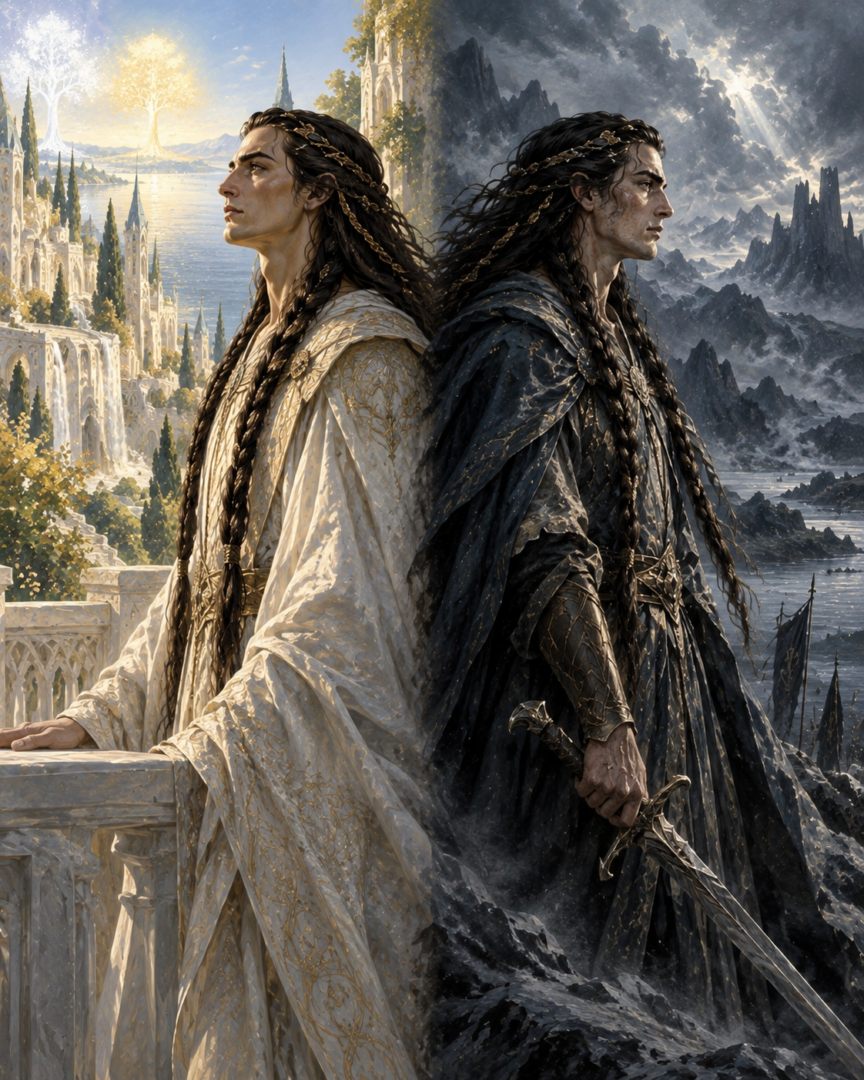
Two Names, Two Worlds
It is easy to treat the names of The Silmarillion as fixed labels. Fingon is Fingon; Turgon is Turgon; the story begins, and those names simply belong to them.
But the linguistic history makes the First Age stranger and richer.
Fingon is, in an important sense, a Beleriand form.
The prince born in Aman bore the Quenya name Findekáno. Only after the Exiles returned to Middle-earth and entered a Sindarin-speaking world does the familiar form Fingon belong naturally to his story.
That makes his name almost a miniature history of the Exile of the Noldor.
A prince leaves the land where he was born. He crosses the Sea and then the Helcaraxë. The language surrounding him changes. His people adapt themselves to another Elvish culture. Even the name spoken around him changes its shape.
Findekáno belonged to Aman.
Fingon belonged to Beleriand.
And between those two names lies the entire catastrophe that carried the Noldor from the light of the Two Trees into the long war beneath the shadow of Thangorodrim.
Sources & Notes
- Tolkien Gateway — Fingon https://tolkiengateway.net/wiki/Fingon
- Tolkien Gateway — The Shibboleth of Fëanor https://tolkiengateway.net/wiki/The_Shibboleth_of_F%C3%ABanor
- Tolkien Gateway — Quenya https://tolkiengateway.net/wiki/Quenya
- Tolkien Gateway — Sindarin https://tolkiengateway.net/wiki/Sindarin
These references document Fingon’s Quenya name Findekáno, the late linguistic source that preserves it, and the changing roles of Quenya and Sindarin among the Exiled Noldor. The two-name framing as a miniature history of exile is interpretive synthesis.