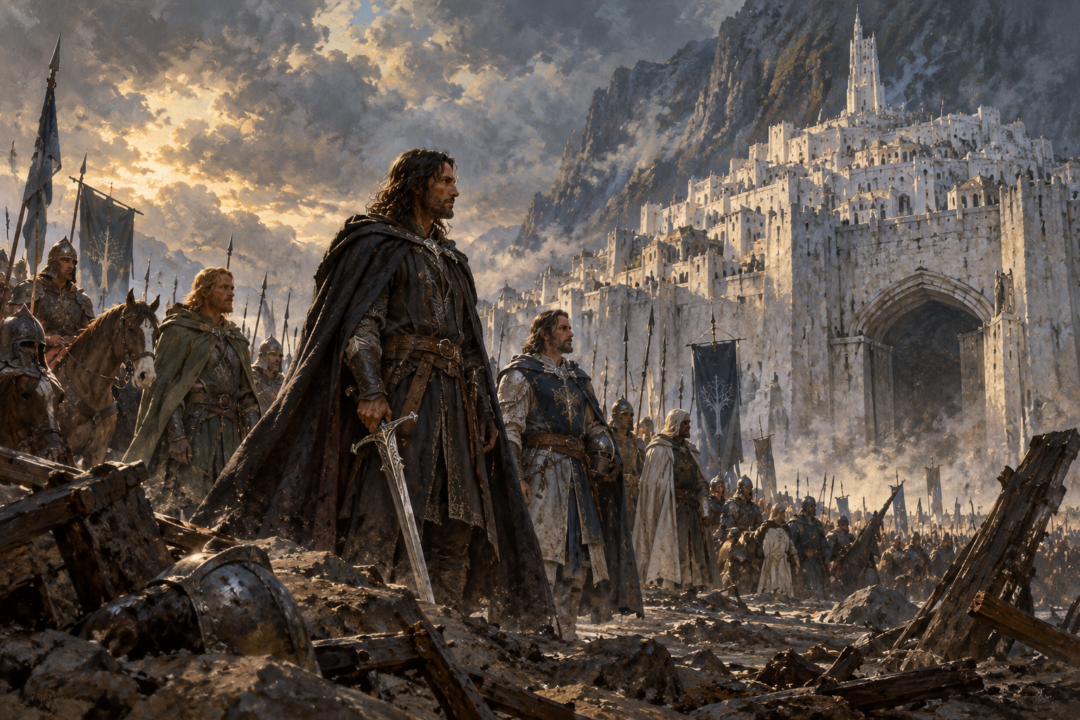
When Aragorn first reaches Minas Tirith after the Battle of the Pelennor Fields, he possesses almost everything a returning king could use to announce himself.
He bears Andúril, the sword reforged from the shards of Narsil. The royal standard has been unfurled. He has commanded the forces that came from the south, fought beside Gondor and Rohan, and demonstrated the healing power associated in Gondor’s lore with the rightful king.
Yet Aragorn does not simply walk into Minas Tirith and take the throne.
Instead, he waits.
Even after Sauron falls, Aragorn’s coronation does not occur immediately. Frodo and Sam are first rescued and honored on the Field of Cormallen. The Captains of the West then return toward Minas Tirith with their host. Only on May 1, 3019, when the victorious company has reached the City, does Aragorn receive the Crown of Gondor.
That delay is not an empty ceremonial pause. It completes a pattern established before the final march against Mordor.
Aragorn refuses to make the restoration of the kingship into a struggle for personal power. He will enter Minas Tirith as king only when the war is won, Gondor can freely receive him, and the people who made victory possible are there to share in the moment.
Aragorn Had Already Refused to Seize His Moment
The key to understanding the coronation comes before the march to the Black Gate.
After the Pelennor Fields, Aragorn approaches Minas Tirith with Éomer, Prince Imrahil, and their captains. He could plausibly press his claim immediately. Denethor is dead. Faramir lies wounded. Aragorn has raised the standard of the Kings and openly displayed the signs of Elendil’s house.
But Aragorn sees the danger.
Gondor has been ruled by the Stewards for many generations. Entering as a claimant while the war continues could provoke uncertainty over authority at exactly the moment the West can least afford internal division.
Aragorn therefore declares that he will not enter openly or make his claim until the struggle against Mordor has been decided. He specifically fears “doubt and debate” arising while the war is still being fought.
That distinction matters.
Aragorn is not renouncing his claim. When Éomer asks whether he will permit the tokens of Elendil’s house to be challenged, Aragorn makes clear that he will not. His claim remains.
What he refuses is to turn that claim into an immediate political confrontation.
The Enemy comes first.
He Enters Minas Tirith as a Healer, Not as King
There is a striking complication: Aragorn does enter Minas Tirith that same night.
But not to claim the throne.
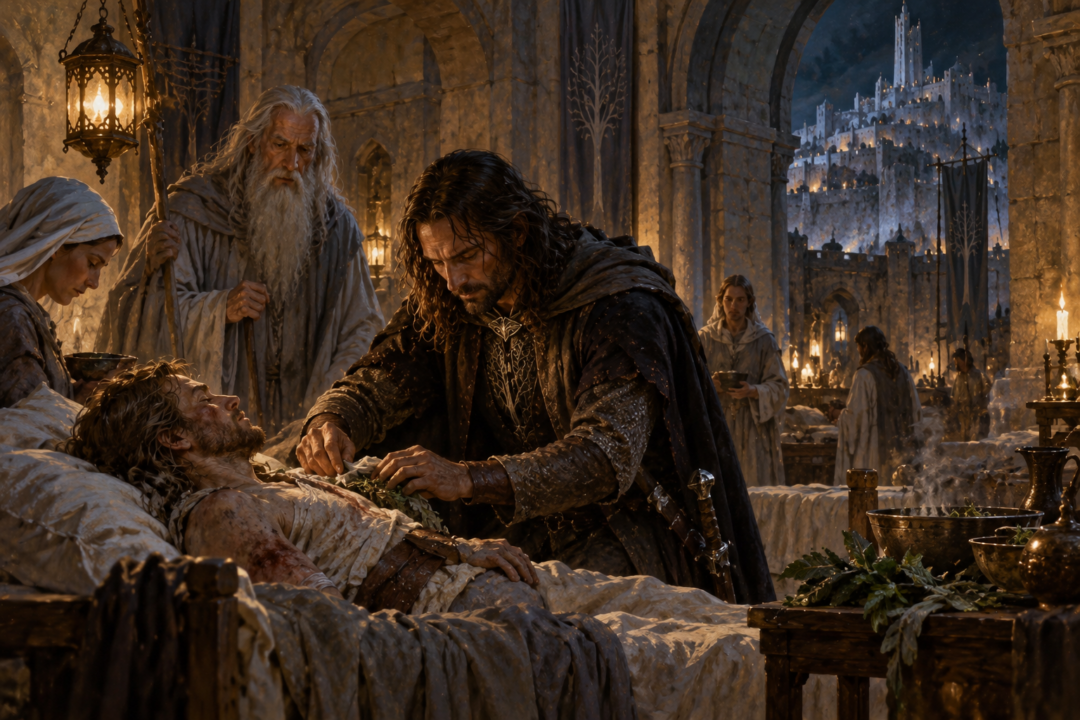
Faramir, Éowyn, and Merry are desperately ill in the Houses of Healing. Aragorn goes into the City quietly to help them. His entry is therefore an act of service rather than enthronement.
This is where an old saying remembered by Ioreth becomes important: the hands of the king are the hands of a healer.
Aragorn succeeds where the healers of the City have struggled, using athelas in the treatment of the wounded. Word begins spreading that a king may indeed have returned.
Yet even this does not cause Aragorn to declare himself ruler.
The contrast is deliberate within the story. He exercises one of the strongest signs associated with kingship while refusing to exploit it politically.
He can save Faramir without demanding Faramir’s office.
He can reveal something of the king before demanding recognition as king.
Then he leaves the City again.
The Final Battle Still Has to Be Fought
There is also a practical reason that no coronation should happen yet: Sauron still exists.
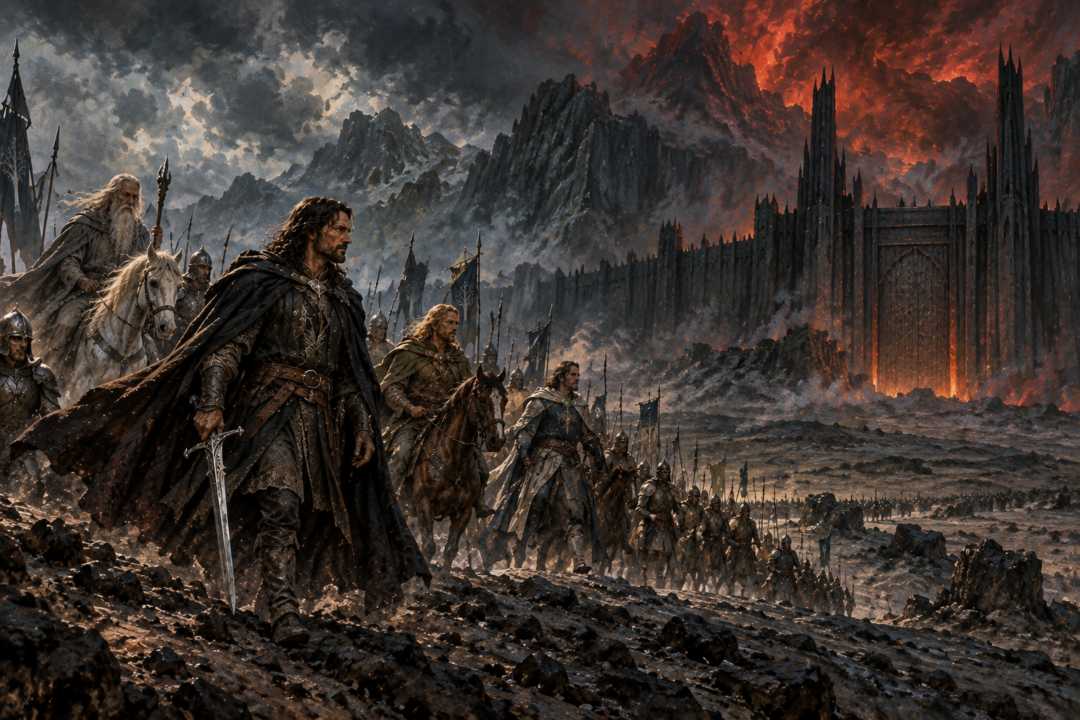
The victory on the Pelennor Fields has saved Minas Tirith, but it has not won the war. The Captains know that their military position remains desperate. Their only real hope is to march against Mordor and draw Sauron’s attention away from the Ring-bearer.
Aragorn therefore goes not to a throne but toward the Black Gate.
This makes the eventual coronation far more significant.
Had Aragorn been crowned immediately after the Pelennor, the ceremony would have taken place while the fundamental struggle remained unresolved. Gondor would have proclaimed a restored king while that king was preparing to lead what might easily become the last army of the West to destruction.
Instead, Aragorn remains Captain of the Host of the West.
He goes with the others.
The crown waits.
Victory Belongs to More Than the Man Who Becomes King
Sauron’s downfall reveals another reason the coronation works so powerfully only after the Captains return.
Aragorn did not personally defeat Sauron.
No single warrior did.
The victory depended upon an extraordinary chain of sacrifices and choices: Frodo carrying the Ring into Mordor, Sam sustaining him, Gollum’s final intervention at the Crack of Doom, Gandalf’s guidance, the armies that deliberately marched into overwhelming danger, and many others whose actions made the quest possible.
Aragorn understands this explicitly at his coronation.
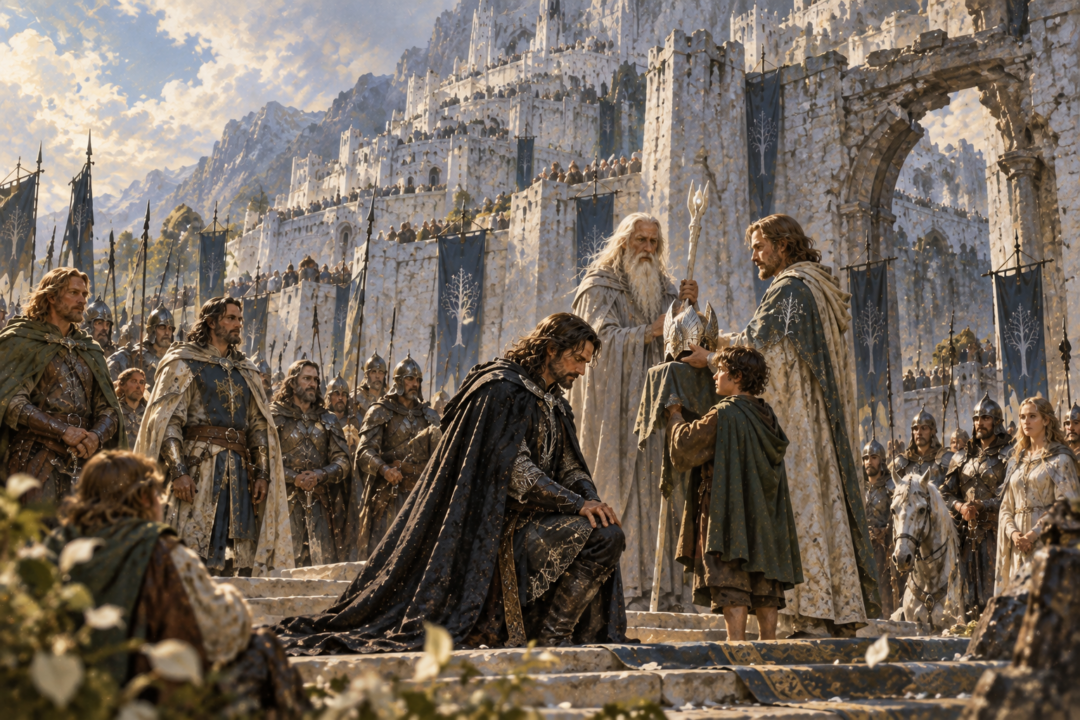
When the crown is brought forward, he does not simply place it on his own head. He asks that Frodo bring it to him and that Gandalf set it upon him.
His explanation is crucial: he has come into his inheritance through the labor and courage of many.
The ceremony therefore refuses to turn the War of the Ring into the story of one triumphant conqueror.
Aragorn becomes king because the Shadow has fallen, but the moment itself remembers those without whom there would be no kingdom left to inherit.
Why the Field of Cormallen Comes First
Before Minas Tirith receives its king, the Ring-bearers receive their honor.
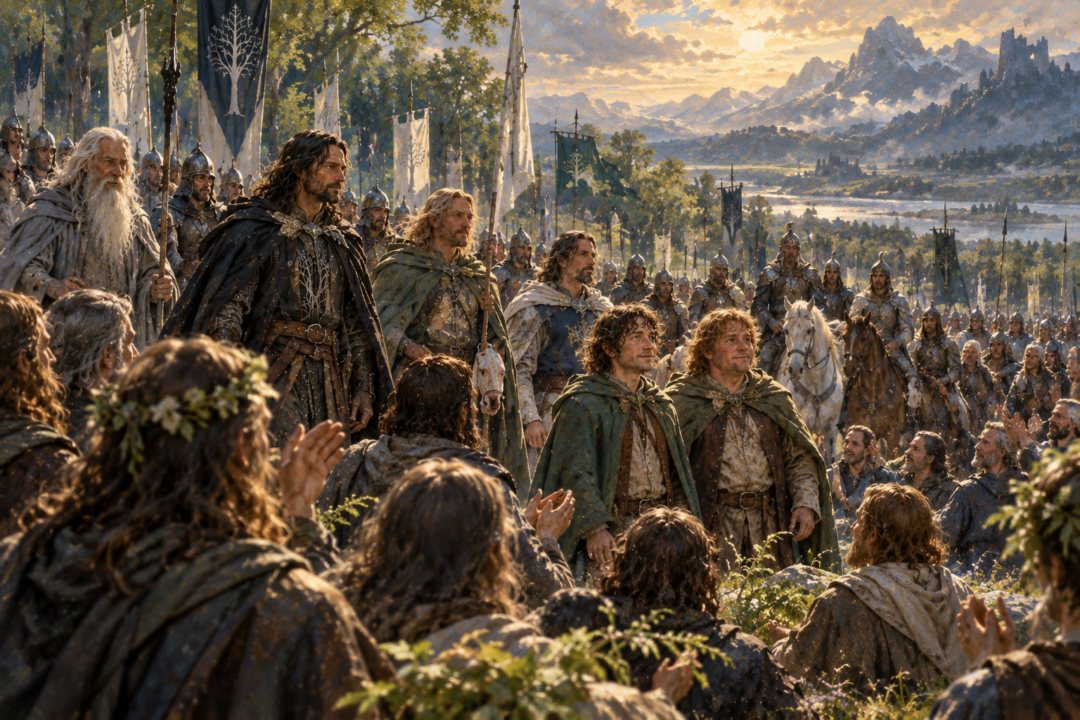
Frodo and Sam awaken in Ithilien and are brought to the Field of Cormallen. There the host of the West celebrates them.
This ordering is easy to overlook.
The narrative does not hurry from the destruction of the Ring directly to Aragorn’s coronation. It pauses to recognize the two hobbits who carried the central burden into Mordor.
Only later does the host begin its return.
According to the chronology in Appendix B, the Ring-bearers are honored on April 8. The Captains later travel back through Ithilien and toward Minas Tirith, reaching the Pelennor at the end of April. Aragorn is crowned on May 1.
The sequence gives the restoration of kingship a communal setting.
The returning king is accompanied by the survivors of the struggle that made his reign possible.
Faramir Must Be There Too
The presence of Faramir is equally important.
Aragorn does not abolish the Stewardship as though everything associated with the old government must disappear. At the coronation, Faramir offers to surrender his office.
Aragorn gives it back.
The Stewardship will continue under the restored royal house.
That act transforms what could have been a replacement into continuity. The line that governed Gondor in the absence of the Kings is not treated as an enemy regime to be humiliated. Faramir participates directly in the lawful transition.
More importantly, Faramir publicly presents Aragorn’s claim to the people.
He names Aragorn’s ancestry and titles and asks whether the people will have him as king and permit him to enter the City and dwell there.
Their answer is unanimous.
This is why the location of the ceremony matters almost as much as its timing.
Aragorn is still outside Minas Tirith.
The City does not merely discover that it has acquired a king. The question is asked before its people, and only after their acclamation does the coronation proceed.
The Broken Gate Becomes a Threshold
There is a remarkable visual detail in the scene.
The Great Gate of Minas Tirith has been destroyed during the siege and has not yet been rebuilt. A temporary barrier stands across the entrance.
Aragorn and the returning host halt outside.
On one side is the City: Faramir, Húrin the Warden of the Keys, Éowyn, knights, soldiers, and the people of Gondor.
On the other is Aragorn with the Captains of the West.
Between them lies the place where the king will be received.
The broken gate is not stated to be a deliberate symbol, but the scene naturally carries symbolic force. The old order has survived the siege, but it has been wounded. The new order has arrived, but it does not simply force its way through the breach.
Recognition comes first.
Then the crown.
Then entry.
Aragorn’s Coronation Is the Opposite of a Seizure
This pattern fits Aragorn’s behavior throughout the crisis.
He possesses power but repeatedly restrains its use.
He reveals himself to Sauron through the palantír, but that bold act serves the larger strategy against the Enemy. He raises the royal standard in battle, but does not use military victory to compel Minas Tirith to accept him. He enters the City when lives need saving, but leaves without claiming its government.
Only after Sauron is gone does the political question finally come to the front.
And even then Aragorn does not simply crown himself.
Faramir acts as Steward. The people give their assent. Frodo bears the crown. Gandalf places it upon Aragorn’s head.
The ceremony gathers the different strands of the victory around the new king rather than allowing the new king to absorb their glory.
The King Enters Only After Gondor Receives Him
That is ultimately why Aragorn’s coronation waits.
It is not because his ancestry suddenly becomes more legitimate on May 1. Aragorn knows who he is long before then.
Nor does victory magically create his claim.
What changes is the world around that claim.
Sauron has fallen. The Captains have returned. The Ring-bearers have been honored. Faramir is restored and able to perform his office. Gondor’s people can gather without an enemy army threatening their walls.
The question of kingship can finally be settled without distracting from the war for survival.
Aragorn had earlier said that he would wait for the welcome of the Lord of the City. At the coronation, that welcome becomes something larger: Steward, soldiers, allies, returning host, and people all stand together at the threshold.
Only then is the White Crown brought forth.
Only then does Aragorn kneel.
And only after he rises as King Elessar does he pass through the broken gateway into Minas Tirith.
The delay is therefore part of the meaning of his kingship.
Aragorn does not enter the City first and demand that Gondor recognize what he has become.
Gondor recognizes him first.
Then the King enters.
Sources & Notes
This article is based on close reading and interpretation of Tolkien's published works and related source material where relevant.