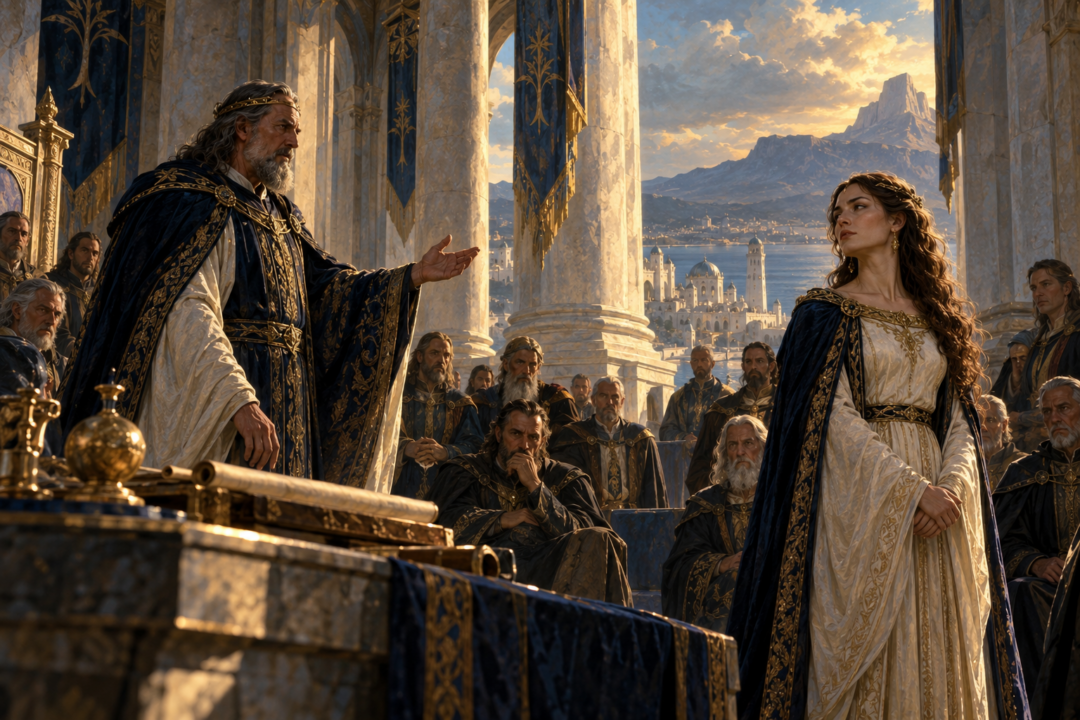
The Sceptre of Númenor was more than a royal possession. It represented the authority of the Kings descended from Elros, and for centuries its passage followed a simple expectation: the kingship would pass through the male line.
Then Tar-Aldarion faced a problem.
His marriage to Erendis had collapsed into bitterness and separation. Their only child was a daughter, Ancalimë. Unless Númenor changed its customs, the direct line from Aldarion could lose the Sceptre.
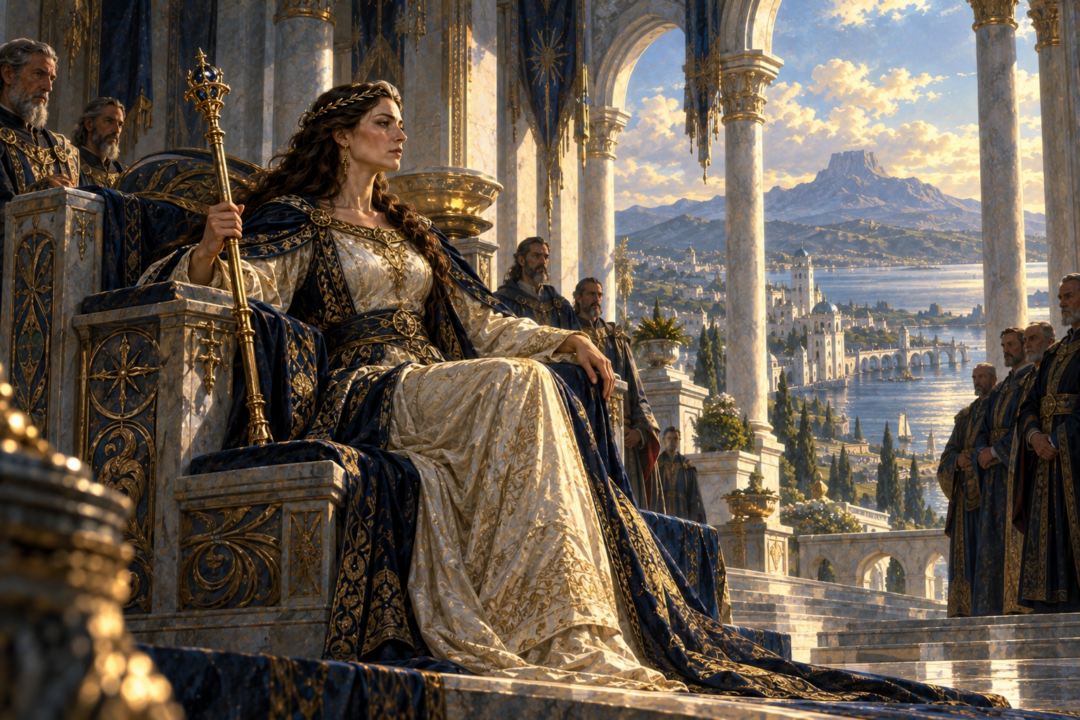
The solution was extraordinary. During Aldarion’s reign, Númenor altered its law of succession so that Ancalimë could become his heir. She eventually took the Sceptre as Tar-Ancalimë, the first Ruling Queen of Númenor.
But the change was more complicated than simply declaring that women could rule. The surviving accounts in Unfinished Tales preserve different formulations of the law, including details about marriage, descendants, and the rights of male and female heirs.
Behind those legal details lies one of Númenor’s most revealing family stories: a constitutional change born from a broken marriage, an increasingly estranged royal household, and a king determined that his daughter should succeed him.

The Problem Created by Aldarion and Erendis
Tar-Aldarion was the sixth ruler of Númenor. His great passion was the sea.
Long before Númenor became the imperial power of its later history, Aldarion devoted himself to ships, exploration, and voyages eastward to Middle-earth. He founded the Guild of Venturers and repeatedly spent long periods away from the island.
His wife Erendis increasingly resented those absences.
Their conflict is the heart of “Aldarion and Erendis” in Unfinished Tales. What begins as a difficult marriage becomes a tragedy of incompatible desires. Aldarion cannot abandon the sea, while Erendis cannot accept a marriage continually subordinated to it.
Caught between them was their daughter, Ancalimë.
Erendis eventually withdrew with her to Emerië, away from Aldarion and much of court life. There Ancalimë grew up under the powerful influence of her mother and within the emotional aftermath of her parents’ estrangement.
The political consequence was unavoidable: Aldarion had no son.
Under the older Númenórean custom, that mattered enormously.
Númenor’s Older Rule Favored Male Heirs
The material appended to “Aldarion and Erendis” explains that the old law did not simply give the throne to the ruler’s eldest child regardless of sex.
Before Aldarion’s reform, the Sceptre descended through male heirs. A ruler’s daughter did not ordinarily inherit the kingship merely because she was his eldest or only child.
This had already affected Númenórean history.
Tar-Elendil, the fourth King, had an elder daughter named Silmariën. Yet she did not become the ruling monarch. The Sceptre instead passed to her younger brother, Tar-Meneldur.
That detail becomes particularly significant in the larger history of Middle-earth because Silmariën’s descendants became the Lords of Andúnië, and through that line came Elendil and ultimately the royal houses of Arnor and Gondor.
But Silmariën herself did not rule Númenor.
Ancalimë was born into a different situation generations later. She was Aldarion’s only child, and if the old system remained unchanged, the succession would have moved away from her.
Aldarion chose another path.
Aldarion Changed the Law
During Aldarion’s reign, Númenor adopted a new succession rule under which the ruler’s daughter could inherit.
The surviving textual material contains complexities and variant formulations, so the reform should not be reduced too neatly to a modern formula of absolute primogeniture from the outset.
One account states that the King’s eldest child, whether male or female, should receive the Sceptre. Another formulation associated with the later law still gave preference to a son over a daughter. The notes also discuss conditions involving marriage and the succession of an heiress.
What is clear is the decisive historical result: the old barrier preventing Ancalimë from inheriting because she was female was removed.
She became the King’s Heir.
The change transformed what had begun as a private dynastic problem into a lasting development in Númenórean kingship.
Yet Aldarion’s motives should be described carefully. The texts establish the succession problem and his legal action, but they do not require us to imagine him as pursuing a general political doctrine of equality. The reform directly ensured that his own daughter could inherit his authority.
That distinction matters.
Númenor’s first Ruling Queen emerged not from an abstract political movement described in the texts, but from the particular circumstances of one royal family.
An Heiress Was Expected to Marry
The revised system came with another complication.
According to the account in Unfinished Tales, an heiress was expected to marry, and one version of the law stated that she should resign the succession if she refused. This was connected to the need to continue the royal line.
That requirement immediately became significant in Ancalimë’s life.
She was deeply reluctant to marry.
Her upbringing helps explain why, although any psychological conclusion must remain cautious. She had witnessed the collapse of Aldarion and Erendis’s marriage and had grown up amid her mother’s hostility toward men and resentment of Aldarion. The narrative makes clear that these experiences shaped Ancalimë’s attitudes.
Her position therefore contained a sharp irony.
The law had been changed so that she could inherit, but inheritance placed pressure upon her to enter the very institution she had strong reasons to distrust.
Eventually she married Hallacar, a descendant of Vardamir and therefore himself of the royal line.
Their marriage was not a happy answer to the tragedy of her parents.
The surviving account portrays serious conflict between them, and Ancalimë’s attempt to control Hallacar became part of another troubled royal marriage. They nevertheless had a son, Anárion, through whom the direct royal succession continued.
The reform had preserved Aldarion’s line.
It had not healed the family.

Tar-Ancalimë Became Númenor’s First Ruling Queen
Aldarion eventually surrendered the Sceptre, and Ancalimë became Queen.
She ruled as Tar-Ancalimë, the seventh monarch of Númenor and its first Ruling Queen.
That title is important. Númenor had naturally possessed queens before her in the sense of wives of kings, but Ancalimë held the Sceptre in her own right.
Her accession established a precedent that would matter centuries later.
Númenor eventually had two further Ruling Queens: Tar-Telperiën and Tar-Vanimeldë.
Their reigns demonstrate that Ancalimë’s accession was not treated as a singular exception that vanished with her death. Female inheritance had become part of Númenor’s royal system, though the surviving traditions concerning the exact succession rules contain qualifications and changes.
The political structure of the kingdom had genuinely shifted.
And there is another revealing contrast.
Had the revised principle existed in the appropriate form during Tar-Elendil’s generation, the history of Silmariën’s place in the succession might have been different. Tolkien’s genealogical material does not invite us simply to rewrite that earlier succession retrospectively, but the comparison shows how significant Aldarion’s reform was.
Before it, an elder royal daughter such as Silmariën could be passed over.
After it, Ancalimë could hold the Sceptre herself.
The Reform Did Not Erase Dynastic Politics
It is tempting to describe the change as though Númenor suddenly adopted a simple rule that gender no longer mattered.
The textual history is less tidy.
The notes associated with “The Line of Elros” and “Aldarion and Erendis” preserve revisions and distinctions concerning the succession. In one form, the new law favored the eldest child irrespective of sex; elsewhere the rule is described in a way that retained preference for a male heir when both sons and daughters existed.
This is one of those areas where the safest reading is to acknowledge the textual variation rather than force every surviving statement into a single rigid constitutional formula.
What remained revolutionary by Númenórean standards was the possibility of a woman inheriting the Sceptre and ruling in her own right.
Ancalimë proved that possibility was real.
Her accession also shows something characteristic of Númenor before its later corruption: its institutions were not completely immovable. Even a tradition governing the descent of Elros’s royal authority could be altered when circumstances demanded it.
But those circumstances were intensely personal.
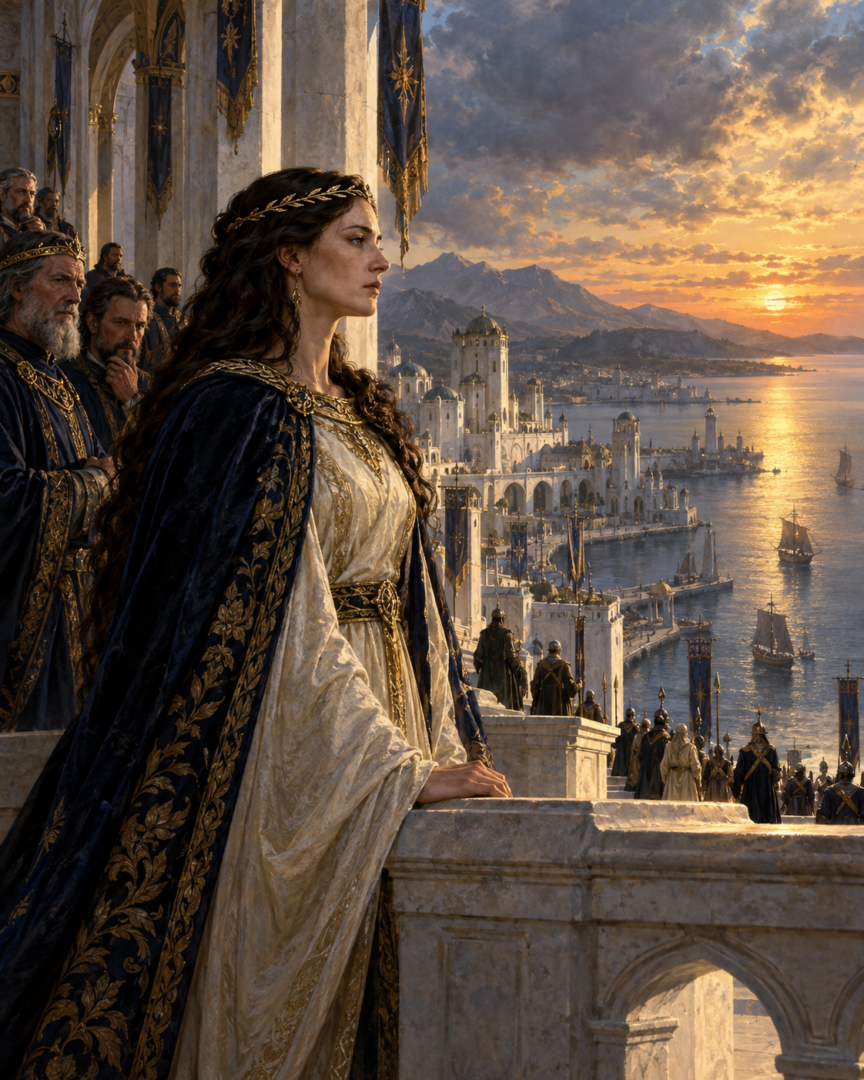
A Law Born from a Broken House
The story of Tar-Ancalimë’s succession is easy to summarize as a milestone: Númenor changed its law, and its first Ruling Queen inherited the Sceptre.
The deeper story is darker.
Aldarion’s devotion to the sea helped destroy his marriage. Erendis’s bitterness profoundly influenced their daughter. Their only child then became the center of a dynastic problem that the existing succession custom could not solve in Aldarion’s favor.
So the law changed.
Ancalimë gained something that earlier royal women had lacked: a recognized path to sovereign rule.
Yet political freedom and personal happiness were not the same thing. The new heiress faced dynastic pressure to marry and continue the line. Her own marriage became troubled, repeating in a different form some of the conflict that had surrounded her childhood.
That is what makes this episode more than a footnote in Númenórean genealogy.
The change in succession law was historically significant, but it did not emerge from an ideal royal household confidently planning a more enlightened future. It emerged from fracture.
And the woman for whom the law was changed became both its great precedent and one of the clearest examples of its human cost.
Tar-Ancalimë inherited the Sceptre because Númenor changed its rules.
But behind that legal revolution stood Aldarion, Erendis, and a daughter raised between them—a family whose inability to remain united permanently changed who could rule the greatest kingdom of Men.
Sources & Notes
This article is based on close reading and interpretation of Tolkien's published works and related source material where relevant.