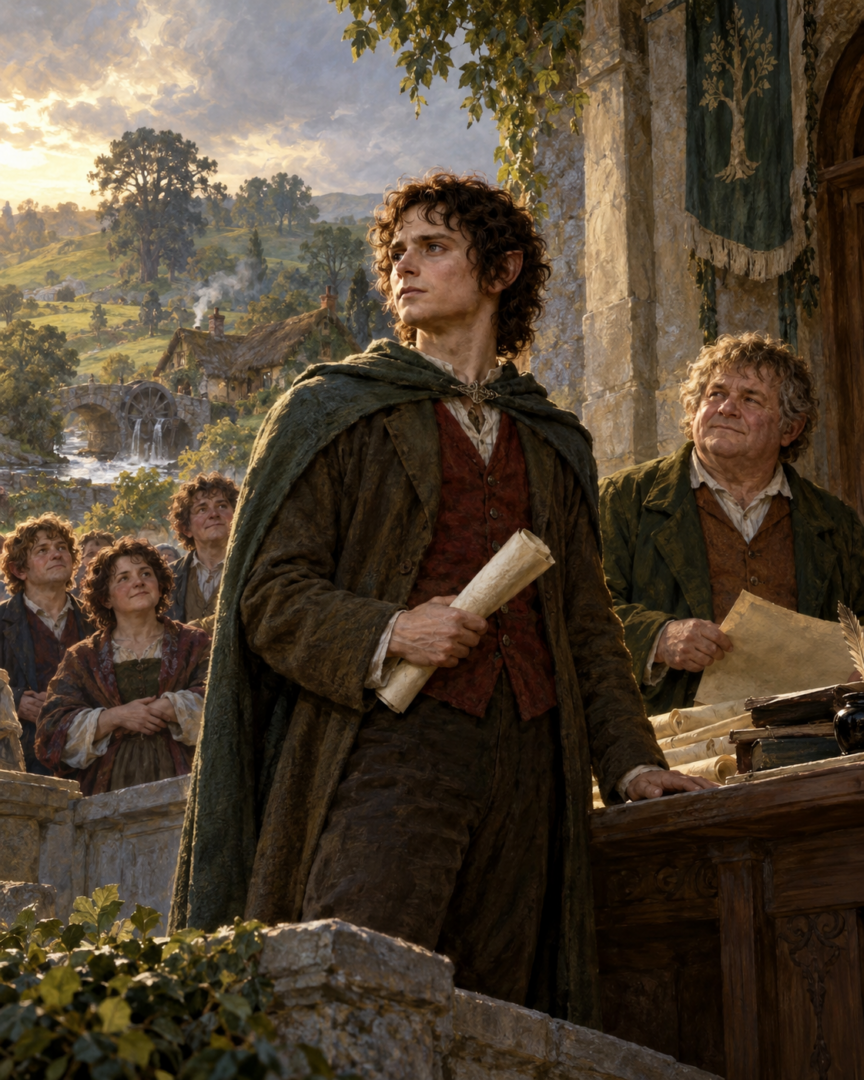
Frodo Baggins returns to the Shire having carried the One Ring into Mordor, survived the destruction of Barad-dûr, and been honored before the victorious armies of the West. Yet one of his final public roles is strikingly ordinary.
He becomes Deputy Mayor.
It sounds almost comic after everything that has happened. But the reason Frodo accepts the office—and especially what he does with it—reveals something important about the entire Scouring of the Shire.
Frodo does not become Deputy Mayor because he wants political power. He temporarily takes the place of Will Whitfoot because the rightful Mayor has been imprisoned and weakened by the regime that seized the Shire. And Frodo's one specifically recorded act in office is not to expand his authority.
It is to dismantle part of the machinery of control that had grown in his absence.
That makes his brief tenure one of the quietest but most revealing consequences of the War of the Ring.
The Shire Had a Mayor, but Hardly a Government
Before the Scouring, the Shire's political arrangements were remarkably light.
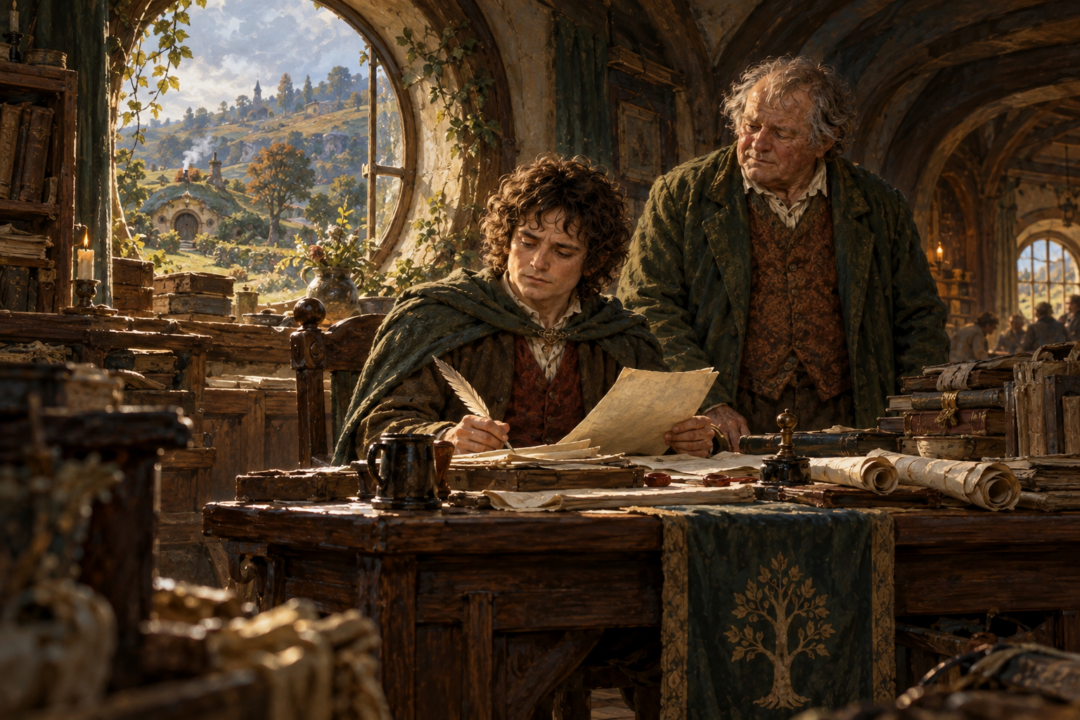
The Mayor of Michel Delving was the Shire's principal elected official. The office also carried responsibility as Postmaster and First Shirriff, but the Prologue to The Lord of the Rings makes clear how little governing hobbits normally required. Families largely managed their own affairs, and the Shirriffs were few.
The Mayor was chosen at the Free Fair on the White Downs for a seven-year term. Much of the office's public importance was ceremonial.
That arrangement tells us something fundamental about the Shire. Its society depends less upon centralized authority than upon custom, family, local responsibility, and habits so deeply established that elaborate government is unnecessary.
This is exactly what the occupation overturns.
While Frodo, Sam, Merry, and Pippin are away, Lotho Sackville-Baggins rises to power with the support of Men brought into the Shire. Eventually Saruman—known there as Sharkey—becomes the power behind the new order.
The transformation is not merely economic. It is political.
There are more Shirriffs. There are new rules. There are Shirriff-houses. Goods are gathered and carried away. Hobbits who resist can be arrested. The old Quick Post itself is used by the new authorities.
The Shire has acquired something it scarcely possessed before: an apparatus for controlling its inhabitants.
And one of the first obstacles to that apparatus is Mayor Will Whitfoot.
Why Will Whitfoot Ends Up in the Lockholes
Will Whitfoot is hardly presented as a revolutionary figure. He is the comfortably established Mayor of the old Shire, remembered in part for his considerable girth.
But when Lotho's activities become intolerable, Whitfoot attempts to protest.
He never gets the chance to exercise whatever authority his office might have carried. He is arrested and imprisoned in the Lockholes at Michel Delving.
The symbolism is difficult to miss even without pushing it beyond what the text states. The existing Mayor is removed, while a new coercive system takes his place.
Other troublesome hobbits eventually join him in imprisonment, including Fredegar Bolger and Lobelia Sackville-Baggins.
When the four Travellers return, therefore, they do not find a Shire simply damaged by outsiders. They find its familiar institutions distorted or displaced.
The Battle of Bywater breaks the armed power of the ruffians. Saruman's death ends the immediate threat at Bag End. But winning the fight does not automatically restore the old Shire.
Someone still has to put ordinary life back in its proper shape.
Frodo Helps Free the Prisoners
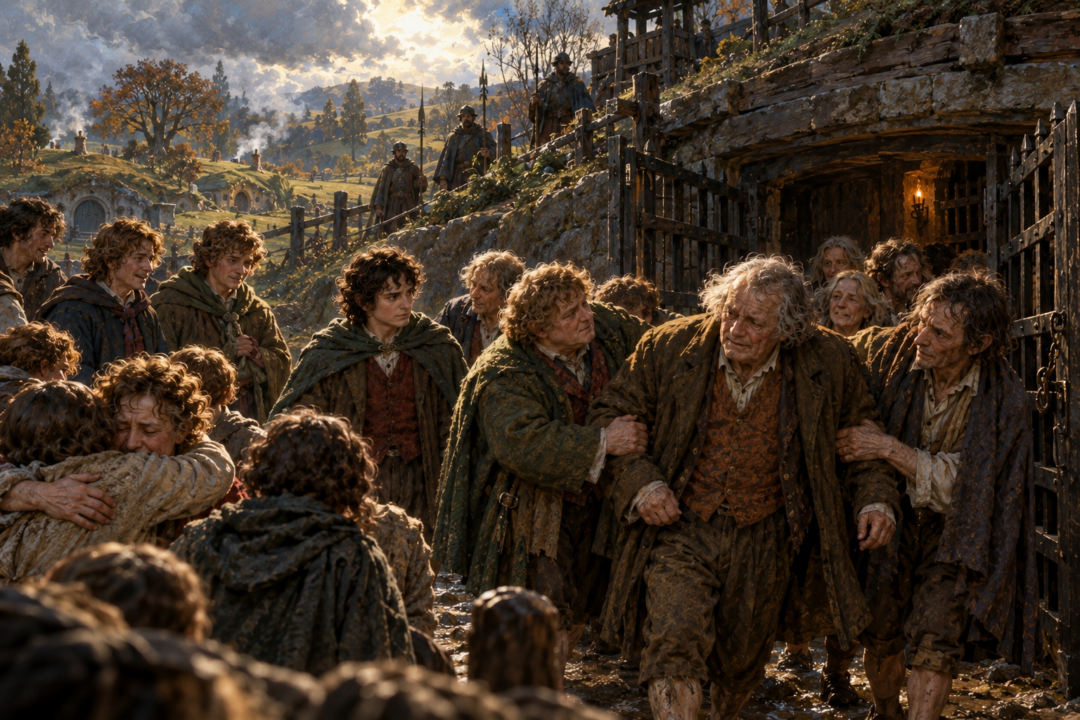
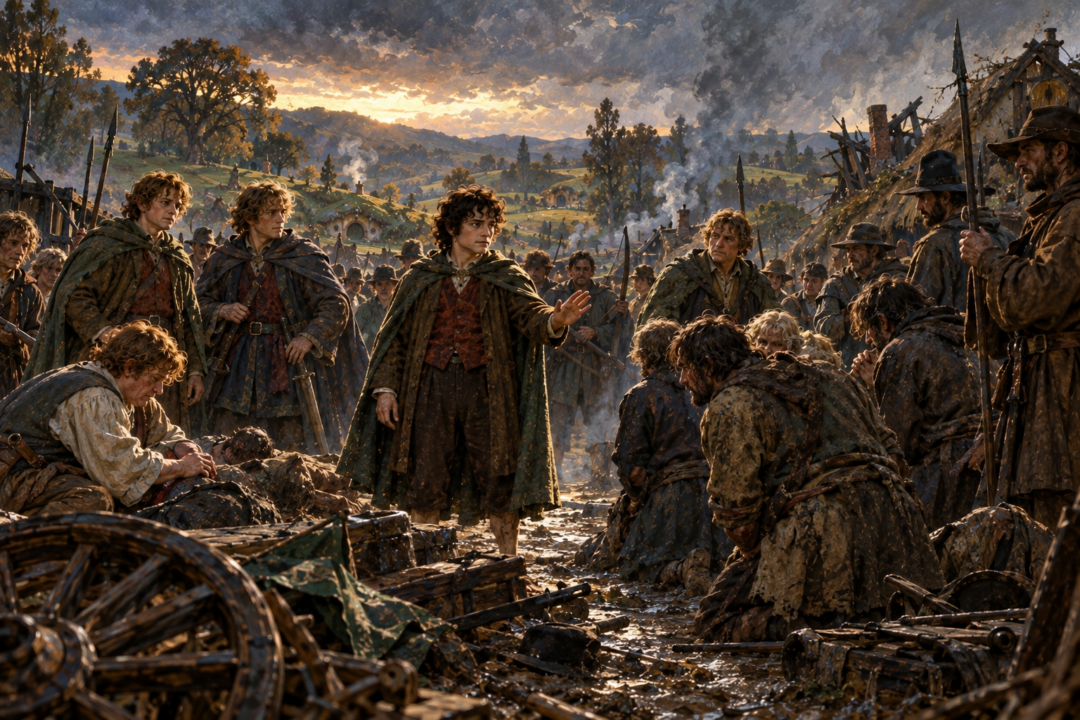
On the day after the Battle of Bywater, the Travellers go to Michel Delving and release the prisoners from the Lockholes.
The condition of those prisoners makes clear that the occupation has not been harmless playacting.
Fredegar Bolger, once nicknamed "Fatty," has become so thin that Pippin initially fails to recognize him. Lobelia, too, emerges aged and thin. Will Whitfoot has spent longer in the Lockholes than anyone else.
Although the narrative suggests that Whitfoot may have been treated less harshly than some prisoners, he is still in no condition immediately to resume the mayoralty.
He needs time to recover.
Frodo therefore agrees to serve as his Deputy.
This distinction matters. Frodo does not replace Whitfoot as the new Mayor, seize the position as leader of the victorious rebels, or claim authority because of his achievements outside the Shire.
He fills in for the legitimate office-holder while Whitfoot recovers.
His authority is temporary from the beginning.
That is particularly fitting after a story in which the central temptation has so often been the desire to use power for supposedly good purposes.
Frodo's Only Recorded Act as Deputy Mayor
What does the Ring-bearer actually do once he has governmental authority?
The answer is remarkably precise.
In "The Grey Havens," the narrative says that Frodo's only act as Deputy Mayor was to return the Shirriffs to their proper functions and numbers.
That detail deserves more attention than it usually receives.
Under the occupation, the Shirriffs had multiplied dramatically. When the Travellers encounter them on returning home, they learn that there are hundreds and that the authorities want still more. Some participate unwillingly; others enjoy interfering in their neighbors' affairs, and some perform spying work for the Chief and his Men.
The old Shire office has been transformed into an instrument of surveillance and enforcement.
Frodo reverses that transformation.
He does not inherit the expanded force and decide that it might now be useful in better hands. He does not preserve emergency powers so that the victors can efficiently reconstruct the country.
He reduces the Shirriffs.
In other words, one of Frodo's final exercises of public authority is an act of institutional restraint.
Frodo Does Not Become the Shire's Strongman
There is another revealing detail in the division of responsibilities after the Scouring.
Frodo does not personally direct the pursuit of every remaining ruffian.
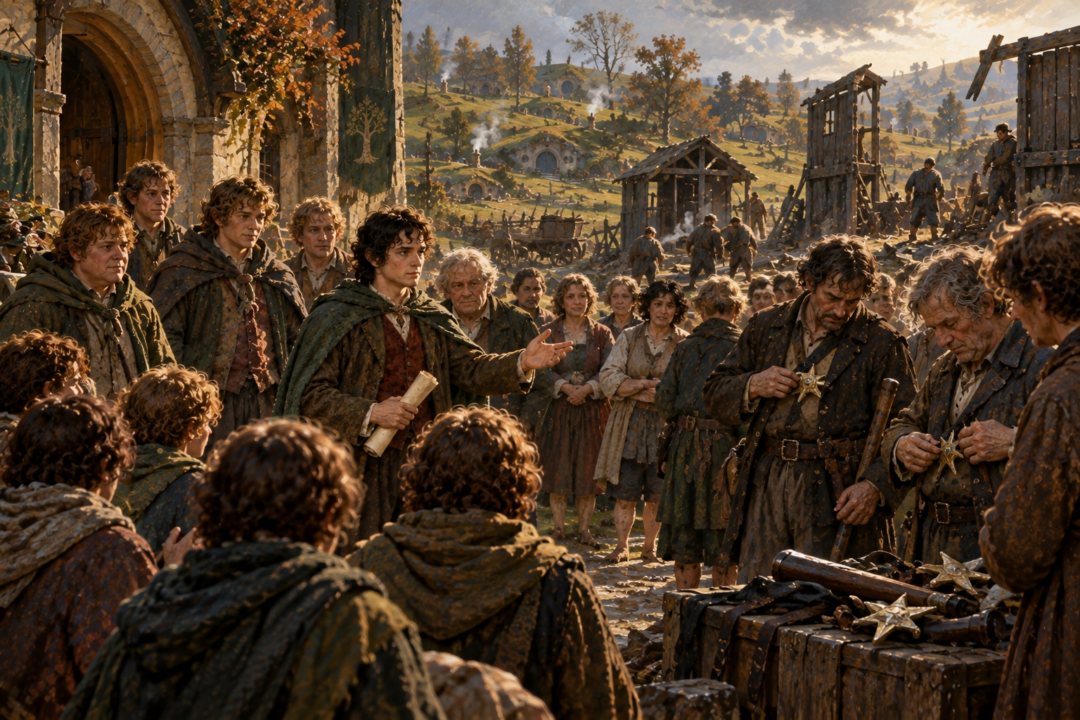
That work is left to Merry and Pippin. The surviving gangs are hunted down, and those who surrender are escorted out of the Shire.
Meanwhile, Sam becomes deeply involved in the physical restoration of the land. The ugly structures raised under Sharkey's rule are demolished, useful materials are recovered, homes are repaired, hidden stores are found, and eventually Sam's gift from Galadriel plays a remarkable role in restoring the Shire's damaged trees.
Each of the Travellers therefore contributes differently.
Merry and Pippin have become capable military leaders. Sam turns his attention toward healing and rebuilding. Frodo's role is quieter.
He helps return authority to its limits.
That is consistent with his conduct during the Scouring itself. Frodo repeatedly tries to prevent unnecessary killing. At Bywater he insists that hobbits who have surrendered must not be harmed, and even toward Saruman he continues to reject vengeance.
His Deputy Mayorship belongs to the same pattern.
Frodo has seen power in its most terrible forms. When he is briefly entrusted with a little power at home, he does not cling to it.
The Shire Heals Faster Than Frodo Does
There is a painful contrast here.
The Shire begins recovering with extraordinary speed.
By Yule, the structures built by Sharkey's Men have been pulled down, and their bricks are being reused for repairs. Supplies hidden by the ruffians are recovered. The following year becomes extraordinarily fruitful, aided by Sam's careful use of the soil from Galadriel's garden.
The wounded landscape can heal.
Frodo cannot heal in quite the same way.
He resumes life at Bag End and works on the written record that will become part of the Red Book. But the injuries of his journey continue to trouble him. On anniversaries associated with his wounding at Weathertop and his poisoning by Shelob, he falls ill.
This gives his brief public office an added poignancy.
Frodo helps restore the conditions in which other hobbits can return to ordinary life, even as ordinary life is becoming increasingly difficult for him.
The Shire is becoming home again.
For Frodo, home is no longer enough.
Why Frodo Gives the Office Back
At the Free Fair on Mid-year's Day in Shire-reckoning 1420, Frodo resigns as Deputy Mayor, and Will Whitfoot returns to office.
There is no struggle over succession.
Whitfoot resumes the mayoralty and continues in office for another seven years. Later, in 1427, Samwise Gamgee is elected Mayor and eventually serves seven terms.
Frodo's place in that sequence is therefore deliberately brief.
He stands between occupation and restoration.
For a few months, the hobbit who carried the Ring holds an office created by necessity because another hobbit has been injured by tyranny. His most clearly recorded governmental action is to undo an expansion of coercive authority. Then, when the old Mayor is ready, Frodo steps aside.
The episode is small enough to overlook because it lacks the scale of the Pelennor Fields or Mount Doom.
Yet that smallness is exactly why it belongs in the Shire.
The victory over Sauron was never supposed to produce another Dark Lord with better intentions. And the victory over Sharkey was not complete merely because the ruffians had lost the Battle of Bywater.
The Shire had to become the Shire again.
Its prisoners had to be freed. Its homes had to be repaired. Its trees had to grow again. Its officials had to return to their proper roles.
Even its Shirriffs had to become ordinary Shirriffs again.
For a short while, Frodo helps make that possible.
Then he gives the authority back.
Sources & Notes
This article is based on close reading and interpretation of Tolkien's published works and related source material where relevant.