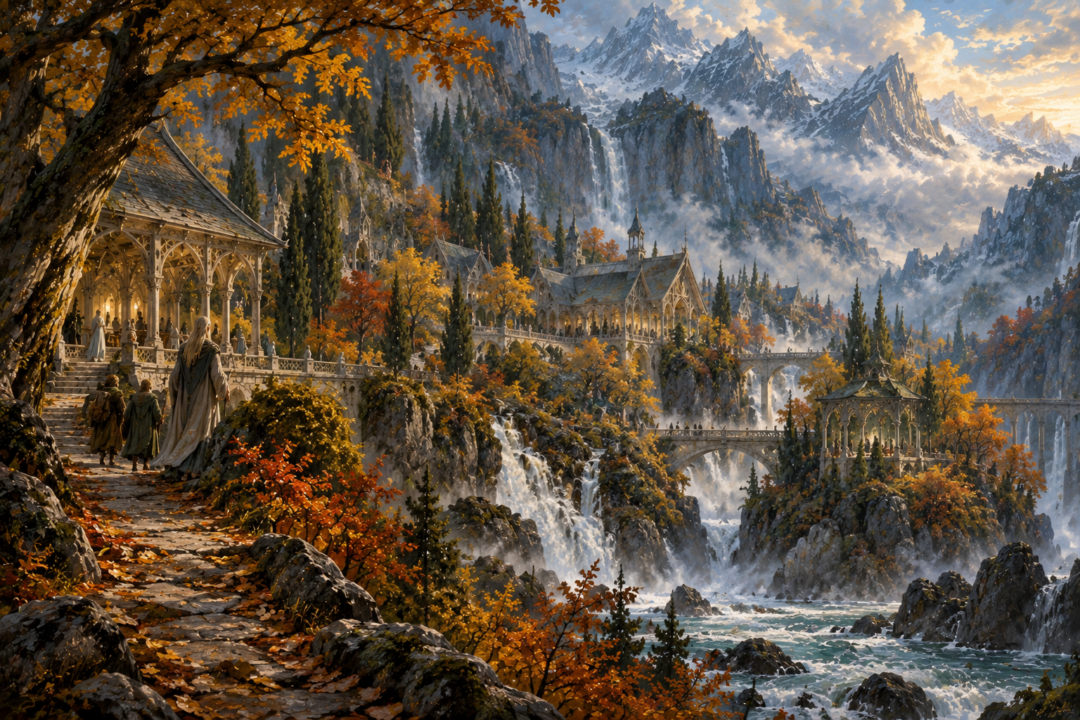
Rivendell and Lothlórien are both refuges of the Elves, both protected by extraordinary powers, and both governed by bearers of the Three Rings. Yet travelers experience them very differently.
In Lothlórien, the Fellowship encounters something difficult even to describe. The Golden Wood seems removed from the ordinary movement of the world. After leaving, Sam struggles to reconcile his experience there with the passage of days, while Frodo senses a land in which the past has somehow remained present.
Rivendell produces no equivalent confusion.
Bilbo can spend years there and grow older. Autumn comes to the valley. Snow gathers in the mountains. Travelers arrive carrying news of a changing world, and they eventually depart again. Yet Rivendell is also one of Middle-earth’s greatest strongholds of memory. Stories reaching back thousands of years remain known there with remarkable clarity.
That distinction reveals something important about Elven preservation.
Lothlórien preserves partly by resisting change. Rivendell preserves largely by remembering through change.
Rivendell Is Ancient, but It Is Not Frozen
Elrond established Rivendell — Imladris in Sindarin — during the war between Sauron and the Elves of Eregion in the Second Age. By the time Frodo reaches it late in the Third Age, the refuge has endured for thousands of years.
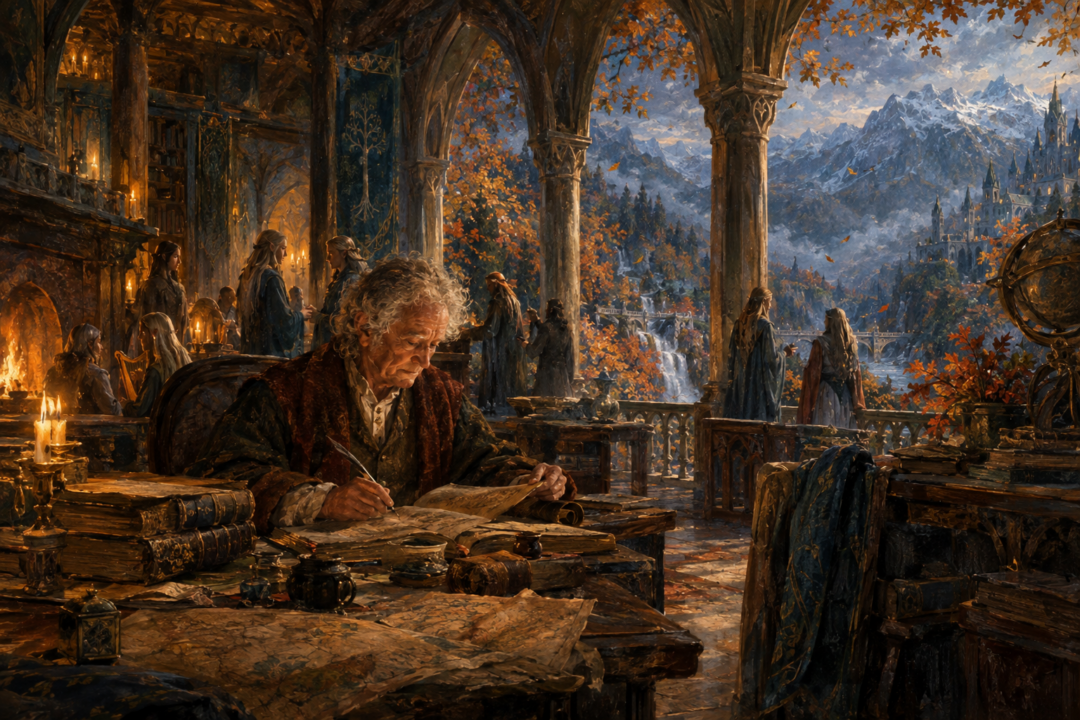
That longevity can make Rivendell appear almost timeless. But the narrative repeatedly grounds it in ordinary natural change.
When Bilbo first encounters the valley in The Hobbit, Rivendell is a place of water, trees, song, food, conversation, and rest. Decades later, Frodo arrives during autumn. The surrounding landscape belongs unmistakably to the season. Later still, winter affects journeys through the wider region.
Nothing suggests that calendars cease to function when someone crosses into Elrond’s valley.
Indeed, Rivendell is deeply connected to events occurring beyond its boundaries. Messengers arrive. News is exchanged. Decisions are made in response to contemporary dangers. Scouts leave to investigate the movements of the Enemy. Travelers depart according to the needs of the outside world.
Rivendell therefore preserves the past without pretending that the present has stopped.
That is crucial to its identity.
Rivendell Keeps History Through Living Memory
The most remarkable archive in Rivendell is not necessarily a library.
It is its inhabitants.
Elrond himself connects multiple ages of Middle-earth. He was born near the end of the First Age, descended from some of the most important lines of both Elves and Men, and witnessed the great struggles of the Second Age. He served Gil-galad and was present during the war against Sauron that ended with the Last Alliance.
When the question of the One Ring finally comes before him, ancient history is therefore not merely academic.
Elrond remembers part of it.
Other figures arriving at Rivendell add their own knowledge. Gandalf brings discoveries made through long investigation. Glóin carries the concerns of Erebor. Boromir brings the troubled perspective of Gondor. Legolas represents the Woodland Realm. Aragorn possesses knowledge inherited through the Dúnedain as well as the experience of his own travels.
The Council of Elrond becomes powerful precisely because these different memories and reports meet in one place.
Rivendell preserves history by assembling witnesses.
Its wisdom is active rather than decorative. The past is retained because it may be necessary for making decisions in the present.
Bilbo Shows How Rivendell Turns Memory Into Record
Bilbo’s later life makes this function especially visible.
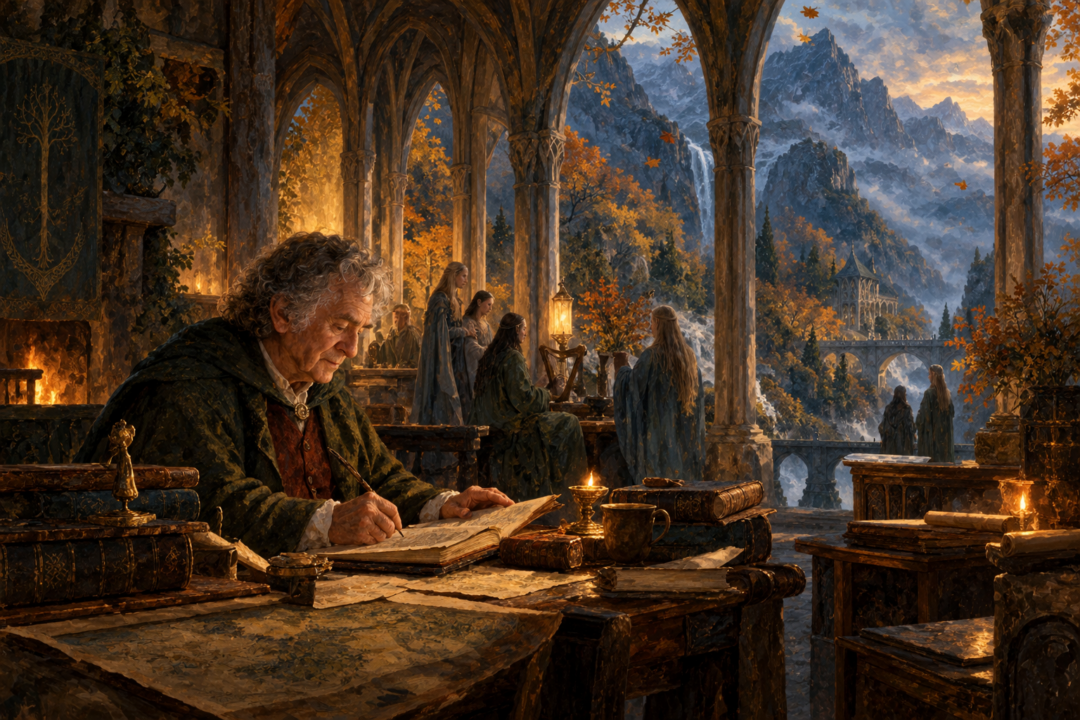
After leaving the Shire, he eventually settles in Rivendell. There he works on poetry and on material concerned with the Elder Days. The Red Book tradition presented in The Lord of the Rings connects Bilbo with translations from Elvish sources, later transmitted alongside the accounts of the War of the Ring.
This is preservation in an unusually concrete form.
Bilbo is not simply enjoying an Elven sanctuary. He is participating in the transmission of memory.
Ancient events become stories and records that can pass beyond the Elves themselves.
That matters because the Third Age is ending.
The Elves are departing. The great Eldarin realms will not continue indefinitely in Middle-earth. Much that they remember could become remote from the peoples who remain.
Rivendell answers that problem not by making history permanent, but by passing history onward.
Its preservation is therefore compatible with loss.
Things may disappear. People may depart. Ages may end. What happened can still be remembered.
Lórien Creates a Different Experience
Lothlórien is harder to describe because the Fellowship’s experience there deliberately unsettles ordinary perceptions of time.
After leaving the Golden Wood, Sam tries to understand how long they remained there. The phases of the moon appear to create a puzzle for him, and the discussion that follows makes clear that time in Lórien did not feel normal to the travelers.
Legolas cautions against simplistic explanations. Time does not literally stop for the Elves. Yet he also indicates that change and growth are not experienced there in the same way mortals commonly understand them.
Frodo’s earlier perception on Cerin Amroth points in the same direction.
Lórien seems simultaneously ancient and immediate. The Elder Days feel close. The world appears fresh rather than worn down by centuries.
This does not establish a mechanical rule that time runs at a different numerical speed inside Lórien. The text is subtler than that. The effect involves perception, preservation, memory, and Elvish experience rather than a clearly defined temporal formula.
Nevertheless, the difference from Rivendell is striking.
Visitors to Rivendell encounter history.
Visitors to Lórien can feel as though they have stepped into it.
The Three Rings Help Explain the Similarity — but Not Every Difference
The connection between the two realms becomes especially significant once the Three Elven Rings are revealed.
Elrond bears Vilya, while Galadriel bears Nenya. Gandalf possesses Narya.
The Three were associated with preservation and resistance to the decay imposed by time. They were not made by Sauron, though because they were forged using knowledge ultimately derived from him, they remained subject to the One Ring while it existed.
Both Rivendell and Lórien therefore benefit from powers connected with preservation.
But the texts do not provide a technical manual explaining exactly what each Ring does to its surrounding territory. It would be too strong to claim that Vilya produces one measurable temporal effect while Nenya produces another.
What can safely be said is that the two realms manifest preservation differently.
Lórien is especially associated with a beauty held against fading. Galadriel herself explains the peril facing the Elves: if the One Ring is destroyed, the power of the Three will fail, and the things accomplished through them will fade.
Rivendell shares that eventual fate.
Yet its narrative character remains distinct.
Lórien Preserves a World; Rivendell Preserves a Story
One useful way to understand the contrast is through what each refuge seems most determined to retain.
Lórien preserves an environment.
Its mallorn trees, golden leaves, silver light, and ancient atmosphere create the impression of an Elven world protected from the weariness overtaking Middle-earth. Galadriel’s realm becomes one of the clearest expressions of the Elvish desire to preserve beauty against inevitable change.
Rivendell preserves continuity.
Its halls contain songs, genealogies, stories, memories, counsel, and people whose lives connect otherwise distant periods of history.
This distinction should not be made absolute. Lórien certainly contains memory and song, while Rivendell is also preserved and protected through Elven power.
But as a literary contrast, it is revealing.
Lórien allows the past to remain experientially near.
Rivendell allows the past to remain intelligible.
One preserves something like the atmosphere of an earlier world. The other preserves the knowledge needed to understand how that world became the present one.
The Council of Elrond Reveals Rivendell’s Purpose
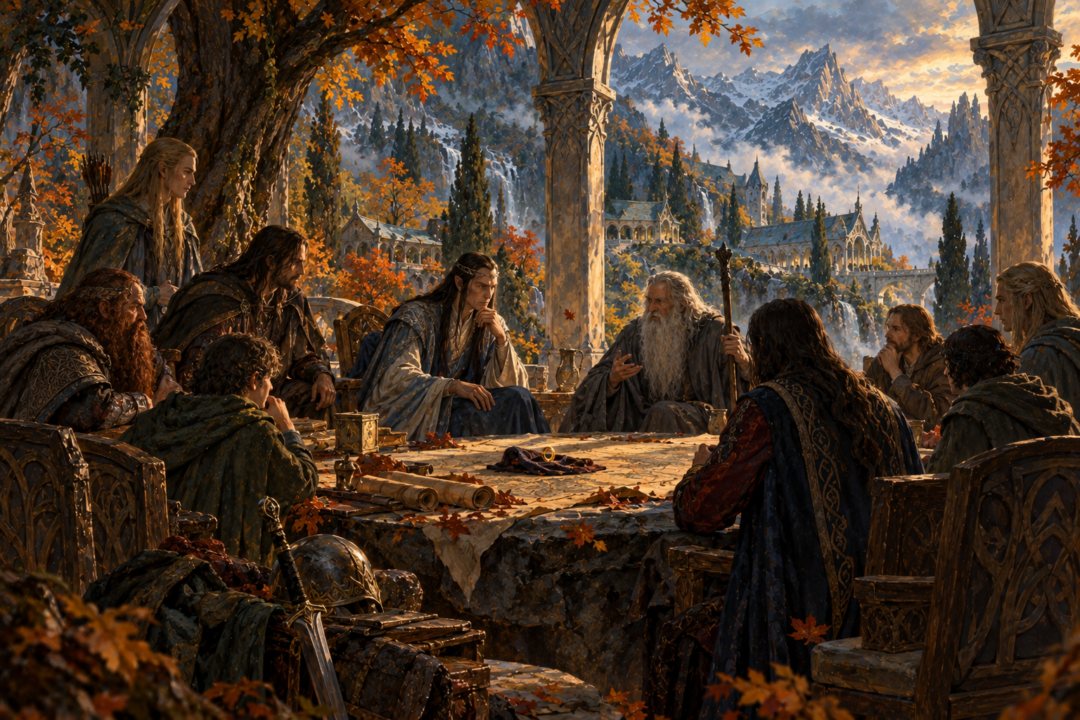
The Council of Elrond may be the clearest demonstration of this difference.
The meeting is not simply a strategy session.
Before anyone can decide what should happen to the Ring, they must reconstruct its history.
Isildur’s actions matter. Gollum’s discovery matters. Bilbo’s finding of the Ring matters. Gandalf’s research matters. Aragorn’s pursuit of Gollum matters. The movements of the Nazgûl matter. The histories of Gondor, Erebor, Mirkwood, and the Shire suddenly converge.
The correct action depends upon remembering correctly.
This is exactly the kind of power Rivendell represents.
Sauron’s return threatens Middle-earth partly because knowledge has become fragmented. Different peoples possess different pieces of the truth. In Elrond’s house, those pieces can be brought together.
History becomes strategically useful.
The past is not preserved merely because it is beautiful.
It is preserved because forgetting can be dangerous.
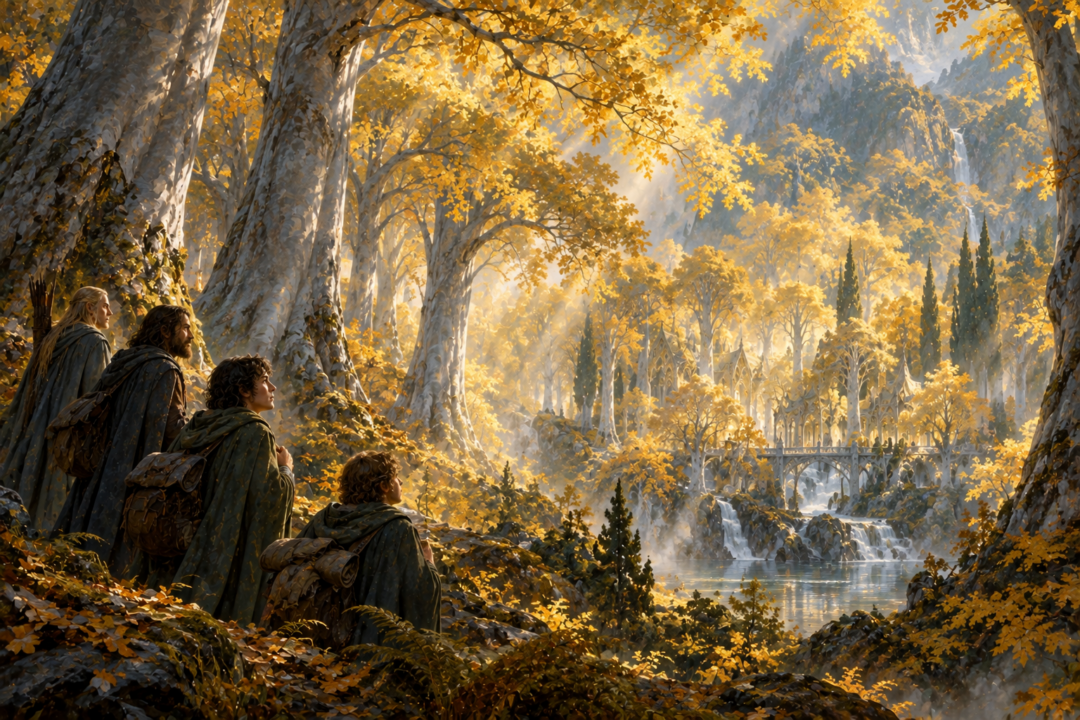
Rivendell Accepts the Passing of the Age
The deepest difference appears at the end.
Neither Rivendell nor Lothlórien can remain unchanged after the destruction of the One Ring. The power of the Three passes, and the Elven realms protected through them must eventually diminish.
Rivendell’s answer to that loss has, in a sense, been prepared throughout the story.
Its accumulated memory can leave the valley.
Bilbo’s writings can travel. Frodo’s account can travel. Sam can carry the Red Book back to the Shire. Aragorn can carry the inheritance of earlier ages into the restored kingship. Songs and stories can survive among peoples who never witnessed the events they describe.
Rivendell itself does not need to remain eternally unchanged for what it preserved to matter.
That may be why it never needs Lórien’s strange temporal atmosphere.
Its victory over time is of another kind.
The seasons can turn. Bilbo can grow old. Elrond can depart. The Third Age can end.
Memory can still cross the boundary between one age and the next.
And in Middle-earth, where even the greatest kingdoms eventually become ruins, that may be one of the most durable forms of preservation available.
Sources & Notes
This article is based on close reading and interpretation of Tolkien's published works and related source material where relevant.