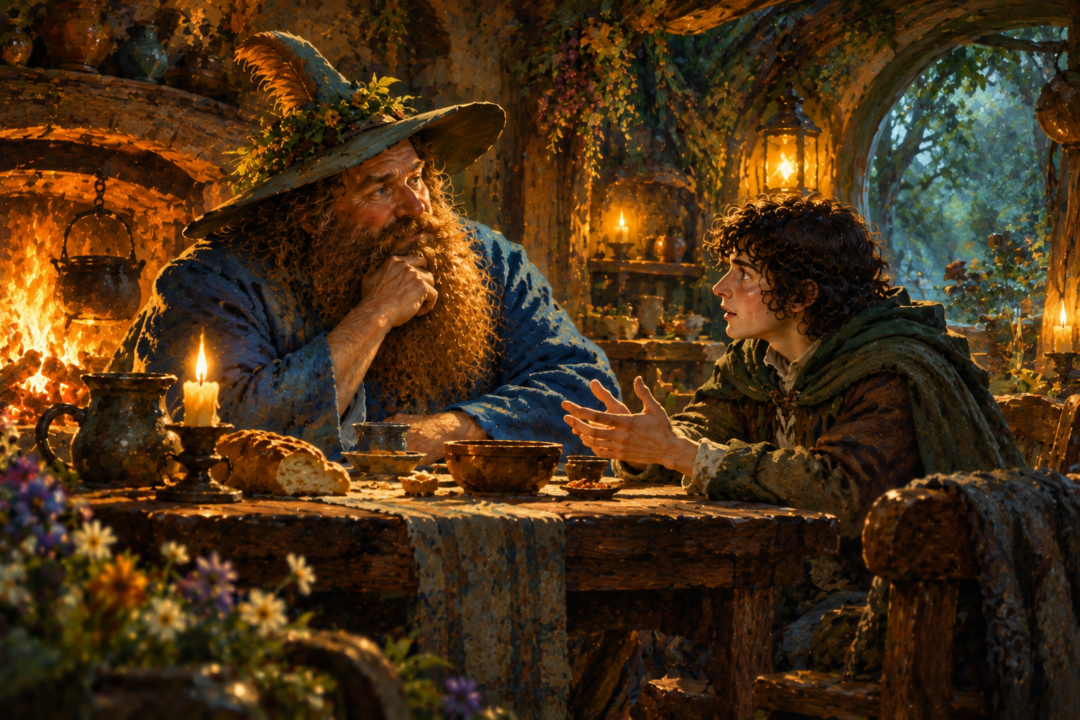
When Frodo and his companions finally reach Tom Bombadil’s house, directions ought to be the simplest thing they need.
They have escaped Old Man Willow. They have wandered through an Old Forest that seems actively hostile to ordinary travelers. Black Riders are somewhere behind them, and Bree still lies ahead. Every unnecessary delay carries danger.
Yet Tom does something curious.
Before the hobbits receive the practical guidance they will need for the next stage of their journey, Tom wants to hear their story. After supper, while Goldberry withdraws, he questions them closely. Frodo ends up telling him much about their flight, and Tom proves to know far more about the wider situation than his strange songs and carefree manner initially suggest.
It can look like another eccentric Bombadil episode: Tom likes stories, so Tom asks questions.
But the sequence reveals something deeper about how knowledge works in this part of The Fellowship of the Ring. Tom does not merely know the geography around his home. He first learns who these travelers are, what has happened to them, what they are carrying, and what dangers are following them.
Only then does geographical knowledge become useful guidance.
Tom Is Already Better Informed Than Frodo Realizes
The first important detail is that Tom is not questioning the hobbits because he knows nothing.
Quite the opposite.
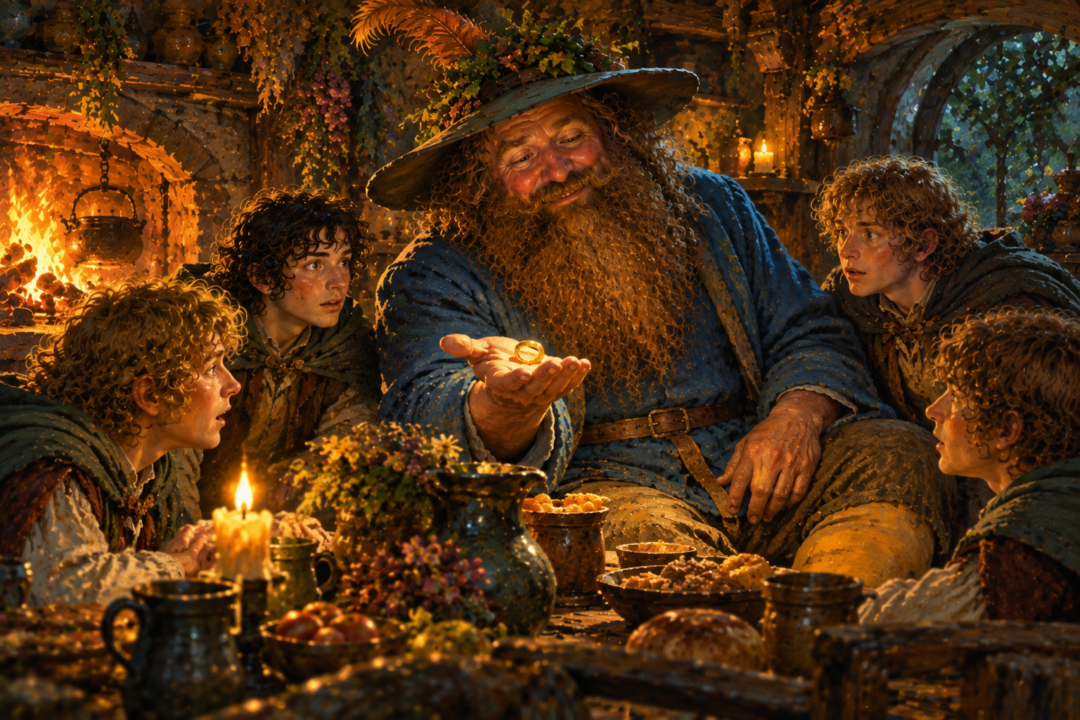
During their conversation, Frodo discovers that Tom has already heard news concerning the Shire and the world beyond his country. Farmer Maggot, whom Tom knows, has supplied him with information. Tom is therefore connected to the seemingly ordinary people and places surrounding his strange little realm.
That matters because it changes the character of his questioning.
Tom is not an isolated woodland spirit suddenly receiving a report from civilization. He possesses knowledge of his country, its inhabitants, and some events beyond its immediate borders. His conversation with the hobbits adds their experience to information he already has.
And his questions are searching.
The narrative says that Tom seems to know much already and somehow draws from Frodo more than Frodo initially intends to reveal. Eventually the story reaches the Riders, the Shire, and the mysterious object Frodo carries.
This makes the evening much more than friendly conversation.
Tom is assembling context.
The hobbits want to know where to go. Tom wants to know what sort of journey they are actually making.
Those are not the same question.
A Road Is Only Safe Relative to the Traveler
The hobbits' problem cannot be solved by saying, in effect, “Bree is that way.”
They are not ordinary travelers.
Frodo is carrying the One Ring. Black Riders are searching for him. The company has already demonstrated that it can become lost even relatively close to the Shire. They have also entered places whose dangers are far older and stranger than anything they understood when they left home.
Tom therefore needs more than their destination.
He needs their story.
This distinction becomes especially important because the country ahead contains the Barrow-downs. Tom knows that region intimately enough to warn them about it, and he gives them practical advice for crossing the downs.
The text does not explicitly say, “Tom questioned Frodo in order to calculate the safest route.” That would go beyond what is stated.
But the structure of the episode strongly connects understanding the travelers with preparing them for what comes next. Tom listens first. Later he supplies knowledge suited to their circumstances.
His directions are therefore not simply cartographic.
They are personal.
Tom's Questions Reveal How Much the Hobbits Do Not Know
There is another reason the storytelling matters: it exposes the imbalance between the hobbits' understanding and the reality surrounding them.
Frodo knows that the Ring is dangerous. Gandalf has already explained enough of its history to make flight necessary. He knows the Black Riders are servants of the Enemy.
But Frodo has only recently left the protected world of the Shire.
Again and again in the early chapters, the hobbits encounter things that do not fit their previous assumptions. The Old Forest has its own hostility and memory. Old Man Willow is more dangerous than any ordinary tree. Tom himself refuses easy classification.
Then the Barrow-downs introduce an even older layer of history.
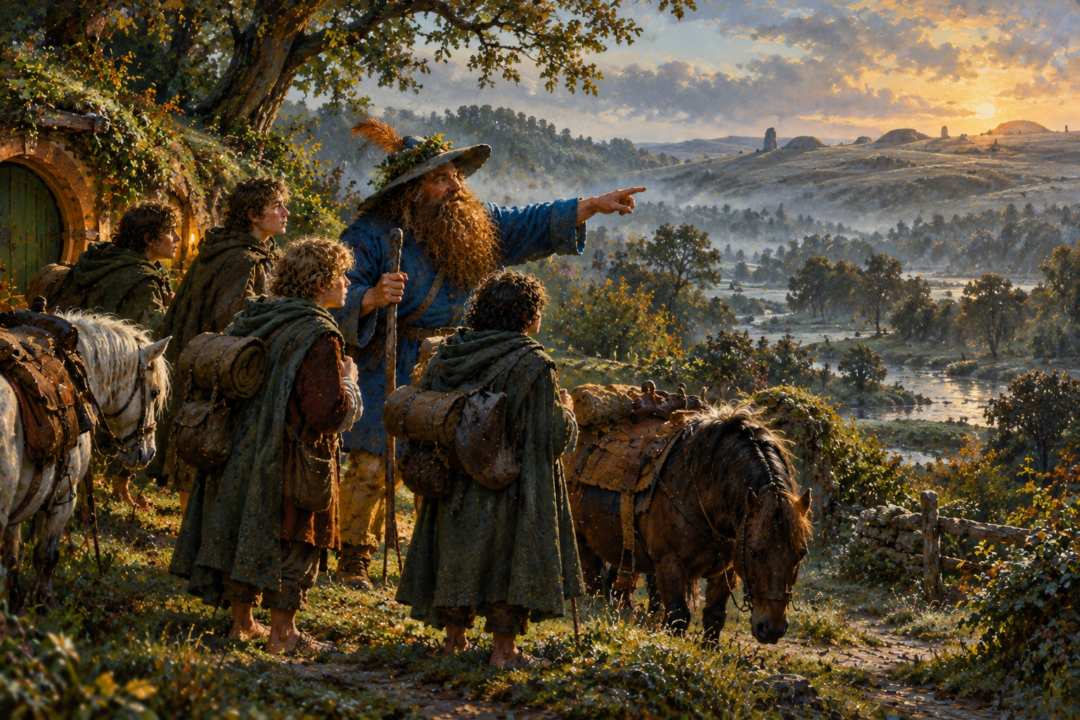
Tom's conversation places the hobbits briefly beside someone whose relationship with the land reaches far beyond their experience. When he later tells them stories concerning the surrounding country, the landscape stops being merely scenery.
It has a past.
That past can still be dangerous.
The hobbits need directions, but they also need to understand that a road through Middle-earth passes through history.
The Story of the Barrow-downs Changes the Meaning of the Journey
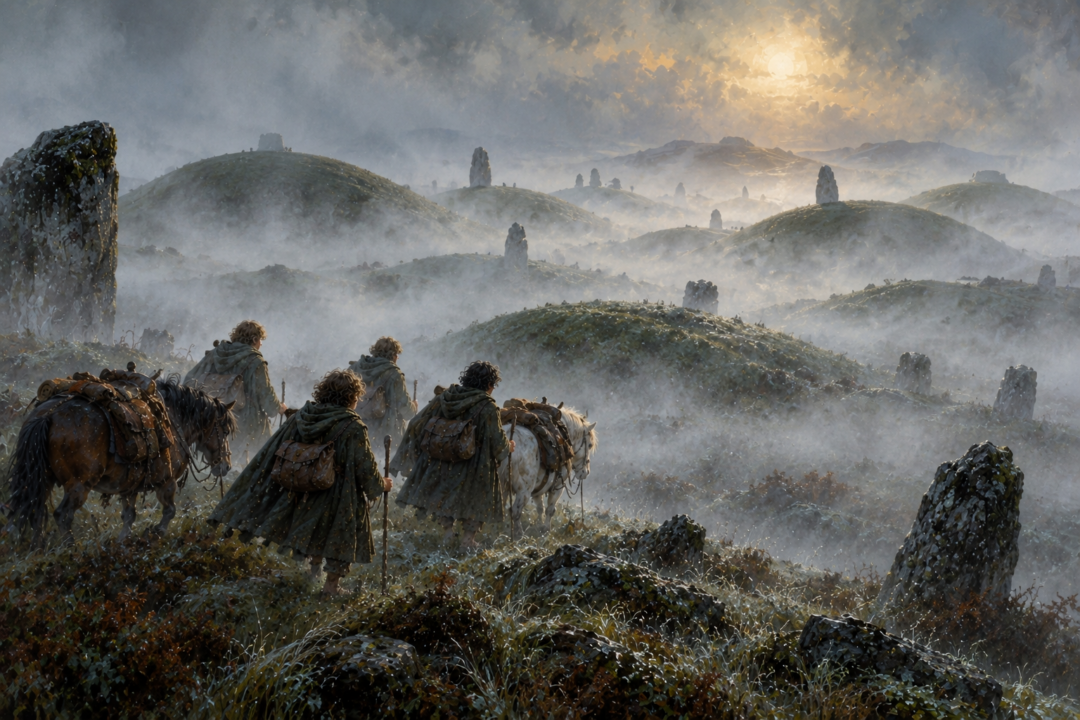
Tom does not merely interrogate Frodo. During the hobbits' stay, he also tells stories of his own.
Through him, they glimpse older ages of the land around them. The downs and their ancient graves belong to histories extending far beyond hobbit memory. The evil associated with the Barrow-wights is not presented as an accidental hazard comparable to bad weather or a broken bridge.
Appendix A later supplies important historical context. During the wars involving Angmar, evil spirits entered the deserted mounds of the Barrow-downs. The Witch-king's shadow therefore reaches into the landscape the hobbits must cross, even though they do not yet understand the full significance of that history.
This creates a grim irony.
The hobbits are fleeing the Ringwraiths, yet their road leads through a region bearing scars connected with the same long conflict against the power of Angmar.
They think they are moving geographically away from danger.
History says otherwise.
Tom's knowledge cannot make the world harmless. What it can do is give them some understanding of the country through which they are moving.
That is why his storytelling and his directions belong together.
Bombadil Does Not Treat the Ring as the Center of Everything
The strangest moment of the visit comes when Tom handles the Ring.
Frodo reluctantly gives it to him. Tom puts it on—and does not disappear.
He later makes the Ring itself disappear for a moment in a trick of his own before returning it. When Frodo secretly puts the Ring on, Tom can still see him.
Whatever precisely explains Tom's nature—and the text deliberately leaves much unresolved—the Ring does not affect him in the familiar way.
That makes his earlier questioning even more striking.
Tom is interested in Frodo's story even though he is not drawn into the Ring's power as others are.
For most of the larger narrative, the Ring threatens to dominate every decision. People desire it, fear it, pursue it, debate it, or attempt to destroy it.
Tom does something different.
He listens to the bearer.
This does not mean Tom regards the Ring's danger as meaningless. At the Council of Elrond, Gandalf makes clear that Tom would not be a suitable guardian of it: he might not understand the need to keep it safe because such things have little hold upon his mind.
But during Frodo's stay, that detachment produces an unusual perspective.
The Ring is not the only important fact about Frodo.
Before Frodo is a Ring-bearer, he is also a frightened traveler with companions, a history, a destination, and choices still ahead.
Tom listens to that whole story.
Listening Comes Before Guidance
There is a subtle contrast here with several dangers the hobbits have recently faced.
The Black Riders seek information because they are hunting Frodo.
Old Man Willow tries to overpower the travelers.
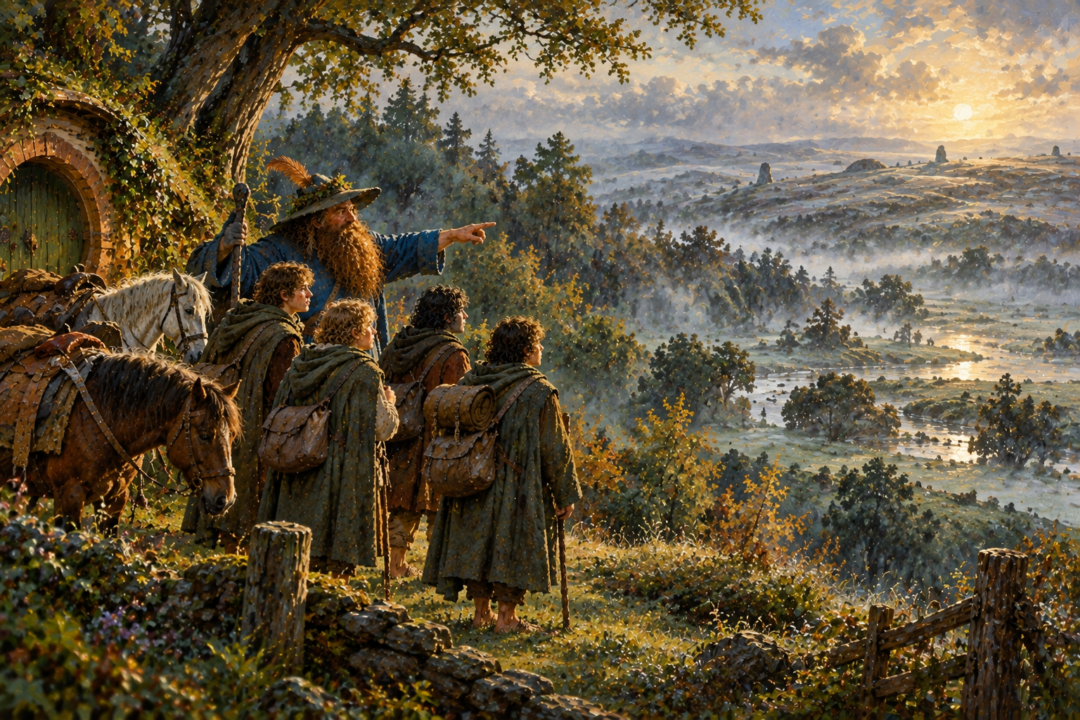
Tom also possesses extraordinary power within his country, but his relationship with the hobbits is fundamentally different. He rescues them, shelters them, feeds them, listens to them, teaches them something of the land, and eventually sends them onward.
His knowledge is used for hospitality rather than possession.
That distinction becomes particularly clear when the hobbits encounter the Barrow-wight.
Despite Tom's warnings, they are trapped in the downs. Frodo awakens inside a barrow and faces one of the earliest genuinely terrible moral choices of his journey. He could use the Ring to escape alone.
Instead, he resists that temptation and remains with his friends.
He remembers the rhyme Tom taught them and calls for Bombadil.
Tom comes.
The directions were not enough.
The relationship was.
Tom Gives Them More Than a Route
After rescuing the hobbits from the barrow, Tom does something else of lasting importance.
From the treasure inside the mound, the hobbits receive blades made long ago by the Men of Westernesse for their war against Angmar. These are not random weapons. They connect the hobbits physically to the buried history Tom has been revealing.
One of those blades will matter enormously later.
On the Pelennor Fields, Merry strikes the Witch-king with his sword from the barrow. The narrative specifically recalls the weapon's ancient making and its connection with the enemies of Angmar before Éowyn delivers the final blow.
A journey that began with four hobbits asking how to reach Bree has unexpectedly equipped one of them with a weapon forged in an ancient war whose last great enemy he will eventually help overthrow.
Tom could not simply have explained all of that at his dinner table.
Middle-earth does not work that neatly.
But the sequence reinforces the importance of his way of dealing with the travelers.
First comes the story.
Then comes knowledge.
Then directions.
Then experience gives the old history a new meaning.
The Deeper Rule Hidden in Bombadil's Hospitality
Tom Bombadil remains deliberately difficult to explain, and this scene should not be turned into a rigid rule Tolkien never states.
The text never explicitly tells us that Tom has a philosophical principle of always hearing someone's history before giving advice.
Yet the order of events is meaningful.
The hobbits arrive believing they mainly need immediate practical help. Tom gives them something broader. He learns what brought them there. He places their journey inside an older landscape. He warns them about what lies ahead. And when their own strength and knowledge fail, the bond created during their stay becomes part of their rescue.
There is a deeply Middle-earth-like idea beneath that sequence.
Knowing where someone should go requires knowing something about where they have come from.
For Frodo and his companions, the road east is not just a line across a map. They are carrying the consequences of the Shire, Gandalf's warnings, the Black Riders' pursuit, and a Ring whose history stretches back thousands of years.
Tom understands the land because he knows its stories.
Before he sends the hobbits farther into that land, he listens to theirs.
And only then does he show them the road.
Sources & Notes
- Encyclopedia of Arda, Tom Bombadil — his encounter with the hobbits and his knowledge of the surrounding country: https://www.encyclopedia-of-arda.com/t/tombombadil.php
- Encyclopedia of Arda, Farmer Maggot — Tom’s acquaintance in the Shire and source of local news: https://www.encyclopedia-of-arda.com/m/maggot.php
- Encyclopedia of Arda, Barrow-wights — the specific danger on the hobbits’ route after leaving Tom’s house: https://www.encyclopedia-of-arda.com/b/barrowwights.html
Primary narrative: J.R.R. Tolkien, The Fellowship of the Ring, Book I, chs. 7–8. The interpretation of Tom’s motive is not an explicit statement in the text.