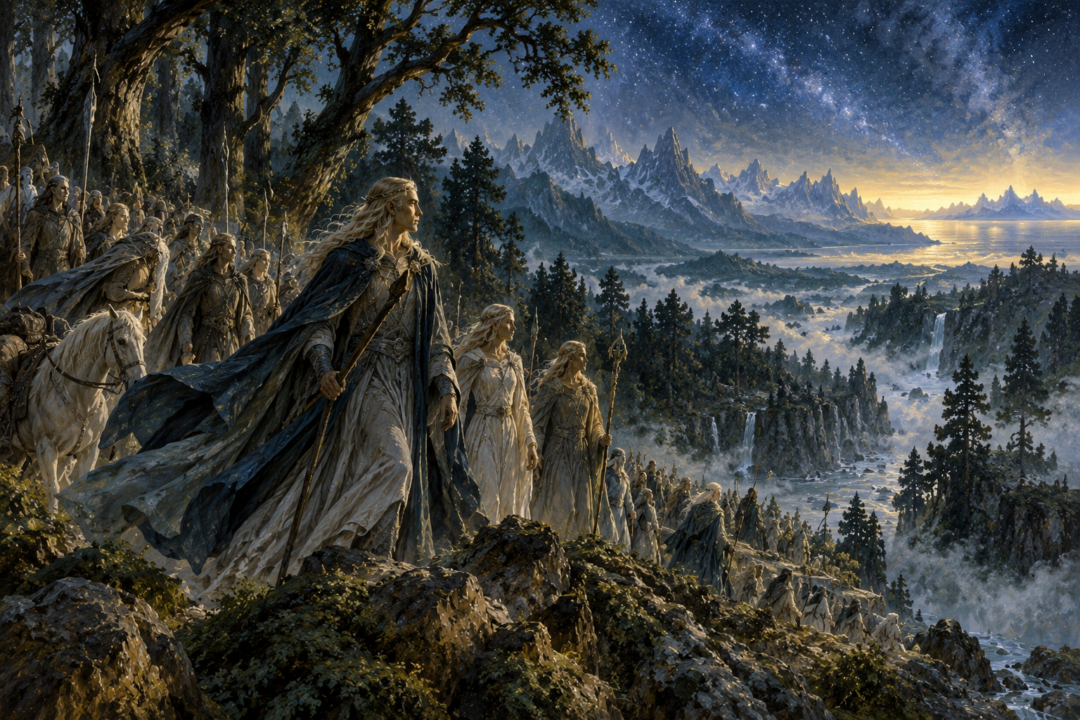
The word Eldar can sound as though it means the Elves of the Blessed Realm: the radiant peoples who crossed the Sea, lived beneath the Two Trees, and returned to Middle-earth carrying the memory of Aman.
But that is not what the name originally means.
The Sindar are the clearest proof.
They never completed the Great Journey to Aman. Most never saw the Two Trees. Their great civilization arose instead beneath the stars of Beleriand, especially under Thingol and Melian in Doriath. Yet the Sindar still belong to the Eldar.
That apparent contradiction reveals something important about the divisions among the Elves. The crucial boundary was not simply between those who reached Aman and those who did not. The first great division came much earlier, when the Elves were summoned to leave Cuiviénen.
The Sindar answered that summons.
And that choice remained part of their identity even though their road ended on the eastern side of the Sea.
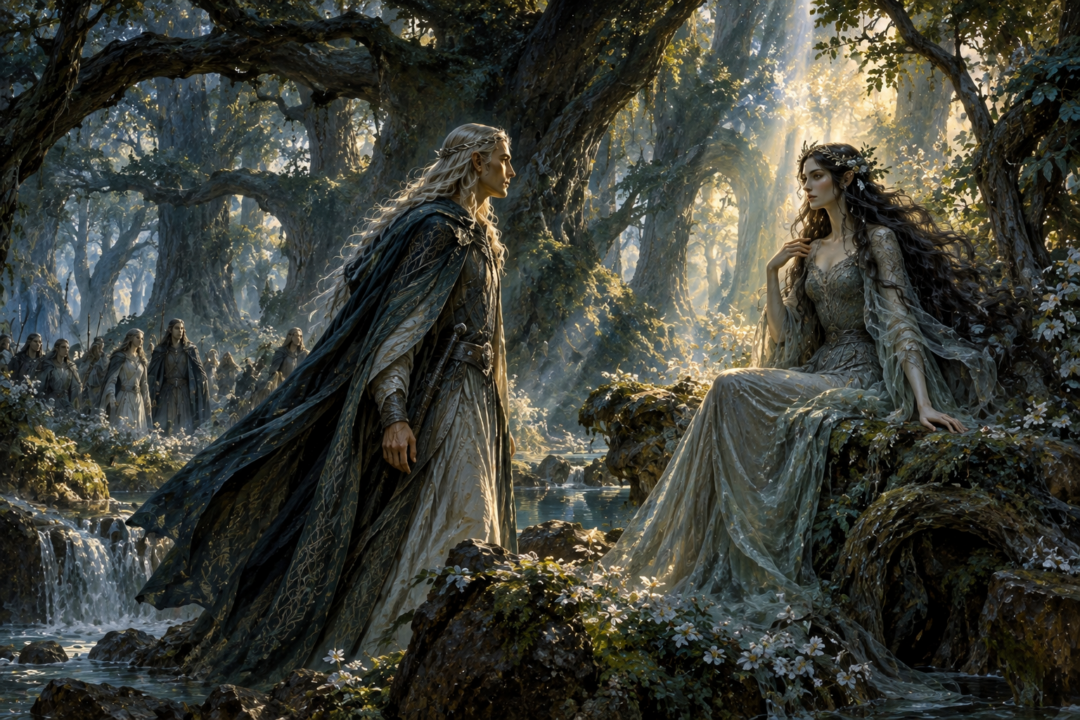
Eldar Originally Meant Those Who Accepted the Journey
After the awakening of the Elves at Cuiviénen, Oromë discovered them and eventually brought three representatives—Ingwë, Finwë, and Elwë—to Aman. They returned bearing news of the Blessed Realm, and the Elves then faced a choice.
Some accepted the summons of the Valar and began the westward journey.
Others refused.
Those who accepted became the Eldar, divided into the Vanyar, Noldor, and Teleri. Those who rejected the summons were the Avari, the Unwilling.
That distinction is the key to understanding the Sindar.
Being Eldar was therefore not originally a reward bestowed upon an Elf for successfully arriving in Valinor. It described the peoples who answered the summons and entered the Great Journey.
The Sindar descended from the Teleri who did exactly that.
They did not remain at Cuiviénen in refusal. They traveled an enormous distance across Middle-earth with the other Eldar. They crossed mountains, rivers, and wilderness until at last they reached Beleriand and the shores of the Great Sea.
Their failure to make the final crossing created another division, but it did not undo the first one.
They remained Eldar.
The Teleri Were Already Eldar Before the Sindar Existed
The Sindar did not begin as an entirely separate people.
They emerged from the Teleri, the largest of the three hosts participating in the Great Journey. The Teleri were led principally by the brothers Elwë and Olwë.
Their journey was slower than that of the Vanyar and Noldor, and portions of their people repeatedly separated from the main host. One major group, led by Lenwë, abandoned the westward march before reaching Beleriand. These became the Nandor.
Those who continued eventually entered Beleriand.
Then came the event that permanently changed their fate.
Elwë wandered into the forest of Nan Elmoth and encountered Melian, one of the Maiar. He vanished from the knowledge of his people for a long period while the two remained together beneath the trees.
The Teleri waited for their missing king.
Eventually, however, the time came for the remaining Teleri to cross the Sea. Olwë and many of his people departed for Aman. Others stayed behind, unwilling to abandon Elwë.
When Elwë finally returned, he became known in Sindarin tradition as Elu Thingol. With Melian as his queen, he ruled a great portion of Beleriand.
The people who remained there became the Sindar, the Grey-elves.
Their story had diverged dramatically from that of their relatives in Aman, but both peoples came from the same Telerin branch of the Eldar.
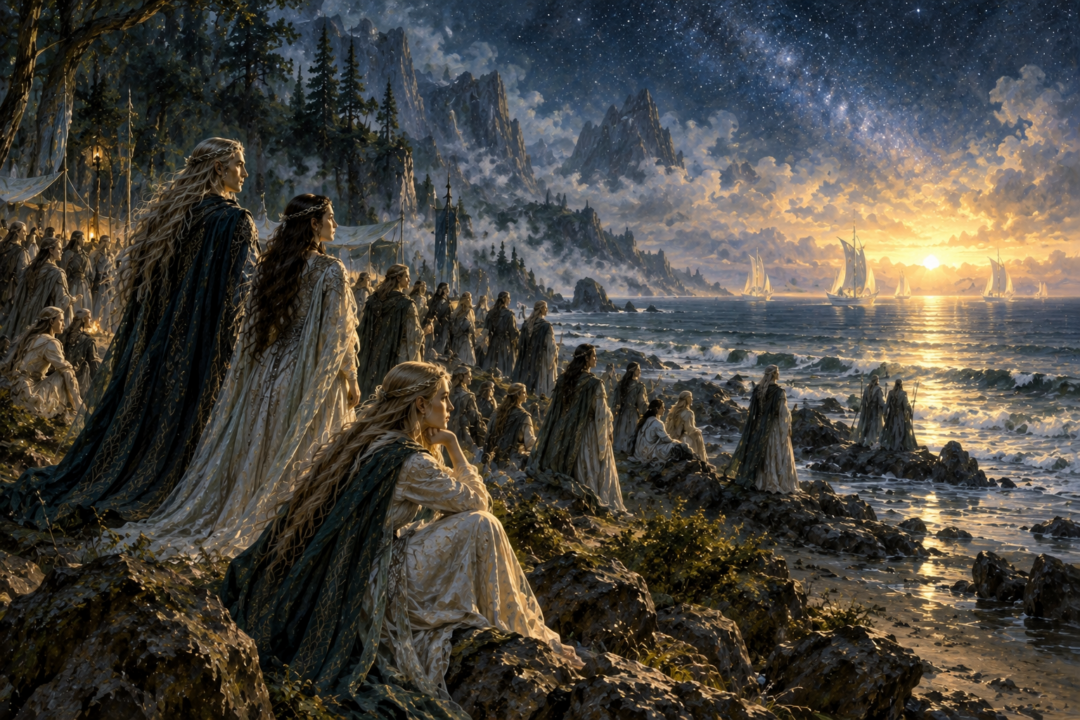
Eldar and Calaquendi Are Not the Same Category
Much of the confusion comes from treating Eldar and Calaquendi as though they were interchangeable.
They are not.
The Calaquendi are the Elves of the Light: those who beheld the light of the Two Trees in Aman. The Vanyar, the Noldor, and the Teleri who crossed the Sea—the Falmari—belonged to this category.
Most Sindar did not.
They remained east of the Sea and never saw the Trees. In the broad classification preserved in The Silmarillion, they therefore belong among the Moriquendi, the Elves of Darkness.
That name can sound morally charged to modern ears, but in this classification it concerns their relationship to the Light of Aman, not allegiance to evil.
So a Sinda can simultaneously be:
an Elf,
a Telerin Elf,
one of the Eldar,
and one of the Moriquendi.
There is no contradiction because these terms answer different questions.
“Eldar” concerns the acceptance of the summons and participation in the westward migration.
“Calaquendi” concerns whether an Elf had seen the Light of the Two Trees.
The Sindar satisfy the first condition but, with one extraordinary exception, not the second.
Thingol Breaks the Simple Classification Even Further
Thingol himself demonstrates why the categories cannot simply be reduced to “Elves who reached Aman” and “Elves who did not.”
Before the Great Journey began, Elwë had already been taken to Aman as one of the three ambassadors of the Elves. He saw the Two Trees there and returned to Cuiviénen.
He therefore knew the Light of Aman firsthand.
Yet during the later migration of his people, he disappeared in Nan Elmoth and did not cross the Sea with Olwë.
Thingol consequently occupies an unusual position. He belongs among the Calaquendi because he had seen the Light of the Two Trees, yet he remained in Middle-earth and became king of a people who, as a whole, had not seen that Light.
The distinction matters because Thingol brought something unusual into Beleriand even before Melian's influence is considered. He had personally experienced Aman.
His people had not.
And yet the Sindar were not simply isolated Elves untouched by the powers of the West.
Their king had seen the Blessed Realm, and their queen was herself a Maia.
Doriath Became Something Between Two Worlds
The resulting civilization of the Sindar occupies a remarkable position in the history of the Elves.
They were not the Calaquendi of Aman, but neither were they culturally identical to Elves who had never undertaken the Great Journey.
Under Thingol and Melian, the Sindar of Doriath grew greatly in wisdom and skill. The Silmarillion explicitly distinguishes their development under this extraordinary rule, describing them as pre-eminent among the Elves of Middle-earth despite their place among the Moriquendi.
Their realm was also thoroughly rooted in Middle-earth.
Thingol's power centered upon Doriath, while Círdan and the Falathrim inhabited the western coasts. The Sindar encountered the Dwarves of the Blue Mountains, traded with them, learned from them, and developed their own civilization long before the return of the Noldor.
Their language became one of their greatest legacies.
Sindarin ultimately spread far beyond the original Grey-elves. When the Noldor returned to Middle-earth, they entered lands in which Sindarin culture was already established. In time, Sindarin became the ordinary Elven tongue across much of northwestern Middle-earth.
The people who had never reached Aman therefore profoundly shaped the Elvish world encountered in the later ages.
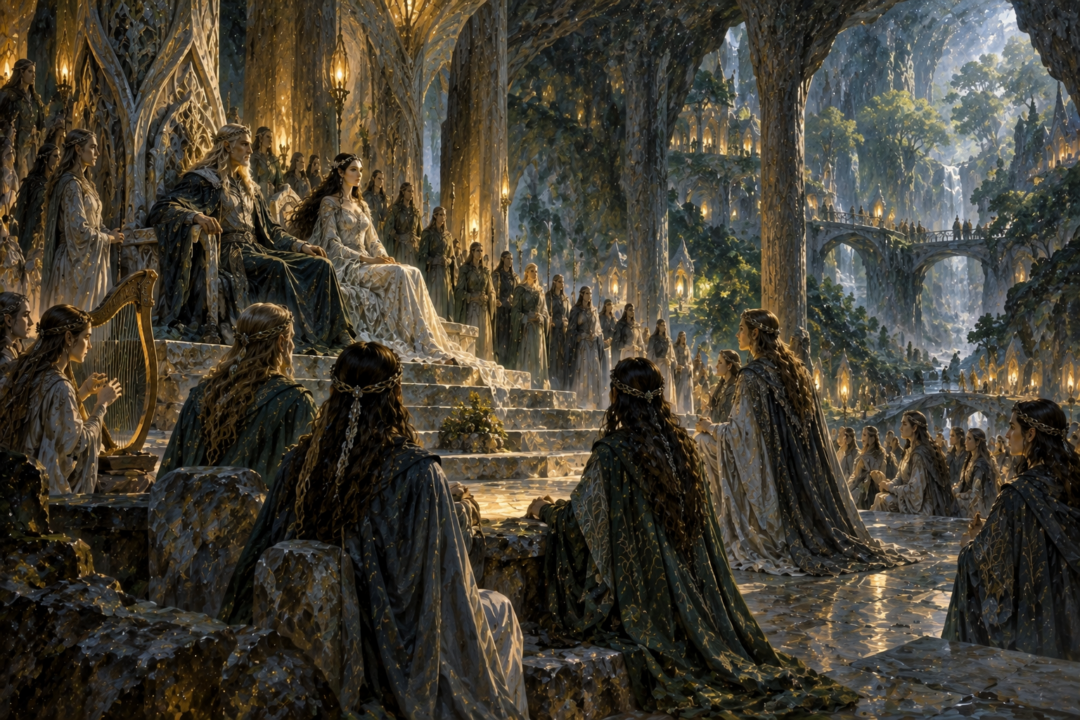
The Sindar Are Also Úmanyar
Another term makes their position even clearer: Úmanyar, usually understood as those Eldar who did not come to Aman.
In the classification used in The Silmarillion, this includes Elves who began the Great Journey but never completed it. Some became lost, some turned aside, and some lingered in Middle-earth.
The Sindar belong naturally within this group.
That creates a useful three-part distinction.
The Avari refused the summons.
The Úmanyar accepted it but did not reach Aman.
The Amanyar came to Aman.
The precise terminology underwent development in the wider linguistic writings, so not every term has exactly the same scope in every stage of the legendarium. But the central distinction relevant to the Sindar is remarkably clear: failure to complete the Great Journey did not make them Avari.
They had answered the summons.
They had marched west.
They were Eldar who remained in Middle-earth.
“Grey” Is More Than a Convenient Middle Position
The familiar English name “Grey-elves” suits their strange historical position remarkably well, though it should not be turned into a rigid metaphysical rule.
The Sindar stand between worlds.
Their relatives crossed the Sea and lived in the light of the Trees. The Avari never joined the westward march at all. The Sindar traveled almost to its end and then built their greatest realms within sight, in a geographical sense, of the Sea that separated them from Aman.
Their history is therefore defined by proximity without arrival.
They knew of the West.
Their ancestors had chosen it.
Some of them waited on its shores.
Yet Beleriand became their home.
That tension helps explain why reducing the Elves to “High Elves” and “Wood Elves” loses so much of the deeper structure. Elven identity is layered. Kindred, migration, experience of Aman, language, realm, and later history all overlap without perfectly replacing one another.
The Sindar are the strongest example.
The Great Journey Changed Even Those Who Never Finished It
The deepest point is not geographical.
The Sundering of the Elves was created through choices.
The first decisive choice was whether to answer Oromë's summons. That divided the Eldar from the Avari. Later events divided the Eldar again: some halted, some remained, some crossed the Sea, and eventually some who reached Aman returned to Middle-earth in exile.
The Sindar show that the road itself mattered.
They did not need to stand beneath the Two Trees to count among the Eldar because “Eldar” was never simply another word for “Elves who lived in Aman.”
They were descendants of those who heard the summons in the ancient East and chose to follow.
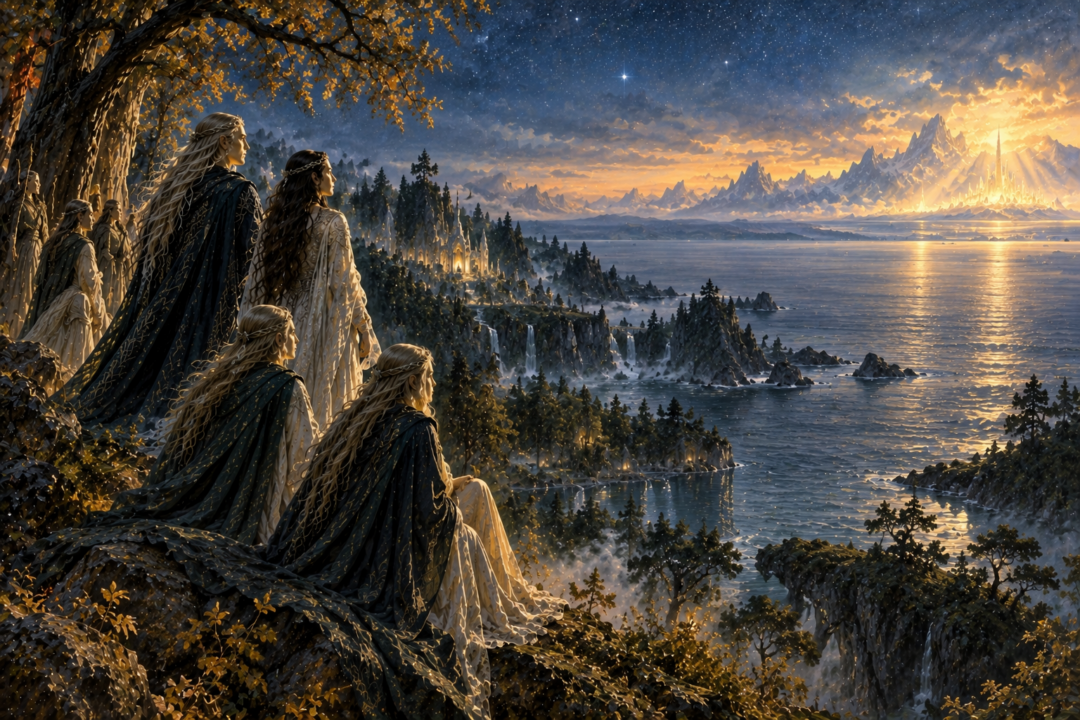
Their journey ended beneath the trees of Beleriand rather than beneath the light of Valinor. There they became a people in their own right: the Grey-elves of Thingol, the Elves of Doriath and the Falas, heirs of the Teleri and participants in the long history of the Eldar.
That is why the Sindar can be both Eldar and Moriquendi, both part of the Great Journey and a people who never completed it.
Their identity was determined not only by where they arrived.
It was also determined by the road they chose to take.
Sources & Notes
- Tolkien Gateway — Sindar (Telerin people remaining in Beleriand): https://tolkiengateway.net/wiki/Sindar
- Tolkien Gateway — Eldar (those who accepted the westward summons): https://tolkiengateway.net/wiki/Eldar
- Tolkien Gateway — Moriquendi (Elves who did not see the Trees): https://tolkiengateway.net/wiki/Moriquendi
Sources distinguishing the Eldar's Great Journey from the Calaquendi's sight of the Two Trees.