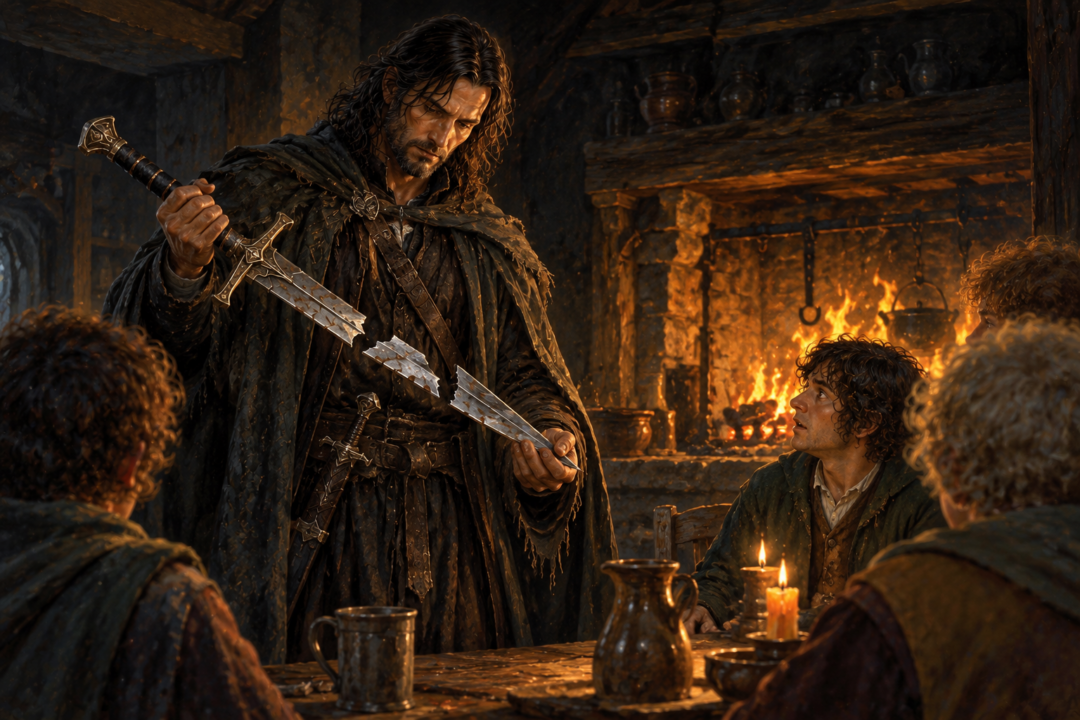
When Aragorn shows his sword to the hobbits at Bree, the weapon is almost absurdly unsuitable for the dangers gathering around them. He draws it, and they see that the blade is broken.
For a Ranger traveling through a country stalked by servants of the Enemy, that is a striking thing to carry. Narsil cannot yet win a duel, defend a road, or cut down an Orc. Its value lies somewhere else.
The broken sword is evidence.
Long before Narsil is reforged as Andúril and carried openly into the War of the Ring, its shards connect Aragorn to Elendil, Isildur, the lost kingdom of Arnor, and the ancient struggle against Sauron. The weapon has lost its practical purpose, but not its identity. In some ways, its broken state makes that identity even more visible.
That distinction helps explain why Narsil matters so much before Andúril ever exists.
The Sword Was Broken at the Moment a Dynasty Was Broken
Narsil belonged to Elendil, the High King of the Dúnedain in exile and founder of the kingdoms of Arnor and Gondor.
Its history was already ancient. In The Silmarillion, the sword is identified as the work of Telchar of Nogrod, the renowned Dwarven smith of the First Age. By the end of the Second Age, it had come into Elendil’s possession.
Then came the Last Alliance.
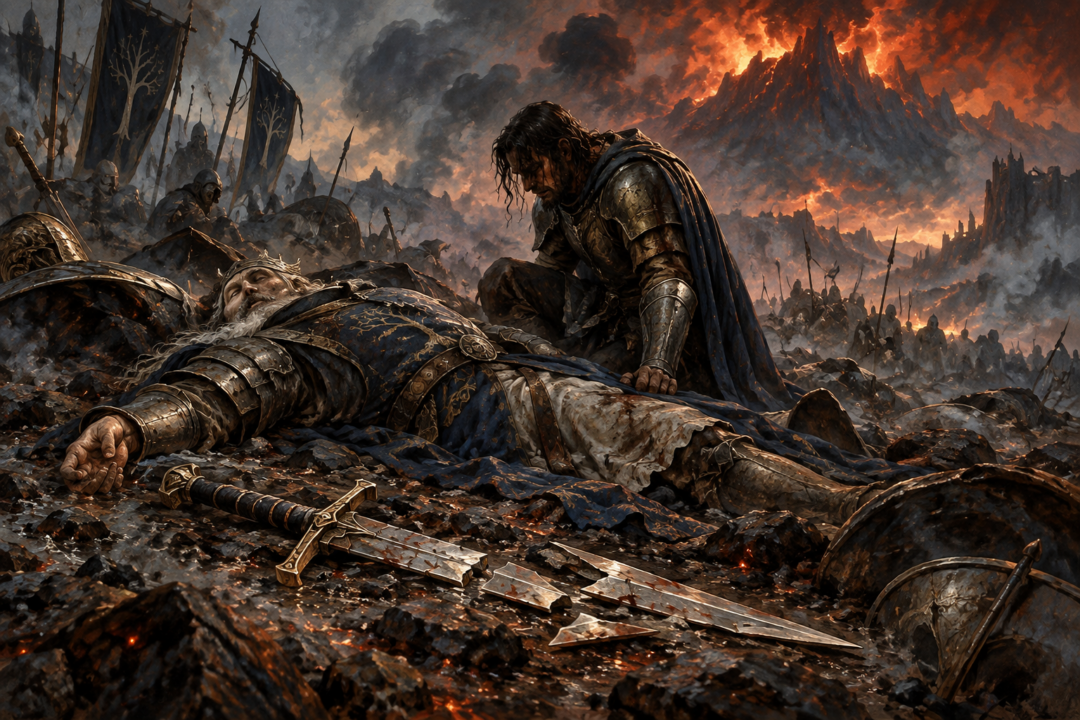
Elendil and Gil-galad confronted Sauron, and both were slain in the struggle that overthrew him. Elendil fell, and Narsil broke beneath him. Isildur then took up the hilt-shard of his father’s sword and used it to cut the Ruling Ring from Sauron’s hand.
That sequence gave the broken sword a significance no intact weapon could have possessed in quite the same way.
Narsil was not merely damaged in some forgotten battle. Its breaking was physically bound to Elendil’s death and to the defeat of Sauron. The shards became surviving material from the catastrophe that ended the Second Age.
And Isildur did not discard them.
That matters.
A purely utilitarian weapon that could no longer function might have been abandoned or melted down. Narsil instead remained within Elendil’s line.
Its usefulness had changed.
The Shards Became an Heirloom of Isildur’s House
After Isildur’s death at the Disaster of the Gladden Fields, the northern line of the Dúnedain continued through his surviving son Valandil.
Narsil’s fragments continued with that inheritance.
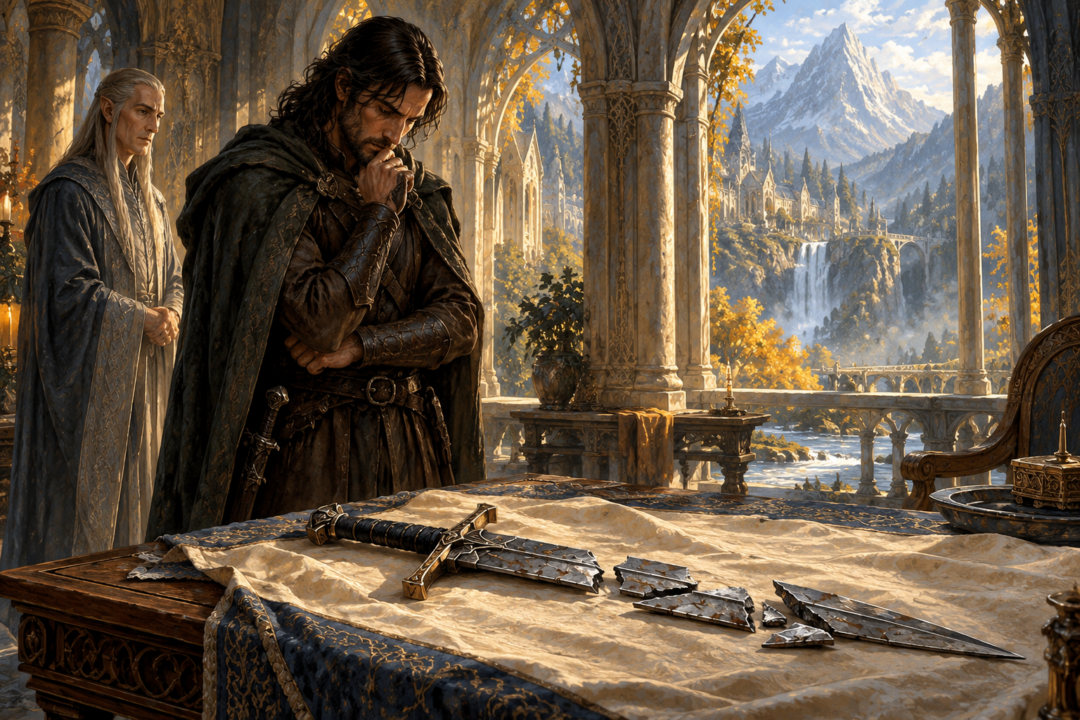
Appendix A of The Lord of the Rings records that the heirlooms of Isildur’s house were eventually kept in Rivendell after the northern kingdom had failed. Among them were the shards of Narsil, together with other objects associated with the royal house.
This placed the broken sword within a larger pattern.
The northern Dúnedain had lost almost everything that normally makes kingship visible.
Arnor had divided into successor kingdoms. Those kingdoms eventually fell. The descendants of Isildur ceased to rule openly as kings and became the Chieftains of the Dúnedain. Their people diminished, and their surviving Rangers lived largely outside the awareness of ordinary inhabitants of places such as Bree and the Shire.
Yet the lineage itself continued.
So did its heirlooms.
Narsil therefore occupied a peculiar position. It belonged to a royal tradition whose kingdom no longer existed, preserved by descendants who possessed neither palace nor throne.
The sword was broken.
The northern realm was broken.
But neither had been erased.
Aragorn Receives a Past Before He Receives a Kingdom
The connection becomes especially important in Aragorn’s own story.
After his father Arathorn II was killed, the young Aragorn was fostered in Rivendell. His identity was initially concealed, and he was called Estel, meaning “Hope.”
When he reached manhood, Elrond revealed his ancestry to him.
At that point Aragorn received the heirlooms of his house. The Lord of the Rings specifically associates this revelation with the Ring of Barahir and the shards of Narsil, although Elrond withheld the Sceptre of Annúminas because Aragorn had not yet earned it.
The contrast is revealing.
Aragorn can inherit the broken sword immediately because it testifies to who he is and where he comes from. The sceptre, a direct emblem of royal authority, remains beyond his reach.
Identity precedes kingship.
Inheritance precedes achievement.
The shards do not make Aragorn King of Gondor and Arnor. They do, however, place him unmistakably within the history of Isildur’s house.
Narsil is therefore not simply a promise that Aragorn will someday become king. At this stage, it is something more basic: material continuity between the hidden young heir and a past extending back through the Númenórean kingdoms in exile.
Why Aragorn Carries a Broken Sword
This is what makes the scene at Bree so memorable.
Aragorn, still known to the hobbits primarily as Strider, produces his sword after they question whether they can trust him.
The blade is broken.
He asks, in effect, what use someone working for the Enemy would have for such a weapon.
The moment operates on two levels.
Practically, the broken sword reinforces the immediate argument that Strider is not presenting himself as an armed agent sent to overpower them.
Symbolically, however, the reader is seeing one of the greatest surviving heirlooms of the Dúnedain in the hands of a man who outwardly looks like a weather-beaten wanderer.
This is Aragorn’s condition in miniature.
His appearance conceals his ancestry. His people possess no northern kingdom. His royal inheritance survives without royal display. Even his famous sword exists only in fragments.
Yet the fragments are authentic.
That is the crucial point.
Narsil does not need to be whole in order to identify the history Aragorn carries with him.
Brokenness Is Part of the Sword’s Meaning
It would be easy to think of Narsil’s broken state as merely an inconvenience awaiting repair.
The narrative gives it greater weight.
If the sword had been reforged immediately after the Last Alliance, it could have become simply another ancient weapon handed from generation to generation. Instead, the shards preserved the visible memory of the event that transformed them.
They recalled Elendil’s fall.
They recalled Isildur’s confrontation with Sauron.
They also recalled an unfinished history.
Sauron had been defeated but not permanently destroyed. Isildur had taken the Ring but failed to destroy it. The kingdoms founded by Elendil did not remain united and secure. The northern kingdom eventually vanished as a political power.
Narsil remained broken through those centuries.
One reading, therefore, is that its physical condition parallels the unresolved condition of Elendil’s inheritance. This is symbolism rather than a stated magical rule: the texts never say that Narsil had to remain broken until a particular prophecy or predetermined moment.
What they do establish is that the shards were deliberately preserved and that they were reforged when Aragorn prepared to enter the decisive struggle of the War of the Ring.
The timing gives the restoration its force.

Reforging Changes What the Heirloom Can Do
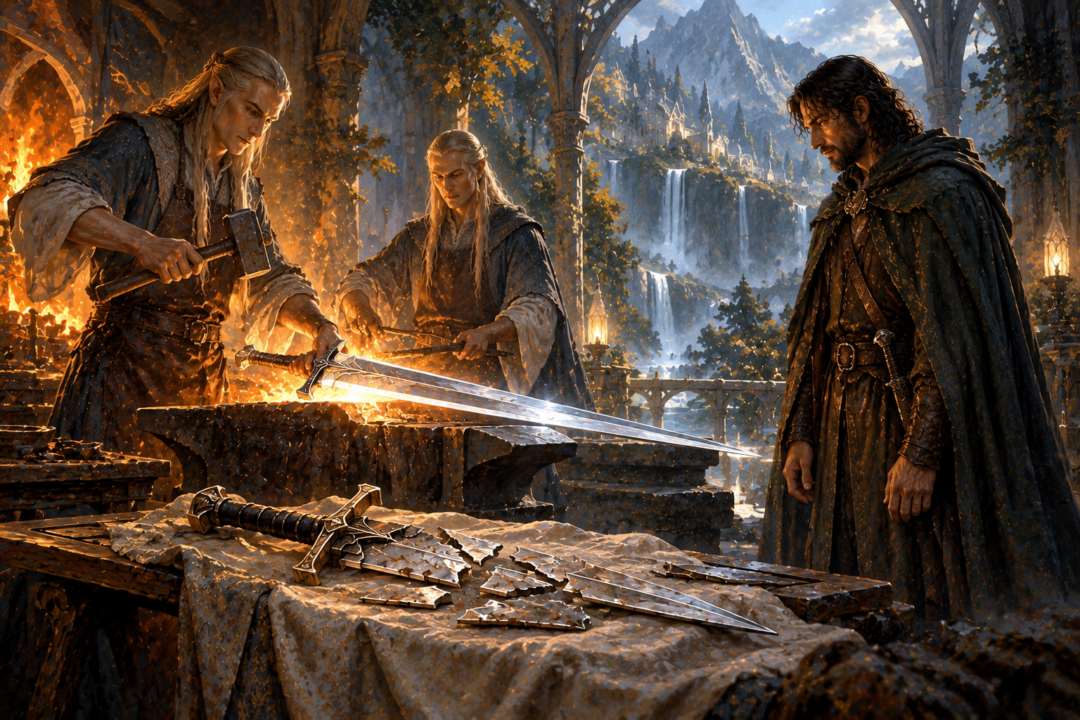
At Rivendell, before the Fellowship departs, the sword is remade.
The reforged weapon receives a new name: Andúril, the Flame of the West.
This is not the replacement of Narsil by an unrelated sword. The old fragments themselves are reforged. The continuity that had been preserved symbolically now becomes physically active again.
That transformation matters because Aragorn’s circumstances are changing as well.
The hidden Ranger is moving toward open confrontation with Sauron. During the journey south, his identity becomes increasingly public. He will eventually reveal himself through the palantír, take the Paths of the Dead, lead forces to Minas Tirith, march against the Black Gate, and finally be crowned.
Andúril accompanies that transition.
The shards had authenticated continuity with the past.
The reforged sword can now participate in the future.
The difference is subtle but important. Aragorn does not acquire his identity when Narsil is reforged. He already possessed that identity while carrying the broken blade.
What changes is his ability to act openly upon it.
The Sword Does Not Create Aragorn’s Claim
This also prevents Narsil from being reduced to a simplistic “sword makes the king” device.
Aragorn’s eventual kingship rests within a much larger historical and political context: his descent, his position as Chieftain of the Dúnedain, his deeds, his relationships with Gondor and its people, and the extraordinary circumstances surrounding the War of the Ring.
Andúril is a potent sign of that identity, but it is not a magical certificate that automatically forces others to recognize him as king.
Indeed, the long history of the shards points in almost the opposite direction.
For generations, the broken sword survives while its bearers possess no restored kingdom.
That separation between inheritance and political power is one of the most interesting things about Narsil.
The heirloom can preserve identity even when history offers no immediate way to turn identity into rule.
Before Narsil Became a Weapon Again, It Was Memory
By the time Andúril flashes openly in the War of the Ring, the sword’s martial function has returned.
But that is only the final stage of a much longer story.
For centuries, Narsil’s fragments could not perform the most ordinary task expected of a sword. They could not make their bearers victorious in battle. They could not restore Arnor. They could not defeat Sauron. They could not place Aragorn upon a throne.
What they could do was endure.
They survived Elendil.
They passed through the house of Isildur.
They remained among the heirlooms of a royal line after its northern kingdom disappeared.
They were delivered to Aragorn when he learned who he truly was.
And when a suspicious group of hobbits encountered a grim Ranger in Bree, the broken blade was still with him.
Only afterward was Narsil made whole.
That is why the reforging of Andúril carries such weight. It is not simply the repair of a powerful weapon before a war. It is the moment when something that had spent centuries preserving memory becomes capable of action again.
The steel recovers its edge only after the shards have already performed another task: carrying the identity of Elendil’s house through an age in which almost everything surrounding that identity had fallen away.
Sources & Notes
- Encyclopedia of Arda — Shards of Narsil: https://www.encyclopedia-of-arda.com/s/shardsofnarsil.php
- Tolkien Gateway — Aragorn (Elrond reveals his ancestry and delivers the shards): https://tolkiengateway.net/wiki/Aragorn
- Encyclopedia of Arda — Flame of the West (the shards' preservation and reforging): https://www.encyclopedia-of-arda.com/f/flameofthewest.php
Sources on Narsil's breaking, preservation as an heirloom, and Aragorn's inheritance before its reforging.