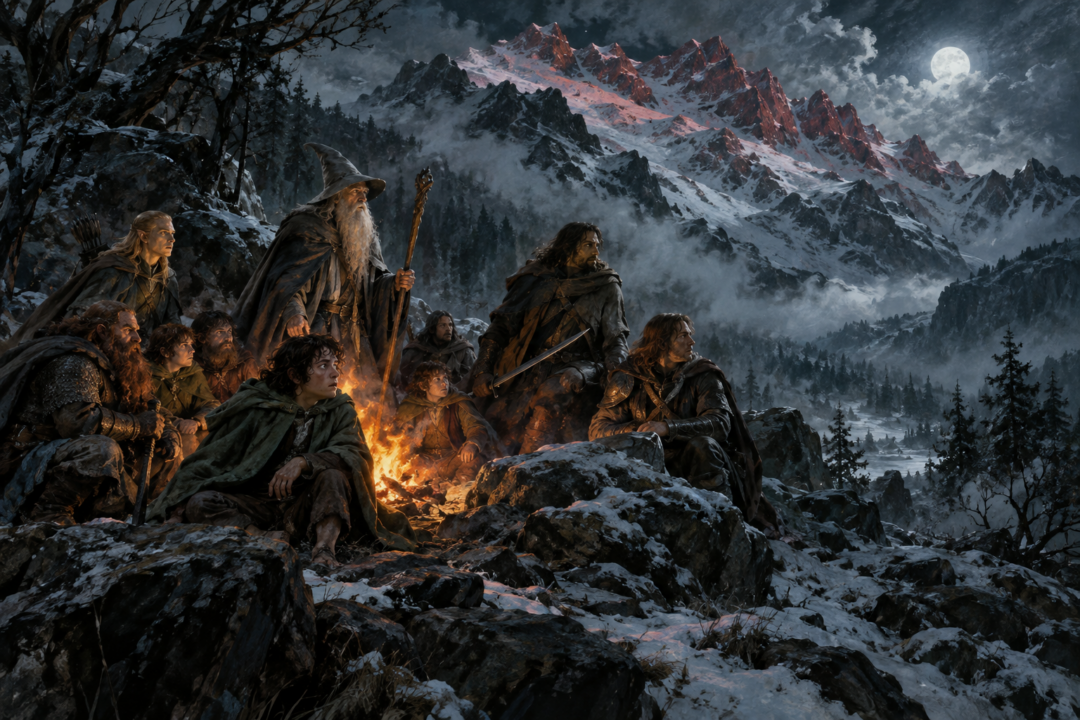
The Fellowship has already been defeated by Caradhras when the next problem begins.
The Redhorn Gate has failed. Snow has driven the Company back down the mountain, leaving Gandalf and Aragorn to confront an increasingly unpleasant question: if they cannot cross the Misty Mountains above ground, how are they going to reach the eastern side at all?
Moria is one answer.
Boromir proposes another: go south.
At first, this is still a genuine argument about roads. Then wolves begin howling in the darkness.
Their arrival west of the Misty Mountains does more than provide the Fellowship with another enemy to fight. It changes the practical meaning of every remaining choice. The Company is no longer simply trying to select the least dangerous route.
They are being hunted.
And once that becomes clear, the road into Moria begins to look very different.
Caradhras Has Already Removed the Best-Looking Road
The Fellowship did not leave Rivendell intending simply to march into Moria.
Gandalf had considered the Mines from the beginning, but Aragorn opposed using that road until an attempt had first been made to cross the mountains by the Redhorn Gate. That distinction matters. Moria is not an improvised idea invented only after Caradhras defeats them; it is a dangerous possibility that has been deliberately postponed.
Caradhras changes the calculation.
The Company cannot force the pass. Whether the mountain itself is acting with hostile purpose is left uncertain in the text: characters speculate about Caradhras, Sauron, and other possible causes, but the narrative never supplies a simple final explanation.
What is certain is the consequence.
The Fellowship retreats.
Going back to Rivendell is discussed, but Gandalf argues that retreat would amount to defeat. Frodo cannot simply remain there indefinitely while Sauron's power grows. The quest requires movement.
That leaves the Company looking for another way through or around the Misty Mountains.
Gandalf finally names Moria.
The reaction is overwhelmingly negative.
Gimli is eager, partly because Balin had led a colony there years earlier. Aragorn has already passed through Moria and remembers the experience with dread. Boromir opposes the route. Legolas does not want it. Frodo is reluctant.
Moria therefore begins as a road almost nobody wants.
Boromir’s Southern Alternative Is Not Foolish
Boromir proposes travelling south to the Gap of Rohan, following a route he knows from his own journey north.
On a map, the suggestion has obvious logic. Instead of entering a notoriously dangerous underground kingdom, the Company could continue around the mountains.
But Gandalf immediately identifies the problem.
The political situation has changed since Boromir travelled north.
Saruman has openly become an enemy. Isengard stands close to the Gap of Rohan, and Gandalf insists that the Ring must not approach it if this can be avoided. Boromir also suggests a still longer southern route, crossing the Isen and eventually approaching Gondor from lands nearer the sea, but Gandalf rejects that option because the Company cannot afford such a delay.
So before the wolves appear, the Fellowship’s choices are already narrowing.
Caradhras is blocked.
Returning to Rivendell means abandoning the forward movement of the quest.
The Gap of Rohan brings the Ring dangerously close to Saruman.
The longer southern detour costs too much time.
Moria is terrible, but it has one enormous advantage: it leads beneath the mountains.
The debate is still unresolved when Frodo asks that they wait until morning before deciding.
Then he notices the howling.
The Wolves Transform a Route Debate Into a Pursuit
Aragorn recognizes what they are hearing.
Wargs have come west of the Mountains.
That geographical detail is crucial.
The Fellowship is already on the western side of the Misty Mountains. A southern journey toward Rohan would therefore keep them travelling through open country on the same side where hostile wolves are now operating.
Gandalf immediately draws the practical conclusion. If the Company survives until dawn, who will want to travel south at night with wolves following them?
Boromir’s response shows how quickly the argument has changed.
He asks how far away Moria is.
Only moments earlier, he had resisted entering it unless the whole Company voted against him. Now the presence of the Wargs makes the nearer underground route more attractive than a long journey south through country in which the Fellowship can be tracked and attacked.
Moria has not become safer.
Everything outside it has become more dangerous.
That is the important shift.
These Are Not Merely Hungry Animals
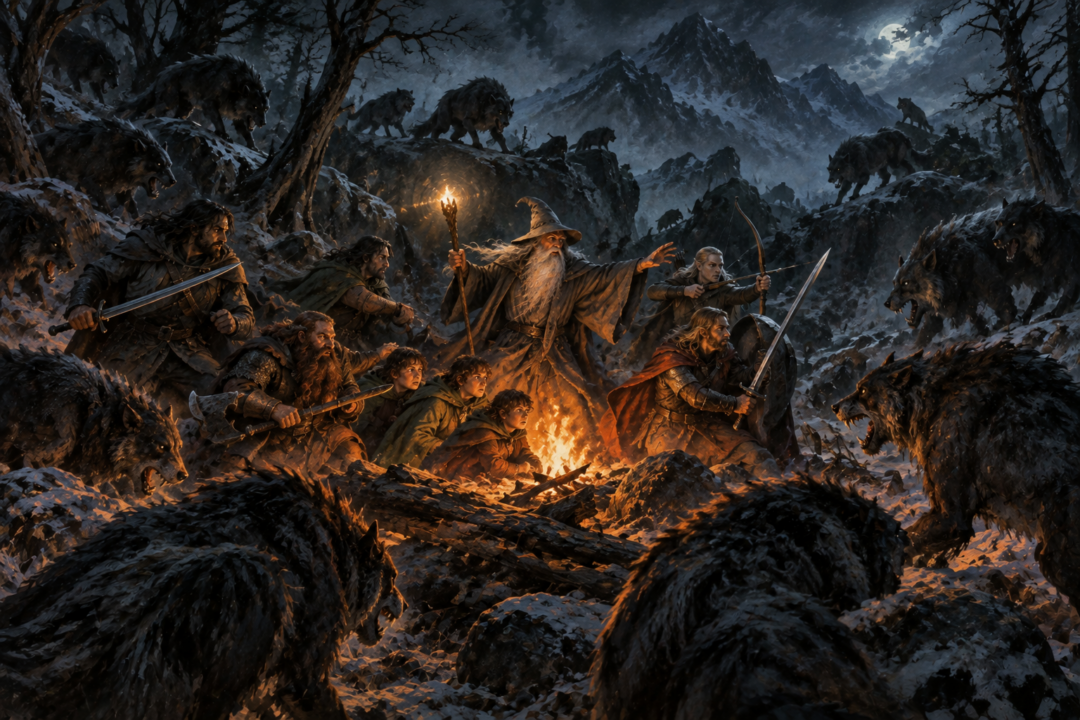
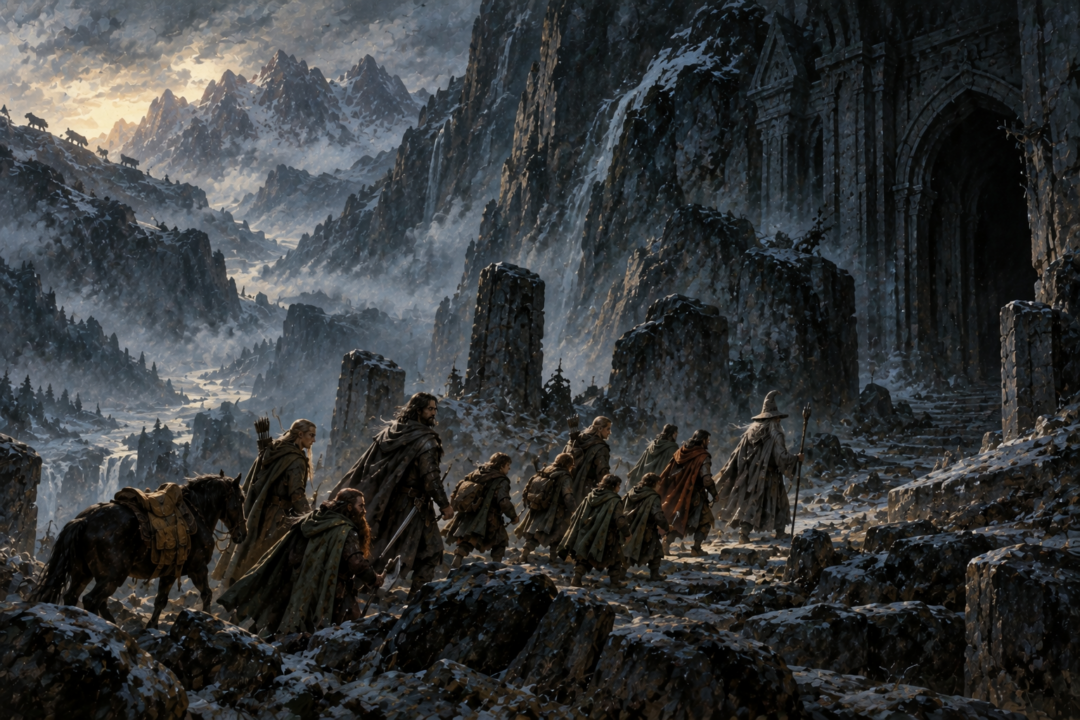
The Company prepares a defensive position among trees and boulders, keeping a fire burning and maintaining a watch.
During the night, the threat becomes unmistakable.
The wolves do not behave like ordinary predators stumbling upon travellers. They gather around the Fellowship and eventually attack in force. Gandalf later explicitly concludes that these were not ordinary wolves hunting for food.
The text also gives their assault a disturbing degree of organization. A great wolf-leader appears, and the pack closes upon the defenders. Aragorn, Boromir, Gimli and the others fight at close quarters, while Legolas uses his bow. Gandalf ultimately employs fire against the attackers.
The Fellowship survives.
But morning produces an unsettling discovery.
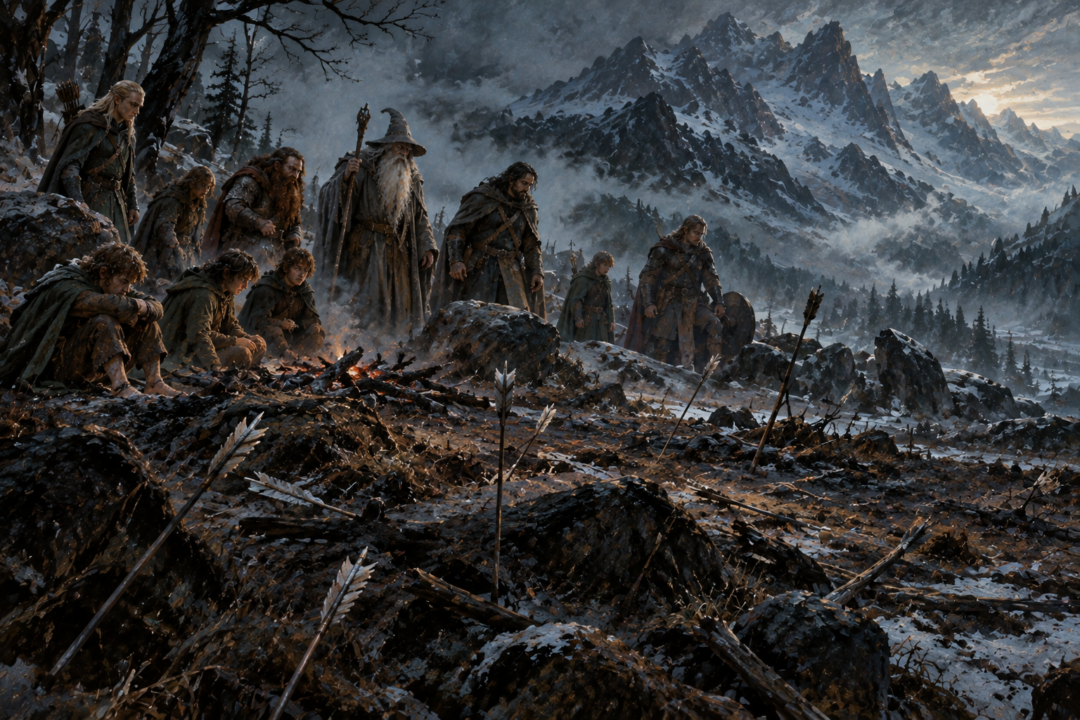
The bodies of the slain wolves are gone.
Only arrows remain.
The narrative does not fully explain the disappearance, and it is safer not to impose a precise supernatural mechanism that the text itself does not provide. What matters is Gandalf’s conclusion: the attack confirms his fear that the Company faces something more purposeful than ordinary wilderness danger.
The road behind and around them no longer feels neutral.
The Attack Makes Secrecy Harder to Preserve
The Fellowship’s journey depends heavily upon avoiding notice.
That hope has already been weakening.
In Hollin, Aragorn observes crebain coming from the direction of Fangorn and Dunland and suspects that the land is being watched. A dark shape also passes overhead during the night, though its exact identity is not established there.
Now come the Wargs.
It would go beyond the text to claim that every hostile creature encountered west of Moria is demonstrably acting under one perfectly coordinated command. The Company itself does not possess that certainty.
But from their perspective, the pattern is alarming.
They have been observed from the air.
They have failed to cross Caradhras.
They are now attacked by organized wolves in territory where Aragorn is surprised to find Wargs at all.
Remaining in the open becomes increasingly dangerous.
This gives Gandalf’s preference for Moria another strategic dimension. An underground road is frightening precisely because nobody knows what is waiting inside it. Yet that same isolation could potentially conceal the Company from enemies searching the lands above.
Gandalf even hopes that passing through Moria may cause the Enemy to lose their trail for a time.
The darkness is dangerous.
But darkness can also hide.
Moria Becomes the Short, Terrible Road
After the attack, delay becomes difficult to justify.
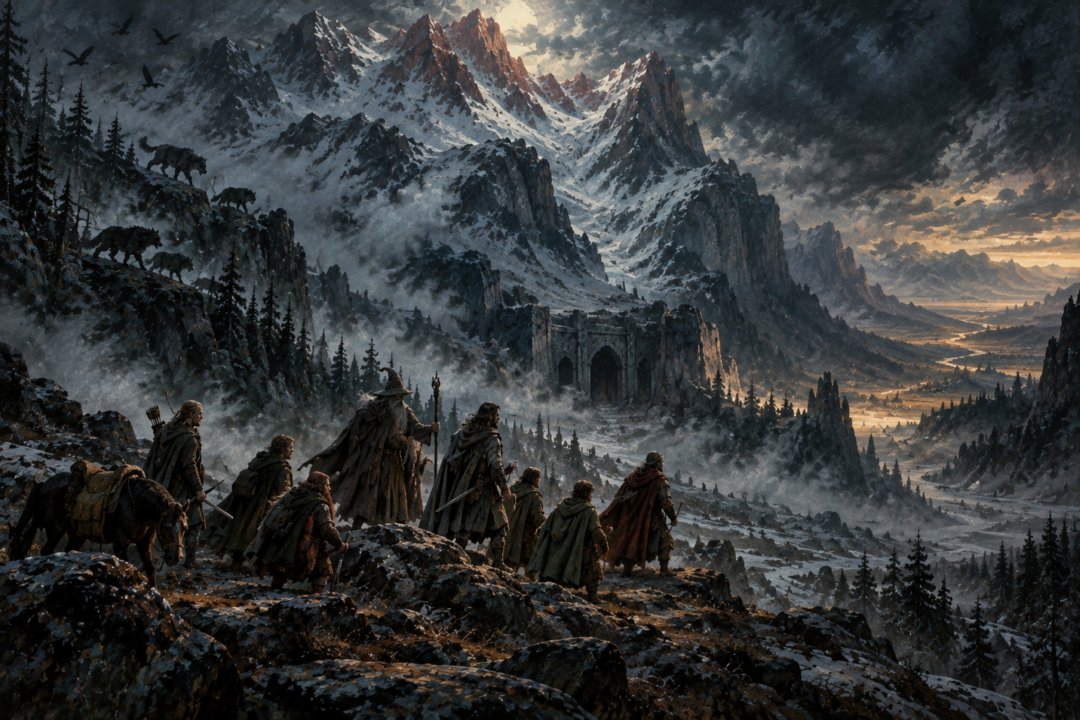
The Fellowship eats and moves quickly toward the western entrance of Moria.
The geography now works strongly in Gandalf’s favor. The West-gate lies comparatively near their position beneath the mountains. By contrast, Boromir’s southern alternatives require continued travel across exposed country.
This is why the wolves matter so much to the decision.
Without them, the Company might have spent the night debating Moria against the southern roads. Frodo explicitly asks for that delay.
The Wargs effectively remove it.
They demonstrate that waiting is dangerous and that moving south does not mean escaping danger. The Fellowship would be taking a pursuing threat with them.
The choice is no longer between frightening Moria and comparatively ordinary wilderness.
It is between different forms of danger.
And the danger outside is mobile.
Aragorn’s Warning Makes the Choice More Tragic
There is another reason the decision feels so heavy.
Aragorn does not merely dislike Moria.
He warns Gandalf personally.
Having passed through the Mines before, Aragorn says that his memory of them is evil. More strikingly, he tells Gandalf to beware if he passes through Moria’s doors. He does not explain exactly what he foresees, and the text should not be stretched into claiming that Aragorn knows Gandalf will fall.
But the warning becomes painfully significant in retrospect.
The Company enters Moria because the alternatives have progressively collapsed around them: Caradhras, Rivendell, the Gap of Rohan, the distant southern road, and finally the possibility of safely lingering or travelling openly west of the mountains.
Yet Moria contains the danger Aragorn fears.
The Fellowship escapes the Wargs only to encounter the Watcher at the West-gate, Orcs within Khazad-dûm, and finally Durin’s Bane.
Gandalf falls at the Bridge.
The wolves do not cause that catastrophe in any simple sense. Gandalf already favored Moria, and several strategic pressures already pointed toward it.
But the Wargs accelerate the decision at precisely the moment when the Company is still resisting it.
The Enemy Does Not Need to Close Every Road
This episode reveals something important about danger in Middle-earth.
The Fellowship is rarely confronted with a neat set of choices where one path is clearly safe and another clearly fatal.
Instead, pressure accumulates.
One road becomes impassable.
Another passes too near a traitor.
Another takes too long.
Another requires retreat.
Then predators appear behind you.
The result is a kind of strategic compression. The Fellowship still technically possesses choices, but fewer of those choices remain practical.
That distinction matters.
The wolves do not literally force the Company through the Doors of Durin. Nobody stands behind them commanding them to enter Moria.
What the wolves change is the cost of refusing.
Before the howling begins, Frodo can plausibly ask for a night to reconsider.
Afterward, even Boromir begins asking how far away Moria is.
That may be the most revealing measure of what has happened.
Moria itself has not changed.
Boromir has not suddenly forgotten its reputation. Aragorn has not withdrawn his warning. Legolas has not become eager to enter. The hobbits have not ceased to fear it.
The world around Moria has changed.
The Company has learned that the western wilderness cannot be treated as empty space through which they may wander indefinitely while choosing their preferred route.
Something is hunting there.
So they turn toward a door beneath the mountains.
Not because the darkness has become safe, but because the open road has stopped looking like freedom.
Sources & Notes
- The Ring Goes South — Caradhras forces the Fellowship to retreat: https://tolkiengateway.net/wiki/The_Ring_goes_South
- Boromir — the southern alternatives and Gandalf's objection: https://tolkiengateway.net/wiki/Boromir
- Wargs — the pack that attacks the Fellowship in Hollin: https://tolkiengateway.net/wiki/Wargs
Sources checked for relevance and availability.