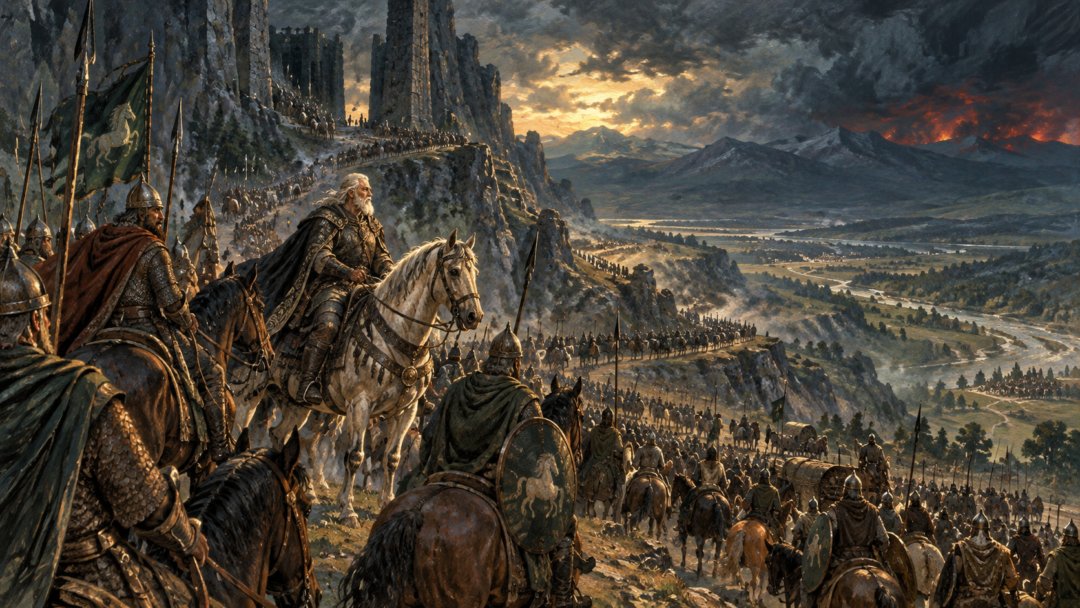
When Théoden prepares to answer Gondor’s call, one number dominates the final Ride of the Rohirrim: six thousand.
It is easy to read that figure as a simple statement of Rohan’s military strength. Six thousand Riders leave for Minas Tirith; therefore, six thousand Riders must be what Rohan can field.
But the text gives us something more complicated.
Théoden himself says that he might have sent ten thousand spears across the plains, but refuses to strip his strongholds of defenders. The older military organization of Rohan points to an even larger theoretical Full Muster. And when the six thousand finally ride east, their number is shaped not merely by how many warriors exist, but by how many can be assembled, supplied, spared, and brought to the battlefield before Gondor falls.
The famous six thousand are therefore best understood as an expeditionary force created by geography and time.
Rohan does not simply count warriors.
It counts days.
Rohan’s Theoretical Army Was Larger
The clearest evidence comes from Unfinished Tales, in the material concerning the military organization of the Rohirrim.
An éored, when operating at full strength, consisted of no fewer than 120 Riders. A Full Muster of the Riders of the Mark—the éoherë—was theoretically one hundred éoreds. That produces a nominal strength of 12,000 Riders.
That does not mean Théoden had 12,000 battle-ready horsemen waiting somewhere during the War of the Ring.
Quite the opposite.
The same material makes clear that such theoretical organization should not automatically be treated as the number available for a particular campaign. A kingdom cannot simply remove every fighting man from every district and send him hundreds of miles away.
By March 3019, Rohan has also just survived Saruman’s war. Théodred has been killed at the Fords of Isen. The Westfold has suffered invasion. The king’s forces have fought at Helm’s Deep. Men have been killed, wounded, scattered, or assigned to essential defensive duties.
So the paper strength of Rohan and the force available to Théoden are two different things.
That distinction becomes crucial at Dunharrow.
Théoden Expected More Than Six Thousand
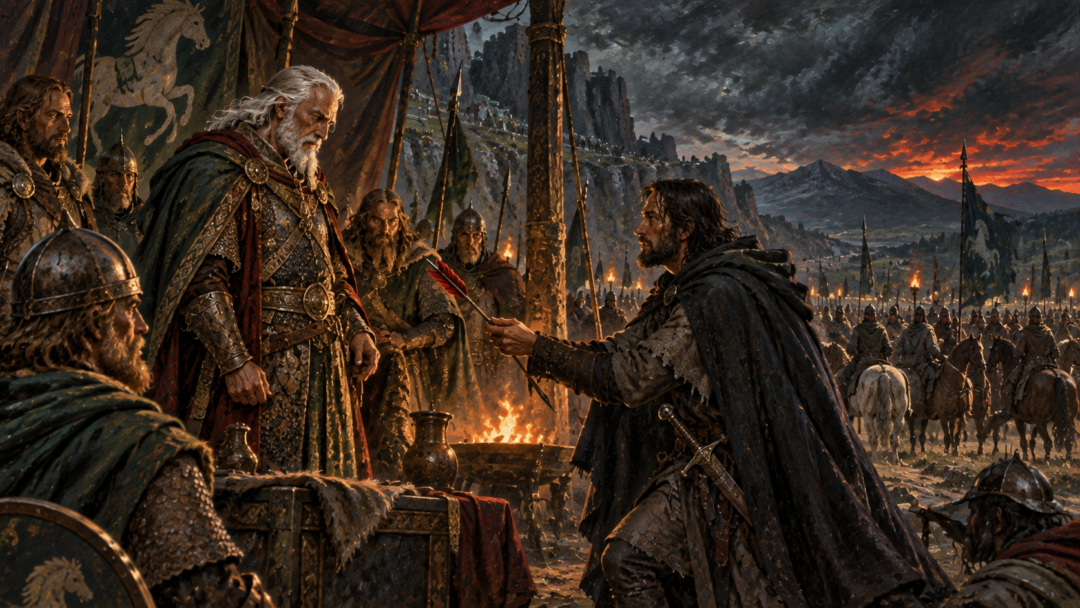
In The Return of the King, Théoden tells Hirgon, the messenger bearing Gondor’s Red Arrow, that he could potentially have sent ten thousand spears before the recent war altered Rohan’s situation.
But even then he immediately adds another constraint: he cannot leave his strongholds unguarded.
That sentence changes the meaning of the entire muster.
Rohan is not an empty staging ground from which every armed Rider can depart. It remains a kingdom threatened by war. Saruman has been defeated as an immediate military danger, but the wider conflict is not over, and Théoden cannot know exactly what may happen once he rides east.
Some strength must remain behind.
The six thousand who accompany Théoden therefore do not represent every Rider Rohan possesses. They are those whom the king can gather and commit to Gondor while preserving some defence at home.
Even this number is given conservatively at first. Théoden promises that “six thousands at the least” will ride behind him.
The wording matters. Six thousand is not presented as an absolute census of Rohirric military manpower.
It is the force he expects to take on the road.
The Real Enemy Is the Calendar
Hirgon brings something more frightening than a request for reinforcements.
He brings a deadline.
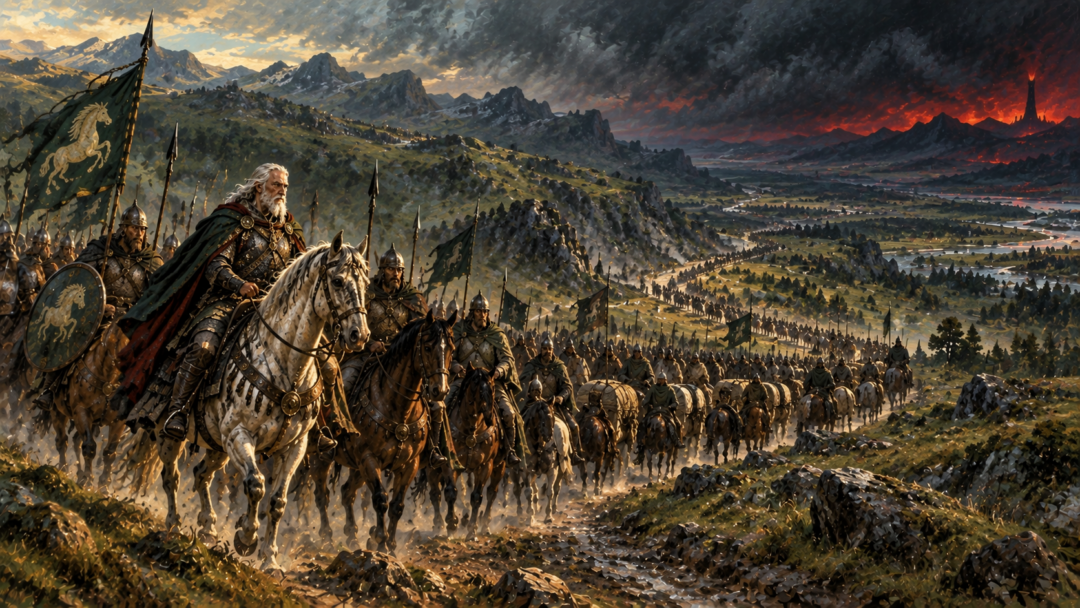
Gondor is already expecting the Enemy’s assault, and Minas Tirith needs help urgently. Théoden tells Hirgon that the Riders will depart on the following morning, yet under the expected timetable they will not reach Minas Tirith for a week.
This is the hidden strategic problem behind the muster.
A larger army is useless if it arrives after the city has fallen.
Every additional delay spent gathering distant Riders risks making the reinforcement irrelevant. Men have to reach the assembly point. Horses have to be ready. Provisions have to be considered. Then the entire mounted host must cross Rohan and Anórien.
The question is therefore not simply:
How many Riders does Rohan have?
It is:
How many Riders can Théoden put on the road now and still reach Gondor in time?
Those are very different questions.
Why Cavalry Does Not Erase Distance
The Rohirrim are extraordinarily mobile by the standards of the peoples around them, but horses do not make logistics disappear.
Thousands of mounted warriors moving together are not equivalent to a handful of messengers galloping from station to station. A warhorse must remain capable of fighting when it reaches the battlefield. Riders must eat. Horses require grazing, rest, and management. The column must remain organized enough to respond to danger.
The narrative repeatedly emphasizes the pace of the journey.
The later song of Rohan remembers Théoden riding east for five nights and days through the Folde, Fenmarch, and Firienwood before reaching the war around Mundburg.
That remembered duration is one of the strongest clues to how we should understand the six thousand.
The Ride of the Rohirrim is not merely a movement of troops. It is a race between an army and the destruction of a city.
And the race becomes worse as the Riders approach Gondor.
The Enemy Tries to Win by Delaying Them
The forces of Mordor understand the importance of the roads.
As Théoden advances through Anórien, he learns that the ordinary route toward Minas Tirith has become dangerous. Enemy forces have entered the region, and the way ahead is threatened.
At this point, Ghân-buri-Ghân and the Drúedain become strategically decisive.
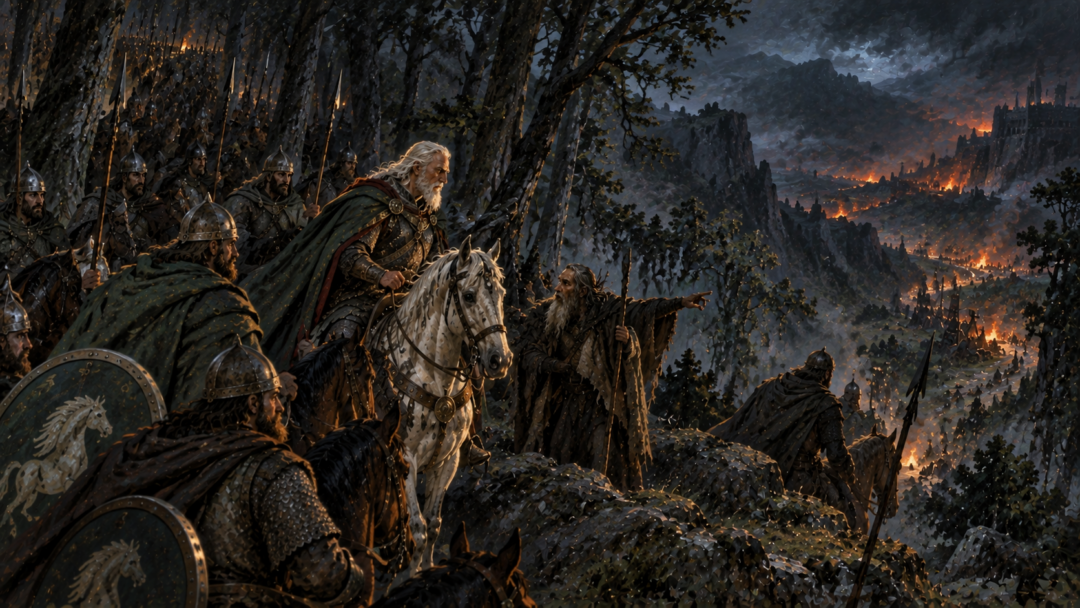
Ghân knows paths unknown to the invading forces and offers to guide the Rohirrim through the Stonewain Valley. This allows Théoden to bypass enemies positioned to obstruct his approach and emerge nearer the Pelennor.
The episode is sometimes overshadowed by the charge itself, but it reveals the underlying mathematics of the campaign.
Mordor does not necessarily need to destroy Théoden’s six thousand Riders on the road.
It only needs to make them late.
If Minas Tirith falls before Rohan arrives, those six thousand spears cease to matter to the defence of the city.
Ghân’s contribution is therefore not additional manpower. It is saved time.
In a campaign governed by a deadline, that can be more valuable than another éored.
The Muster Is a Snapshot, Not a Population Count
This is why attempts to infer Rohan’s entire population directly from the six thousand Riders should be treated cautiously.
The number describes a particular host at a particular moment under extraordinary circumstances.
Rohan has suffered casualties. Some Riders must remain behind. Others may not be able to reach the muster quickly enough. Théoden is operating under severe time pressure. And the kingdom’s military structure, as described elsewhere, allows for a larger force than the one that actually rides to Gondor.
None of this gives us a precise census of Rohan.
The texts do not provide one.
What they provide instead is a much more believable picture of mobilization: theoretical strength, immediately available strength, local defence, previous losses, travel time, and operational necessity all interact.
The six thousand are what Théoden can actually bring to the decisive place at the decisive moment.
That is strategically more meaningful than a theoretical maximum.
Six Thousand Arrive at Exactly the Moment They Are Needed
The final irony is that Théoden’s force looks inadequate when measured against the armies gathering around Minas Tirith.
Yet its timing transforms the battle.
The Rohirrim reach the Pelennor after the siege has already reached the walls of the city. The Great Gate has been broken. The Witch-king has entered, and Gondor’s situation is desperate.
Then horns sound from the north.
The effect of the Rohirrim cannot be understood purely through numbers. They arrive as a fresh mobile army against an enemy already committed to the siege. Their appearance creates a new battlefield outside the city and forces Mordor’s host to respond.
That does not mean six thousand Riders defeat Mordor alone. The battle continues at terrible cost. Théoden is killed. The arrival of Aragorn with forces from southern Gondor becomes another crucial turn.
But the Rohirrim arrive before the opportunity to save the city disappears.
That is the achievement.
Not merely mustering six thousand men.
Getting six thousand men there in time.
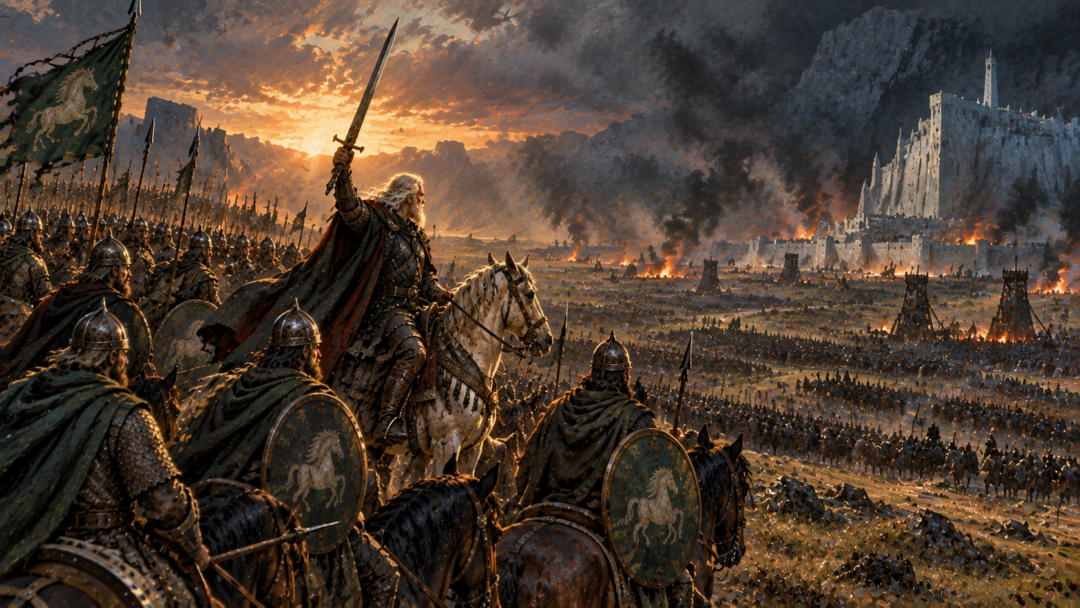
Théoden’s Greatest Decision Is When to Stop Gathering
There is a temptation in military stories to imagine that commanders should always wait for more strength.
Another hundred Riders would help. Another éored would help more. Another thousand could change a battle.
But reinforcement has diminishing value when the battlefield itself is about to vanish.
Théoden must eventually stop assembling his army and begin moving it.
That decision is embedded in the chronology of The Return of the King. Gondor’s appeal is urgent. The Darkness spreads. The host rides. Obstacles appear. Ghân provides another road. And the Rohirrim finally reach the Pelennor at the edge of catastrophe.
The six thousand therefore tell us something subtler than the size of Rohan’s army.
They reveal the difference between strength that exists and strength that can be used.
Rohan may possess more warriors than Théoden takes east. Its traditional Full Muster may be larger still. But warriors scattered across a kingdom are not yet an army at Minas Tirith.
They must be summoned.
They must be spared.
They must be supplied.
They must travel.
And above all, they must arrive before they are too late.
The glory of the Ride of the Rohirrim is usually remembered in the charge: horns in the morning, spears raised, horses thundering onto the Pelennor.
But the victory hidden beneath that moment begins days earlier.
Théoden does not bring every Rider he might theoretically command.
He brings the Riders who can reach the war while there is still a war to save.
Sources & Notes
- Tolkien Gateway — The Muster of Rohan https://tolkiengateway.net/wiki/The_Muster_of_Rohan
- Tolkien Gateway — Éored https://tolkiengateway.net/wiki/Eored
- Tolkien Gateway — Hirgon https://tolkiengateway.net/wiki/Hirgon
These references cover Théoden’s Dunharrow muster and timing, Rohan’s theoretical éored structure, and Hirgon’s urgent delivery of Gondor’s Red Arrow. The distinction between field force and total capacity is interpretive synthesis.