
The Black Speech sounds like the perfect language for an empire obsessed with control. Sauron devised it during the Dark Years and intended it to be the common speech of his servants. Yet when we actually see Mordor functioning during the War of the Ring, its military system does not behave like a supernatural communications network. Orders arrive. Reports must be carried. Captains worry about what will reach Barad-dûr. Patrols respond to messages. Even urgent intelligence can depend upon someone physically getting it to the Dark Tower.
That apparent contradiction reveals something important about Mordor.
The Black Speech was designed to impose linguistic unity. It was not a magical substitute for communication across distance. Mordor still needed roads, signals, messengers, commanders, patrols, and reports—and the events around Cirith Ungol show just how vulnerable that system could become.
What the Black Speech Was Actually For
Appendix F of The Lord of the Rings gives the essential background. Sauron devised the Black Speech during the Dark Years and wanted it to become the language of those who served him.
The project did not entirely succeed.
After Sauron’s overthrow at the end of the Second Age, the language in its ancient form was no longer generally preserved among his servants, although the Nazgûl remembered it. When Sauron’s power rose again, Black Speech was once more used in Barad-dûr and among Mordor’s forces, but Orcs continued to possess their own degraded dialects and often relied upon Westron when different groups needed a mutually intelligible tongue.
That distinction matters.
Creating a common language solves one problem: two servants who understand it can exchange information when they meet.
It does not solve the problem of distance.
A captain at Cirith Ungol may understand exactly what Barad-dûr wants. Someone still has to bring him those instructions—or some other signal has to communicate them.
The Black Speech standardizes the message. It does not transport the message.
Cirith Ungol Shows Mordor’s Command System in Action
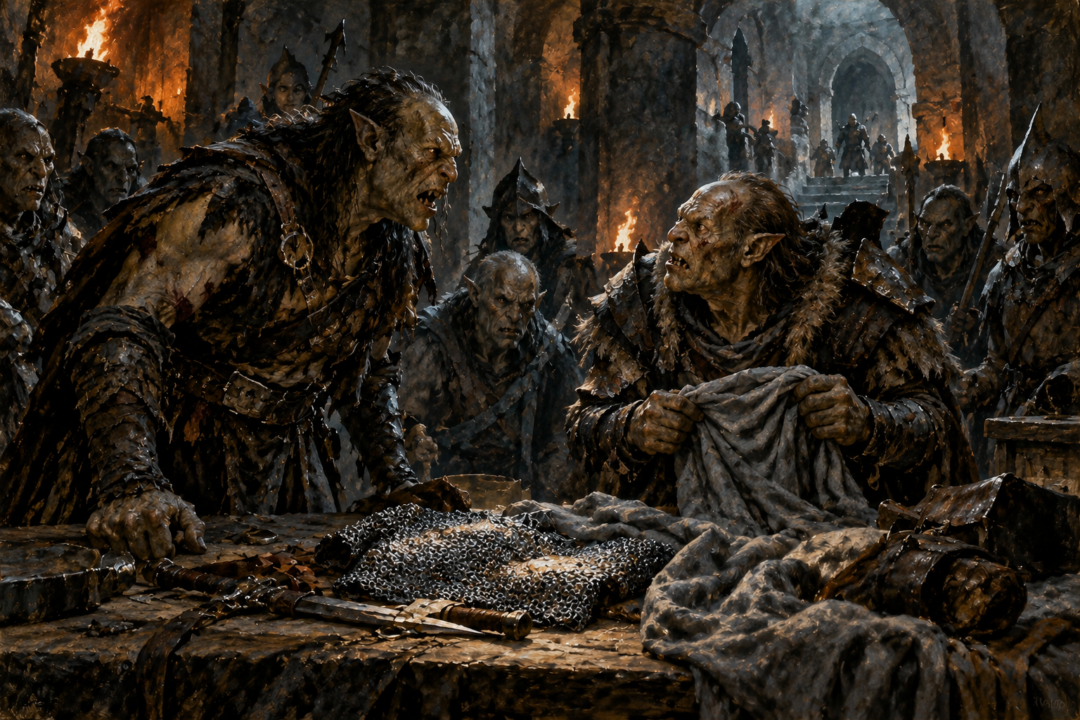
The clearest glimpse comes when Sam overhears Shagrat and Gorbag after Frodo has been taken by the Orcs.
Their conversation is unusually valuable because these are not outsiders guessing how Mordor operates. They are officers discussing their duties.
Gorbag reports that a message had come because the Nazgûl were uneasy and spies were feared upon the Stairs. The response was practical: vigilance was increased and a patrol was sent.
Then Shagrat explains his standing orders concerning intruders.
A trespasser must be held at the Tower. The prisoner must be searched. A description of the prisoner’s possessions—including such things as weapons, letters, rings, and other objects—must be sent directly to Lugbúrz, the Orcish name for Barad-dûr. The prisoner must meanwhile remain alive and intact until further instructions arrive or higher authority intervenes.
This is not vague domination through Sauron’s will.
It is administration.
There are standing orders, local commanders, reports, designated recipients, security procedures, patrols, and severe penalties for disobedience.
Most revealingly, information has to travel both ways.
Cirith Ungol receives instructions from above.
Barad-dûr expects reports from Cirith Ungol.
Mordor Does Have Long-Distance Signals
Messengers are not Mordor’s only means of coordination.
Just before the army of Minas Morgul marches, Frodo and Sam witness the enormous red flash rising from Mordor. Minas Morgul answers with its own violent signal, and the great host begins moving.
Gorbag later refers to the event as the Great Signal.
This demonstrates that Mordor possessed at least one method of communicating a predetermined command rapidly over a considerable distance. For something simple—effectively, the moment has come to begin the planned operation—a visual signal could be far faster than a rider or runner.
But signals have limits.
A flash can mean “begin.”
It cannot easily communicate the complicated situation discovered at Cirith Ungol:
An unknown intruder has been captured. Another may still be loose. Shelob has attacked. The prisoner possesses unusual equipment. The guards disagree about what happened. A detailed inventory must be transmitted.
That requires information rather than a simple prearranged instruction.
And detailed information requires a messenger, a report, or some equivalent channel.

The Nazgûl Are Powerful, but They Are Not a Telecommunication Network
It is tempting to imagine that Sauron could simply communicate mentally with every servant in Mordor.
The texts do not establish such a system.
Sauron certainly possesses extraordinary powers of perception, domination, and will. The Nazgûl are bound to him and act as his greatest servants. They can travel rapidly on their winged mounts during the War of the Ring, making them extraordinarily effective commanders, scouts, and agents.
But none of this means that every Orc captain receives Sauron’s thoughts instantaneously.
In fact, the narrative repeatedly depicts information moving through ordinary chains of command.
Even the Nazgûl themselves sometimes receive messages. In the account of their hunt for the Ring given in Unfinished Tales, messengers from Sauron direct their movements after earlier stages of their search.
The pattern is therefore consistent: supernatural beings exist within Mordor’s command structure, but physical communication still matters.
The Nazgûl can make that structure faster and more terrifying. They do not eliminate it.
Why Sauron Cannot Simply Watch Everything
Another misconception comes from the Eye.
Sauron’s ability to perceive distant events is formidable, but The Lord of the Rings never presents him as possessing continuous omniscience.
Much of the plot depends upon exactly the opposite.
Sauron gathers information, interprets evidence, watches particular threats, deploys spies, interrogates prisoners, and sometimes reaches the wrong conclusion.
His attention also matters.
When Aragorn confronts him through the palantír, Sauron interprets what he sees according to his fears and assumptions. Later, the march of the Captains of the West helps concentrate his attention upon the threat approaching the Morannon.
Meanwhile Frodo and Sam cross Mordor.
If Sauron automatically knew everything occurring within his borders, their journey would be impossible.
His surveillance is immense, but it is not perfect.
That makes reports from frontier fortresses valuable.
Shagrat’s Desperate Need to Get the News Through
After the Orcs of Cirith Ungol slaughter one another over Frodo’s mithril coat, the importance of communication becomes even clearer.
Shagrat survives the fighting, badly hurt.
He orders Snaga to leave and carry news toward Lugbúrz. Snaga refuses. Shagrat insists that the news must get through and fears the punishment awaiting them if it does not.
Eventually Shagrat himself escapes from the Tower carrying Frodo’s possessions.
This is one of the most revealing logistical moments in Mordor.
Something extraordinary has happened almost on the doorstep of the Dark Land—and Barad-dûr does not automatically know the complete story.
Someone must report it.
The physical evidence must also be carried.
Later, at the Morannon, the Mouth of Sauron produces Frodo’s mithril coat, cloak, and sword before Gandalf and the Captains of the West.
Those objects have travelled through Mordor’s command structure.
Sauron’s intelligence depends partly upon things being brought to him.

Why the Mouth of Sauron Matters
The Mouth of Sauron makes the same principle visible on a larger scale.
He is not merely a warrior. He is the Lieutenant of Barad-dûr and serves as Sauron’s ambassador at the Black Gate.
When Sauron wishes to communicate detailed terms to Aragorn, Gandalf, and their companions, he does not project his voice across the battlefield.
He sends a representative.
The Mouth can negotiate, display captured possessions, issue demands, answer objections, and communicate Sauron’s position.
Language is essential to that encounter.
But again, language and transmission are different things.
Knowing what words to use does not eliminate the need for someone to speak them.
Mordor Is an Empire of Roads as Well as Fear
The geography of Mordor reinforces the point.
Barad-dûr is connected to other strategically important places by roads. During Frodo and Sam’s final journey, they encounter military traffic moving toward the Black Gate. Companies converge at road junctions, officers force stragglers into marching columns, and troops are being concentrated for war.
This is a physical military machine.
Soldiers march.
Supplies move.
Orders pass through ranks.
Reports return toward headquarters.
Signals coordinate predetermined events.
The Black Speech belongs inside that machine rather than replacing it.
Its value is obvious in an empire containing Orcs of different origins alongside Trolls, Men, Nazgûl, and other servants. A ruler seeking domination would benefit from imposing linguistic uniformity upon such disparate forces.
But linguistic unity cannot conquer geography.
The Failure at Cirith Ungol Reveals the Weakness Beneath the System
Mordor’s command structure is impressive, but Cirith Ungol exposes its fragility.
Shagrat possesses clear orders.
He knows the consequences of disobedience.
He understands that Barad-dûr requires a report.
None of that prevents catastrophe.
Gorbag covets Frodo’s mithril coat. Rivalry becomes violence. Discipline collapses. The two Orc companies virtually destroy one another while the prisoner they were ordered to preserve is rescued.
The problem is not misunderstanding the command.
It is that Sauron’s servants do not become loyal simply because they understand the same words.
Fear can compel obedience while authority is present. It cannot erase greed, resentment, rivalry, or self-interest.
That distinction becomes even more dramatic after Sauron’s fall. At the Morannon, when the Ring is destroyed and Sauron’s directing power vanishes, his servants lose the force that held their war machine together.
His empire possessed organization.
It never possessed genuine unity.

The Black Speech Solved the Wrong Problem
That is the deeper irony.
Sauron attempted to give his servants one language, and there is a terrible logic to the idea. A single ruler, a single military system, and a single imposed speech all express the same desire: diversity reduced into instruments of one will.
Yet Mordor still needs captains to interpret situations, patrols to investigate threats, roads to move armies, signals to begin operations, and messengers to carry information.
Even the perfect command is useless until it reaches the person expected to obey it.
And even when it arrives, obedience is not guaranteed.
Cirith Ungol proves both points within a single night.
The orders from Barad-dûr are clear. The Orcs know what they are supposed to do. The Black Speech—or any other common tongue available to them—is not the problem.
The servants themselves are.
Mordor can impose words more easily than loyalty, and Sauron can build roads more easily than trust. That is why an empire created around the domination of a single will still depends upon frightened captains carrying reports through the dark.
The language may belong to the Dark Lord.
The message still has to get through.
Sources & Notes
- Tolkien Gateway, “Black Speech” — Sauron’s attempt at a common language for his servants. https://tolkiengateway.net/wiki/Black_Speech
- Tolkien Gateway, “Shagrat” — Orc captain and the transfer of Frodo’s captured possessions. https://tolkiengateway.net/wiki/Shagrat
- Tolkien Gateway, “Gorbag” — Orc captain whose conversations expose military command and communication. https://tolkiengateway.net/wiki/Gorbag
- Tolkien Gateway, “Mordor” — The territory and languages of Sauron’s forces. https://tolkiengateway.net/wiki/Mordor
Sources document Black Speech, Shagrat, Gorbag, Mordor. Interpretive claims remain distinguished from the primary narrative.