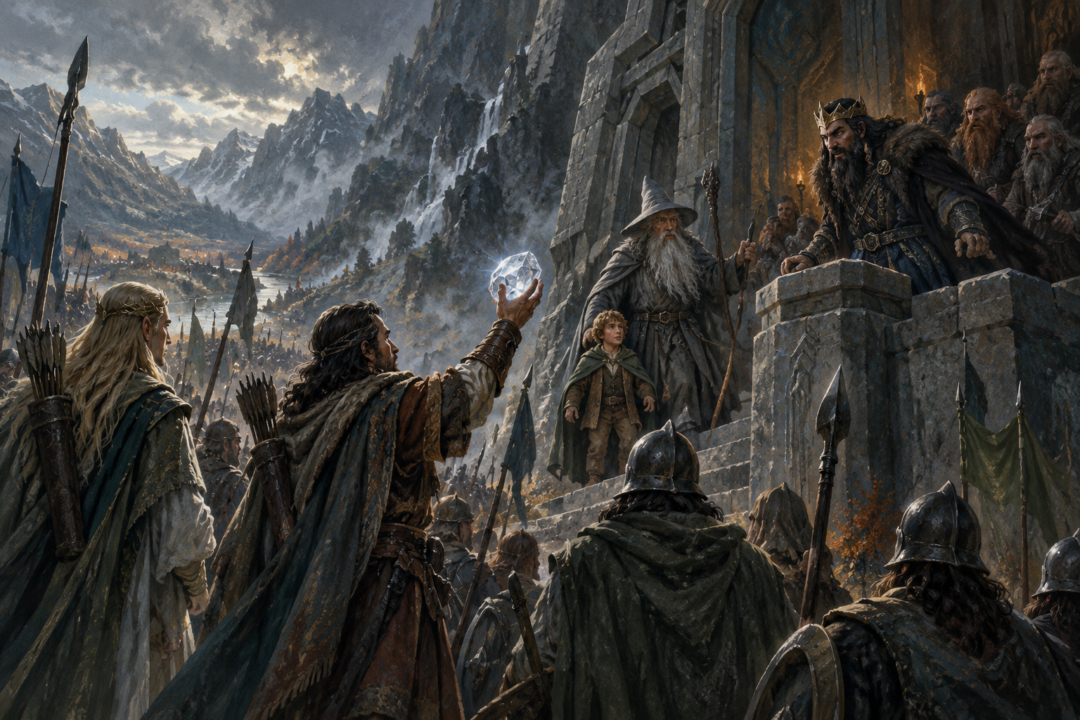
The Arkenstone is small enough for Bilbo to carry in his pocket, yet by the final chapters of The Hobbit it has become powerful enough to hold an army at the gate of Erebor.
Bilbo understands why. Thorin has named the Heart of the Mountain above all the other treasures recovered from Smaug. When Bilbo secretly gives it to Bard and the Elvenking, he is not merely surrendering a valuable jewel. He is placing the one possession Thorin most desperately wants into the hands of the people besieging him.
Then comes one of the most easily overlooked details in the confrontation.
Gandalf is there.
His appearance does not magically settle the dispute. He does not take the Arkenstone from Bard, validate Thorin's position, or persuade everyone into peaceful agreement. In fact, the negotiations remain dangerously close to collapsing into battle.
What Gandalf changes is something more immediate: the fate of Bilbo, the moral shape of the confrontation, and eventually the entire context in which the quarrel must be understood.
Gandalf Actually Returns Before the Public Confrontation
The timing matters.
Bilbo leaves Erebor secretly during the night because he fears the gathering armies will fight. Carrying the Arkenstone, he crosses into the camp of Bard and the Elvenking and offers the jewel as a bargaining tool.
His reasoning is characteristically practical. Thorin had promised him a fourteenth share of the treasure. Bilbo knows that Thorin would never willingly count the Arkenstone as part of that payment, but he nevertheless claims the jewel as his share and hands it over in the hope that Bard can use it to force negotiations.
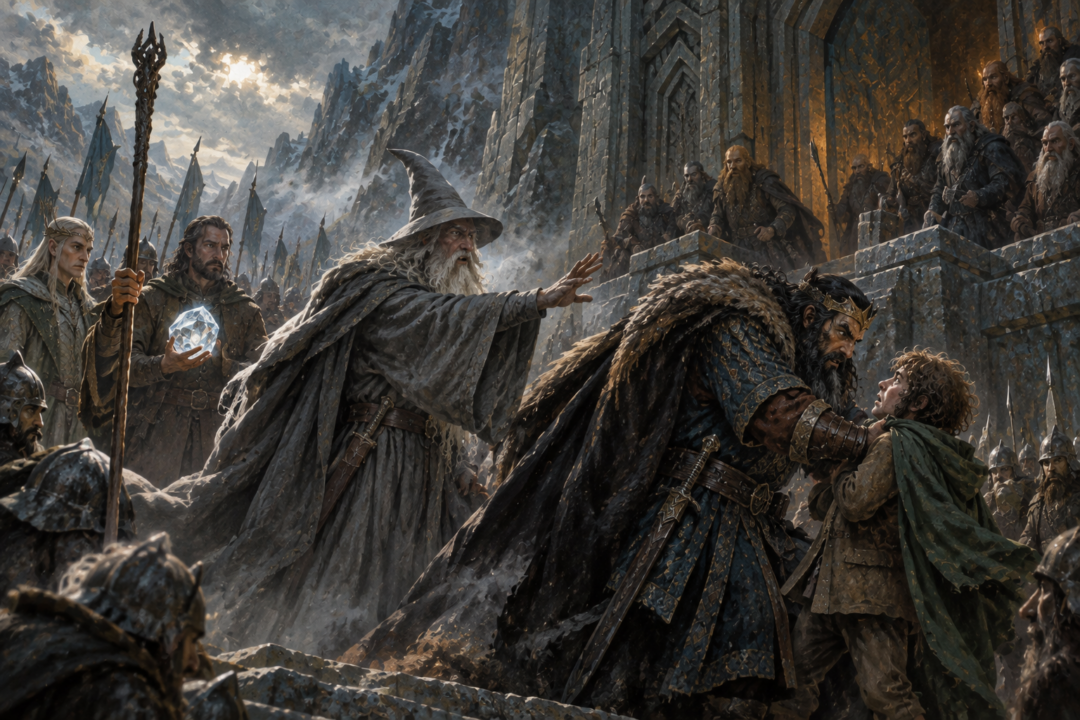
When Bilbo prepares to return to the Mountain, he unexpectedly encounters Gandalf in the camp.
That is Gandalf's actual reappearance in Bilbo's story.
The wizard approves of what Bilbo has done and hints that important news is approaching—news Bilbo does not yet understand. This is significant because Gandalf already knows that the dispute over Smaug's treasure is about to become part of a much larger crisis.
Bilbo returns to Erebor. Gandalf remains outside.
So when Bard comes to the gate the following day with the Arkenstone, Gandalf's later intervention is not an accidental arrival at the perfect second. He has already returned and already knows about Bilbo's plan.
The Arkenstone Gives Bard the Leverage Bilbo Intended
Before Bilbo's intervention, Bard possesses arguments but little leverage.
His claims are not frivolous. Smaug has destroyed Lake-town, leaving its people in desperate need. Bard also invokes treasure associated with Dale that had entered the dragon's hoard. Yet Thorin refuses to negotiate while an armed Elven host remains before his gate.
The situation is therefore trapped.
Thorin has the treasure and the Mountain. Bard and the Elvenking have forces outside. Thorin has also secretly summoned Dáin and the Dwarves of the Iron Hills.
Bilbo's solution is the Arkenstone.
When Bard produces it before Thorin, the balance changes immediately because Thorin cannot simply dismiss this particular object as another piece of treasure. The Arkenstone was found beneath the Lonely Mountain in the days of Thráin I, fashioned by the Dwarves, and treasured by Thorin's house. Thorin has already declared it uniquely his.
Bard consequently proposes an exchange.
The besiegers will surrender the Arkenstone in return for the portion of treasure they demand.
Bilbo's gamble has worked in one limited but crucial sense: Thorin must now engage with the offer.
But Bilbo has also underestimated what the revelation will do to Thorin personally.
The Negotiation Suddenly Becomes a Trial of Bilbo
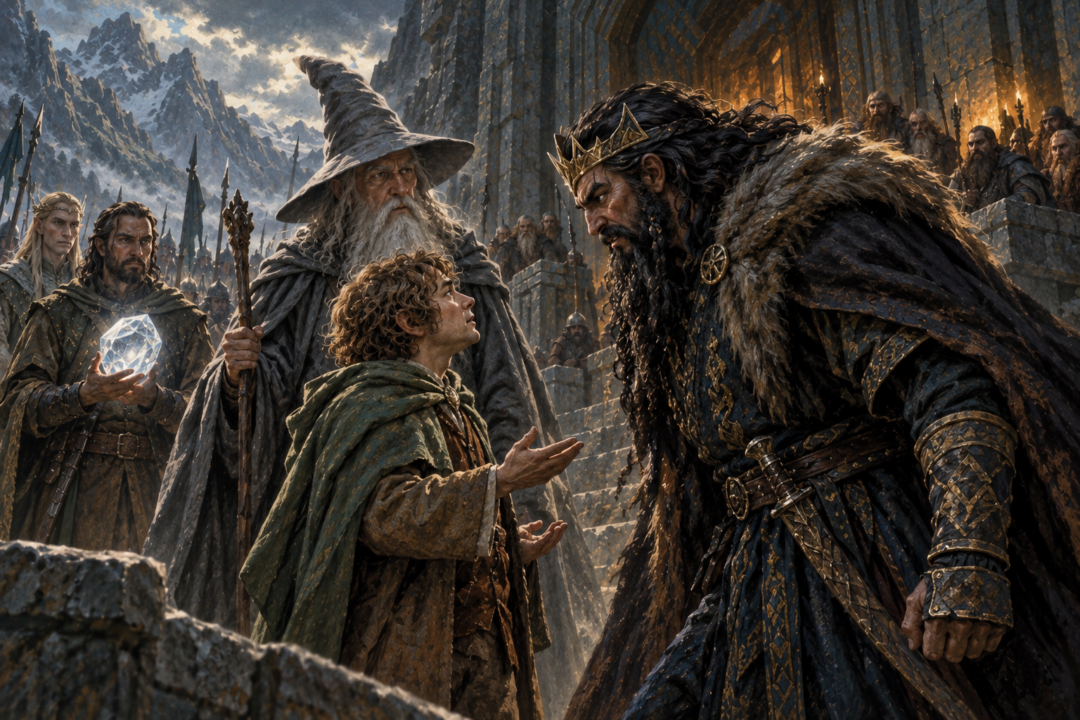
Thorin initially wants to know how Bard obtained the Arkenstone.
That question transforms the scene.
Bilbo steps forward and admits what he has done.
At this point the dispute is no longer merely Thorin against Bard. The emotional center becomes Thorin against Bilbo.
For Thorin, the discovery combines several wounds at once. The object he desires most has been withheld from him. One of his own companions secretly possessed it. Worse, Bilbo has delivered it to the opposing camp and enabled Bard to use it against him.
Bilbo attempts to justify himself through the agreement concerning his fourteenth share. Legally or morally, the strength of that argument is open to interpretation; Bilbo himself had earlier sensed that Thorin never intended the Arkenstone to be included in his portion.
What is much clearer is Bilbo's motive.
He is trying to prevent a battle.
That difference between motive and method lies at the heart of the scene. Bilbo has deceived Thorin, but not for personal enrichment. He gives away the greatest bargaining asset he possesses because he sees Dwarves, Men, and Elves moving toward unnecessary bloodshed.
Thorin, consumed by anger, cannot accept that distinction.
And this is where Gandalf suddenly matters.
Gandalf’s Intervention Protects Bilbo
Thorin's rage becomes physical.
He seizes Bilbo and threatens him. The confrontation has passed beyond angry diplomacy into immediate danger.
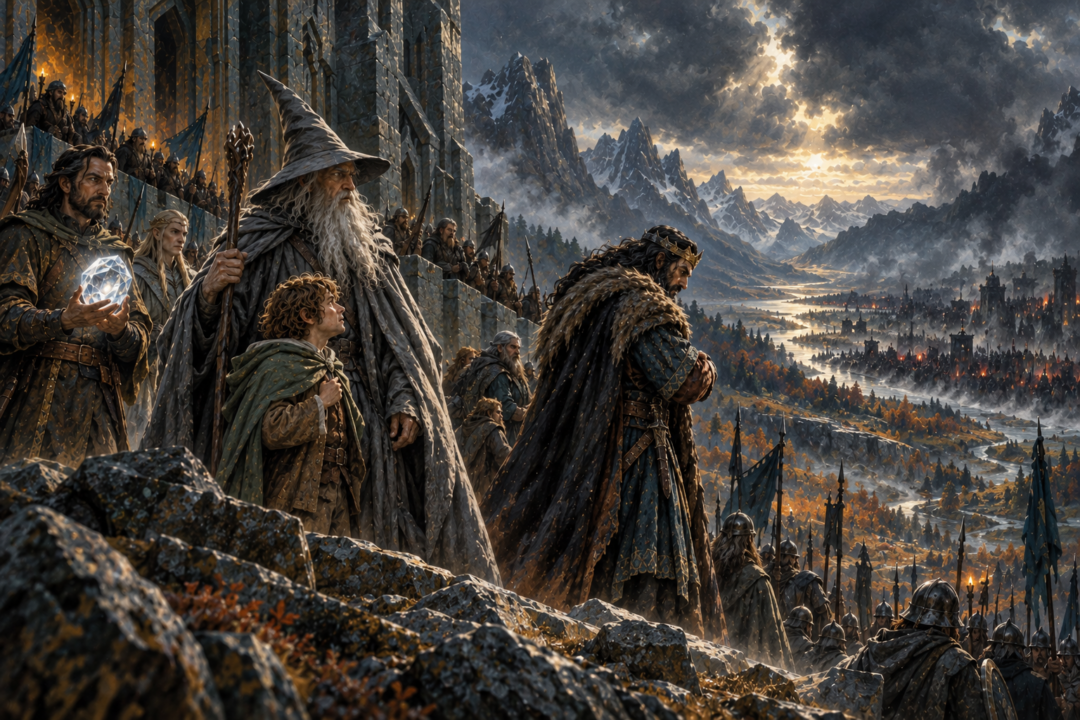
Then Gandalf reveals himself and orders Thorin to put Bilbo down.
This is the decisive effect of Gandalf's sudden appearance.
The wizard does not solve the treasure dispute. He protects the person who created the possibility of negotiation.
That distinction is essential.
Without Gandalf's intervention, the text leaves Bilbo in a frightening position: physically in Thorin's power while Thorin is enraged by what he regards as betrayal. It would go beyond the text to state exactly what Thorin would have done had Gandalf not intervened. What can be said is that Gandalf stops the immediate threat and gives Bilbo a safe path out of Thorin's company.
Bilbo is cast away rather than reconciled with Thorin.
Yet he survives the rupture.
Gandalf's presence also gives Bilbo's action an authoritative defender. The Hobbit who once seemed absurdly unsuited to the Quest is now the person who has independently attempted to prevent a war—and Gandalf openly stands behind him.
Gandalf Does Not Actually End the Conflict
It is tempting to treat Gandalf's return as the moment wisdom triumphs over greed.
The text is less comfortable than that.
Thorin does agree to terms involving the Arkenstone. He will exchange Bilbo's promised share—one fourteenth of the treasure—for the jewel. Because Bilbo has now been expelled, Thorin treats that portion as available for the bargain.
On the surface, Bilbo has succeeded.
But Thorin is not sincerely reconciled to the settlement.
He is waiting for Dáin.
When the Dwarves of the Iron Hills arrive, the underlying conflict immediately resurfaces. Bard will not allow Dáin's armed force to enter the Mountain, and the possibility of battle becomes even more immediate.
This prevents us from exaggerating Gandalf's influence during the Arkenstone negotiation. He does not cure Thorin's fixation on the treasure. He does not establish lasting trust between the opposing camps. He does not make Bilbo's bargain permanently secure.
The crisis merely changes form.
And then Gandalf changes the conversation again.
Gandalf Knows the Treasure Is About to Become the Smaller Problem
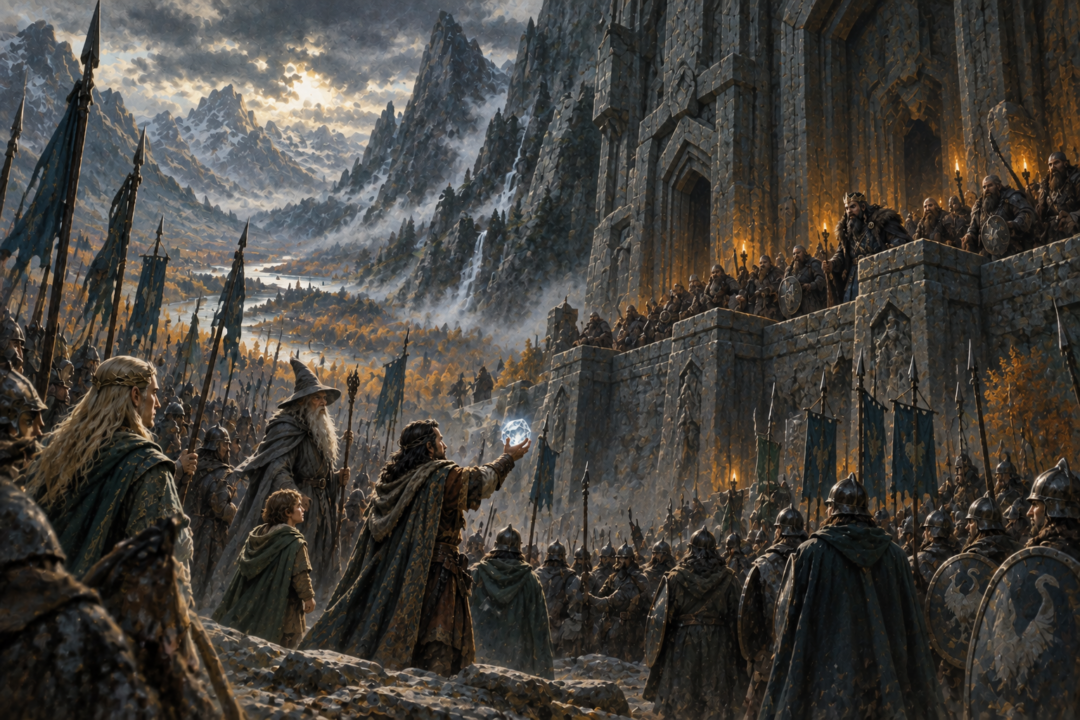
When Bilbo encounters Gandalf during his secret visit to the camp, the wizard hints that larger events are moving.
The meaning soon becomes clear.
As Dáin's Dwarves confront the forces of Bard and the Elvenking, Gandalf warns them of the approaching Goblins and Wargs.
Suddenly the entire Arkenstone dispute is dwarfed by a common enemy.
The irony is severe.
Dwarves, Elves, and Men have been preparing to shed one another's blood over possession, compensation, inherited claims, and treasure. Within moments, they must cooperate or face destruction together.
Gandalf therefore affects the Arkenstone episode on two levels.
First, he intervenes personally when Thorin turns upon Bilbo.
Second, he possesses knowledge that reveals how dangerously narrow the entire dispute has become.
The treasure matters. Bard's claims matter. Thorin's inheritance matters. Bilbo's loyalty matters.
But none of them exists in isolation from the wider world.
Bilbo and Gandalf Represent a Different Kind of Wisdom
There is also a revealing contrast between Bilbo and Gandalf.
Gandalf has knowledge Bilbo lacks. Bilbo has nevertheless reached an important conclusion without it.
He does not know that an enemy army is approaching when he gives away the Arkenstone. He simply knows that a battle between the people outside Erebor and the Dwarves inside it would be disastrous.
That makes his decision more significant, not less.
Bilbo acts because he values lives above his own financial advantage and above Thorin's demand for absolute control of the recovered hoard. His plan is risky, deceptive, and arguably presumptuous—but its purpose is unmistakably peaceful.
Gandalf recognizes that.
The wizard's approval does not mean every aspect of Bilbo's reasoning must be treated as unquestionably correct. Rather, Gandalf understands the quality that has emerged in the Hobbit over the course of the journey: Bilbo is capable of making an independent moral choice even when it costs him friendship, wealth, and safety.
That is a remarkable reversal from the beginning of the story.
The reluctant burglar has become the person willing to walk alone between armies.
The Arkenstone Cannot Heal What Thorin Has Become
The tragedy is that Bilbo's plan can create leverage, but it cannot change Thorin's heart.
Only later, after the Battle of Five Armies has shattered the old dispute, does Thorin fully reconsider his treatment of Bilbo.
Mortally wounded, he reconciles with his former companion. His final reflections reject the values that had dominated him during the siege: the excessive elevation of hoarded wealth over simpler and more humane goods.
The Arkenstone itself then receives a fitting final place.
Bard returns it.
It is laid upon Thorin's breast in his tomb beneath the Mountain.
The jewel that nearly helped bring armies to battle is no longer bargaining currency. Thorin possesses it at last, but only in death.
That ending casts a shadow backward over the negotiation at the gate.
Bilbo had understood something Thorin could not yet accept: possessing the Arkenstone was not worth the lives that might be spent defending it.
Gandalf's sudden appearance does not win that argument for Bilbo. It does something subtler and more necessary.
It ensures Bilbo can survive long enough for the truth of his choice to become clear.
And when the greater enemy finally appears, Gandalf forces everyone at Erebor to look beyond the treasure at precisely the moment when their quarrel is about to become irreversible.
The Arkenstone gives Bard leverage over Thorin.
Bilbo gives Bard the Arkenstone.
But Gandalf's return reveals the deeper scale of the crisis: while everyone is fighting over who has the strongest claim to the treasure under the Mountain, an enemy is approaching for whom their competing claims mean nothing at all.
Sources & Notes
- Tolkien Gateway — A Thief in the Night: Bilbo's transfer of the Arkenstone and Gandalf's return — https://tolkiengateway.net/wiki/A_Thief_in_the_Night
- Tolkien Gateway — The Clouds Burst: the one-fourteenth bargain and the approaching common enemy — https://tolkiengateway.net/wiki/The_Clouds_Burst
- Penguin Random House / Del Rey — The Hobbit teacher's guide: Arkenstone bargaining and the treasure dispute — https://www.penguinrandomhouse.com/books/179206/the-hobbit-movie-tie-in-edition-by-jrr-tolkien/teachers-guide/
Primary reading: The Hobbit, chapters 16–18, 'A Thief in the Night', 'The Clouds Burst' and 'The Return Journey'. The links are chapter guides and publisher teaching material. Gandalf's protective role is distinguished from a successful settlement: the narrative does not tell us what Thorin would have done without the intervention.