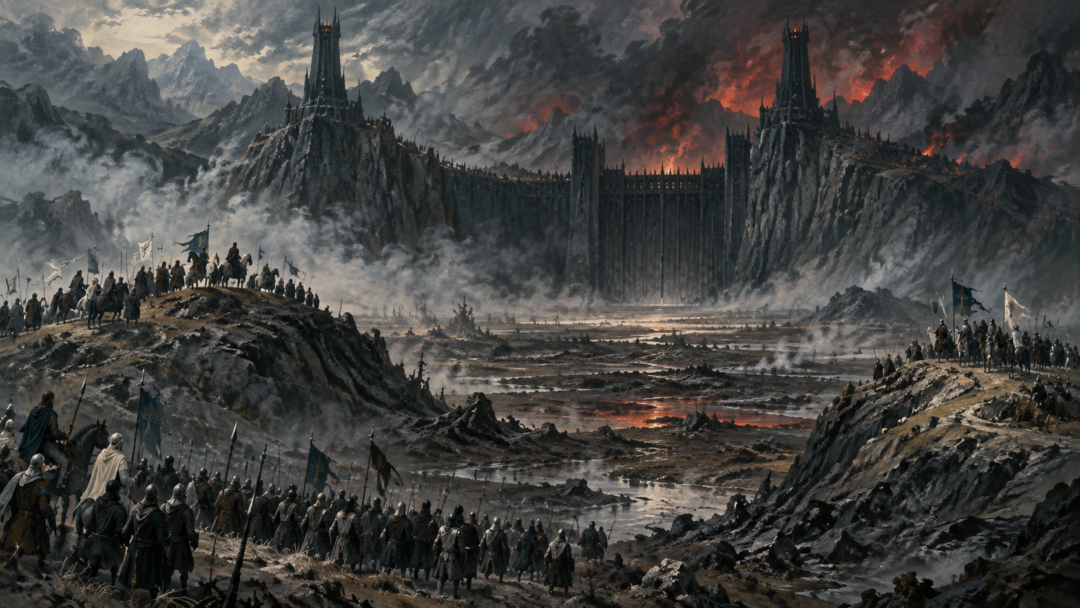
When Aragorn’s army finally reaches the Black Gate of Mordor, there is no realistic prospect of storming it.
The Morannon is a fortified barrier across the entrance to Mordor. Enemy forces are concealed in the surrounding country. The Nazgûl watch from above. And the Captains of the West have arrived with fewer than six thousand men after leaving forces behind during the march.
Yet Aragorn does something remarkably deliberate before challenging Sauron.
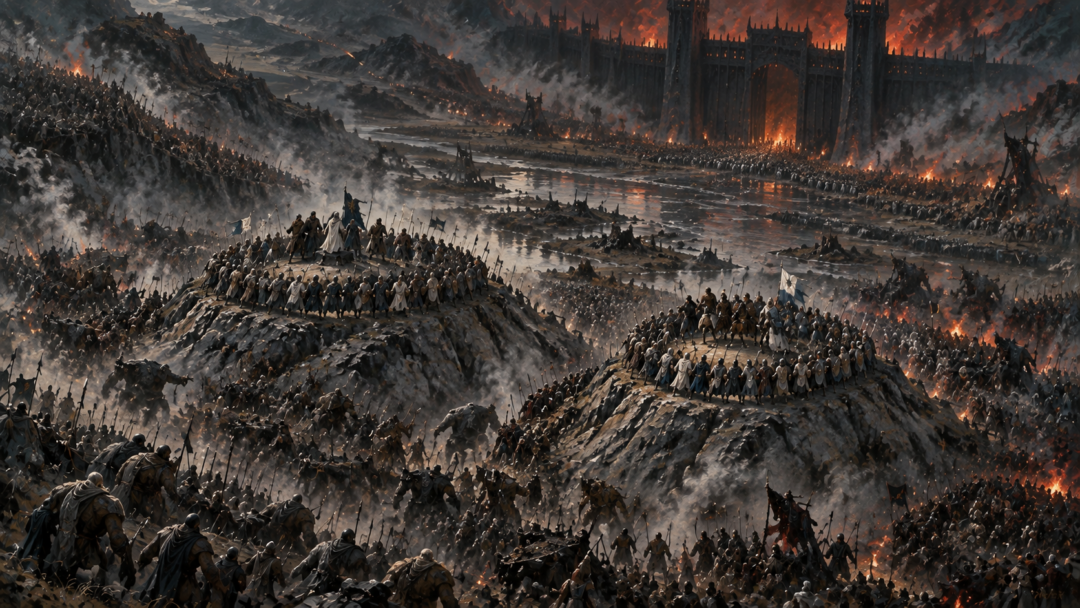
He places his army on two great artificial hills of blasted stone and earth, with a foul mire lying between them and Mordor.
Later, when Sauron closes his trap, those two hills become separate all-round defensive positions. Aragorn and Gandalf hold one; Éomer and Imrahil hold the other. Rings of soldiers face outward in every direction.
This is not an arrangement designed to win the Battle of the Morannon.
It is an arrangement designed to survive encirclement for as long as possible.
And that distinction reveals the terrible logic behind the entire march.
The Western Army Has Come to Mordor as Bait
The first thing to understand is that Aragorn is not attempting an ordinary invasion.
At the Last Debate after the Battle of the Pelennor Fields, Gandalf argues that military victory over Sauron is no longer possible by conventional means. The West cannot simply gather enough soldiers to conquer Mordor.
Their remaining hope lies with Frodo.
The Captains therefore intend to force Sauron to concentrate his attention and military strength upon them. Their challenge must appear dangerous enough—and reckless enough—to convince him that his enemies have become overconfident.
The plan is especially effective because Aragorn has already revealed himself to Sauron through the palantír. Gandalf believes Sauron may interpret Aragorn's audacity as the pride of someone who has obtained the One Ring.
The Western army is therefore performing a deception.
It marches openly.
Heralds proclaim the coming of the King of Gondor.
The Captains challenge Sauron at his own gate.
Everything is calculated to make the Dark Lord look outward at them instead of inward toward the two Hobbits crossing his land.
That means the army's true objective is not territorial conquest.
Its objective is time.
Aragorn Chooses the Best Ground Available
When the army reaches the Morannon on March 25, the Black Gate itself is effectively unassailable by the force before it.
The text emphasizes the hopelessness of attacking those fortifications even if the defenders were limited to the gate and wall. Worse, the surrounding hills and rocks conceal enemies.
Aragorn consequently arranges his army “as could best be contrived.”
The Host occupies two great hills composed of blasted stone and earth accumulated through years of Orc-labour. Between those positions and Mordor lies a great mire of foul mud and pools.
The book does not give a technical military explanation for every element of Aragorn's choice, so it would be too strong to claim that Tolkien explicitly presents a detailed tactical doctrine here.
But what follows makes the advantage unmistakable.
Once surrounded, the Western soldiers form rings around the hills, facing outward in every direction.
The hills have become defensive islands.
Instead of remaining on open ground while enemies attack from every side, the army possesses elevated positions around which compact defensive fronts can be formed.
And the horrible landscape created by Mordor itself now offers the defenders some protection.
The Mire Becomes an Accidental Moat
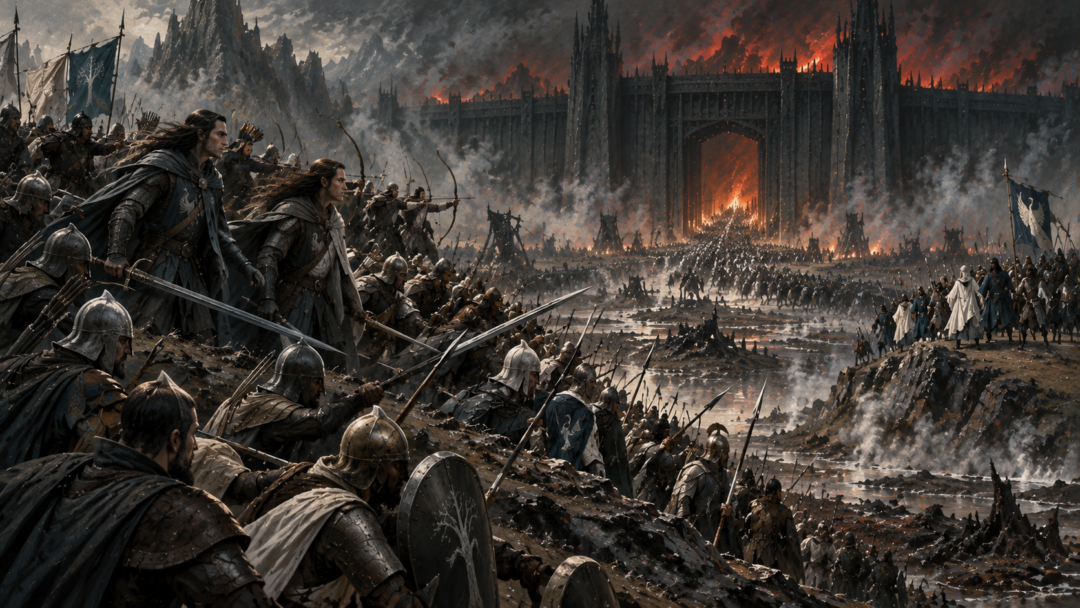
The foul ground in front of the hills is compared directly to a moat before the battle begins.
That detail matters.
Sauron's army has overwhelming numerical superiority, but numbers become most useful when they can actually be brought against an enemy. Difficult ground interferes with that advantage.
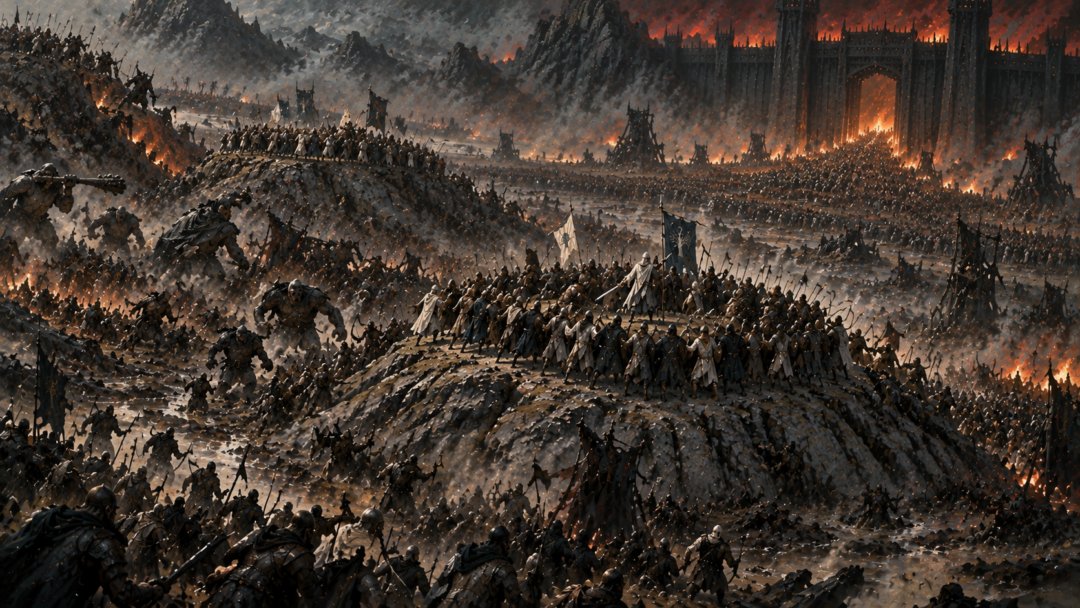
During the battle, many of Sauron's soldiers cannot easily climb to the defenders and instead shoot upward at them. Trolls, however, are able to cross the mire and assault the Western positions directly.
The terrain therefore does not make the hills safe. Nothing at the Morannon could do that.
But it complicates the enemy's approach.
That is enormously valuable to an army whose fundamental problem is numbers.
The Western soldiers cannot prevent themselves from being surrounded. They can, however, make that encirclement more difficult to exploit.
Sauron's own devastated landscape has supplied Aragorn with something resembling a primitive field fortification.
Why Two Hills Instead of One?
The text never gives an explicit sentence explaining why Aragorn chooses two hills rather than concentrating everyone upon a single mound.
Any answer therefore has to remain partly interpretive.
The simplest explanation is that these are the strongest usable positions available for the host Aragorn must deploy. Once Sauron's trap closes, the narrative shows how they function: each hill becomes its own circular strongpoint.
On one hill stand Aragorn and Gandalf beneath the banner of the Tree and Stars.
On the other stand Éomer and Prince Imrahil beneath the banners of Rohan and Dol Amroth.
Around each hill soldiers form a ring facing outward.
The arrangement also prevents the battle from having a conventional rear.
That becomes essential because Sauron does not merely attack through the Black Gate.
Easterlings emerge from concealment near the Ered Lithui, while Orcs descend from the hills on either side of the Morannon. The Western army is surrounded by forces described as more than ten times its match.
A normal battle line facing Mordor would now be disastrous. Its flanks could be enveloped and its rear attacked.
Circular defenses answer that problem in the simplest possible way: everyone faces outward.
There is no safe direction because there is no longer a rear.
Aragorn Places Strong Troops Where the Blow Will Be Hardest
The defense is circular, but it is not evenly weighted.
The Captains expect the strongest initial pressure from the direction of Mordor.
On the forward part of Aragorn's position stand Elladan and Elrohir with the Dúnedain. On the corresponding front of the other hill are Imrahil, the Men of Dol Amroth, and picked soldiers of the Tower Guard.
This is one of the clearest signs that the formation is deliberate rather than merely desperate.
Aragorn has little time once Sauron's forces appear, but he does not simply tell everyone to hold whichever ground they happen to occupy.
The best available troops are concentrated where the hardest assault is expected.
Behind them, the complete rings protect against the wider encirclement.
It is a defense designed for an army that already knows it will be surrounded.
Sauron's Trap Works
There is an important irony here: Aragorn's deployment does not mean he has outsmarted Sauron tactically.
Sauron's battlefield trap succeeds.
The Mouth of Sauron withdraws, signals are given, the Black Gate opens, and the hidden forces move.
The Western army is caught exactly as Sauron intends.
The narrative describes the forces of Mordor gathering around the hills like a sea around the defenders. Aragorn has not discovered some clever formation capable of defeating such numbers.
He has merely made annihilation harder.
That distinction is central to understanding the battle.
The two hills are not a path to military victory.
They are a way of refusing immediate military defeat.
The Defense Must Last, Not Win
This explains why the Battle of the Morannon feels so different from the Pelennor Fields.
At the Pelennor, military events can genuinely change the outcome: Théoden's charge, the arrival of Aragorn's forces, the destruction of the Witch-king, and the fighting across the field all contribute to a real victory.
At the Black Gate, no comparable battlefield victory is available.
Sauron's forces are simply too numerous.
The Captains have knowingly entered a battle they cannot expect to win by arms.
Their strategic victory has to happen somewhere else.
Every moment Sauron's attention remains fixed upon Aragorn is another moment in which the real threat may remain unnoticed.
Every soldier who holds one of those miserable grey hills is helping maintain the deception.
And Sauron does indeed take the bait.
Mordor's Waste Becomes the West's Last Fortress
There is also a grim visual irony in the choice of ground.
These are not noble hills crowned with ancient Gondorian walls.
They are heaps of ruin.
Orcs have accumulated the blasted earth and stone over long years. The landscape around the Morannon has been scarred by Mordor's industry and pollution.
Yet at the final battle, the West turns those heaps into its last defensive ground.
There is an additional historical resonance. In material published in Unfinished Tales, a tradition connects one of the great mounds in this region with the place where King Ondoher of Gondor was slain during the disaster against the Wainriders more than a thousand years earlier. The identification is presented through Gondorian historical tradition rather than as something the characters explicitly discuss during the Battle of the Morannon.
If that association is accepted, the symbolism becomes striking.
A place connected with an ancient defeat of Gondor becomes part of the ground upon which Gondor's returning King makes his final stand against Sauron.
But this time the purpose is different.
Aragorn does not need the hill to give him victory.
He needs it to give someone else a chance.
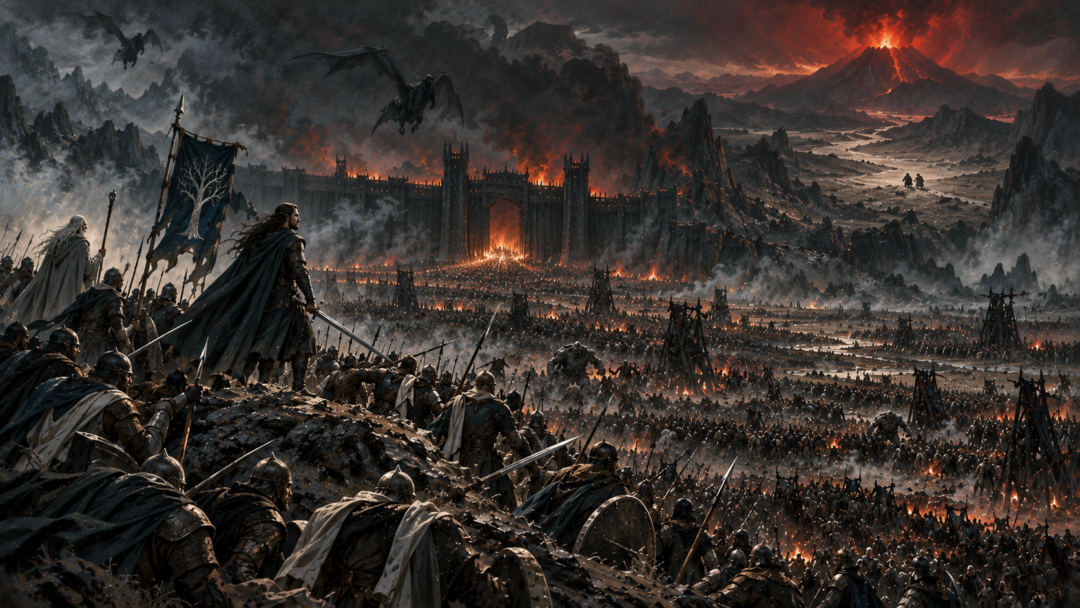
The Two Hills Reveal the Real Strategy of the Black Gate
Seen from a distance, Aragorn's march can look like a reckless attack upon Mordor.
Seen from the two hills, its logic becomes much clearer.
The Western army deliberately draws Sauron's attention. Aragorn chooses the strongest ground available. The mire obstructs approaches. Two separate hills become compact strongpoints. Circular formations answer encirclement. Veteran and elite troops reinforce the most threatened fronts.
Everything is arranged to prolong resistance.
And still it is not enough.
The hosts of Mordor close around them. Trolls break into the fighting. The Nazgûl circle overhead. Pippin eventually loses consciousness beneath a falling troll and believes that the end has come.
In purely military terms, that judgment is close to the truth.
The Western army has reached the limit of what courage, leadership, terrain, and disciplined formation can accomplish against overwhelming strength.
Then something happens that no battlefield formation could achieve.
Far inside Mordor, the Ring reaches the Fire.
The foundations of Sauron's power collapse, and the battle that Aragorn could never win becomes a battle he no longer needs to win.
That is why the two hills matter.
They are not evidence that the West possessed one final tactical trick capable of defeating Mordor.
They show something more desperate: Aragorn arranged his doomed army intelligently even though its survival ultimately depended upon events beyond the battlefield.
At the Black Gate, the Captains do not fight because they believe their swords can overthrow Sauron.
They fight because somewhere beyond those mountains, two Hobbits still might.
Sources & Notes
- Tolkien Gateway — Slag-hills: the two defensive mounds, mire and Ondoher tradition — https://tolkiengateway.net/wiki/Slag-hills
- Tolkien Gateway — Battle of the Morannon: encirclement, circular formations and elite troops — https://tolkiengateway.net/wiki/Battle_of_the_Morannon
- Tolkien Gateway — The Last Debate: the plan to distract Sauron from the Ring-bearer — https://tolkiengateway.net/wiki/The_Last_Debate
Primary reading: The Return of the King, 'The Last Debate', 'The Black Gate Opens' and 'The Field of Cormallen'; Unfinished Tales, 'Cirion and Eorl and the Friendship of Gondor and Rohan'. The links are secondary guides. Tolkien describes the deployment and encirclement; the explanation of why two hills were preferable is a tactical inference, not an explicit statement of Aragorn's reasoning.