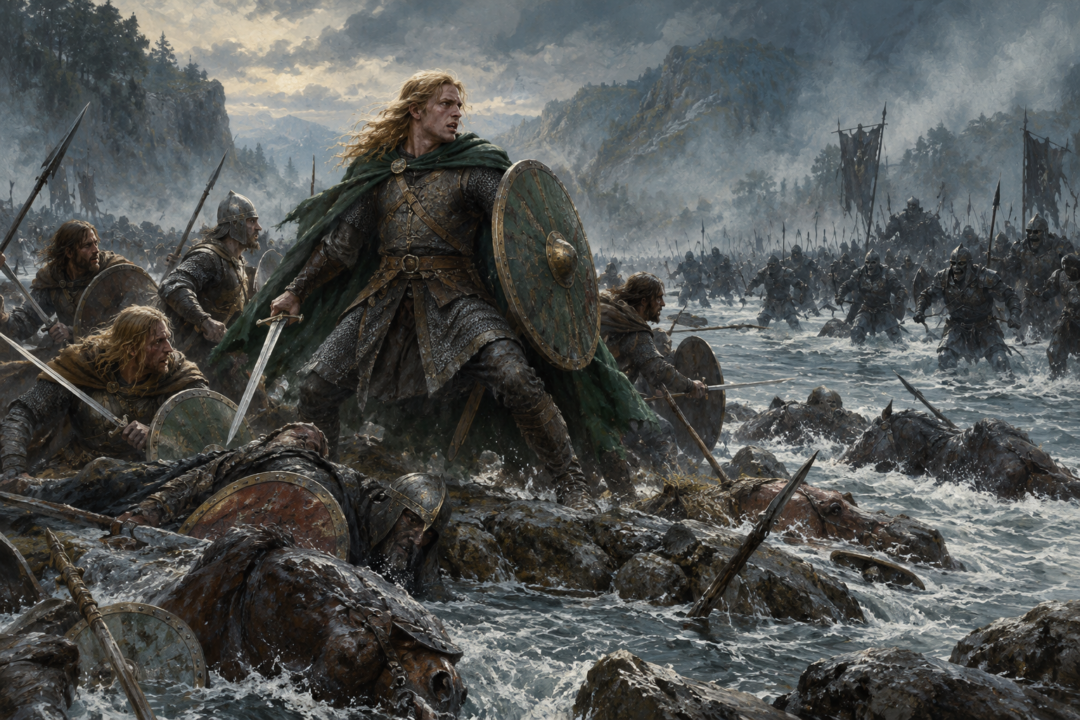
When Théodred falls at the Fords of Isen, Rohan loses far more than King Théoden’s only son.
It loses the man commanding its most threatened frontier. It loses the heir who stands between an aging king and an uncertain succession. And, at almost exactly the same moment, another of Rohan’s great commanders—Éomer—is becoming increasingly isolated from the royal court.
That combination matters because Rohan does not enter the War of the Ring with a clean, centralized command structure. Théoden is still king, but his authority has been weakened by illness, age, and the poisonous counsel of Gríma. Théodred and Éomer therefore carry enormous practical responsibility.
Saruman’s attack on Théodred is devastating precisely because it strikes this already strained system at one of its strongest remaining points.
Théodred Is Not Merely the Heir Waiting at Edoras
The fuller account in Unfinished Tales, “The Battles of the Fords of Isen,” makes Théodred’s military importance much clearer than a casual reading of The Lord of the Rings might suggest.
Théodred is the Second Marshal of the Mark. Éomer is the Third Marshal. Under the arrangements then prevailing in Rohan, the First Marshalship was associated with the king himself, while Théodred’s responsibilities placed him at the center of the defense against Isengard.
That distinction is crucial.
Théodred is not simply a prince whose death creates a future problem about who will inherit the throne. He is already part of the machinery keeping Rohan alive.
As Saruman’s hostility becomes increasingly open, Théodred takes responsibility for the western theater. The threat is obvious: Isengard lies beyond Rohan’s western approaches, and the Fords of Isen are strategically vital to resisting an invasion from that direction.
Meanwhile, Éomer’s responsibilities lie elsewhere. Rohan is therefore depending upon two younger commanders while Théoden’s effective leadership deteriorates.
This means that before Théodred ever meets Saruman’s army, Rohan’s command structure is already dangerously dependent upon a small number of people.
Then Saruman removes one of them.
Saruman’s Assault Is Aimed at Théodred
The First Battle of the Fords of Isen on 25 February 3019 is especially revealing because the account in Unfinished Tales indicates that Théodred himself is a specific target.
Saruman’s forces do not simply happen to kill Rohan’s heir during an ordinary border engagement. The account states that Saruman had ordered his forces to kill Théodred if possible.
That makes strategic sense.
Removing Théodred simultaneously damages Rohan’s army and its royal house.
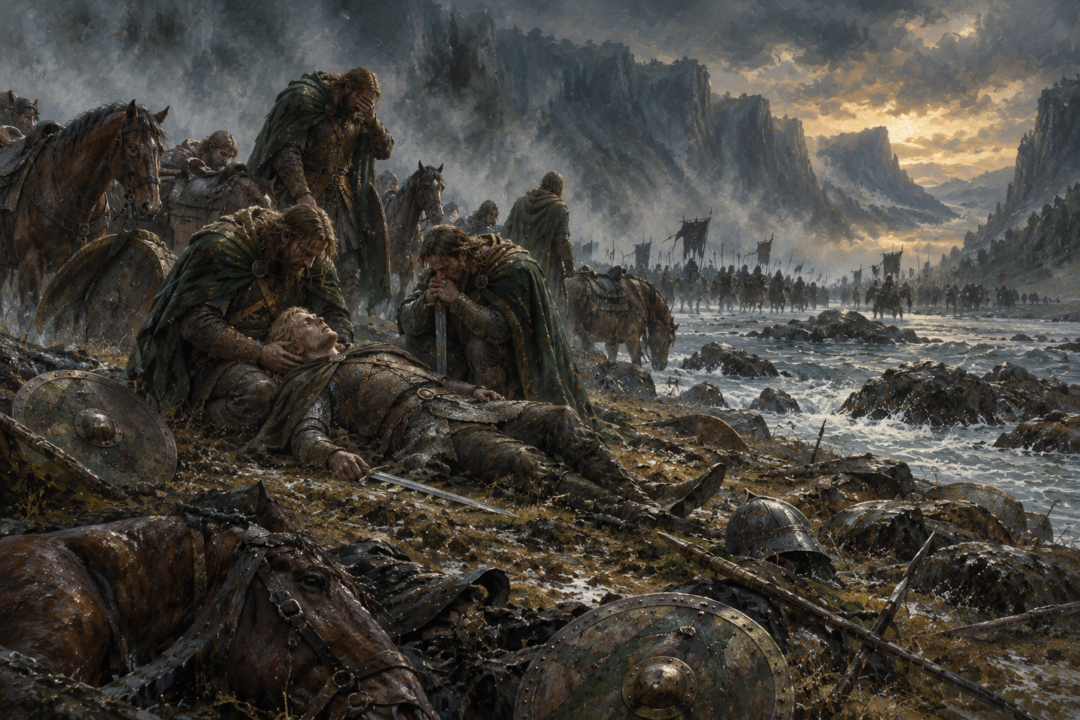
During the fighting, Théodred is driven back toward the Fords and makes his stand on the eyot in the river. Saruman’s warriors press particularly hard against his position. Grimbold comes to his defense, and Elfhelm later arrives with reinforcements, but Théodred receives a mortal wound.
The attackers then withdraw.
The battle therefore produces an unsettling result. Rohan has not yet suffered the full invasion that will come days later, but Saruman has achieved something enormously valuable: the commander responsible for the western defense and the king’s only son is dead.
Théodred’s loss creates a vacancy that cannot simply be solved by promoting the next man in line.
The Western Command Fractures
This is where the military consequences become especially important.
Théodred had been exercising authority in the west as Second Marshal. Once he dies, there is no immediate royal appointment neatly replacing him.
Erkenbrand, Lord of Westfold, assumes authority over the West-mark because somebody has to do so. The surviving forces around the Fords are also associated with experienced commanders such as Grimbold and Elfhelm.
But the situation is improvised.
The account in Unfinished Tales explicitly notes the unusual nature of Erkenbrand’s position. He effectively takes command in the west without having received the formal appointment that would normally establish his authority as marshal.
That detail reveals how serious Théodred’s death is.
Rohan still possesses brave and capable commanders. What it lacks is a functioning mechanism at the top capable of rapidly reorganizing them.
The king should be able to respond to the death of his western commander by appointing a replacement, issuing orders, coordinating the musters, and establishing a new strategy.
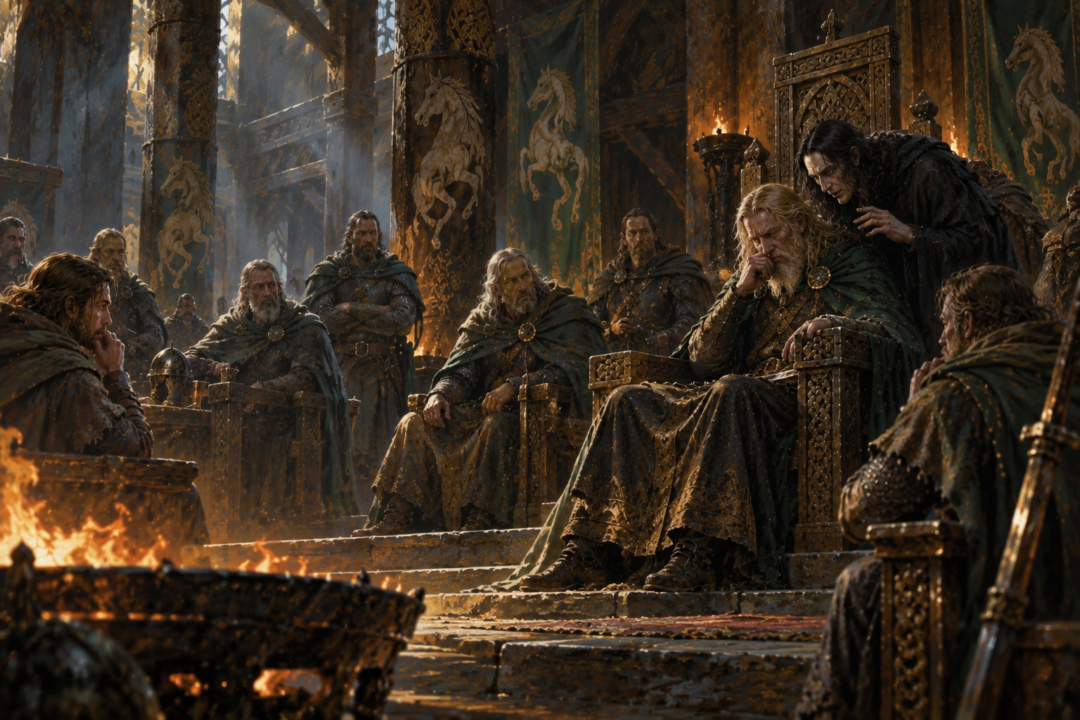
Instead, Théoden remains under Gríma’s influence in Edoras.
So local commanders begin filling the vacuum themselves.
Éomer Cannot Simply Replace Théodred
At first glance, the obvious answer seems to be Éomer.
He is Théoden’s nephew, an experienced commander, and Third Marshal of the Mark. Once Théodred dies without children, Éomer also becomes the obvious successor within the royal family.
But Éomer is not standing beside Théoden directing the kingdom.
His relationship with Gríma has become openly hostile. Éomer understands that Rohan is in danger and distrusts the policies being imposed around the king. His decision to pursue the Orc-band carrying Merry and Pippin is made without the king’s permission.
When Aragorn, Legolas, and Gimli encounter him, Éomer is therefore already acting in a dangerous space between military necessity and royal authority.
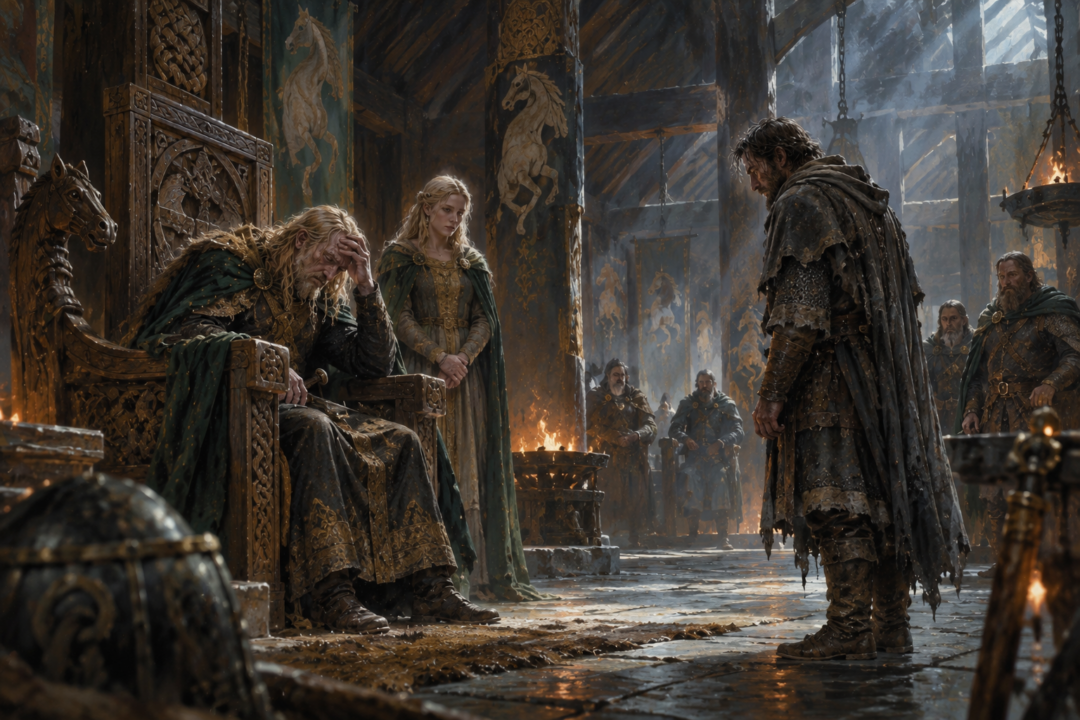
Soon afterward, he is imprisoned at Edoras.
The result is extraordinary.
Within days of Théodred’s death, Rohan’s heir has been killed and the man who now stands nearest to the succession is under arrest.
Saruman has not conquered Edoras. He does not need to.
Rohan’s command system is effectively attacking itself.
Gríma’s Real Damage Is Institutional
Gríma’s influence is sometimes reduced to the image of a whispering counselor poisoning an old king’s mind. But the political damage goes deeper.
A kingdom at war depends upon trusted information moving upward and legitimate commands moving downward.
Under Gríma’s influence, both processes become unreliable.
Warnings can be dismissed. Commanders acting independently can be treated as disobedient. Théoden’s household becomes increasingly separated from the men attempting to defend his borders.
Théodred’s death magnifies every weakness in that arrangement.
Had Théoden been exercising vigorous authority, losing the Second Marshal would still have been a severe blow. Yet the king could have reorganized the defense.
Instead, the West-mark has to improvise while Éomer’s conflict with the court removes another senior commander from effective service.
This is why Théodred’s death matters beyond grief or succession. It exposes how badly Rohan needs an active king.
The Second Battle Shows the Consequences
Saruman attacks the Fords again on 2 March.
This time Théodred is gone.
Grimbold and Elfhelm play major roles in the defense, while Erkenbrand has assumed broader responsibility in the west. These are experienced men, but they are dealing with a much larger assault while Rohan’s central leadership remains compromised.
The defenders are eventually forced away from the Fords, and Saruman’s forces advance into Westfold.
It would be too simple to claim that Théodred’s survival would automatically have prevented this defeat. The texts do not establish that, and Saruman commits formidable forces to the second attack.
But his absence unquestionably changes the command situation.
The commander who had organized the earlier defense is dead. His forces have been redistributed among surviving leaders. The western defense is operating under emergency arrangements while the king remains politically immobilized.
The problem is therefore not that Rohan suddenly has no leaders.
It has several.
The problem is that those leaders are no longer integrated into a healthy chain of command.
Théoden’s Restoration Repairs the System
When Gandalf reaches Meduseld, the transformation that follows is political and military as well as personal.
Théoden resumes command.
Éomer is released and restored. The king begins issuing decisions again. Rohan’s scattered strength can once more be directed toward a common purpose.
That recovery comes just in time.
The king rides west, the defense ultimately concentrates at the Hornburg, and Erkenbrand’s surviving forces become crucial to the destruction of Saruman’s army there.
Rohan does not recover because one perfect commander replaces Théodred.
It recovers because legitimate authority begins functioning again.
That distinction is one of the most interesting elements of Rohan’s story.
Its strength lies not merely in heroic individuals but in the ability of king, marshals, local lords, household troops, and regional musters to act together. Gríma’s influence weakens those connections. Théodred’s death tears a major hole in them. Théoden’s return to active kingship begins reconnecting them.
Théodred’s Death Also Changes the Succession
There is another consequence that extends beyond the campaign against Saruman.
Théodred is Théoden’s only son.
His death therefore ends the direct father-to-son continuation of Théoden’s line.
Éomer, son of Théoden’s sister Théodwyn and Éomund of Eastfold, becomes the natural successor. Before Théoden rides to Gondor, he formally names Éomer as his heir.
That decision becomes decisive on the Pelennor Fields.
When Théoden is mortally wounded, Éomer succeeds him. With Éomer begins the Third Line of the Kings of the Mark.
The transition is lawful and dynastically intelligible, but it exists because Théodred is no longer there.
In that sense, the axe-stroke at the Fords of Isen reaches far beyond one battlefield.
It changes who will rule Rohan after the War of the Ring.
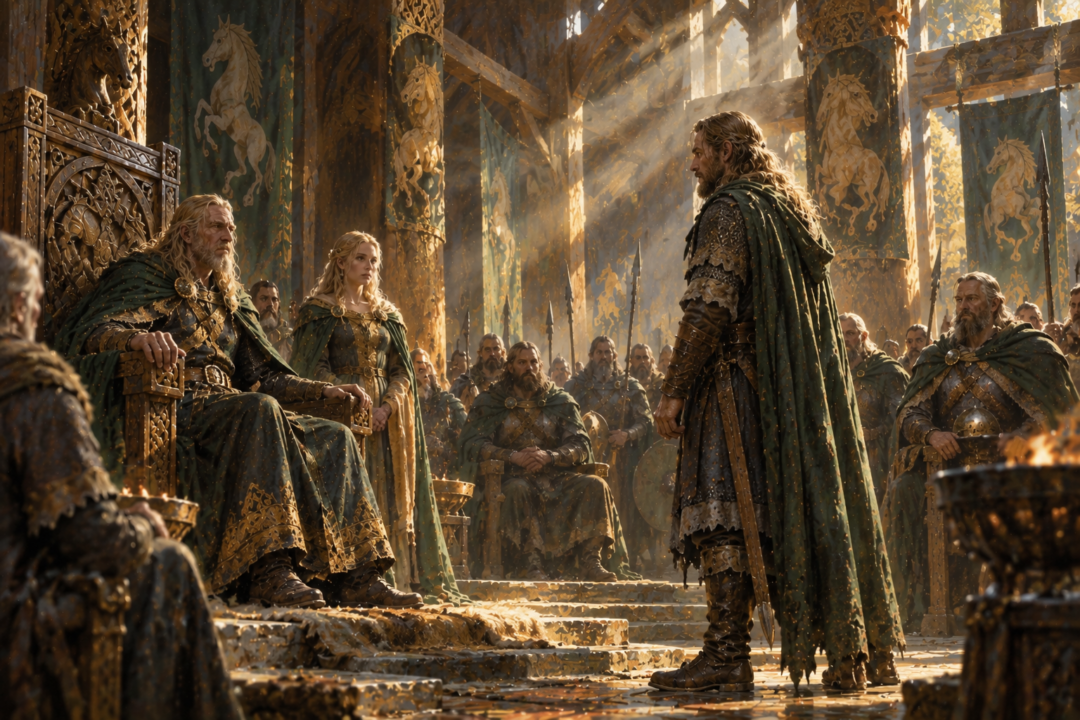
There Is a Final Irony in Théodred’s Last Stand
Théodred dies defending the Fords, and yet the Fords will soon be lost.
Measured only by possession of the ground, his sacrifice can look futile.
But that is not the whole story.
Saruman wanted Théodred dead because Théodred mattered. He was an obstacle: an active royal commander in a kingdom whose king had been rendered dangerously passive.
His death helps expose the fragility of Rohan’s leadership, but it does not destroy the kingdom. Grimbold survives. Elfhelm survives. Erkenbrand acts. Éomer returns to command. Théoden rises from his chair and rides to war.
Rohan’s answer to the loss of its heir is ultimately not the appearance of another Théodred.
It is the restoration of a functioning network of loyalty and command.
That is why the death at the Fords is such an important hidden turning point in Rohan’s war.
Théodred’s fall removes the man who had been holding together the western defense at precisely the moment Saruman prepares his decisive invasion. It leaves local commanders improvising, places greater importance on Éomer even as he clashes with Gríma, and turns Théoden’s incapacity from a private tragedy into a military emergency.
The succession changes too. Théoden will still ride from Meduseld. Rohan will still answer Gondor’s call. But the son who should have inherited the Golden Hall will never sit there as king.
When Éomer eventually takes Théoden’s place, the Third Line of Rohan begins.
And behind that new beginning lies the empty place left beside the Isen.
Sources & Notes
- Tolkien Gateway — Théodred: the Second Marshal's defence of the Fords and targeted killing https://tolkiengateway.net/wiki/Th%C3%A9odred
- Tolkien Gateway — The Battles of the Fords of Isen: the fuller account in Unfinished Tales https://tolkiengateway.net/wiki/The_Battles_of_the_Fords_of_Isen
- Tolkien Gateway — Erkenbrand: assumption of western command after Théodred's death https://tolkiengateway.net/wiki/Erkenbrand
Primary reading: Unfinished Tales, 'The Battles of the Fords of Isen' and its appendix; The Two Towers, 'The Riders of Rohan' and 'The King of the Golden Hall'; The Lord of the Rings, Appendix A, 'The House of Eorl'. These are secondary military and character guides. The command disruption and succession are grounded in the texts; Théodred's survival would not demonstrably have prevented the later defeat.