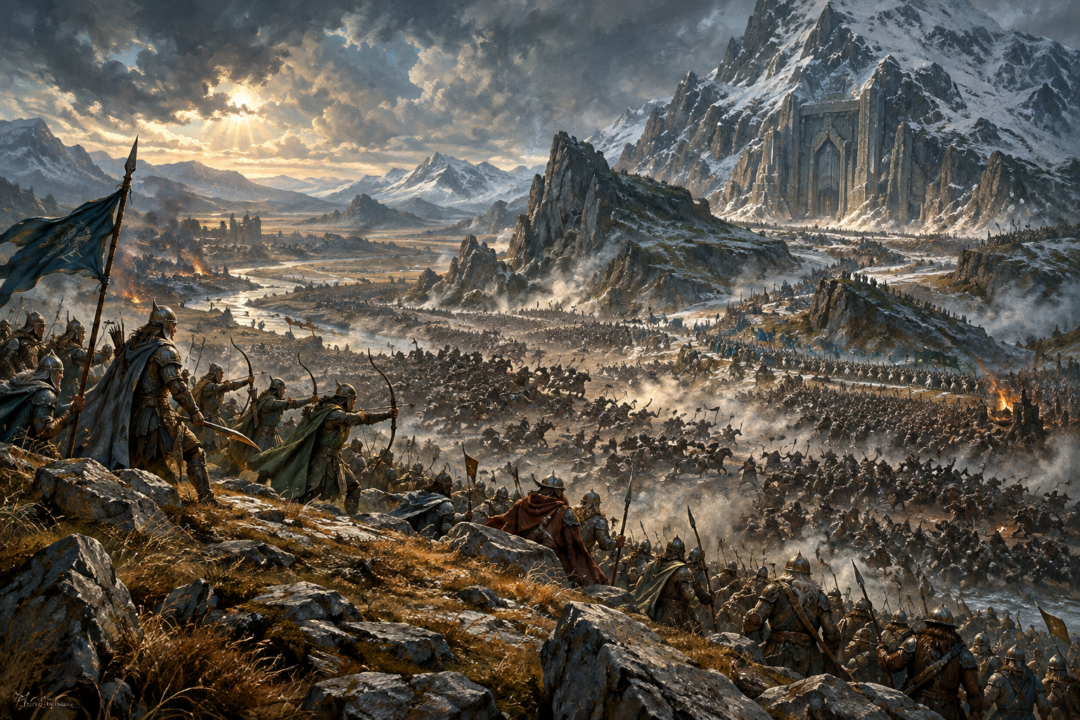
When Bilbo Baggins looked for somewhere to endure the Battle of Five Armies, he did not choose the highest summit in sight. He went to Ravenhill.
That detail is easy to overlook. The Lonely Mountain dominates the landscape around Dale. Erebor is the enormous landmark, the fortress, the treasure-house, and the reason five armies have gathered in the first place. Ravenhill, by comparison, is only a lower spur of the Mountain.
Yet when the battle begins, Ravenhill becomes one of the most revealing places on the entire field.
Not because it towers above everything else. Not because it contains some hidden weapon. And, contrary to the famous film version, not because Thorin marches there to fight Azog. That confrontation belongs to the adaptation, not the book.
Ravenhill matters in the text for a subtler reason: position.
Its importance shows how geography works throughout Middle-earth. The decisive place is not always the greatest place. Sometimes a comparatively modest piece of ground becomes crucial because of what can be seen from it, who occupies it, and how it relates to the terrain around it.
Ravenhill Was Already a Place of Watching
Ravenhill enters the story before the Battle of Five Armies.
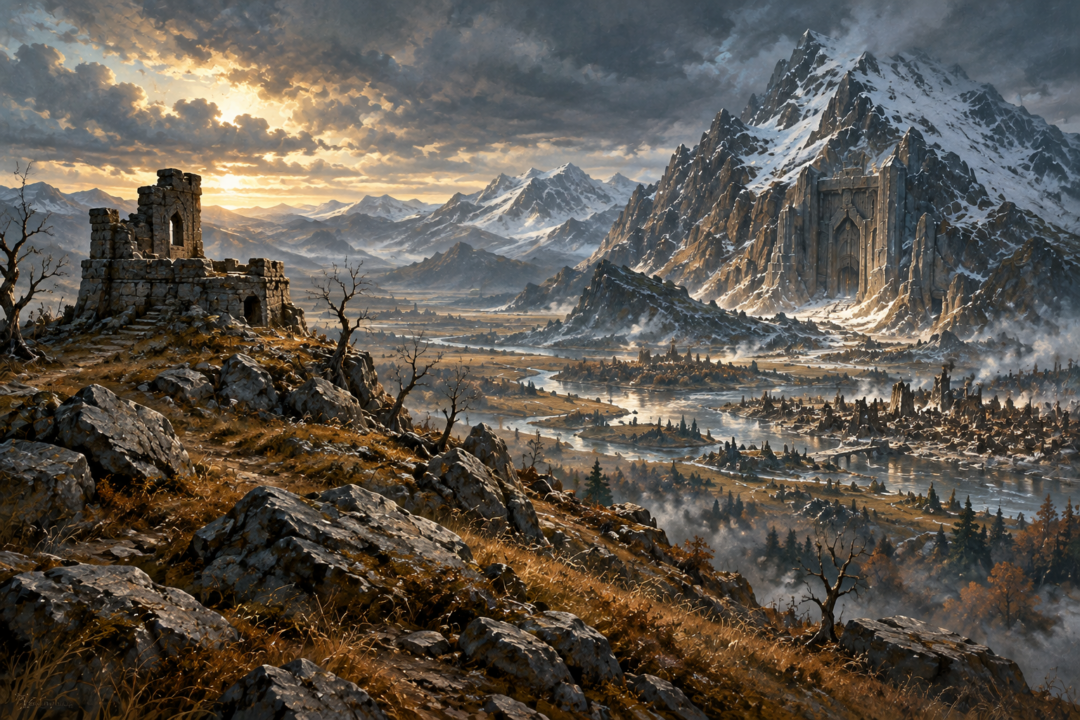
After Smaug leaves the Mountain to attack Lake-town, Thorin and his companions eventually venture out of the hidden passage and explore their recovered home. They later move to Ravenhill, which the narrative describes as an old lookout-post.
That history matters.
Ravenhill was associated with watching the lands around Erebor long before armies filled the valley. Its usefulness was therefore geographical rather than merely defensive. It was a place from which events beyond the immediate walls of the Mountain could be observed.
The ravens reinforce that association.
It is after the company has reached Ravenhill that the old raven Roäc comes to them, bringing the momentous news that Smaug is dead. Through Roäc, Thorin also learns that Men and Elves are moving toward the Mountain.
Ravenhill therefore becomes a place where information arrives before it becomes a battlefield position.
That is an important pattern.
The Dwarves have recovered the treasure of Erebor, but treasure alone does not tell them what is happening beyond the Mountain. From Ravenhill, the outside world begins pressing back into their story.
Smaug is dead. Lake-town has suffered terribly. Other peoples are approaching. The struggle over the treasure is beginning.
Before Ravenhill becomes associated with battle, it is associated with awareness.
The Battle Is Built Around Terrain
The Battle of Five Armies is sometimes remembered as a gigantic collision of armies before Erebor. In the book, however, the defenders deliberately use the shape of the land.
Once Gandalf warns Bard, the Elvenking, and Dáin that the goblins and Wargs are approaching, their quarrel over Thorin's treasure immediately becomes secondary. Their former opponents are now forced into alliance against a common enemy.
They prepare accordingly.
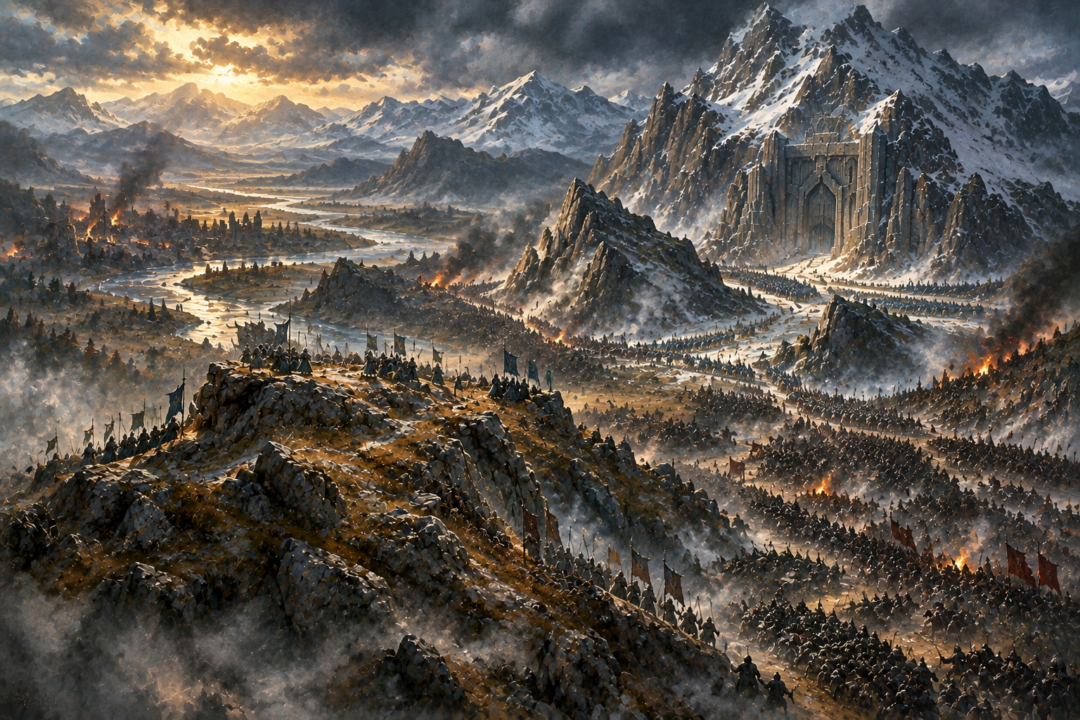
The Mountain has great spurs projecting toward the south, enclosing a valley before the gates of Erebor. The allied commanders place their forces so that the terrain itself becomes part of their plan.
The Elves occupy one side. Men and Dwarves occupy the other. A smaller force remains farther forward to draw the enemy into the space between them.
The idea is essentially a trap.
If the goblins advance into the valley, the allied forces can attack them from both sides.
At first, it works.
But the goblins have understood the country too.
They climb over the Mountain itself and appear above the defenders, threatening positions that had seemed protected by steep ground.
That reversal is one of the battle's most important lessons: terrain provides an advantage only until the enemy finds a way to use it differently.
Ravenhill belongs inside this geography.
Its significance cannot be separated from the spurs, slopes, valley, and Mountain around it.
Why Bilbo Goes to Ravenhill
Bilbo's decision to move toward Ravenhill tells us something important about the place.
He has no desire to become a battlefield hero.
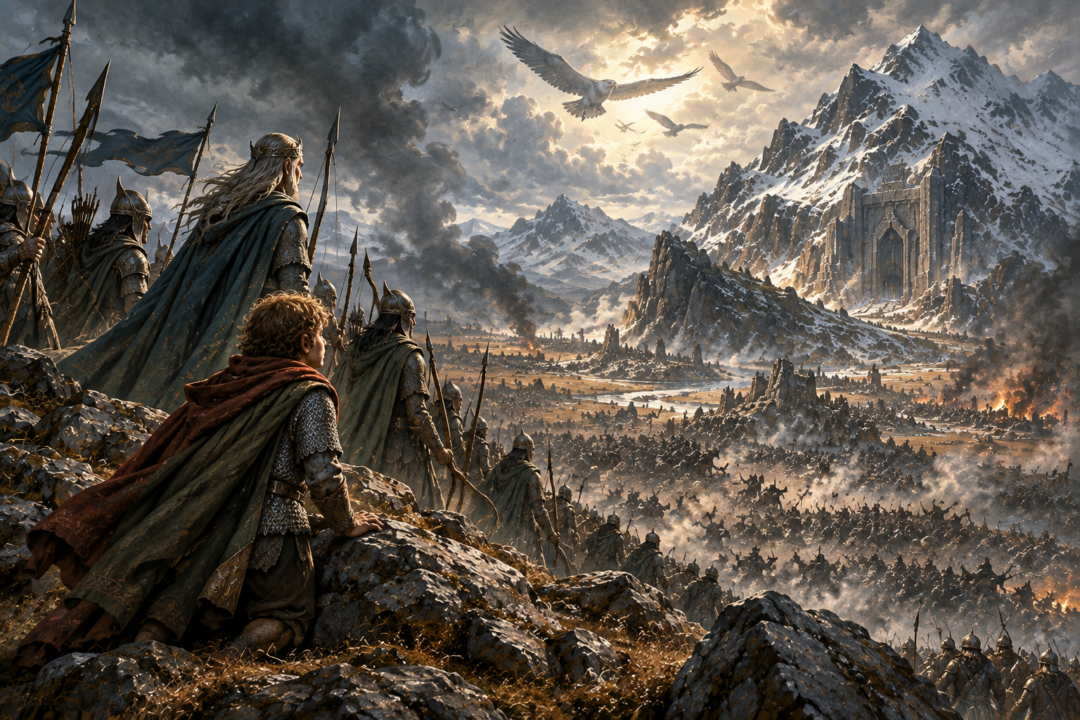
After putting on the Ring, he considers where he might best avoid the fighting. He ultimately joins the Elves on Ravenhill, where Gandalf is also present.
This does not mean Ravenhill is completely safe. Nothing near Erebor is safe once the goblins attack.
But it does suggest that Ravenhill offers something Bilbo desperately wants: a position somewhat removed from the worst close fighting while still overlooking the struggle.
That combination is crucial.
Bilbo can see enough of the battle to understand its changing course.
He watches the crisis deepen. The goblins gain the heights. The defenders are pushed back. Thorin eventually bursts from the gate with his companions and joins the battle, temporarily transforming the morale of the allied forces.
Then the situation turns against them again.
From Ravenhill, Bilbo becomes a witness to these changes rather than one of the principal combatants producing them.
That is a very Tolkien-native use of perspective. One of the smallest and least martial characters stands at the edge of a gigantic conflict and sees enough to understand how terrible it has become.
Ravenhill Becomes the Place Where Bilbo Sees Hope
Ravenhill's most memorable battlefield moment is not a duel.
It is a sighting.
As the allied forces are being overwhelmed, Bilbo looks upward and sees something approaching.
The Eagles.
His cry announces their arrival just before he is struck by a stone and loses consciousness.
This moment is easy to reduce to a famous line or a sudden rescue, but its geography matters. Bilbo is on Ravenhill, watching the wider field and sky while others are engulfed in combat.
He sees the Eagles because he is looking outward.
That fits Ravenhill's role throughout this part of the story remarkably well.
It was a lookout-post.
It was a place where Thorin received news from Roäc.
During the battle, it becomes the place from which Bilbo notices the arrival of unexpected aid.
The hill's narrative importance repeatedly comes from perception.
Ravenhill does not determine events because it is enormous. It matters because it provides a place from which changes in the wider world can be recognized.
What Ravenhill Does Not Do in the Book
There is an important distinction to make here because adaptation imagery has strongly reshaped how many readers remember the battle.
In the book, Ravenhill is not the location of an elaborate confrontation between Thorin and Azog.
Azog is already dead by the time of The Hobbit. He was killed long before the Quest of Erebor, during the war between the Dwarves and Orcs. His son Bolg commands the goblin host in the Battle of Five Armies.
Nor does the book describe Thorin taking Fíli, Kíli, and Dwalin to Ravenhill on a mission to kill an enemy commander.
Thorin's actual battlefield action is different.
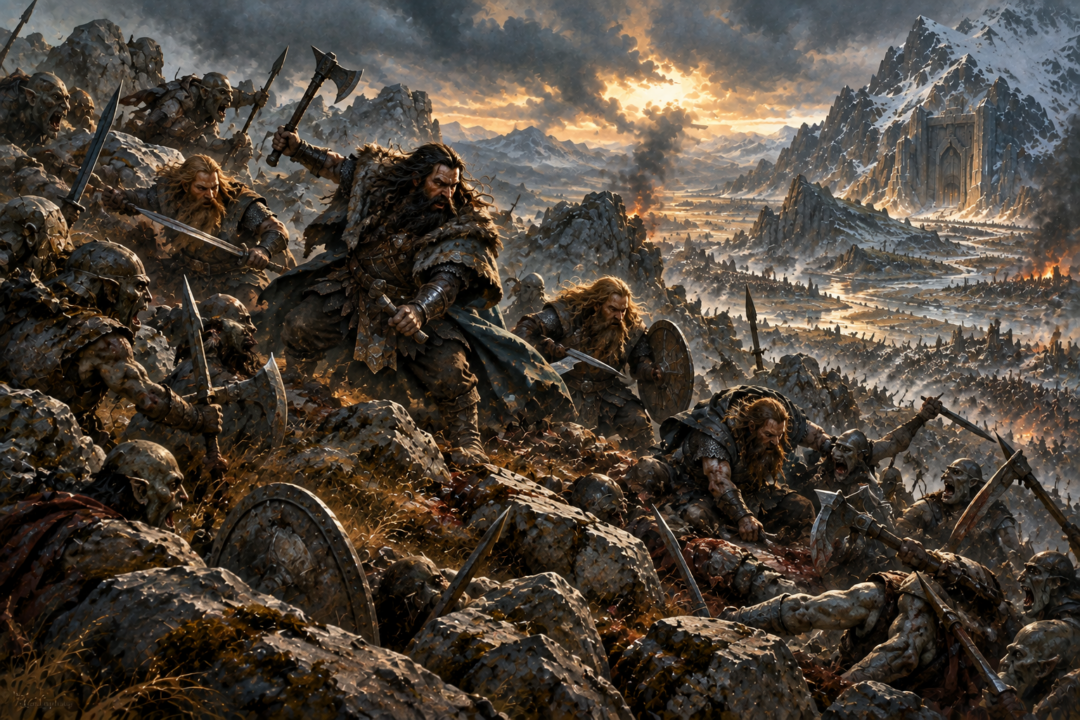
When he finally emerges from Erebor, he and his companions charge into the battle. His appearance rallies the defenders, and he drives toward Bolg's bodyguard. But the advance carries him too far. His support dwindles, his companions fall around him, and he is eventually wounded.
Fíli and Kíli die defending him.
This distinction matters because the book's Ravenhill is less a stage for heroic single combat and more a vantage point from which Bilbo experiences the battle.
That arguably makes the hill more interesting, not less.
Its importance is quieter.
The Highest Ground Is Not Always the Most Important Ground
Erebor is obviously higher and vastly more imposing than Ravenhill.
But height by itself does not explain strategic value.
A useful military position depends on relationships: where roads and valleys run, where enemies approach, what neighboring ground can be observed, and how easily forces can move between positions.
The Battle of Five Armies repeatedly demonstrates this principle.
The allied armies initially benefit from the two great spurs of the Mountain because those features help create a killing ground between them. Then the goblins undermine that advantage by climbing the slopes and attacking from above.
No piece of terrain possesses permanent tactical value independent of what armies do with it.
Ravenhill should be understood in the same way.
The text does not present it as the supreme commanding height of the entire battlefield, nor does it say that controlling Ravenhill alone determines victory.
Its significance is more restrained and better supported: it is an established lookout-post, it becomes associated with the Elven position during the battle, Gandalf and Bilbo are there, and Bilbo can observe crucial developments from it.
Those facts are enough.
There is no need to turn Ravenhill into a fortress greater than the text describes.
Ravenhill Connects Information, War, and Consequence
There is also a deeper irony in the hill's repeated role.
Thorin reaches Ravenhill after recovering the Mountain and learns that possession of Erebor has not ended his troubles.
Bilbo later stands on Ravenhill during the battle and discovers that the quarrel over the treasure has become almost irrelevant beside a far greater danger.
The same landscape witnesses two dramatic changes in perspective.
First, Thorin learns that Smaug's death has opened a political crisis rather than simply securing his kingdom.
Later, Bilbo watches Dwarves, Elves, and Men fight together against enemies who make their earlier hostility seem tragically wasteful.
The hill therefore sits at the intersection of knowledge and consequence.
From Ravenhill, characters repeatedly discover that the situation is larger than they thought.
That may be its most interesting significance.
A Small Hill Beside a Great Mountain
Middle-earth is filled with enormous places.
Mountains break kingdoms. Fortresses dominate valleys. Towers become symbols of power. Great cities embody entire civilizations.
Ravenhill is not one of those places.
And that is precisely why it is worth noticing.
Beside Erebor, it is comparatively modest. Yet before the battle it serves as a lookout connected with news from the wider world. During the battle, it becomes the position of the Elves where Gandalf and Bilbo are found. From there Bilbo witnesses the collapse of the defenders' hopes—and then sees the Eagles approaching.
Its importance comes from location, perspective, and timing.
Ravenhill reminds us that geography in Middle-earth is rarely decorative scenery. Hills, passes, rivers, gates, forests, and roads shape what characters know and what armies can do.
The Lonely Mountain may dominate the horizon.
But during the Battle of Five Armies, the smaller hill beside it gives Bilbo something the Mountain cannot:
a place from which to see the battle changing.
Sources & Notes
- Tolkien Gateway — Ravenhill: the old lookout-post and Bilbo's position during the battle https://tolkiengateway.net/wiki/Ravenhill
- Tolkien Gateway — The Gathering of the Clouds: Roäc's news and the approaching armies https://tolkiengateway.net/wiki/The_Gathering_of_the_Clouds
- Tolkien Gateway — The Clouds Burst: allied deployment, Bilbo's sighting of the Eagles, and the battle https://tolkiengateway.net/wiki/The_Clouds_Burst
Primary reading: The Hobbit, 'The Gathering of the Clouds', 'The Clouds Burst', and 'The Return Journey'; The Lord of the Rings, Appendix A, 'Durin's Folk'. These are secondary chapter and geography guides. Ravenhill's role as a vantage point is distinguished from the films' Thorin–Azog confrontation; the text does not say the hill alone determined victory.