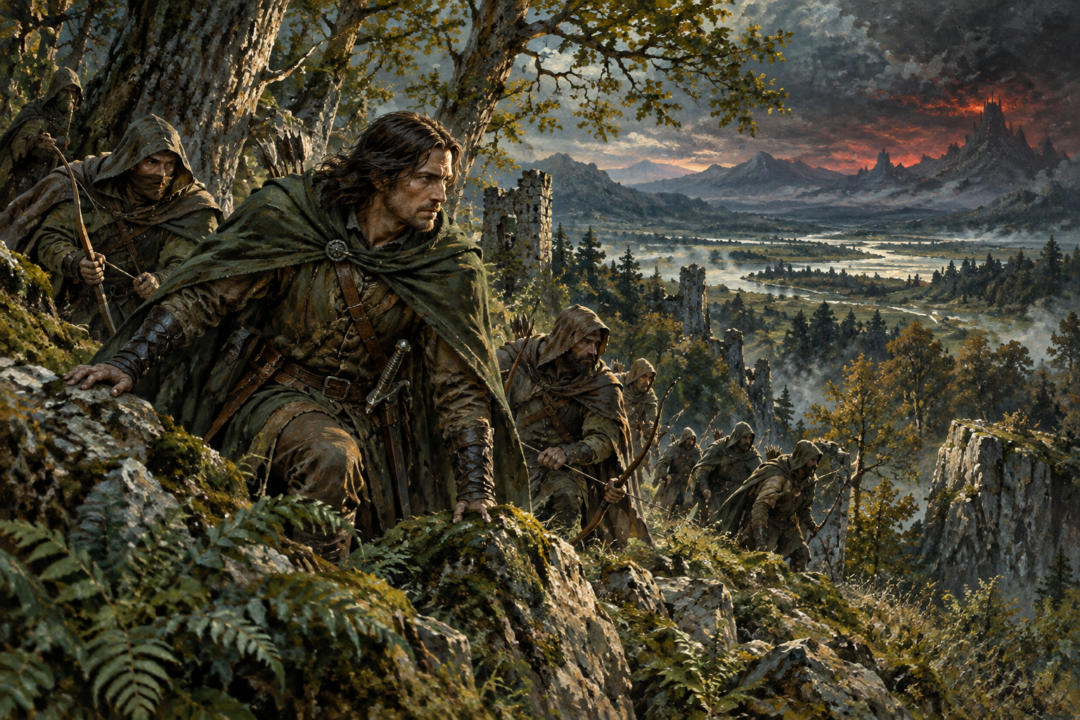
When Frodo and Sam first encounter Faramir’s men in Ithilien, they do not meet the Gondor most readers have been taught to expect.
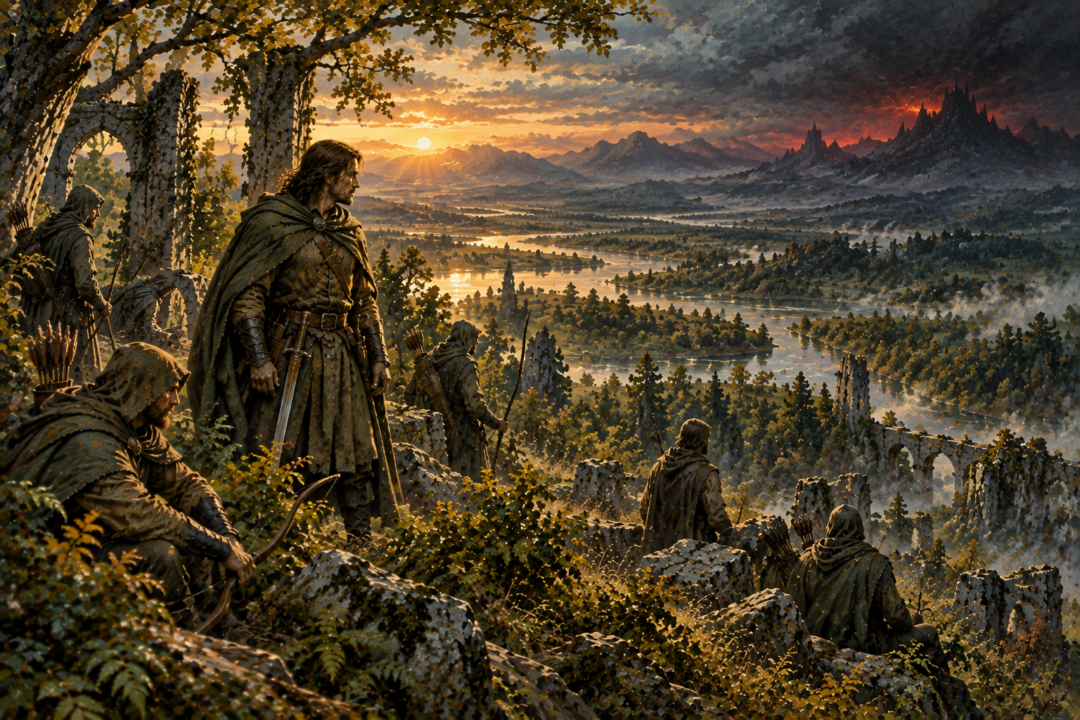
There are no white walls, no great gates, no massed companies beneath proud banners. Instead, armed men emerge almost invisibly from the landscape. They are dressed in greens and browns chosen to help them pass unseen through Ithilien, their faces hooded and masked except for watchful eyes. They carry swords, spears, and great bows. Yet Frodo immediately recognizes something familiar in their stature, bearing, and speech: they remind him of Boromir.
That contrast is important. The Rangers of Ithilien have not ceased to be Gondorians in order to become woodland fighters. They have altered the outward expression of Gondorian soldiery because the war they are fighting demands it.
Under Faramir, Gondor’s identity survives precisely because it is capable of adaptation.
Gondor Without the Visible Symbols of Gondor
Much of Gondor’s power is associated with permanence. Minas Tirith is stone layered upon stone. Its history reaches back through the Stewards toward the Númenórean kingdoms in exile. Its soldiers defend fortifications, roads, river crossings, and cities.
Ithilien presents almost the opposite military problem.
The land lies between the Anduin and the Ephel Dúath, dangerously close to Mordor. Once inhabited by Gondorians, it has been progressively abandoned as the Enemy’s pressure increases. Appendix A records that in the days of Steward Túrin II, attacks from Mordor became so severe that most of Ithilien’s remaining people fled west across the Anduin.
Gondor nevertheless refuses simply to surrender the region.
Its answer is not to rebuild Ithilien as though nothing has changed. Instead, Gondor sends men back across the river who can operate inside hostile territory.
The Rangers are drawn from people descended from inhabitants of Ithilien. Their connection with the land therefore runs deeper than temporary military deployment. They are Gondorians returning covertly to a country historically belonging to their own people, fighting in woods and hills where ordinary settlement has largely become impossible.
That creates one of the most interesting reversals in Gondorian warfare: the defenders of a great civilization must learn to hide.
Their Clothing Reveals the Adaptation
The Rangers’ appearance makes their purpose unusually clear.
When they surprise Frodo and Sam, they are clothed in varied shades of green and brown specifically suited to moving unseen through Ithilien. Green coverings conceal their hands and faces. Their equipment includes swords and large bows, while other Rangers seen during the fighting carry spears.
This is camouflage described directly in the narrative, not merely a modern interpretation imposed upon them.
More importantly, concealment is not treated as dishonorable.
These men belong to the same realm that can march openly beneath standards and sound horns in battle. Yet in Ithilien, survival requires different habits. The Rangers exploit vegetation, broken ground, secrecy, and surprise.
They have changed the visibility of Gondorian power without changing whom that power serves.
Their clothing therefore becomes a small but revealing symbol of Gondor’s situation late in the Third Age. The kingdom cannot always afford to confront its enemies under ideal conditions. Sometimes its soldiers must disappear among leaves because open control of the land has already been lost.
Ithilien Becomes Part of Their Weapon
Faramir’s company does more than wear colors suited to the forest. Their entire method depends upon understanding the country around them.
Their encounter with the Haradrim demonstrates this clearly.
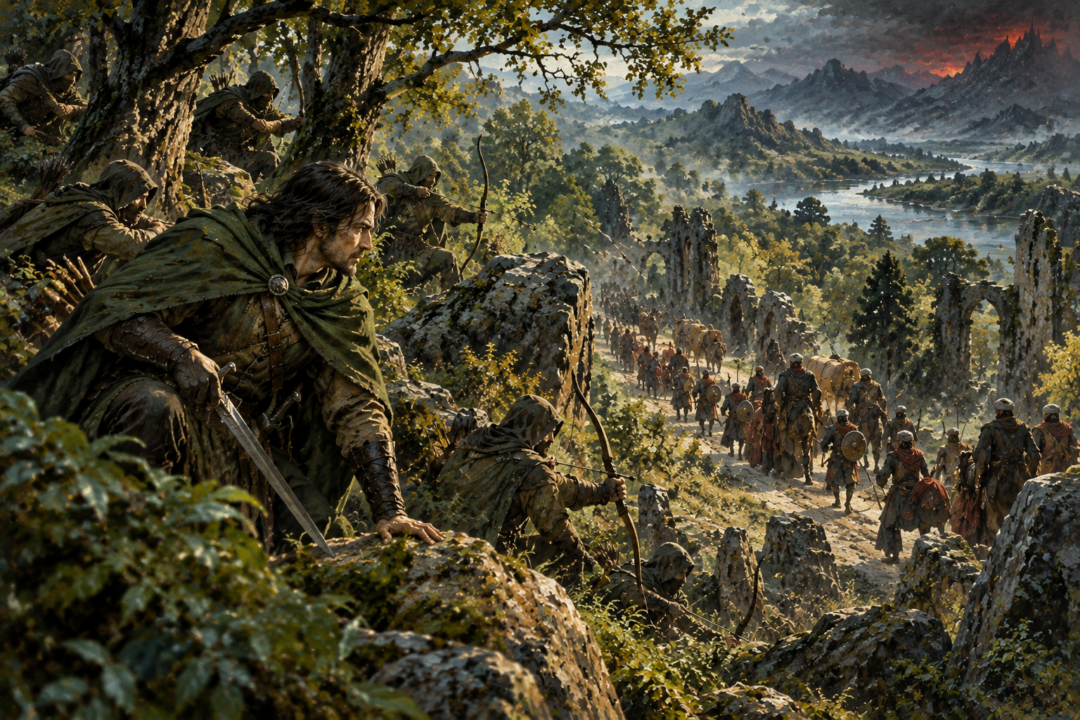
Forces from Harad are moving north through Ithilien to join Sauron. Faramir’s Rangers know of their movement and prepare an ambush. Frodo and Sam do not initially see a conventional Gondorian army assembling for battle. Sam gradually becomes aware of concealed men moving into position among the trees and slopes.
Then the fighting erupts.
The Rangers are using terrain to offset the disadvantages under which Gondor increasingly operates. They do not need to hold every road continuously if they can watch enemy movements and strike at favorable moments. Woods that might obstruct a conventional formation become concealment. Hills provide observation and firing positions. Knowledge of paths and hidden places becomes a form of military strength.
This does not make the Rangers invulnerable, nor does the text suggest that such warfare can by itself defeat Mordor. Their operations belong to a larger defensive struggle that Gondor fears it may be losing.
But they make enemy-held or enemy-traversed territory dangerous.
Ithilien has not been securely recovered. Neither has it been completely yielded.
Henneth Annûn Is Gondor in Miniature
The Rangers’ hidden refuge expresses the same adaptation in architectural form.
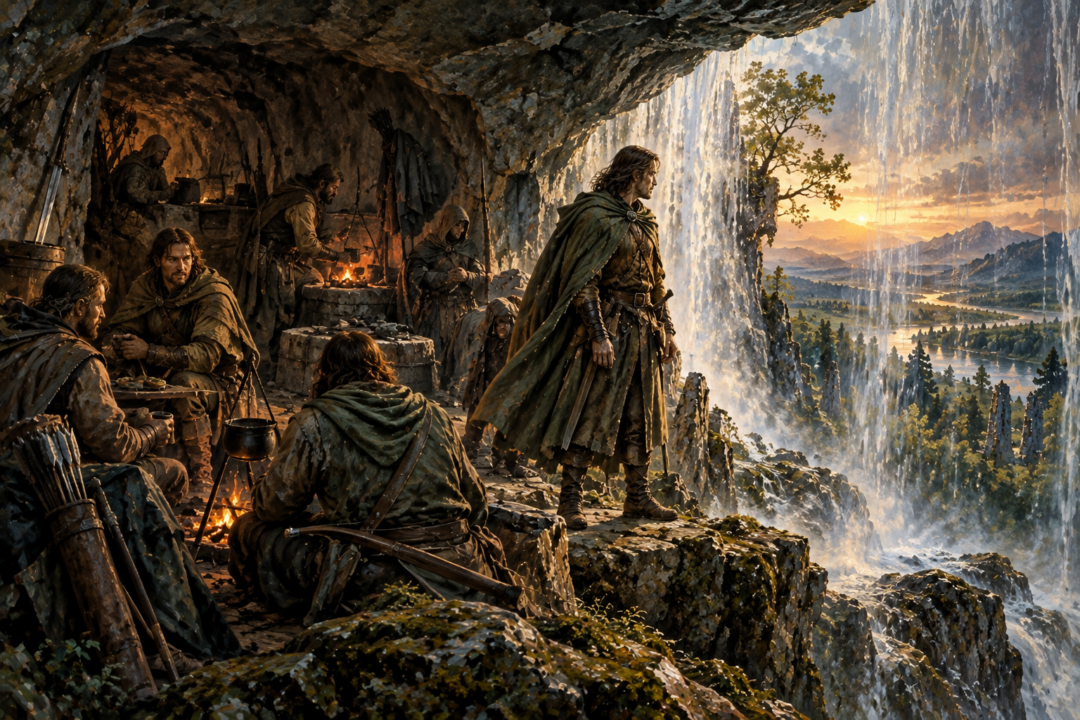
Henneth Annûn, the Window of the Sunset, is concealed behind a waterfall in North Ithilien. The refuge was prepared by Gondor after Ithilien became increasingly dangerous, and secrecy is fundamental to its survival. Frodo and Sam are blindfolded while being brought there so that they cannot learn the route.
Inside there is no palace corresponding to the spectacular beauty of the waterfall outside. The chamber is practical and hidden.
Yet Henneth Annûn is not merely a cave occupied by fugitives.
Faramir commands there. Guards maintain watch. Men eat together and follow an established military order. Prisoners are questioned. Decisions are made according to Gondorian authority. Even in concealment, the Rangers remain part of an organized realm.
That distinction matters.
They are not outlaws surviving beyond the reach of civilization. They are civilization maintaining an outpost where its ordinary visible structures can no longer safely stand.
Henneth Annûn is therefore almost a compressed version of Gondor itself: authority, memory, discipline, and fellowship protected behind stone, but stripped of monumentality.
Faramir Is the Right Captain for This Kind of War
The adaptation is not only tactical. It also depends upon Faramir’s character.
Faramir is unquestionably a warrior. He commands dangerous operations close to Mordor and personally leads men who repeatedly enter contested territory. But his conversations with Frodo reveal that he does not define Gondor’s greatness simply through martial glory.
In “The Window on the West,” he distinguishes between valuing the things warriors protect and valuing warfare for its own sake. His reflections on Gondor’s history show a man conscious of both the greatness and the decline of his people.
That outlook fits the Rangers remarkably well.
Their victories are rarely spectacular public triumphs. Much of their work consists of watching, waiting, gathering knowledge, moving secretly, and attacking when circumstances permit. Such warfare rewards restraint.
Faramir displays the same quality when confronted with something far more dangerous than a Southron column: the One Ring.
Once he understands enough of Frodo’s burden, he refuses to seize the weapon that could seemingly strengthen Gondor. His refusal is not a rejection of duty. It is an understanding that not every available form of power should be used merely because Gondor is desperate.
The connection should not be pushed too far—the text does not explicitly present woodland tactics as a moral metaphor for Faramir’s resistance to the Ring. But both reveal a captain capable of adjusting his means without losing sight of his ends.
The Rangers Preserve More Than Territory
There is another layer to their presence in Ithilien.
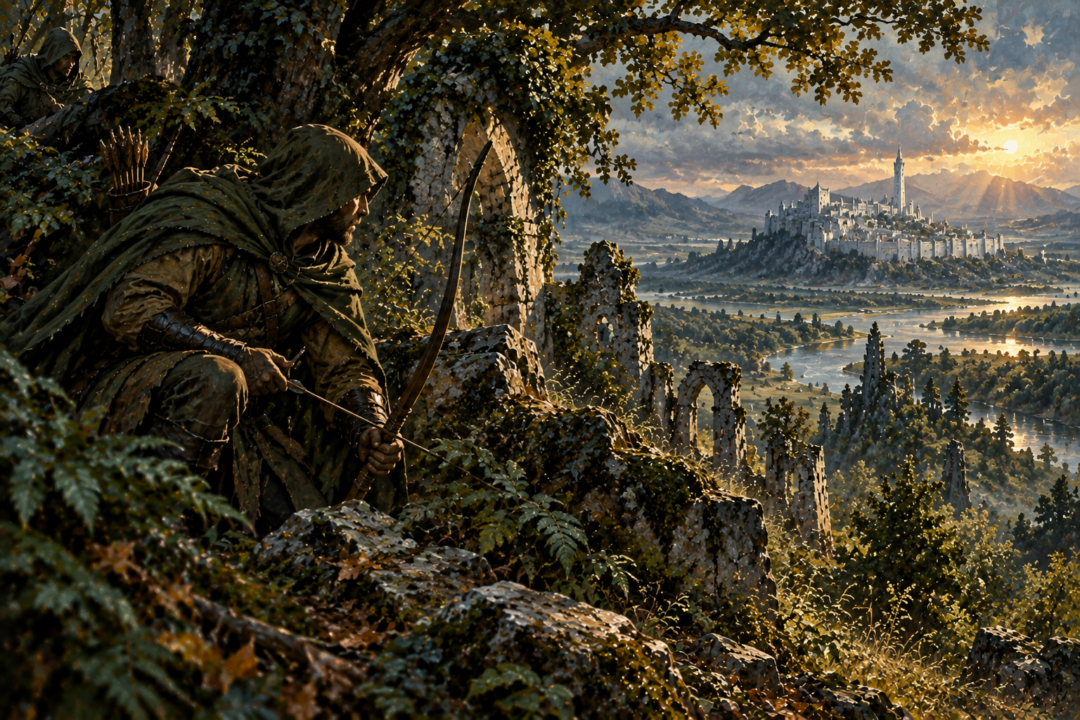
Ithilien is repeatedly presented as beautiful despite its proximity to Mordor. Its woods, streams, herbs, and flowers preserve something of the older Gondorian world even as warfare moves through it. Ruins and abandoned works testify that this is not simply wilderness. It is a wounded country.
The Rangers themselves embody that memory.
They are descended from people who once lived there, and they continue crossing the Anduin to resist the Enemy in the land their forebears inhabited. Their warfare is therefore defensive in a deeper sense than merely disrupting troop movements.
They maintain a Gondorian presence in a place from which Gondorian civilian life has largely retreated.
That gives their concealment a tragic irony. They fight for a land in which their own people can no longer safely live, and they preserve Gondor’s claim partly by becoming almost invisible within it.
The better they perform their task, the less obvious their presence becomes.
They Are Still Recognizably Men of Gondor
Yet concealment never erases identity.
Frodo’s first impression is crucial. Despite their woodland clothing, these strangers recall Boromir to him. Their speech, bearing, weapons, discipline, and allegiance identify them as Men of Gondor.
Faramir himself makes the political reality of Ithilien starkly simple when questioning the hobbits: in such a dangerous land, travelers are assumed to belong ultimately to one side or the other—the Dark Tower or the White.
The Rangers know exactly which they serve.
This is why it would be misleading to treat them as a separate “Ranger culture” detached from Gondor. Their distinctiveness is functional. Their tactics respond to the conditions of Ithilien.
They have not exchanged Gondorian identity for the wilderness.
They have translated that identity into a form the wilderness permits.
The Hidden Strength of Gondor
The Rangers of Ithilien complicate the familiar picture of Gondor.
Gondor is Minas Tirith, certainly: stone, ceremony, memory, banners, walls, and armies prepared to endure siege.
But Gondor is also Mablung and Damrod moving quietly beneath the trees. It is hidden archers waiting above an enemy road. It is guards behind a waterfall. It is Faramir returning again and again to a province his kingdom can no longer openly inhabit.
The contrast reveals something larger about Gondor in its final struggle.
Its traditions matter, but survival cannot mean reproducing the past unchanged. The Enemy has transformed the strategic world around it. Ithilien has become a frontier haunted by forces moving to and from Mordor. Holding such a country requires soldiers willing to surrender some of the outward signs of power while preserving the loyalties underneath them.
The Rangers therefore represent neither the abandonment of Gondorian tradition nor nostalgia for an older wilderness.
They show tradition adapting under pressure.
Their colors are green and brown instead of ceremonial brilliance. Their fortress is hidden rather than monumental. Their battles begin from concealment rather than formal deployment.
But beneath the leaves, the allegiance remains unmistakable.
They are still Gondor.
Sources & Notes
- Tolkien Gateway — Rangers of Ithilien: Gondorian origins, camouflage, and woodland operations https://tolkiengateway.net/wiki/Rangers_of_Ithilien
- Tolkien Gateway — Henneth Annûn: the hidden refuge of the Rangers https://tolkiengateway.net/wiki/Henneth_Ann%C3%BBn
- Tolkien Gateway — Of Herbs and Stewed Rabbit: the meeting with the Rangers and ambush of the Haradrim https://tolkiengateway.net/wiki/Of_Herbs_and_Stewed_Rabbit
Primary reading: The Two Towers, 'Of Herbs and Stewed Rabbit' and 'The Window on the West'; The Lord of the Rings, Appendix A, 'The Stewards'. These secondary guides support the Rangers' origins, concealment, and hidden refuge. Adaptation of Gondorian identity is the article's interpretation; the text does not explicitly make woodland tactics a moral metaphor for Faramir's refusal of the Ring.