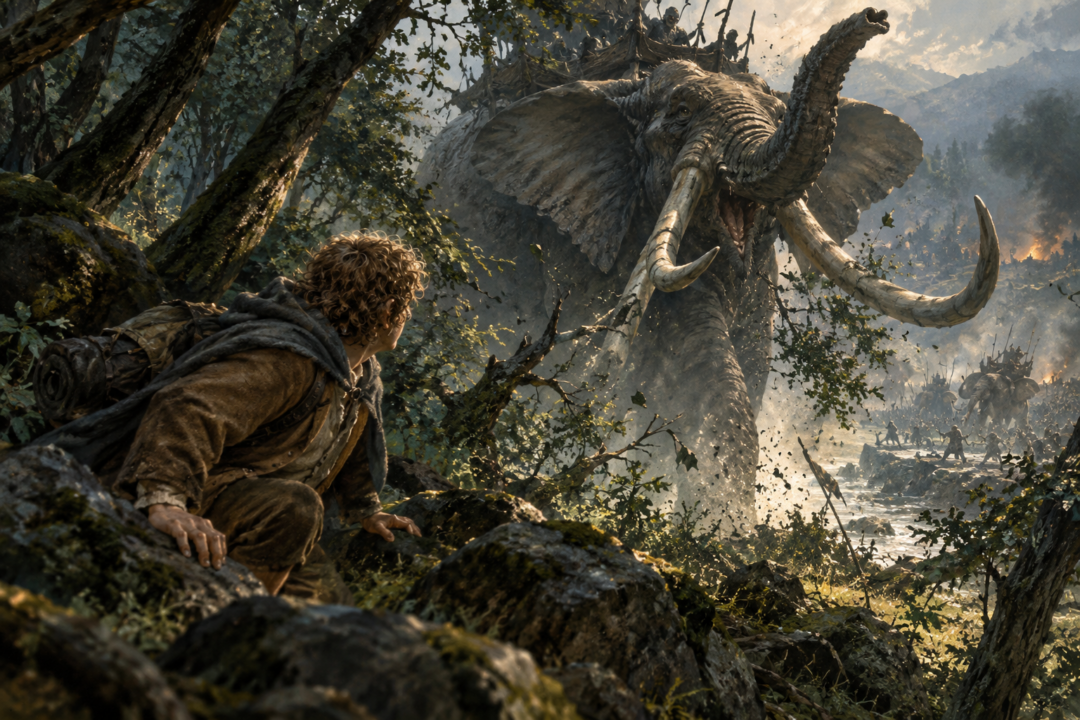
Sam Gamgee already had a word for the enormous beast he dreamed of seeing: Oliphaunt. It belonged to the Shire’s half-legendary store of knowledge, preserved in a comic rhyme about a creature so immense that Sam himself was unsure whether such things truly existed.
Then, in Ithilien, Sam heard another word.
As battle approached the hidden position of Faramir’s Rangers, Damrod suddenly cried out in alarm: “Mûmak! Mûmak!” Moments later the creature itself burst from the fighting, and Sam realized that his impossible Oliphaunt was real.
That tiny collision of vocabulary is easy to overlook. Yet it preserves something unusually valuable about Middle-earth: a word apparently originating among peoples far south of the Shire has crossed cultural and linguistic boundaries and entered the speech of Gondor. It then appears in the translated narrative that reaches us.
The surviving evidence lets us trace part of that journey. But only part.
Two Names Meet in Ithilien
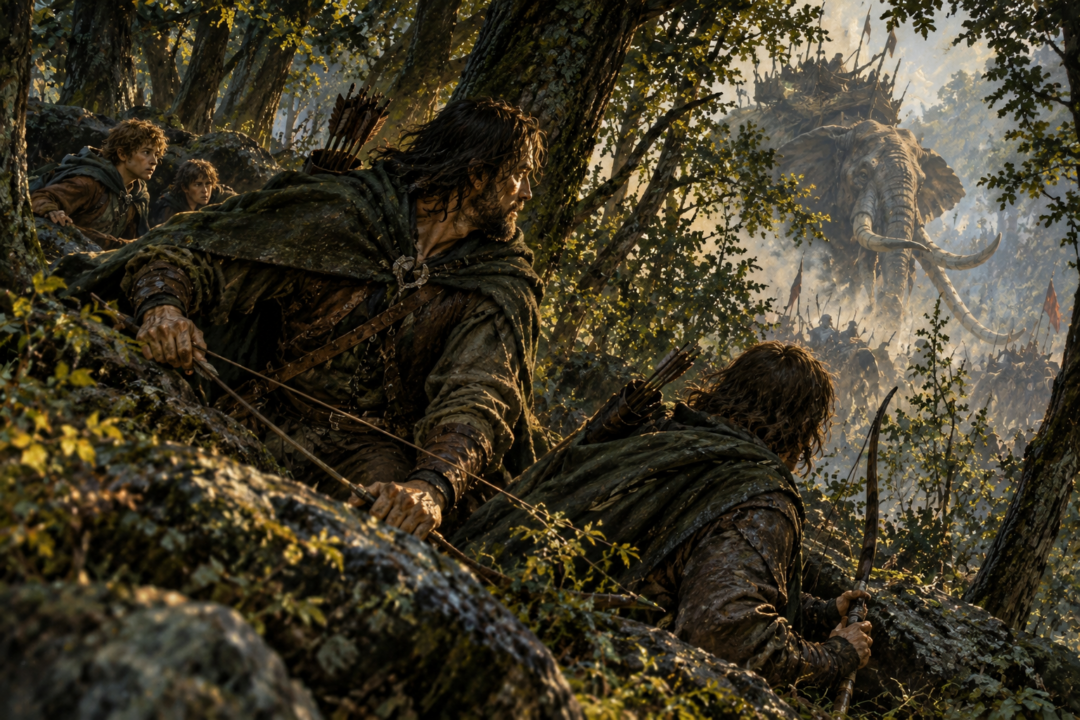
The crucial scene comes in “Of Herbs and Stewed Rabbit” in The Two Towers.
Sam knows Oliphaunt before he ever sees the animal. Earlier, while discussing the South with Gollum, he recites the Shire rhyme beginning “Grey as a mouse,” describing the gigantic creature of hobbit tradition. Gollum does not recognize the word and says he has never seen such a beast.
That establishes an important distinction. “Oliphaunt” belongs to Sam’s linguistic world. It is a traditional name known in the Shire, attached to stories about distant southern creatures.
But when a real animal appears during the Rangers’ ambush of the Haradrim, the Gondorian Damrod does not shout “Oliphaunt.” He cries mûmak.
The narrative then identifies the charging animal with Sam’s legendary creature. Two different naming traditions suddenly point to the same thing.
That gives us our first secure stage of transmission: by the end of the Third Age, mûmak was understood and used by at least some Men of Gondor.
It does not tell us where Damrod learned it.
The Strongest Evidence Comes from an Earlier Appendix
The published Appendix F explains that The Lord of the Rings is presented through a translation convention: the Common Speech, or Westron, has generally been rendered as English, while some names and words from other languages remain visibly foreign.
This matters because mûmak is one of those conspicuous foreign-looking survivors.
Even more revealing evidence exists in an earlier form of the linguistic appendix, published later in The Peoples of Middle-earth. In that draft, the discussion of the languages of peoples allied with Sauron says that almost nothing of their speech appears, apart from mûmak, the name of the great elephant of Harad.
That statement is extraordinarily useful, but it needs careful handling.
It identifies mûmak with the speech of Men of the East and Sauron’s allies and specifically connects the word with the great elephant of Harad. This is the strongest textual basis for treating it as a word originating outside the western linguistic traditions represented by Westron, Sindarin, and the languages of the Shire.
However, that explanatory sentence did not survive into the published Appendix F.
So the safest conclusion is not that we possess a complete canonical dictionary entry for a fully described Haradric language. We do not. Rather, an earlier linguistic explanation explicitly treated mûmak as one of the extremely rare words preserved from the speech of eastern or southern peoples associated with Sauron.
The narrative itself remains compatible with that explanation.

Gondor Is the Visible Bridge
If the word comes from the linguistic world of Harad, how did it reach the western narrative?
The only directly observable bridge is Gondor.
Damrod is a Ranger of Ithilien serving under Faramir. He belongs to a society that has been in prolonged contact and conflict with Harad. Gondor’s history is repeatedly entangled with the South: warfare, contested frontiers, Umbar, invasions, and centuries of political struggle connect the two regions.
It is therefore unsurprising that Gondorians might know a southern name for a southern war-beast.
But here the evidence reaches an important limit.
The texts do not tell us that a particular Gondorian soldier first borrowed the term. They do not name a merchant, prisoner, scout, interpreter, frontier community, or military campaign through which it entered Gondorian usage. They do not provide a chain such as Haradric language → border dialect → Gondorian military vocabulary → Westron.
Such a reconstruction would be plausible historical linguistics invented by the reader, not recorded history.
What we can say is narrower and stronger: a Gondorian speaker uses mûmak naturally in direct speech when confronted with the animal.
The word has already crossed whatever boundary once separated its southern source from Damrod’s vocabulary.
Mûmak and Mûmakil Reveal Another Layer
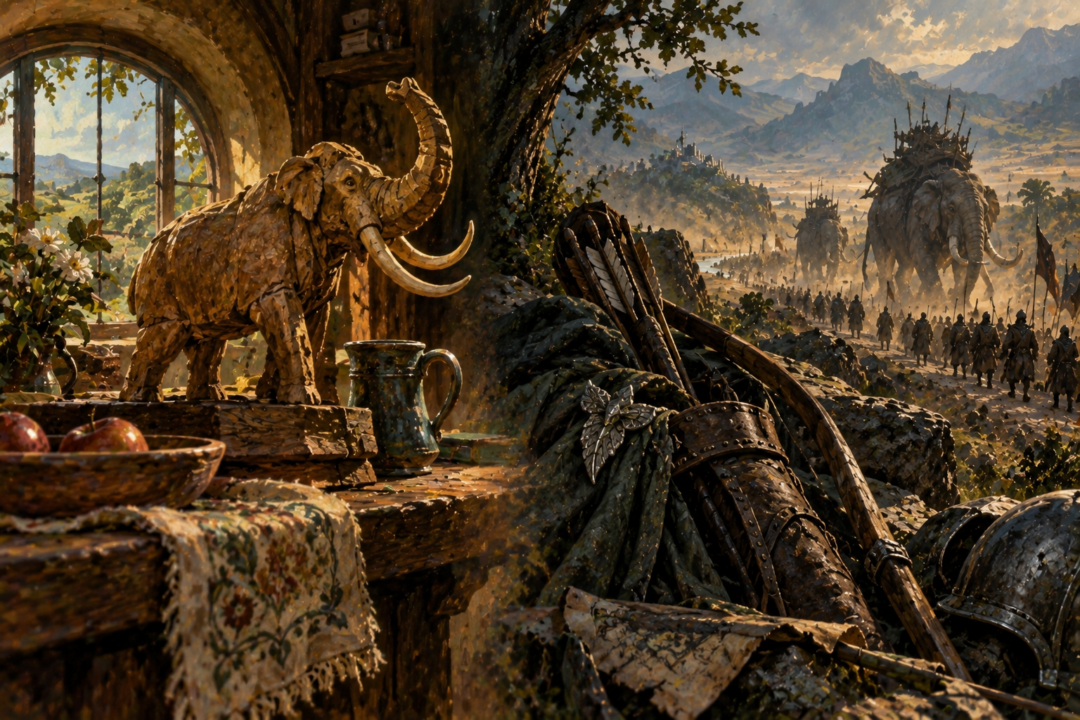
The singular mûmak is not the only form that appears. The plural mûmakil is also used in the narrative.
This creates a tempting question: is -il a Haradric plural ending?
The surviving material does not give us enough evidence to build a grammar from it.
We know the singular and plural forms as presented in the text, but a single pair cannot establish the broader grammatical system of an otherwise almost unattested language. We cannot safely invent other nouns, declensions, or rules from mûmak/mûmakil.
This restraint matters because Tolkien’s linguistic framing makes Middle-earth appear much more completely documented than it sometimes is. For Quenya or Sindarin, large bodies of linguistic material allow meaningful grammatical comparison. For the languages of Harad, the evidence is radically thinner.
Mûmak is valuable precisely because so little survived.
It is less a window into a complete Haradric grammar than a single foreign object embedded in western speech.
Why Wasn't It Simply Translated as “Oliphaunt”?
The coexistence of the two terms is especially revealing because the narrative could theoretically have flattened them into one English word.
Instead, it preserves the contrast.
When Sam speaks from Shire tradition, the creature is an Oliphaunt. When Damrod reacts as a Gondorian soldier, he uses mûmak. Later narration can employ mûmak and mûmakil for the actual beasts of Harad.
That distinction preserves register and cultural viewpoint.
“Oliphaunt” carries folklore with it. Before Ithilien, Sam knows the animal through inherited tales. The word belongs to wonder, hearsay, and childhood knowledge of distant lands.
“Mûmak,” by contrast, enters Sam’s experience through people for whom the creature is a military reality. Damrod does not debate whether mûmakil exist. He is afraid that one is charging toward him.
The two words therefore mark different relationships with the same animal.
One is the Shire’s distant memory.
The other belongs to a world close enough to Harad for the beast to require an immediately useful name.
The Narrator Adds a Further Translation Problem
There is another layer between Damrod’s cry and the modern reader.
The Red Book tradition underlying The Lord of the Rings is itself presented through a fictional history of textual transmission and translation. Westron has largely become English on the page. Hobbit names and place-names are frequently represented by English equivalents designed to reproduce their original meanings and associations rather than their literal historical forms.
Against that translated background, untranslated or only lightly adapted foreign words become conspicuous.
Mûmak appears to be one of them.
That does not mean we can reconstruct every manuscript stage by which the spelling reached the final text. Nor should we assume that the written form reproduces every phonetic detail of some hypothetical Haradrim original.
What matters is the literary-linguistic distinction: the word is allowed to remain foreign inside a narrative whose dominant speech has been translated for us.
The effect is subtle. The reader encounters the South partly as Sam does—not through a vocabulary lesson, but through a strange word suddenly spoken by someone who already knows what it means.
What We Can Actually Reconstruct
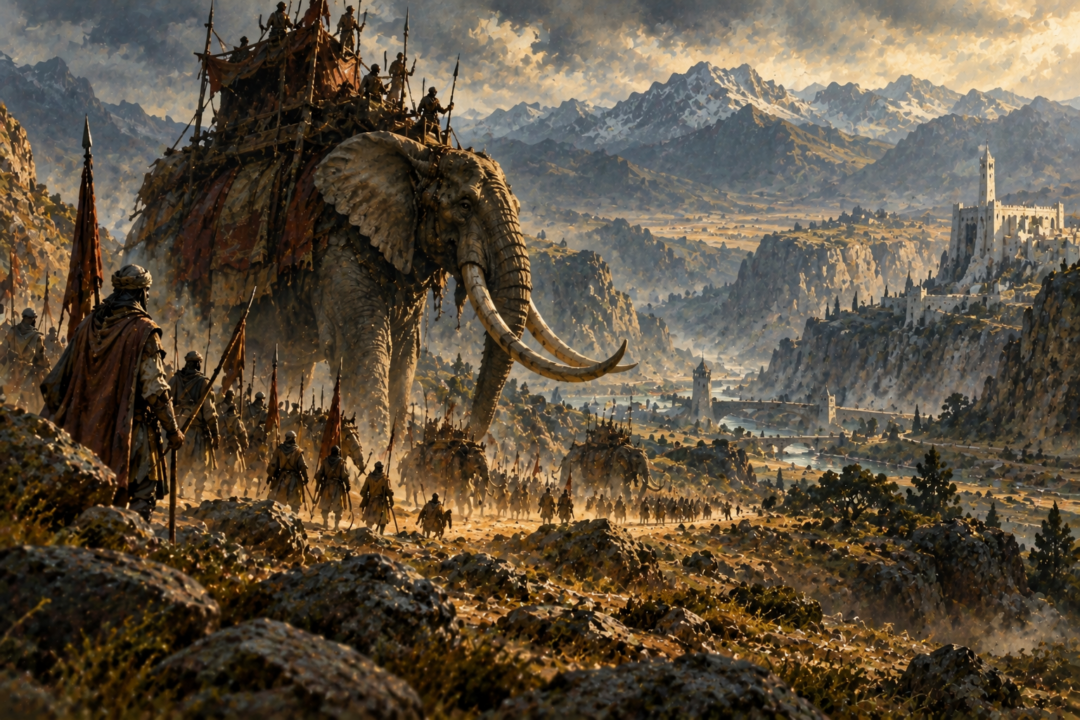
The evidence therefore supports a short transmission chain, not a complete one.
At the southern end stands a name associated in the linguistic drafts with the speech of peoples allied to Sauron and specifically with the great elephant of Harad.
At the western end stands Gondor, where Damrod demonstrably uses mûmak in ordinary speech during the War of the Ring.
Beyond Gondor stands the narrative tradition that preserves the foreign form instead of replacing every occurrence with Sam’s familiar “Oliphaunt.”
That much can be reconstructed.
What lies between those stages cannot.
We do not know which community first coined the word. We cannot identify a single “language of Harad” from this evidence alone, since Harad contained multiple peoples and the surviving linguistic record is sparse. We do not know when Gondor borrowed the term, whether it passed through Umbar, whether soldiers learned it directly from Haradrim, or whether it had been familiar in Gondor for centuries.
The record simply falls silent.
And that silence is part of what makes mûmak so interesting.
Middle-earth’s linguistic realism does not depend on every language being explained. Sometimes it depends on the opposite: a lone borrowed word survives because cultures have touched one another, while the people who first carried it across the frontier remain unnamed.
Sam knew an Oliphaunt from a rhyme.
Damrod knew a mûmak well enough to fear one.
Between those two words lies an entire history of contact between the West and Harad—but the texts preserve only its edges.
Sources & Notes
- The Encyclopedia of Arda — Mûmakil — Discusses the early Appendix F draft preserved in The Peoples of Middle-earth and the southern name. https://www.encyclopedia-of-arda.com/m/mumakil.html
- The Encyclopedia of Arda — Oliphaunts — The Hobbit term, Sam’s rhyme and the word’s real-world linguistic history. https://www.encyclopedia-of-arda.com/o/oliphaunts.html
- Ardapedia — Mûmakil — The creatures of Harad, their singular and plural names, and their appearance in Ithilien. https://www.ardapedia.org/wiki/M%C3%BBmakil
Primary passages: The Two Towers, “The Black Gate Is Closed” and “Of Herbs and Stewed Rabbit”; The Peoples of Middle-earth, “The Appendix on Languages.” The explicit language-origin explanation belongs to an earlier appendix draft, not the final published Appendix F. Damrod’s use is textual; the exact borrowing route and a complete Haradric grammar are not recorded.