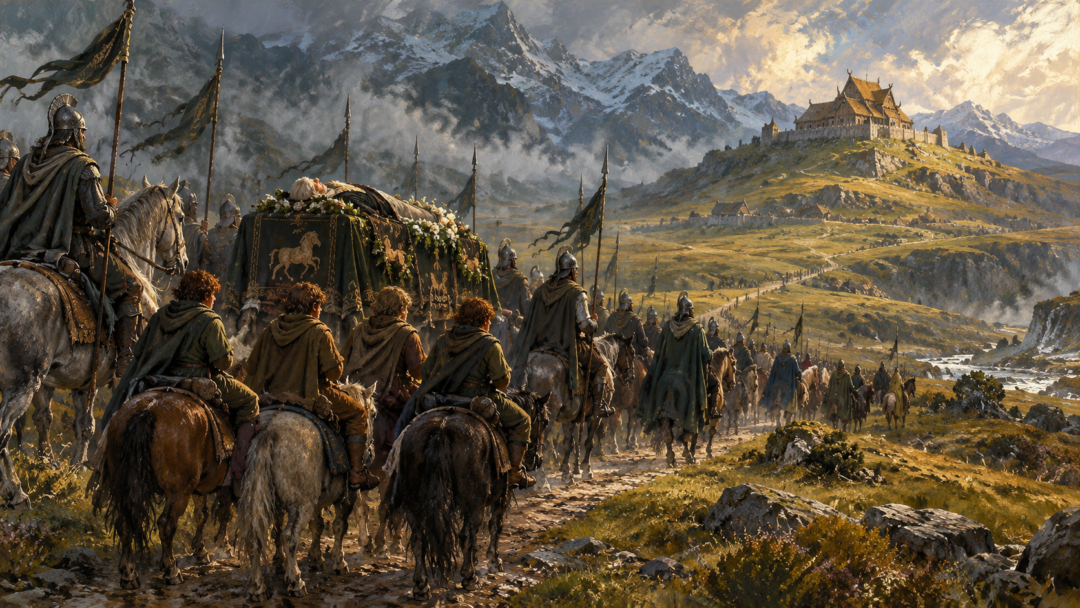
When the One Ring is destroyed and Sauron falls, the four hobbits have every reason to think of home. Frodo and Sam have crossed Mordor. Merry and Pippin have survived battles far beyond anything imagined in the Shire. Yet even after Aragorn is crowned and the great victory celebrations in Gondor are over, the road back to Bag End does not simply open before them.
One of the most important delays comes in Rohan.
Théoden is dead, but he has not yet been buried in his own country. His body must be brought from Gondor to Edoras, and the returning company accompanies him. Only after Rohan has received its fallen king, buried him among his forebears, and completed the ceremonies surrounding his death and Éomer's succession can the hobbits continue their journey north.
It can look like a detour in the geography of the homeward journey. In the story, however, it is something deeper. The war may be finished, but the obligations created by the war are not.
Théoden Dies Far from the Golden Hall
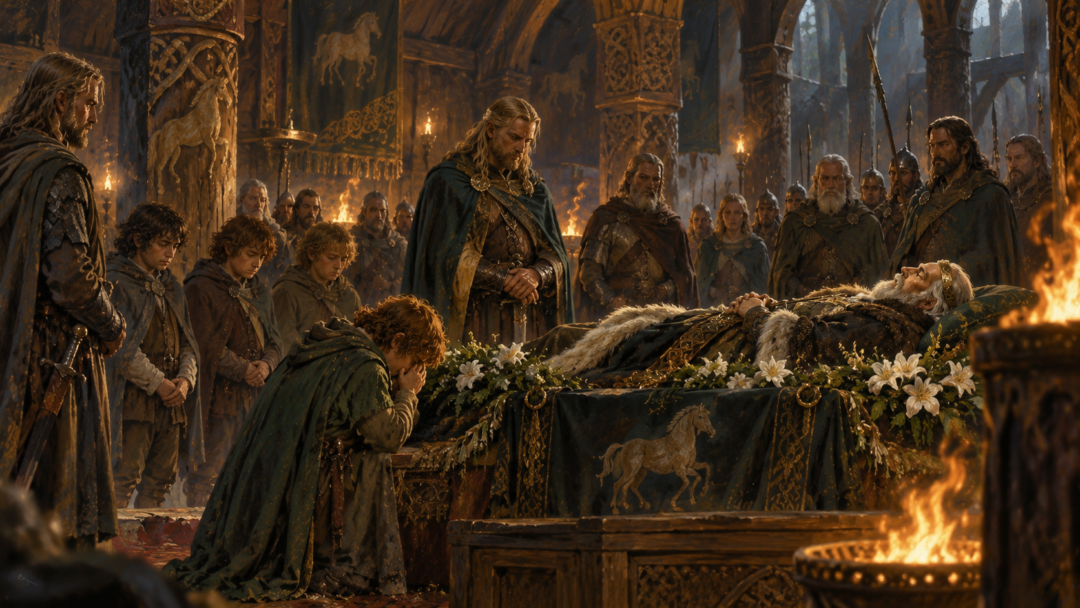
Théoden falls on the Pelennor Fields, far from Edoras and Meduseld.
His death therefore leaves unfinished business that victory cannot erase. Gondor has been saved, Sauron has been defeated, and Aragorn has entered into his kingship, but the King of the Mark still has to be returned to the land he ruled.
The narrative makes that return part of the larger movement away from war. After Aragorn's coronation, the companions do not immediately scatter toward their separate homes. There are farewells to make, promises to fulfil, and political and personal bonds to honour.
Théoden's burial belongs to that process.
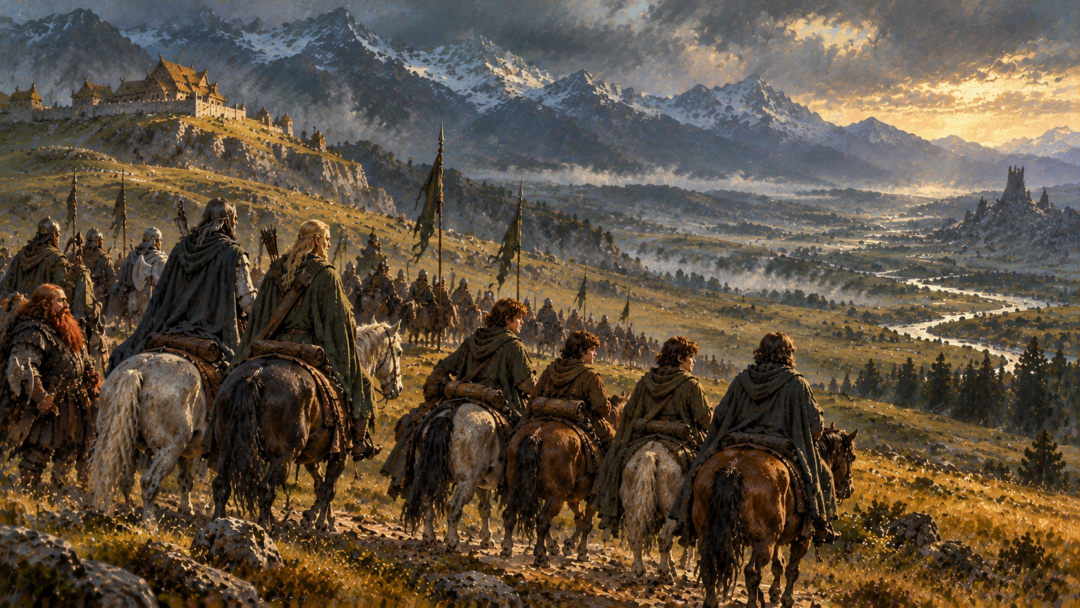
His body is carried with the company as they leave Minas Tirith and journey toward Rohan. This means the hobbits' route home is temporarily bound to the king's final journey. They are not simply travellers choosing the shortest road north. They remain members of a fellowship of peoples whose relationships have been transformed by the war.
For Merry especially, this is personal.
Merry Cannot Simply Ride Past Rohan
Meriadoc Brandybuck's connection to Théoden is unlike Frodo's or Sam's.
Merry had entered Théoden's service and become his esquire. Before the Battle of the Pelennor Fields, the king ordered Merry to remain behind when the Riders rode to war. Merry nevertheless reached the battlefield with Dernhelm, who was Éowyn in disguise, and was present in the terrible events surrounding Théoden's death.
The bond between the hobbit and the king is therefore not merely that of two members of the same alliance.
Merry had served him.
That makes the return to Rohan particularly significant. The homeward journey cannot convincingly become a simple flight back toward the familiar while Théoden remains unburied. Merry has a duty of affection and service that extends beyond the battlefield itself.
The text does not reduce the entire company's decision to Merry's personal feelings, and it would go too far to claim that the funeral is held up specifically for the hobbits. Rather, the hobbits travel within a larger royal and allied company whose route includes the return and burial of Théoden.
Their road home consequently follows the obligations of that company.
The Journey Home Begins as a Shared Journey
This is easy to miss because readers naturally think of the hobbits' destination as the Shire.
But when they finally leave Minas Tirith, they do not depart as four isolated travellers making directly for Eriador. Aragorn and many of the principal figures of the victorious alliance accompany the northward journey for a considerable distance.
The departure also has another purpose: Aragorn is travelling with Arwen toward their parting from Elrond and the other members of her kindred who will continue north.
Théoden's body travels with this great company toward Rohan.
The arrangement turns the beginning of the hobbits' homeward journey into something almost ceremonial. The roads that once brought scattered peoples toward desperate war now carry them away from it, but not all at once and not toward the same destination.
At each stage, someone must part from the others.
Rohan comes before the hobbits can make the road truly their own.
Edoras Must Receive Its King
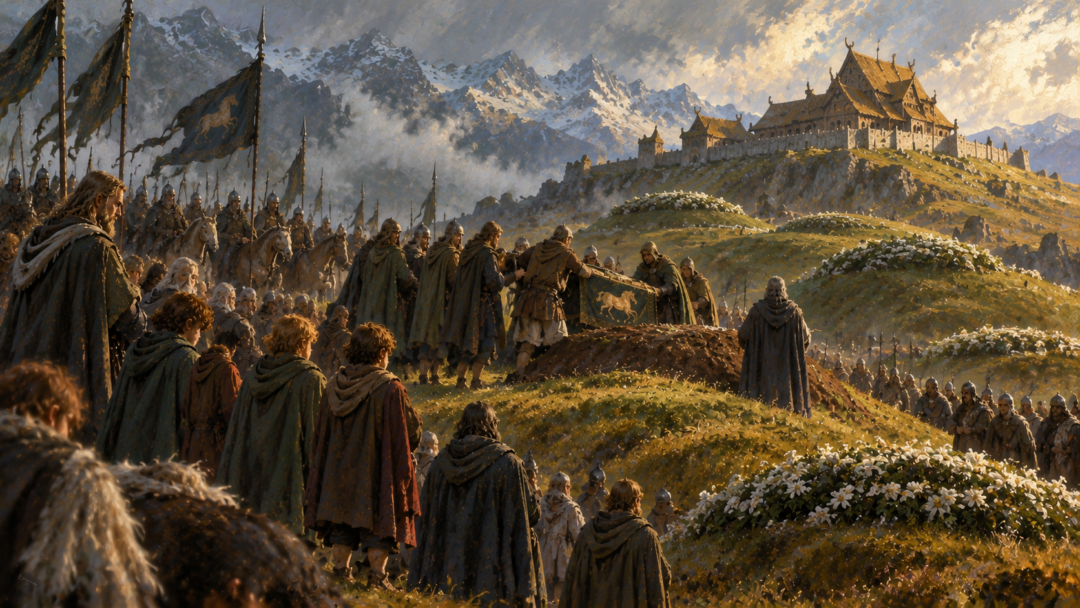
The company reaches Edoras with Théoden, and there the homeward movement pauses.
This matters because Théoden's death occurred in Gondor, but his identity and kingship belong to Rohan. Bringing him back to Edoras restores him, in death, to the history of his own people.
The burial is not presented as an incidental stop along the road.
Théoden is laid in a mound, joining the dead kings of the Mark. The Rohirrim sing for him, and the ceremonies surrounding his burial place his death within the continuing memory of his people. The white flowers called simbelmynë grow upon the royal mounds, connecting the landscape of Edoras with generations already gone.
Yet the funeral is about more than the dead.
Rohan also has a living king.
Éomer has inherited the kingship, and after Théoden's burial he holds a feast in Meduseld. The gathering therefore marks both an ending and a continuation: Théoden is formally mourned and laid to rest, while Éomer stands as the ruler who will carry the Mark into the peace that follows the war.
For the travelling company, these are not events to rush through on the way somewhere else.
They are part of completing the war.
The Funeral Creates a Real Pause in the Homeward Story
The chronology makes the effect on the hobbits' journey clear without requiring us to invent a precise hypothetical timetable.
They have already spent a substantial period in Gondor after Sauron's defeat. Aragorn's coronation takes place, and later comes his marriage to Arwen. Only afterward does the great company finally begin the journey north.
Then Rohan introduces another major ceremonial stage.
The company brings Théoden home, remains for his burial, and participates in the events at Edoras before departing again.
It is therefore fair to say that Théoden's funeral delays the hobbits' road home, provided "delay" is understood correctly. Nothing in the text suggests that the hobbits are impatiently detained against their wishes, nor does Tolkien provide an alternate schedule showing how quickly they could have reached the Shire had they bypassed Rohan.
The delay is narrative and practical: before their northward return can continue, the company pauses to complete an obligation created by Théoden's death.
That distinction matters.
This is not an inconvenient interruption imposed on the hobbits. It is part of what their homeward journey now means.
The Road After War Is Made of Farewells
The return from Mordor is sometimes remembered as though the story simply reverses direction after the Ring is destroyed.
It does not.
The outward journey had been driven by urgency. The Ring had to reach Rivendell. The Fellowship had to leave before the Enemy's power became overwhelming. Frodo and Sam had to reach Mount Doom before hope disappeared entirely.
The return journey operates differently.
Its rhythm is slower and shaped by separation.
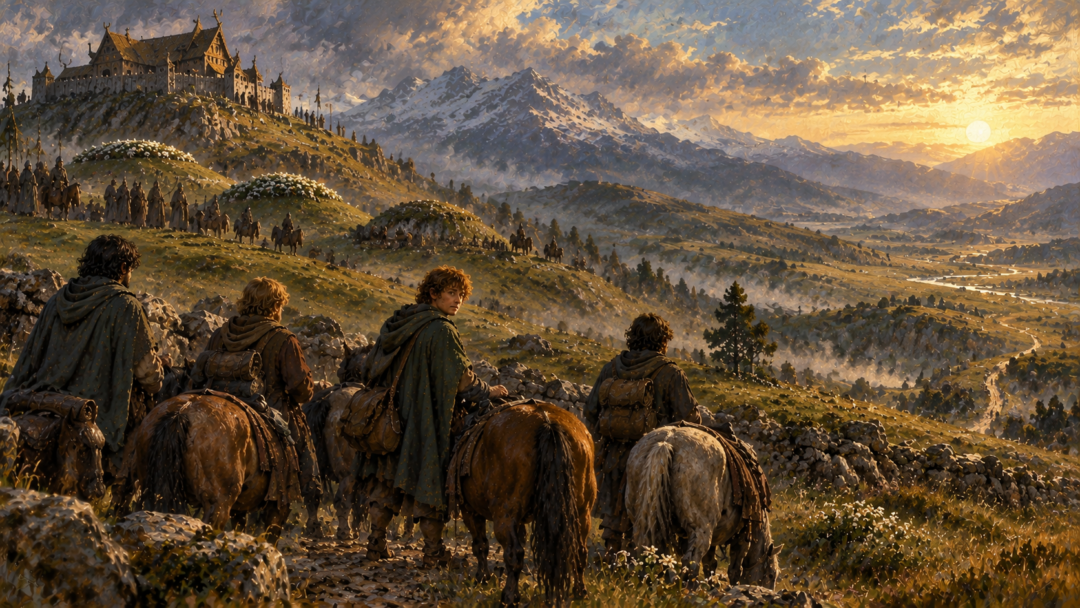
Théoden must be buried. Éomer must take his place in the new order. Friends who came together because of the war begin choosing different roads. Eventually the hobbits will revisit places from their earlier journey and discover that even apparently familiar landscapes have changed.
The funeral at Edoras is one of the first great reminders that victory does not restore the world to the way it was before.
Some companions are dead.
Some kingdoms have new rulers.
Some relationships can now exist only as memory.
The hobbits are going home, but they cannot undo the journey that took them away from it.
Merry's Farewell Makes the Detour Personal
Among the four hobbits, Merry gives the Rohan episode its strongest emotional connection.
His relationship with Théoden had begun under extraordinary circumstances. A hobbit from Buckland, a people almost entirely unknown to the Rohirrim, became the esquire of the King of the Mark. Théoden treated him with warmth, and Merry's service eventually carried him onto the field where the king died.
At Edoras, that relationship reaches its final earthly conclusion.
Merry can no longer serve Théoden. He can only help honour his memory and then leave.
That is one reason the episode fits so naturally into the return journey. The hobbits are gradually releasing the roles that the war gave them. Merry had become a warrior and royal esquire; Pippin had entered the service of Gondor. Frodo had borne the Ring into Mordor. Sam had briefly borne it too.
Going home requires them to leave those worlds behind.
But leaving properly requires farewells.
Why They Do Not Simply Continue North
Geographically, a traveller concerned only with reaching the Shire might imagine a more direct homeward logic.
That is not the logic governing this company.
They are travelling through a world of alliances, households, kingdoms, promises, and personal loyalties. Théoden did not die as an anonymous casualty whose burial could occur outside the concerns of the surviving companions. He was one of the central leaders of the alliance that resisted Sauron, and he had formed direct bonds with members of the company.
The return of his body to Rohan therefore determines part of their route.
The texts do not state that some formal law required every member of the company to attend, so it is better not to turn their presence into a rigid rule of Middle-earth etiquette. What the narrative does show is that they go together, that Théoden is brought to Edoras, and that his funeral occurs before the company moves onward.
The obligation is demonstrated through action rather than explained as a legal requirement.
That makes it more powerful.
Nobody needs to announce that friendship requires them to stop.
They stop.
The Funeral Marks the Boundary Between War and Home
When the company finally leaves Edoras, the hobbits are still far from the Shire.
There will be more meetings and more partings before they reach it. Their road will take them back through places associated with the earlier stages of the quest, and the return will increasingly become a reckoning with what has changed.
But Théoden's funeral establishes the pattern.
The great events of history do not end when the battlefield falls silent. The dead must be carried home. The living must acknowledge new responsibilities. Friends must stand beside one another before their roads divide.
For the hobbits, Edoras is therefore more than a geographical detour.
They could not pass directly from the overthrow of Sauron into ordinary Shire life because the story they had entered was not finished merely when its Enemy was defeated. Théoden still had to make his last journey to the land of his fathers, and those who had ridden and fought beside Rohan accompanied him.
Only after the fallen king had returned to Edoras and been laid to rest could another stage of the homeward road begin.
The Shire was waiting.
But first came the farewell.
Sources & Notes
- LitCharts — The Return of the King, Book VI, chapter 6 — The companions escort Théoden to Rohan, remain for his burial and then continue their farewells. https://www.litcharts.com/lit/the-return-of-the-king/book-6-chapter-6
- The Thain’s Book — Théoden — The funeral procession, burial at Edoras and the accompanying Fellowship. https://thainsbook.minastirith.cz/theoden.html
- The Encyclopedia of Arda — Gléowine — The minstrel’s final lament at Théoden’s graveside. https://www.encyclopedia-of-arda.com/g/gleowine.php
Primary passage: The Return of the King, “Many Partings”; compare Appendix B’s chronology. The funeral precedes the hobbits’ onward journey. The text does not supply a counterfactual faster itinerary or say they were unwillingly detained.