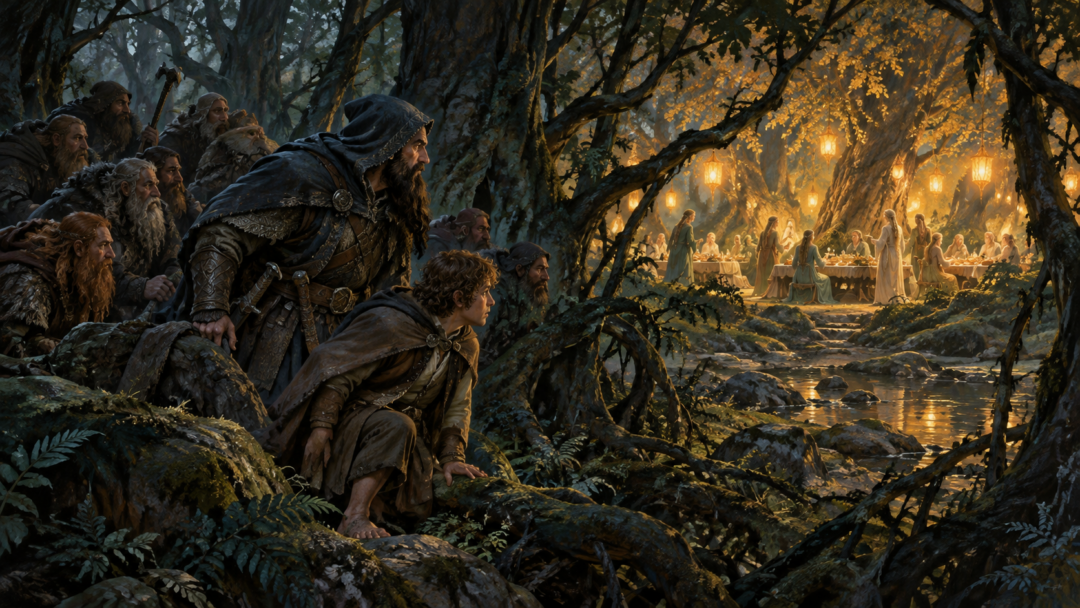
Deep inside Mirkwood, Thorin Oakenshield and his companions discover something almost impossible to resist: warm lights beneath the trees, Elven voices singing, and the promise of food after days of hunger and exhaustion.
Yet whenever the travelers attempt to reach the woodland feast, the lights vanish. The singing stops. Darkness closes around them, leaving the company more confused and vulnerable than before.
It feels like a trap. But the strange truth of this episode in The Hobbit is that the Wood-elves are never shown deliberately arranging their celebrations to capture the Dwarves.
Instead, the feasts become a kind of moving trap through their repeated disappearance, the travelers' desperate attempts to reach them, and the disorientation that follows.
The distinction matters. What destroys the company's remaining order is not a carefully planned Elven ambush, but a series of encounters in which hope repeatedly turns into darkness.
The First Feast: A Promise of Safety in the Forest
By the time Bilbo and the Dwarves discover the first woodland gathering, Mirkwood has already reduced them to a desperate condition.
Their supplies have dwindled, their journey has become increasingly miserable, and the forest seems to offer almost nothing they can safely eat. Their departure from the path is a serious mistake, but the circumstances make the temptation understandable.
Then they see firelight among the trees.
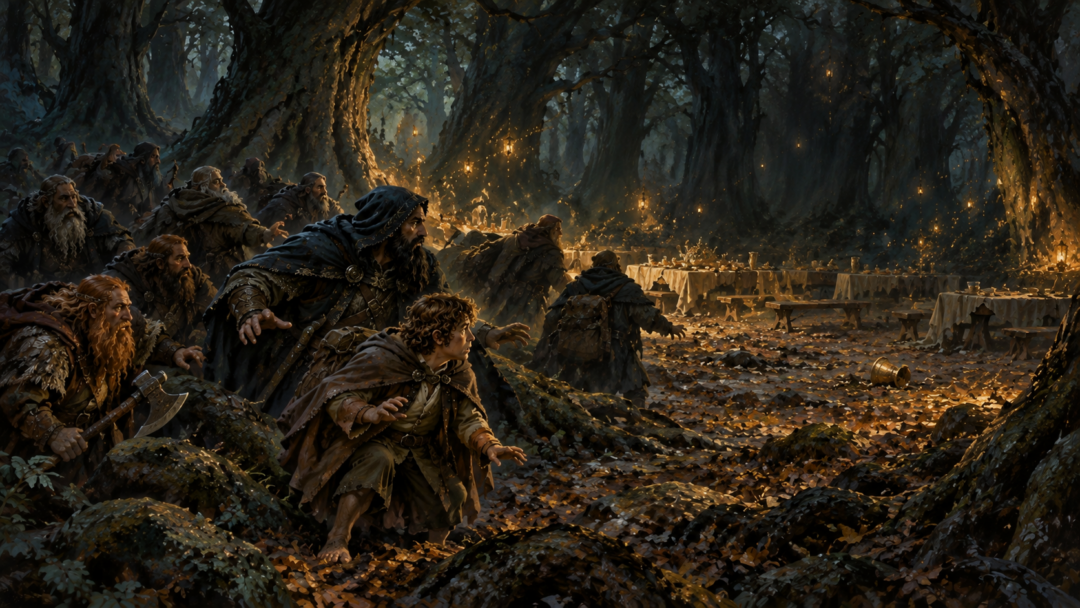
In Chapter 8, "Flies and Spiders," the company encounters a woodland clearing where Elves are feasting. There are lights, food, music, and the unmistakable signs of a gathering that appears welcoming from a distance.
This is the first important contradiction.
The travelers have entered a forest where ordinary comforts have become scarce, yet suddenly they can see a celebration that seems to possess everything they lack.
The feast is not described as a cruel illusion created specifically for them. It is an actual Elven gathering.
But its apparent accessibility is deceptive.
The Dwarves can see the celebration without understanding the conditions under which they might safely approach it. The distance between observing the feast and joining it becomes far more dangerous than they expect.
When they rush toward the clearing, the lights disappear.
Instead of finding food and shelter, they find themselves in darkness.
The first apparent rescue has become another disaster.
Why the Lights Go Out When the Dwarves Approach
The central mystery is not whether the Wood-elves are real or whether the feasts actually exist. The narrative establishes that the woodland celebrations are genuine.
The question is why they repeatedly disappear at the moment the travelers try to reach them.
The narrator presents the feasting Elves as elusive and difficult for outsiders to encounter. Their woodland gatherings can vanish suddenly, leaving approaching strangers unable to find what they have just seen.
This behavior fits the wider portrayal of the Wood-elves as a people who live within the forest and possess ways of moving and concealing themselves that outsiders do not understand.
But there is an important limit to what the text establishes.
It does not explain that the Elves have organized a deliberate operation to lure Thorin's company away from the path. Nor does it identify an individual Elf who plans the successive disappearances as part of a capture strategy.
The feasts are interrupted when the company approaches, but that is not the same as saying they were arranged to attract the company.
The Wood-elves' withdrawal can reasonably be understood as part of their reluctance to be approached by strangers. The precise intention behind each interruption, however, is not fully explained.
That uncertainty is what makes the episode so unsettling.
From the travelers' perspective, the feast behaves like bait.
From the perspective of the story's established facts, it remains an actual Elven celebration that the company repeatedly fails to enter.
The apparent trap emerges from the consequences of the encounter, rather than from a demonstrated plan to capture them.
Three Attempts, Three Disappearances
The repeated structure of the feast encounters is essential to understanding their effect.
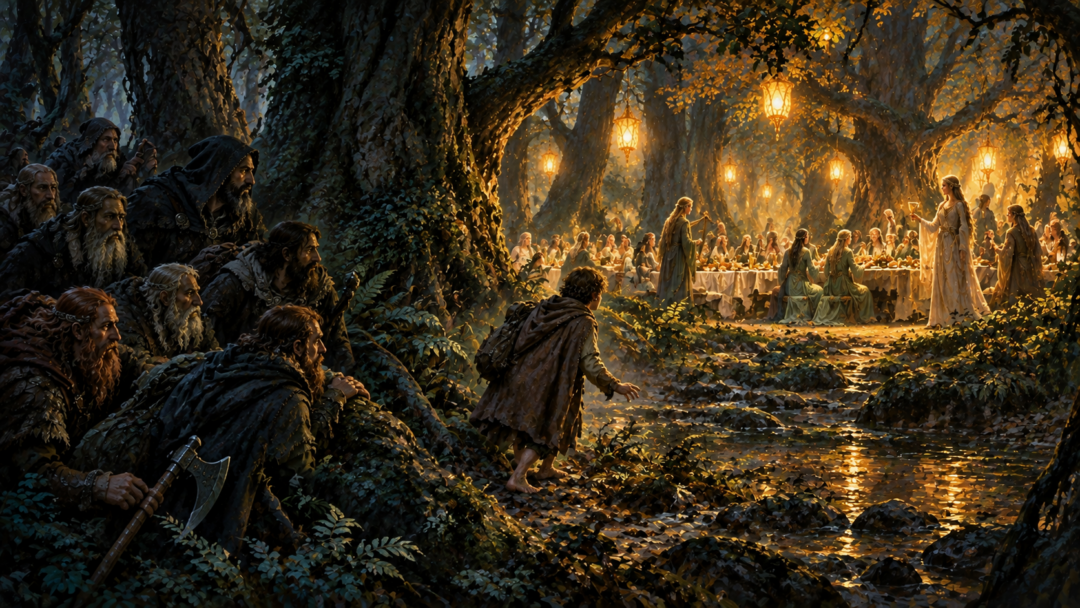
The travelers do not simply glimpse one light and lose their way. They repeatedly try to reach the woodland celebrations, and each attempt makes their situation worse.
At the first gathering, their approach extinguishes their hope of finding food and leaves them struggling in darkness.
They eventually discover another Elven feast. Despite their previous failure, they remain desperate enough to attempt an approach again.
Once more, the celebration disappears before they can properly join it.
The repetition changes the meaning of the lights.
What initially appeared to be a fortunate discovery now becomes an increasingly dangerous temptation. Yet the company cannot easily abandon the possibility that the next gathering might finally provide relief.
The third encounter proves especially disastrous.
This time, the company makes another attempt to reach the feast, and Thorin is separated from the others when the lights vanish.
The Dwarves and Bilbo cannot find him.
The repeated disappearances have now produced a consequence far more serious than temporary disappointment. The company has lost its leader.
There is a grim irony in the sequence.
Each feast seems to offer an end to the travelers' suffering. Each attempt to reach one instead increases their helplessness.
The celebrations themselves do not need to move toward the Dwarves to produce this effect. Their successive appearances at different locations, followed by sudden disappearance, make the company pursue something it can never securely reach.
That is the sense in which the feasts function like moving traps.
They continually renew the hope of rescue while leaving the travelers increasingly exposed.
The Darkness Is More Dangerous Than the Feast
The most destructive part of the encounters happens immediately after the lights disappear.
The Dwarves have left the relative security of the path. They are moving through unfamiliar woodland, without a reliable way to navigate back to safety.
When the Elven lights vanish, they lose the visible destination toward which they have been traveling.
Their surroundings become confusing again.
This creates a sequence of escalating dangers.
First comes attraction: the travelers see light, food, and apparent companionship.
Then comes commitment: they move toward the clearing, placing themselves farther from any familiar route.
Next comes disappearance: the feast is suddenly inaccessible, and the darkness returns.
Finally comes disorientation: the company must attempt to recover its bearings without the guidance that drew it forward.
The pattern is effective precisely because it does not require an enemy to physically attack the travelers.
Their own movement toward the lights creates the vulnerability.
This does not mean that the Wood-elves are necessarily manipulating them. Rather, the Elves' ability to withdraw so suddenly has disastrous consequences for outsiders who cannot navigate the forest as they do.
The contrast between the two groups is striking.
For the Elves, the woodland is a place where feasts can be held beneath the trees.
For Thorin's company, the same forest has become a maze in which even a few steps in the wrong direction can be ruinous.
The danger lies in the difference between belonging to Mirkwood and being lost within it.
Thorin's Disappearance Is Not the Same as His Capture
One of the most important distinctions in this episode concerns what happens to Thorin.
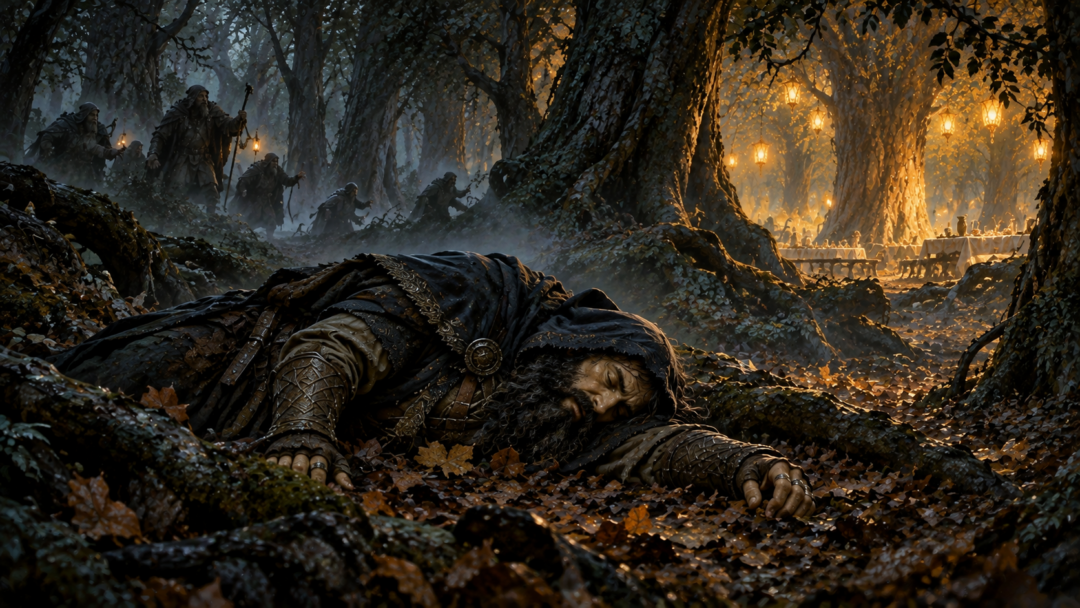
During the final feast encounter, he becomes separated from his companions. The narrative subsequently reveals that he has fallen into the hands of the Wood-elves.
But his separation and his imprisonment are not presented as one uninterrupted, prearranged ambush.
Thorin is overcome by enchantment and sleep in connection with the disappearance of the final feast. His companions lose him, and the Elves later take him into custody.
The Elvenking then questions Thorin about his presence in the forest and the purpose of his journey.
Thorin refuses to explain the company's true business.
His refusal helps turn an already suspicious encounter into imprisonment.
The king's response belongs to a different stage of the story from the disappearing feast lights.
At the feast, the company is seeking food and becomes scattered.
After Thorin is taken, the Elvenking is dealing with an unexplained intruder who will not reveal his purpose.
These are connected events, but they are not identical.
The narrative gives the Elvenking reasons to be suspicious of strangers wandering through his realm, especially when they refuse to answer his questions. It does not establish that he arranged the woodland feasts as a scheme to capture Thorin's expedition.
That distinction prevents the episode from becoming a simpler story about malicious Elves deliberately baiting starving Dwarves.
The actual chain of events is more complicated.
The travelers pursue the feasts, the lights disappear, Thorin is lost, and his subsequent encounter with the Wood-elves leads to captivity.
The apparent trap and the later imprisonment belong to the same unfolding disaster without requiring the same original intention.
The Wood-elves Are Suspicious, Not Simply Evil
The later explanation of the Wood-elves' character helps clarify the feast encounters.
In The Hobbit, Chapter 8, the narrator explicitly distinguishes these Elves from wicked creatures. They are nevertheless wary of strangers, and their distrust is particularly relevant when outsiders intrude upon their woodland gatherings.
This does not make every action of the Elvenking unquestionably fair.
Thorin is imprisoned, and the other Dwarves eventually suffer the same fate after their separate capture. Their unwillingness to disclose their mission contributes to the conflict.
But the Wood-elves' distrust should not be confused with evidence of an elaborate hunting operation.
Their behavior is consistent with a people who protect their privacy and their realm, possess powerful enchantments, and do not readily welcome unexpected visitors.
One reading is that the sudden disappearance of the feasts expresses this guarded woodland culture.
The Dwarves see an invitation where none has been offered.
The Elves see unwanted intruders where the travelers hope to find hosts.
Both sides misunderstand the encounter, but only the travelers are helpless when the lights go out.
The Feast's Most Terrible Consequence Comes From Elsewhere
The Wood-elves are not the only danger waiting beyond the path.
After the final disappearance, Bilbo and the remaining Dwarves become exhausted and fall asleep in the forest. The giant spiders then capture them.
Bilbo awakens to discover himself entangled in webbing, beginning the struggle that leads to his rescue of the others.
The spiders are a separate threat. The narrative does not establish that the Wood-elves cooperate with them or deliberately leave the Dwarves as prey.
Nevertheless, the feast encounters have helped create the conditions for this catastrophe.
The company is lost, scattered, exhausted, and unable to maintain its former order.
The spiders exploit that vulnerability.
This is perhaps the most frightening consequence of the disappearing celebrations: a danger need not be intentionally created by one group for another danger to take advantage of it.
The Wood-elves withdraw.
The Dwarves lose their bearings.
The spiders attack.
Each event follows from the developing situation, without requiring a single hidden mastermind behind the entire disaster.
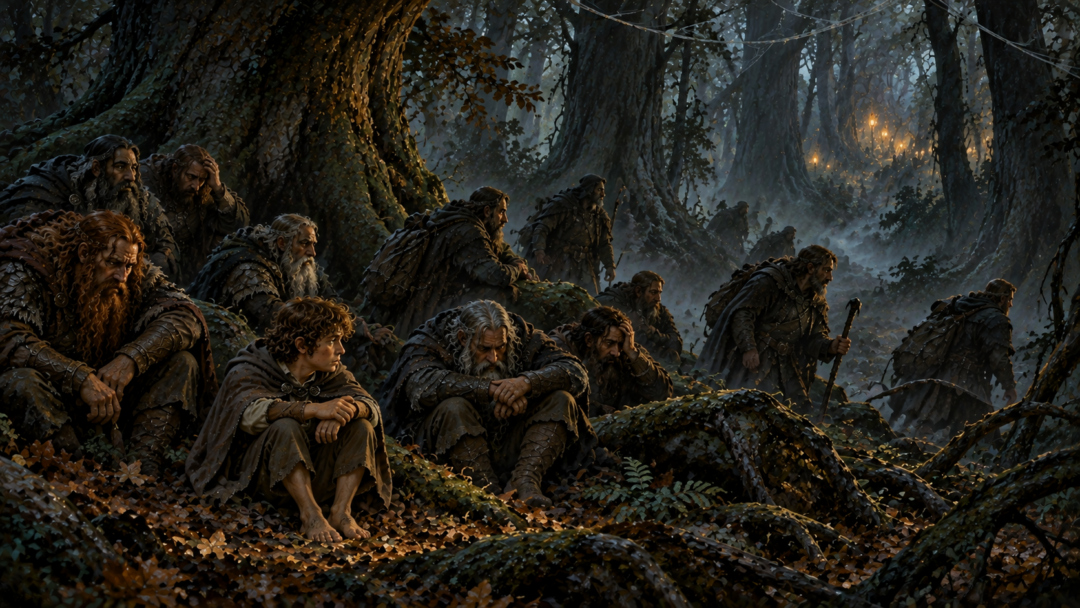
Why the Feasts Feel Like Moving Traps
The woodland feasts are memorable because they reverse the usual meaning of light in a dark place.
A fire normally promises warmth, safety, and companionship. A gathering of singing Elves might reasonably suggest refuge.
But for Thorin's company, the visible promise of safety repeatedly produces the opposite result.
The feasts are genuine, yet unreachable.
The lights are beautiful, yet their disappearance leaves the travelers helpless.
The Elves are not described as wicked, yet their withdrawal contributes to a disaster.
And Thorin is eventually imprisoned, although the narrative never establishes that his imprisonment was the original purpose of the celebrations.
The mechanism is therefore more subtle than a conventional ambush.
The feasts function as traps from the perspective of those pursuing them, not because the story proves that they were deliberately constructed as traps.
They repeatedly draw the company forward, disappear at the critical moment, and leave the travelers facing consequences they cannot control.
That is the deeper irony of the episode.
In Mirkwood, the most dangerous thing the Dwarves encounter is not always something that wishes to harm them.
Sometimes it is something genuinely beautiful, belonging to another people, that they mistake for an offer of rescue.
And by the time the lights have vanished for the third time, the difference between a deliberate trap and a disastrous misunderstanding no longer matters to the lost travelers beneath the trees.
Sources & Notes
- Penguin Random House — The Hobbit teacher's guide, chapter 8: hunger, the interrupted Elven feast, separation, spiders and Thorin's capture. https://www.penguinrandomhouse.com/books/179206/the-hobbit-by-jrr-tolkien/teachers-guide/
- LitCharts — The Hobbit, chapter 8, Flies and Spiders: leaving the path for food, the sudden darkness and the later Elvenking interrogation. https://www.litcharts.com/lit/the-hobbit/chapter-8-flies-and-spiders
- LitCharts — The Hobbit, chapter 9, Barrels Out of Bond: the later capture of the remaining Dwarves, the Elvenking's questions and refusal to disclose the expedition's purpose. https://www.litcharts.com/lit/the-hobbit/chapter-9-barrels-out-of-bond
Primary passage: J.R.R. Tolkien, The Hobbit, chapter 8, ‘Flies and Spiders’; compare chapter 9, ‘Barrels Out of Bond’. The three disappearing feasts and Thorin's later imprisonment are narrative events. ‘Moving traps’ describes their effect on the travelers, not an established plan to lure the Dwarves or cooperation between the Elves and spiders. The linked publisher's guide and chapter commentaries support the event sequence; the distinction between consequence and intention is close-reading interpretation.