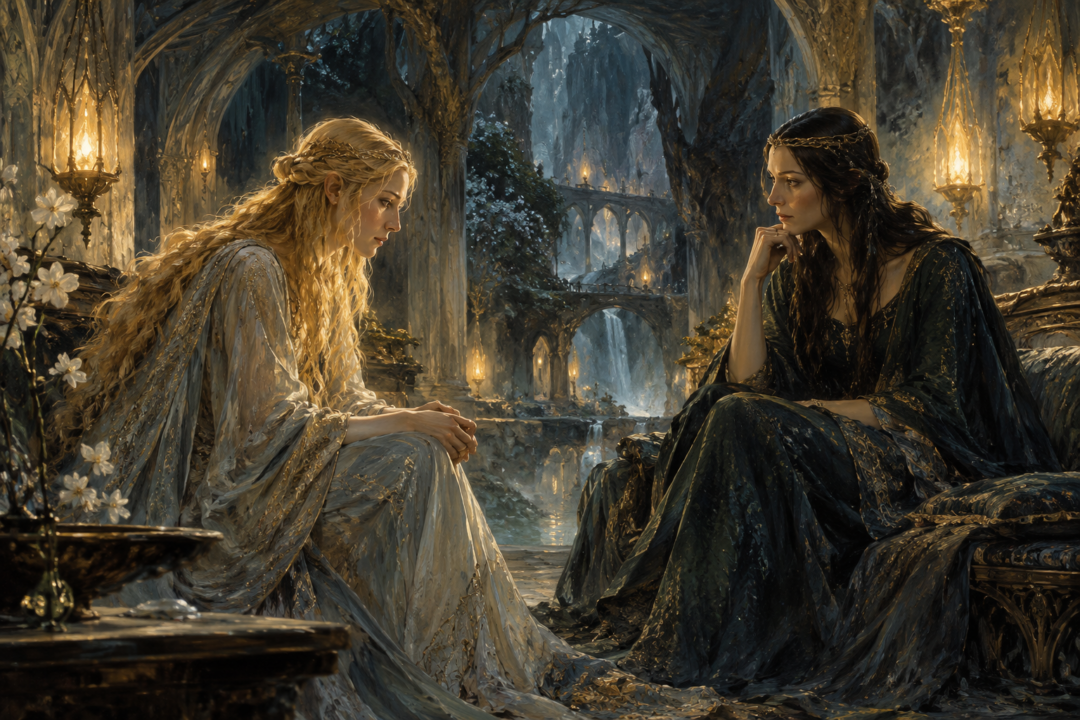
In Doriath, Galadriel faces a question far more dangerous than any demand for names or dates. Melian wants to know why the Noldor truly returned to Middle-earth.
Galadriel does not lie to her.
That is what makes the scene so revealing.
She admits that the Noldor came from Aman against the will of the Valar. She speaks of Morgoth, the Silmarils, and the murder of Finwë. She acknowledges vengeance as part of their purpose. Yet she stops before the facts that would most radically change how Thingol viewed his powerful new relatives: the Oath of Fëanor, the Kinslaying at Alqualondë, and the burning of the stolen ships at Losgar.
Melian nevertheless understands that something terrible remains hidden.
The exchange in The Silmarillion, in “Of the Noldor in Beleriand,” is brief, but it exposes one of the First Age’s most consequential forms of secrecy. Galadriel gives Melian enough truth to explain the rebellion of the Noldor while withholding the bloodshed within that rebellion.
For a time, that silence protects her kin. But it also leaves Thingol without information he will later consider decisive.
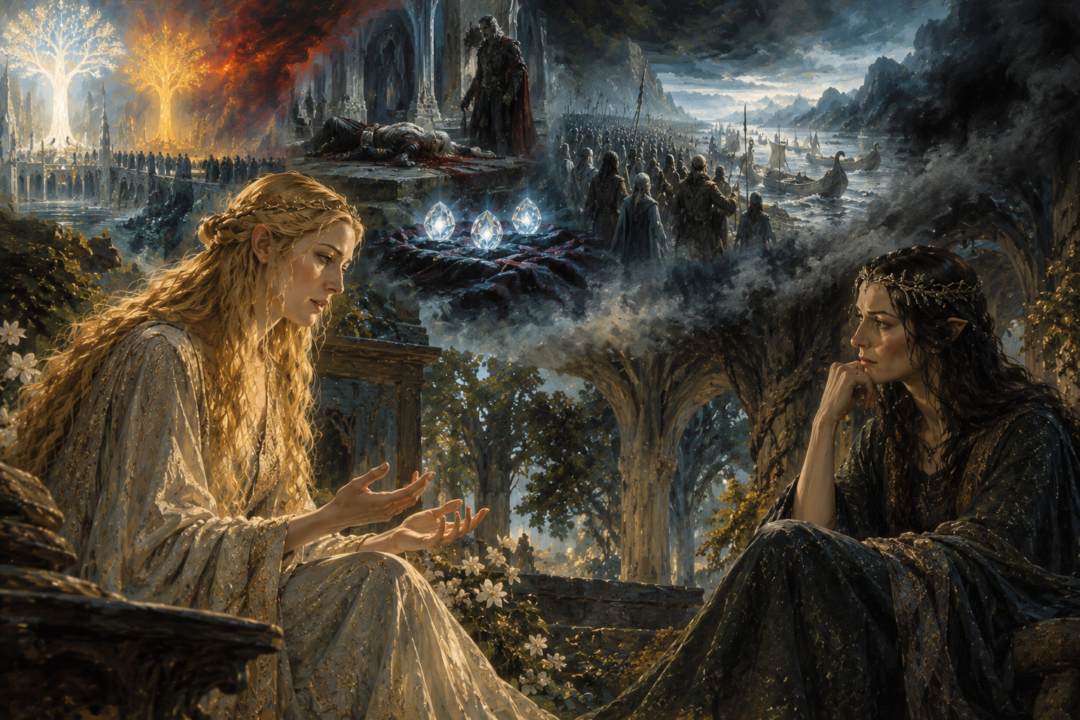
Galadriel’s Silence Begins Before Her Confession
Galadriel is living in Doriath while Finrod establishes Nargothrond. There she develops a close relationship with Melian, the Maia who is Thingol’s queen.
Their conversations repeatedly return to Valinor.
Yet Galadriel has a boundary. She will speak of the bliss of the Blessed Realm, but when the story reaches the destruction of the Two Trees, she falls silent.
Melian notices.
This matters because Melian cannot simply reconstruct the missing history through supernatural sight. She tells Galadriel that a shadow lies over Aman and that what happened in the West is hidden from her perception. What she can perceive is the burden carried by Galadriel and her people.
She therefore asks.
Galadriel’s first response is not a fabricated story. She says, in effect, that the grief belongs to the past and that she would rather preserve what joy remains than disturb it through memory.
That answer reveals something important about the whole conversation. Galadriel is not merely withholding intelligence from a foreign ruler. The subject is personally painful, politically dangerous, and entangled with her own family.
But Melian does not accept silence as evidence that the past no longer matters.
Melian Has Already Detected the Problem
Melian reasons from what she has actually observed.
The Noldor have appeared in Middle-earth at an extraordinarily convenient moment, bringing great strength against Morgoth. Yet they do not behave like emissaries sent by the Valar. Their lords carry no message to Thingol from Manwë, Ulmo, or even from Olwë, Thingol’s brother and lord of the Teleri in Aman.
Something does not fit.
Melian therefore presses Galadriel on two connected questions: whether the Noldor were driven out as exiles and what evil lies upon the sons of Fëanor.
Her suspicion is remarkably close to the concealed truth without yet identifying the Kinslaying itself.
That forces Galadriel to choose how much to disclose.
And here the precision of her answer becomes crucial.
Galadriel Admits the Rebellion
Galadriel corrects Melian on one point: the Noldor were not simply driven out.
They departed by their own will and against the will of the Valar.
That is an enormous admission.
Galadriel is no longer allowing the arrival of the Noldor to remain wrapped in the impression that they came west-to-east as authorized helpers. She openly acknowledges rebellion and defiance. She also says that they crossed through great peril in order to take vengeance on Morgoth and recover what he had stolen.
She then explains the Silmarils and the murder of Finwë at Formenos.
Taken together, these facts create a coherent account of the Flight of the Noldor. Morgoth murdered their king, stole Fëanor’s jewels, and fled to Middle-earth. The Noldor followed in defiance of the Valar, seeking vengeance and recovery of the Silmarils.
All of that is substantially true.
It is also radically incomplete.
What Galadriel Does Not Tell Her
The narrative explicitly identifies the omissions.
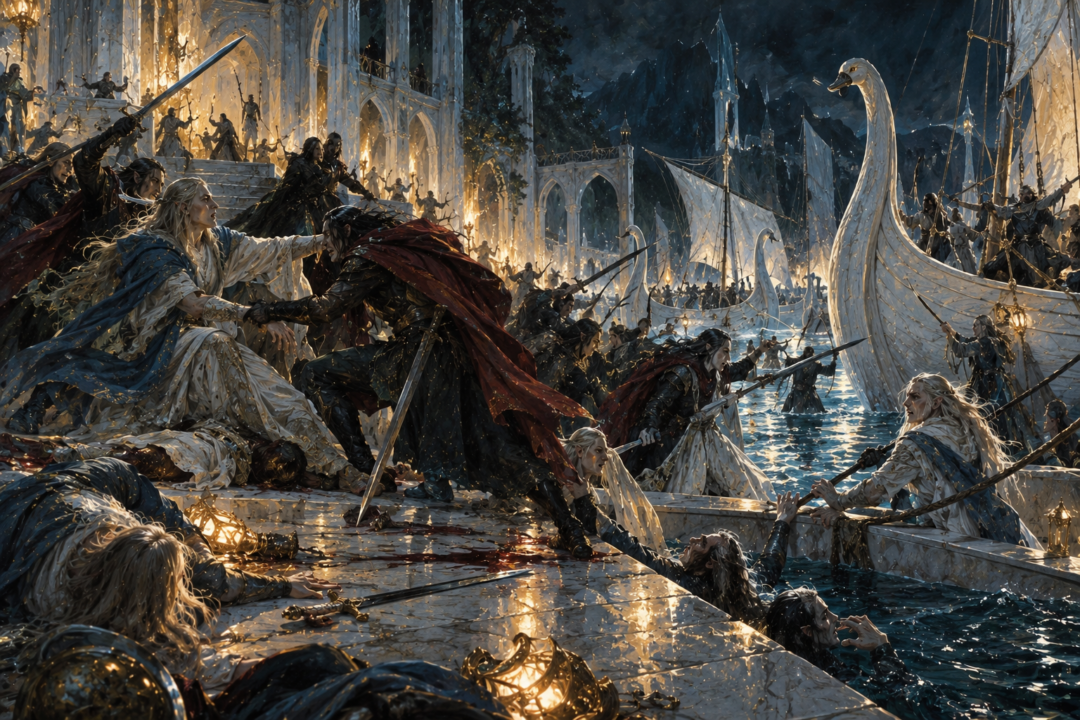
Galadriel says nothing about the Oath sworn by Fëanor and his sons. She says nothing about the Kinslaying at Alqualondë. She says nothing about the burning of the ships at Losgar.
These are not minor details.
The Oath explains why the Silmarils have become more than objects the Noldor hope to recover from Morgoth. Fëanor and his sons have bound themselves to pursue anyone who possesses or withholds a Silmaril.
Alqualondë reveals the most terrible immediate consequence of the rebellion: Elf slew Elf when the Teleri resisted the seizure of their ships.
And Losgar reveals the internal betrayal of the departing Noldor, when Fëanor burned the ships after reaching Middle-earth, leaving Fingolfin’s people behind. They eventually reached Middle-earth through the deadly crossing of the Helcaraxë.
Galadriel therefore reveals the conflict between the Noldor and the Valar while concealing the violence committed among the Eldar and the rupture within the Noldor themselves.
That distinction is central to the scene.
Why the Kinslaying Matters Especially in Doriath
Galadriel is not speaking in a politically neutral place.
Thingol is the brother of Olwë.
Olwë is the lord of the Teleri of Alqualondë.
The people killed when the Noldor seized the ships were therefore Thingol’s own people and kin in the broadest and most immediate dynastic sense. Once Thingol eventually learns what happened, the news is not simply another grim episode from distant Valinor.
It concerns his family and his people.
This is why Galadriel’s selective disclosure has such weight. Telling Melian that the Noldor defied the Valar might provoke concern. Telling her that Noldor had shed Telerin blood would introduce an entirely different question: what relationship should Thingol maintain with those involved in, associated with, or concealing that deed?
The text does not give us a private statement from Galadriel explaining her precise motive for withholding these facts. We should therefore resist assigning her a certainty the narrative does not provide.
Her reluctance to reopen past grief is explicit. Concern for her Noldorin kin is also consistent with what follows. But the exact mixture of shame, loyalty, grief, political caution, and personal responsibility behind her silence is not fully spelled out.
The omission itself, however, is explicit.

Melian Recognizes a Truth-Shaped Gap
Melian does not accuse Galadriel of speaking falsely.
Instead, she perceives that what Galadriel has revealed points toward something still concealed.
This is the most subtle moment in their exchange.
Galadriel’s account explains why the Noldor pursued Morgoth, but it does not completely explain the darkness Melian perceives around their journey. The stated facts and the moral weight surrounding them do not quite match.
Melian therefore concludes that there is evil on the road from Tirion which Thingol ought to know for his guidance.
Galadriel still refuses to be the source of that disclosure.
Her answer is essentially: perhaps—but not from me.
That refusal preserves an important distinction. Galadriel does not replace the Kinslaying with a false event. She declines to reveal it.
The scene is about selective testimony rather than a simple lie.
And Melian is perceptive enough to recognize the difference between everything she has been told and everything she needs to know.
The Secret Eventually Reaches Thingol
The silence cannot last.
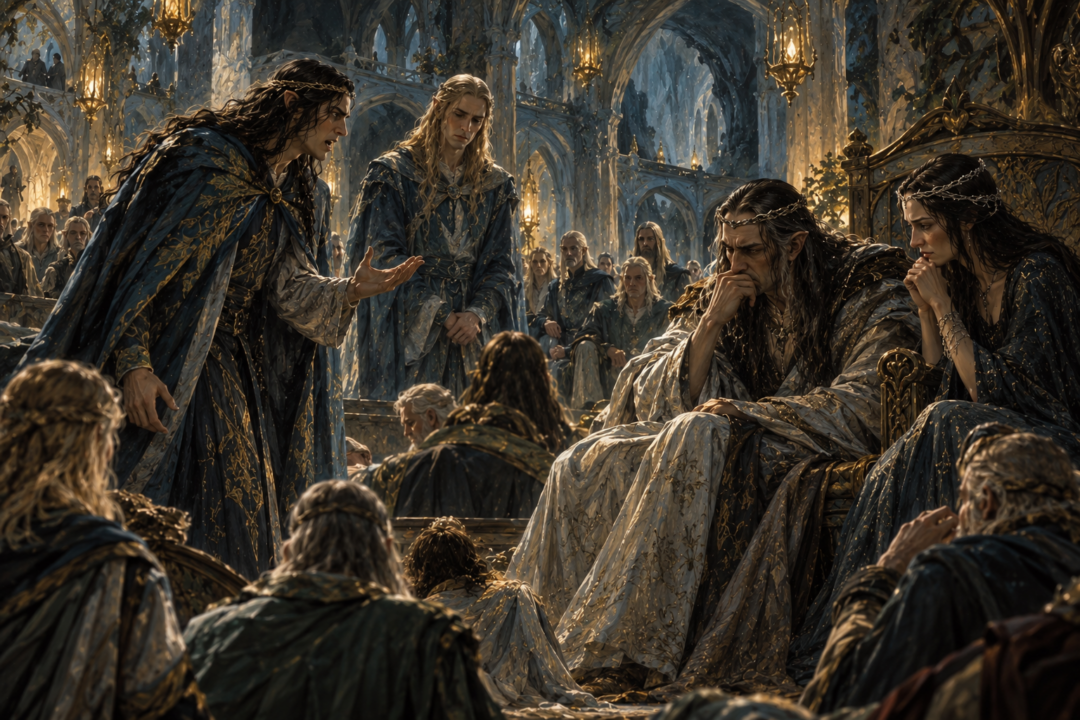
Rumours concerning the deeds of the Noldor eventually spread among the Sindar, with truth mingled with falsehood under Morgoth’s influence. Thingol confronts Finrod, demanding an explanation.
Finrod refuses to speak against the other princes of the Noldor.
Angrod does not.
In anger, Angrod tells Thingol about the bloodshed at Alqualondë, the Doom pronounced upon the Noldor, and the burning of the ships at Losgar. He also distinguishes the house of Finarfin from the chief guilt of Fëanor and his followers, pointing to the suffering endured by those who crossed the Grinding Ice.
Now Thingol possesses what Galadriel would not tell Melian.
His reaction demonstrates why the omitted information mattered.
He does not treat every Noldo as equally guilty of the Kinslaying. His anger is particularly directed against the house of Fëanor. Yet the revelation changes his relationship with the Noldor as a people, and he forbids the use of their tongue, Quenya, in his realm.
The past Galadriel hoped to leave undisturbed has become politically present.
Melian’s Warning Was About Guidance
This also clarifies Melian’s role in the earlier conversation.
She does not demand the hidden truth merely from curiosity.
She believes Thingol needs it for his guidance.
That wording captures the ethical problem created by Galadriel’s silence. The Kinslaying is not simply Galadriel’s private trauma. It is information directly relevant to a king deciding how to deal with newly arrived powers whose actions have affected his own kin.
Galadriel has understandable reasons to resist becoming an accuser of her own people. Finrod later displays a comparable unwillingness to denounce his fellow Noldorin princes before Thingol.
Yet withholding the truth has a cost.
Thingol is temporarily denied knowledge that would affect his judgment.
This does not mean that immediate disclosure would necessarily have produced peace. The First Age offers little reason for such confidence. Thingol’s anger might simply have erupted sooner.
The narrower conclusion is stronger: Melian correctly recognizes that the concealed history has consequences for Doriath.
The Tragedy of Galadriel’s Selective Honesty
Galadriel’s conversation with Melian is powerful precisely because it resists an easy moral category.
She tells the truth.
She also withholds the truth.
She admits that the Noldor departed voluntarily against the will of the Valar. She identifies vengeance and the Silmarils as causes of their coming. She reveals Finwë’s murder.
But she stops before the Oath, Alqualondë, and Losgar.
For a time, that protects the Noldor from the consequences of full disclosure in Doriath. It also protects Galadriel from becoming the person who exposes the darkest deeds of her own kindred.
Melian sees the problem anyway.
She cannot see through the shadow covering Aman, but she can recognize the shape of an omission. Galadriel’s explanation accounts for the journey without accounting for all the darkness surrounding it.
And that is the deeper tragedy of the scene.
The past does not become harmless merely because it remains unspoken.
In Beleriand, the Noldor have crossed the sea hoping to confront Morgoth and build new realms. Yet they have brought more than armies, memories, and ancient skill out of the West. They have brought unresolved guilt, divided loyalties, and secrets whose consequences now belong to people who did not choose them.
Galadriel can decide that the Kinslaying will not be revealed by her.
She cannot decide that it will cease to matter.
Sources & Notes
- Silmarillion Writers' Guild — Melian, Part 2: Galadriel's withheld history and Melian's counsel https://www.silmarillionwritersguild.org/node/4425
- The Thain's Book — Galadriel: rebellion, residence in Doriath, and the concealed Kinslaying https://thainsbook.minastirith.cz/galadriel.html
- The Thain's Book — Doriath and Menegroth: Thingol, the Noldor, and the Quenya ban https://thainsbook.minastirith.cz/doriath.html
Primary passage: The Silmarillion, “Of the Noldor in Beleriand.” The linked commentaries support the exchange with Melian and Thingol’s later response; interpretations of Galadriel’s motives remain interpretations.