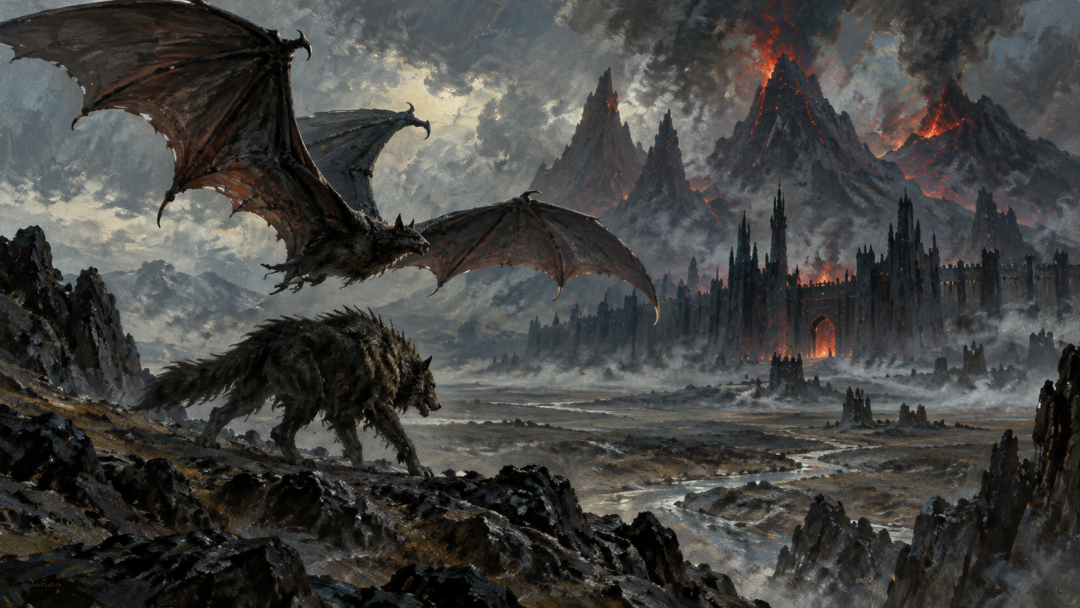
At the gates of Angband, where Morgoth guarded the Silmarils beneath the mountains of Thangorodrim, Lúthien faced a problem that courage alone could not solve. How could an Elven princess and a mortal Man approach the greatest fortress of the Enemy without being destroyed before reaching its master?
The answer lay partly in something deeply unsettling: Lúthien would approach Morgoth’s stronghold wearing the appearance of one of his own servants.
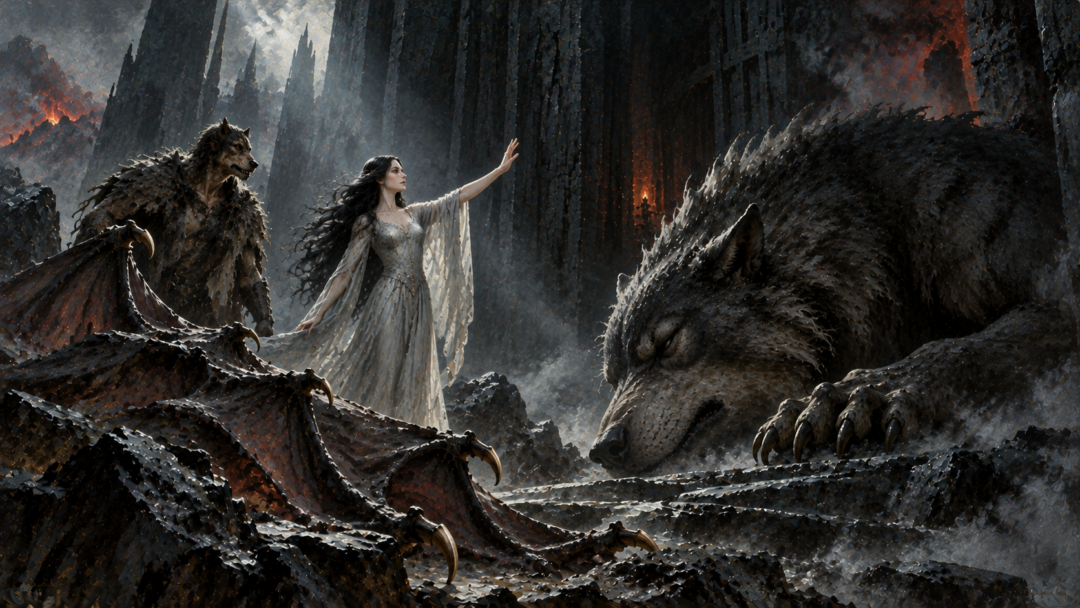
Her disguise was the winged form of Thuringwethil, Sauron’s vampire messenger, a creature accustomed to travelling between the Enemy’s strongholds. Beside her, Beren would assume the likeness of Draugluin, a dreadful werewolf formerly in Sauron’s service.
This was more than an attempt to look frightening. It was a way of making two intruders resemble creatures that belonged to Morgoth’s world.
The remarkable detail is that Lúthien did not need to invent an entirely new identity. She borrowed one already associated with the Enemy’s communications.
Although the texts describe no formal recognition system at Angband, the disguises suggest a powerful tactical principle: a familiar servant of darkness might approach places where an obvious enemy would immediately invite attack.
Yet that advantage had limits. The very defenses they hoped to deceive would eventually force Lúthien to reveal herself.
Thuringwethil Was Not an Ordinary Creature of Darkness
Thuringwethil appears only briefly in the surviving account of the Elder Days, but her role is unusually important.
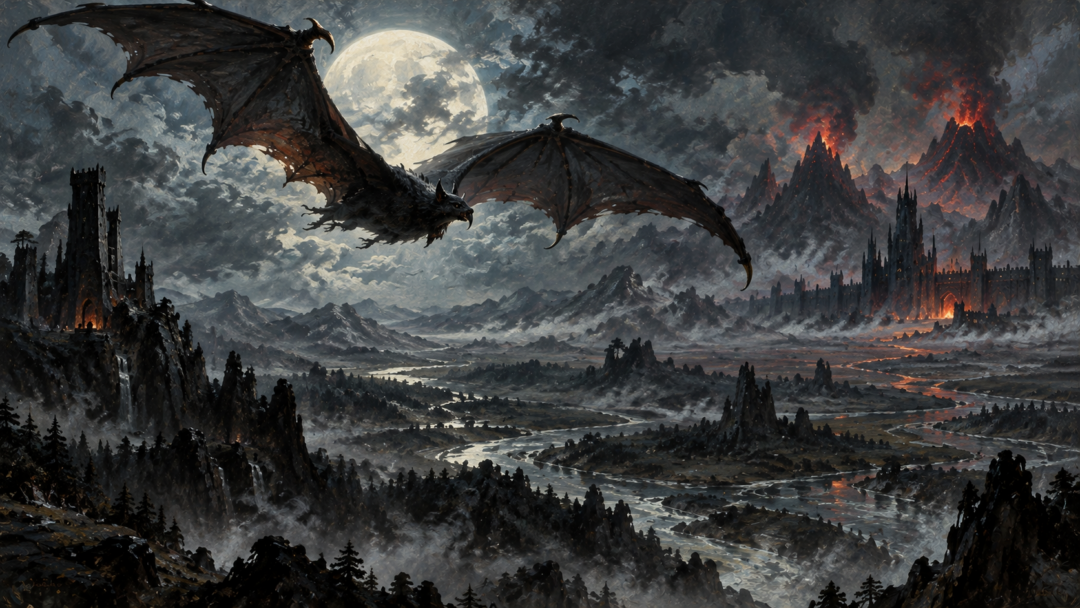
In The Silmarillion, she is identified as a messenger of Sauron who travelled to Angband in vampire form. Her appearance was that of a great bat-like creature, with fingered wings bearing iron claws at their joints.
Her name means “Woman of Secret Shadow.”
The precise nature of her being is not fully explained. The narrative establishes her shape and her service to Sauron, but it does not provide a complete account of her origin or powers.
What matters for Lúthien’s mission is her function.
Thuringwethil was not merely a monster inhabiting the wilderness. She served as a messenger between powers within Morgoth’s dominion.
That distinction gives her appearance a particular significance.
A strange creature approaching Angband might be treated as a threat. A creature resembling a known messenger of Sauron could, at least initially, fit an established pattern of movement between the Enemy’s servants.
This does not mean Thuringwethil possessed unrestricted access to Morgoth’s halls. No such privilege is explicitly described.
But her accustomed journeys to Angband make her form a plausible choice for anyone attempting to approach the fortress without appearing immediately hostile.
Lúthien’s disguise exploited that possibility.
Why an Enemy Messenger Was the Perfect Identity to Borrow
Angband was not simply a fortress filled with creatures attacking everything that moved.
It was the centre of Morgoth’s power, connected to subordinate strongholds, commanders, spies, and servants operating throughout Beleriand.
Sauron himself held Tol-in-Gaurhoth, the Isle of Werewolves, until his defeat by Huan and Lúthien. Thuringwethil’s journeys demonstrate that communication existed between Sauron’s domain and Angband.
This creates an important distinction between two kinds of approach.
An Elf travelling openly toward Angband would have no convincing reason to be welcomed. An apparent servant of Sauron, however, would resemble someone whose presence might be expected.
The phrase “recognition system” is useful here as an interpretation, not as a literal institution described in the story.
There is no evidence of passwords, written permissions, designated checkpoints, or a formal process for admitting messengers.
Instead, the relevant mechanism is recognition through appearance and association.
Thuringwethil’s form could suggest allegiance before any explanation was offered.
Her wings, monstrous proportions, and unmistakably sinister character all belonged to the visual language of Morgoth’s servants.
Lúthien therefore turned the Enemy’s own frightening appearance into a means of concealment.
The disguise did not make her safe. It made her presence less obviously impossible.
Huan’s Counsel and the Two Disguises
The decision to use these forms came through Huan, the great hound who had already helped Lúthien overcome Sauron.
After Beren and Lúthien were reunited near the borders of Angband, Huan counselled them concerning the perilous road ahead.
He could not accompany them to the final confrontation, but he provided the means by which they might continue.
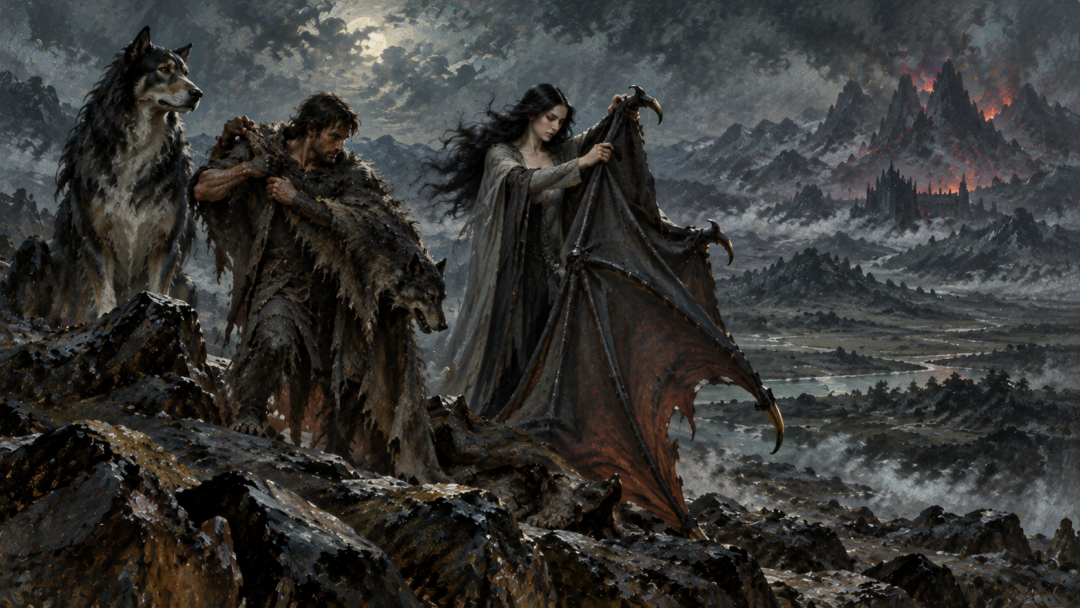
Through his counsel and Lúthien’s arts, Beren was arrayed in the hide of Draugluin, while Lúthien assumed the winged covering of Thuringwethil.
Draugluin had been a powerful werewolf serving Sauron. He had been mortally wounded by Huan during the struggle at Tol-in-Gaurhoth.
The account describes Beren’s resulting appearance as remarkably convincing. He looked like a werewolf, though the spirit visible in his eyes remained different from the evil creature whose shape he wore.
Lúthien appeared as a bat-like being beside him.
Together, the two disguises created a coherent image: a dreadful wolf and a winged creature associated with Sauron’s service.
This pairing mattered.
Had Beren approached Angband openly as a Man, he would have stood out immediately. Had Lúthien appeared openly as an Elf of Doriath, her presence would have been equally extraordinary.
Instead, they resembled beings drawn from the Enemy’s own world.
The tale does not explicitly say that guards identified them as Draugluin and Thuringwethil during the journey. It does, however, establish that they travelled through great dangers in these forms before reaching Angband.
The disguises offered concealment during an approach that would otherwise have been extraordinarily exposed.
Crossing Anfauglith Without Declaring Their Purpose
The road toward Angband led across the desolation of Anfauglith, the vast northern waste created after Morgoth’s destruction of Ard-galen.
This was no friendly wilderness in which Beren and Lúthien could hope to find shelter among allies.
They were moving toward the heart of hostile power.
The narrative does not catalogue every danger they encountered. It describes their passage through perils before their arrival at the gate.
That absence of detail is important.
We should not imagine a series of documented guard posts where Thuringwethil’s identity was checked and accepted. Such scenes are not given.
Nevertheless, the disguises help explain how the pair could attempt such a journey without relying solely upon combat.
Their objective was not to defeat Morgoth’s armies on the road. It was to reach the place where the Silmarils were held.
Every confrontation avoided preserved the possibility of success.
A disguise that made them resemble servants of darkness could reduce the need to challenge every enemy they encountered.
This is the central tactical value of Thuringwethil’s form.
It offered a plausible appearance within hostile territory, allowing Lúthien to approach the fortress as something other than an unmistakable intruder.
But the closer they came to Morgoth, the more dangerous that borrowed identity became.
Carcharoth Reveals the Limits of the Deception
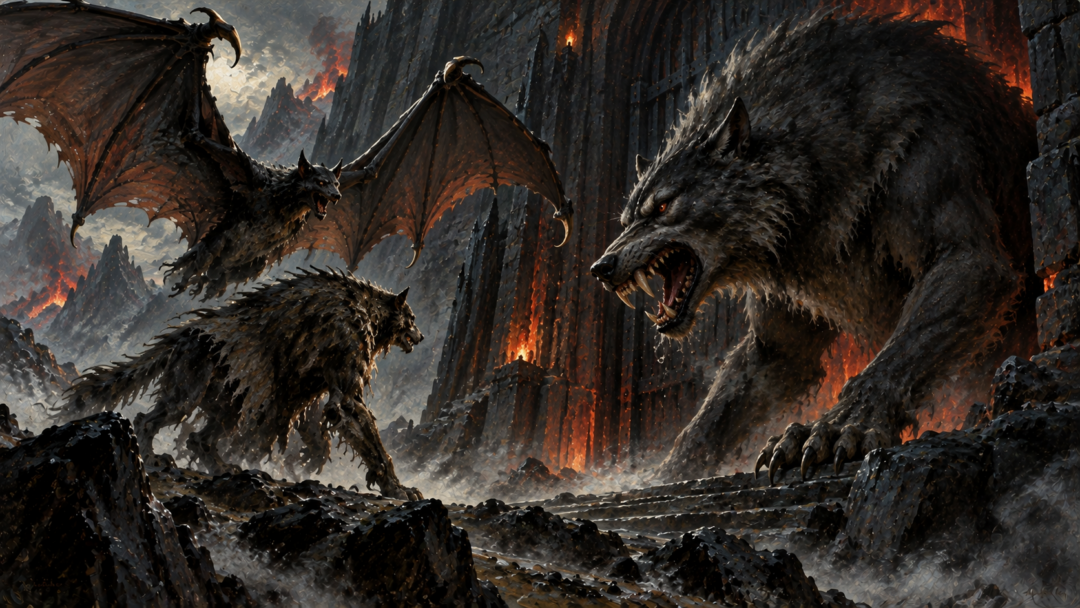
At Angband’s entrance stood Carcharoth, the enormous wolf whom Morgoth had raised to guard his doors.
Here the strategy encountered its decisive limitation.
Carcharoth was no ordinary beast. Morgoth had nourished and empowered him, making him a terrible guardian.
The account indicates that news of Draugluin’s death had reached Angband. Consequently, the appearance of a creature resembling the dead werewolf aroused suspicion.
This detail changes how the entire disguise should be understood.
The Enemy’s servants were not necessarily fooled by appearance alone.
Information could travel through Morgoth’s domain, and a familiar shape might become suspicious when it contradicted what the guardian knew.
Beren’s disguise therefore carried an unexpected danger: the more recognizable Draugluin was, the more troubling his apparent return could seem.
The presence of Thuringwethil’s form did not solve this problem.
Carcharoth barred their passage.
At that moment, Lúthien did not obtain entry by continuing to impersonate Sauron’s messenger.
She cast aside her disguise, revealed herself, and exercised a power that overcame the guardian, commanding him to sleep.
Only then could Beren and Lúthien pass through the gate.
This distinction is essential.
The disguise helped them approach Angband. It did not automatically defeat its final defense.
The story therefore presents concealment and supernatural power as separate stages of their success.
The Deeper Irony of Wearing the Enemy’s Shape
There is something particularly striking about Lúthien’s choice.
She was the daughter of Thingol, King of Doriath, and Melian, a Maia whose power protected that realm.
Yet to reach Morgoth, she clothed herself in the appearance of a creature serving Sauron.
Her disguise placed the outward image of darkness over someone whose purposes opposed the Enemy completely.
Beren underwent a similar reversal.
His werewolf appearance concealed a mortal Man who had endured suffering and loss through Morgoth’s wars.
The contrast is especially clear in the description of his eyes. His outward form resembles Draugluin, but his inner nature is not transformed into that of a servant of evil.
The disguises therefore separate appearance from allegiance.
In Morgoth’s dominion, terrifying forms ordinarily signify the power of the Enemy. Lúthien temporarily uses those forms against him.
One reading is that the episode exposes a weakness in a realm built upon fear and monstrous obedience: its familiar symbols of power can be imitated.
The appearance that normally announces loyalty can conceal resistance.
But this is a thematic interpretation rather than a statement that Morgoth’s servants universally trusted one another.
Indeed, Carcharoth’s suspicion demonstrates the opposite.
The deception was useful precisely because it could work for part of the journey without being reliable everywhere.
Why the Disguise Cannot Explain Morgoth’s Defeat
After passing Carcharoth, Beren and Lúthien descended into Angband and eventually came before Morgoth.
Their success inside his halls involved powers beyond disguise.
Lúthien’s appearance as Thuringwethil did not compel Morgoth to accept her as a messenger.
In the published Silmarillion account, her concealment is stripped away before the decisive enchantment. She then sings and dances before Morgoth, bringing sleep upon his court and finally upon the Dark Lord himself.
Beren, meanwhile, remains concealed in the werewolf’s shape until the moment comes to act.
The distinction becomes even clearer when different versions of the legend are considered.
In the poetic Lay of Leithian, Morgoth directly challenges Lúthien’s assumed identity. The exchange emphasizes that her disguise cannot withstand his scrutiny.
The precise presentation differs between versions, but neither supports the idea that Thuringwethil’s appearance alone defeated Morgoth’s vigilance and power.
The disguise enabled the approach. Lúthien’s enchantment made the taking of the Silmaril possible.
Beren then used Angrist to cut a jewel from Morgoth’s Iron Crown.
The mission succeeded through several distinct acts of courage, concealment, and power, not through one perfect deception.
What Thuringwethil’s Form Really Accomplished
Thuringwethil’s appearance was valuable because it belonged to the Enemy’s own world.
She had served as Sauron’s messenger and travelled to Angband. Her monstrous form therefore carried an association with the movements and purposes of Morgoth’s servants.
By assuming that appearance, Lúthien gained a kind of plausible identity for the dangerous journey north.
It was not a guaranteed passage, nor a magical permission to cross every threshold.
Carcharoth’s challenge proves that recognition could become suspicion. Morgoth’s later confrontation with Lúthien shows that concealment could not substitute for her deeper power.
Yet the disguise had already served its purpose by helping bring the two companions to the very place where the impossible deed could be attempted.
That is the overlooked brilliance of the episode.
Lúthien did not have to conquer the outer reaches of Angband by force. She approached them wearing a shape associated with those who already served the fortress.
The Enemy’s own familiar forms became the covering beneath which his greatest adversaries advanced.
And beneath the iron-clawed wings of Thuringwethil was not another messenger carrying news to Morgoth, but Lúthien herself, coming to take a Silmaril from his crown.
Sources & Notes
- Silmarillion Writers’ Guild — Oshun, ‘Thuringwethil’: a text-referenced biography covering Sauron’s messenger, her winged disguise, and the distinction between the published Silmarillion and the Lay of Leithian. https://www.silmarillionwritersguild.org/reference/characterofthemonth/thuringwethil.php
- Ardapedia — ‘Thuringwethil’ (German): summarizes the messenger’s bat form and Lúthien’s disguise, with references to The Silmarillion, chapter 19, and The Lays of Beleriand. https://www.ardapedia.org/wiki/Thuringwethil
- Valar Guild Tolkien Encyclopedia — Irmo, ‘Huan’: traces Huan’s recovery of Draugluin’s wolf-hame and Thuringwethil’s bat-fell, Carcharoth’s recognition of the dead Draugluin, and Lúthien’s spell at the gate, citing The Silmarillion and The Lays of Beleriand. https://valarguild.org/tolkien/encyc/articles/h/Huan/HuanI.htm
The narrative basis is Tolkien’s The Silmarillion, ‘Of Beren and Lúthien’; the linked references also discuss The Lays of Beleriand. ‘Recognition system’ is an interpretation of the disguises, not a named institution in Tolkien’s text. Thuringwethil’s precise nature and the circumstances of her death are not explicitly established.