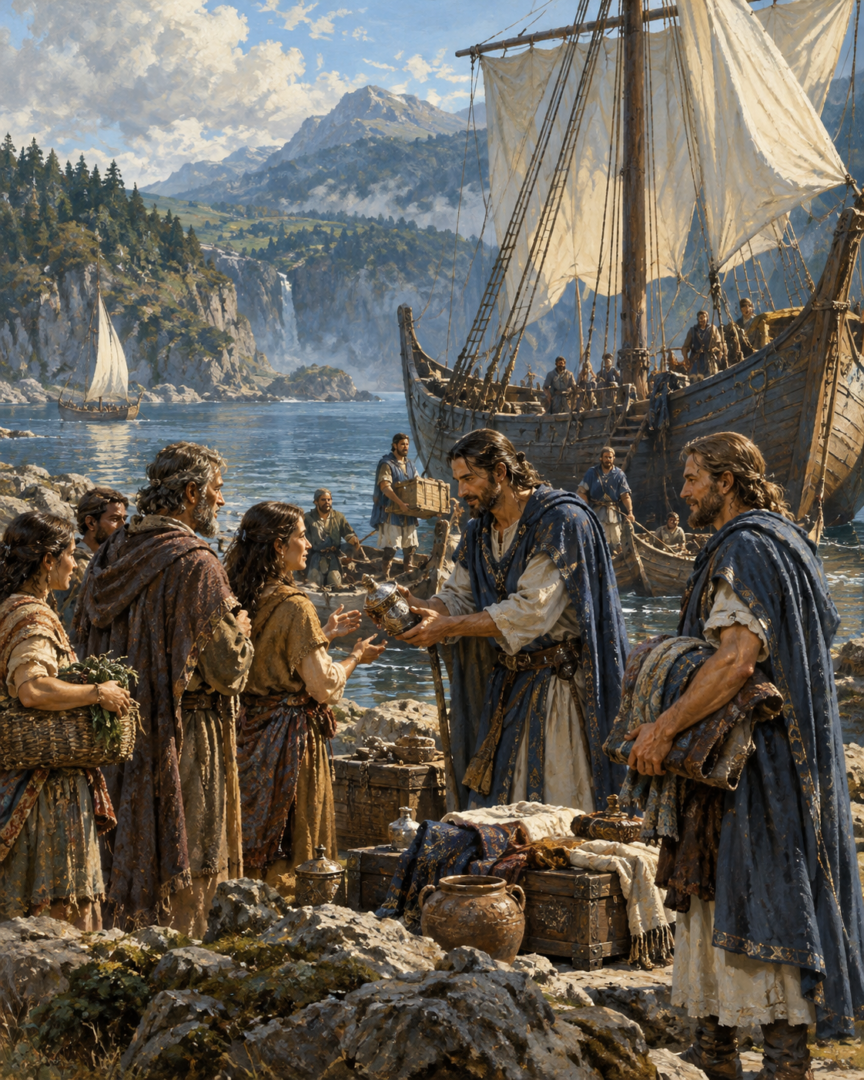
The ships of Númenor once brought friendship to the shores of Middle-earth. Their mariners crossed the Great Sea carrying knowledge, skills, and goods from a kingdom whose people had been granted extraordinary prosperity after the defeat of Morgoth.
Yet centuries later, ships from that same island kingdom returned to Middle-earth for a very different purpose.
They came seeking wealth, demanding tribute, and establishing dominion over coastal peoples.
The transformation was not simply a matter of building larger harbours or sending more ships. It represented a fundamental change in the relationship between Númenor and the lands beyond the sea.
A harbour that once connected different peoples could become an instrument of political control. Resources that might once have been exchanged could instead be demanded. Communities that had welcomed visitors could find themselves living beneath foreign authority.
The history of Númenórean ports reveals how this change unfolded—and why the consequences reached far beyond the waterfront.
The First Voyages: When Númenor Came as a Friend
The earliest Númenórean voyages to Middle-earth belonged to an age of exploration and renewed contact.
In the Second Age, the descendants of the Edain lived upon Númenor, the island granted to their ancestors after the wars against Morgoth.
Although their kingdom was prosperous, its people increasingly turned toward the sea.
According to the account of Númenor in Unfinished Tales, Vëantur made the first recorded voyage from Númenor back to Middle-earth in the year 600 of the Second Age. His ship reached the Grey Havens, where the Númenóreans renewed contact with the Elves.
This voyage did not establish a network of colonial ports. It marked the reopening of a connection that had been interrupted by the destruction of Beleriand and the departure of the Edain.
As Númenórean voyages became more frequent, their sailors also encountered the mortal inhabitants of Middle-earth.
The Akallabêth describes the earlier Númenóreans as visitors who helped and taught the peoples they encountered.
Their superior knowledge of crafts, agriculture, and other arts could benefit communities whose circumstances were far less fortunate than those of the island kingdom.
The surviving narratives do not provide a complete commercial history of these encounters. We cannot reconstruct exact cargo lists, prices, or formal trading agreements.
Nevertheless, the early relationship was fundamentally different from the imperial domination that developed later.
The Númenóreans were not yet generally presented as conquerors demanding submission.
That distinction matters because the later transformation was not inevitable from the first landing.
Aldarion and the First Warning Signs
The story becomes more complicated during the voyages of Aldarion, the great mariner who eventually became king.
Aldarion understood that distant voyages required more than courage and skilled navigation.
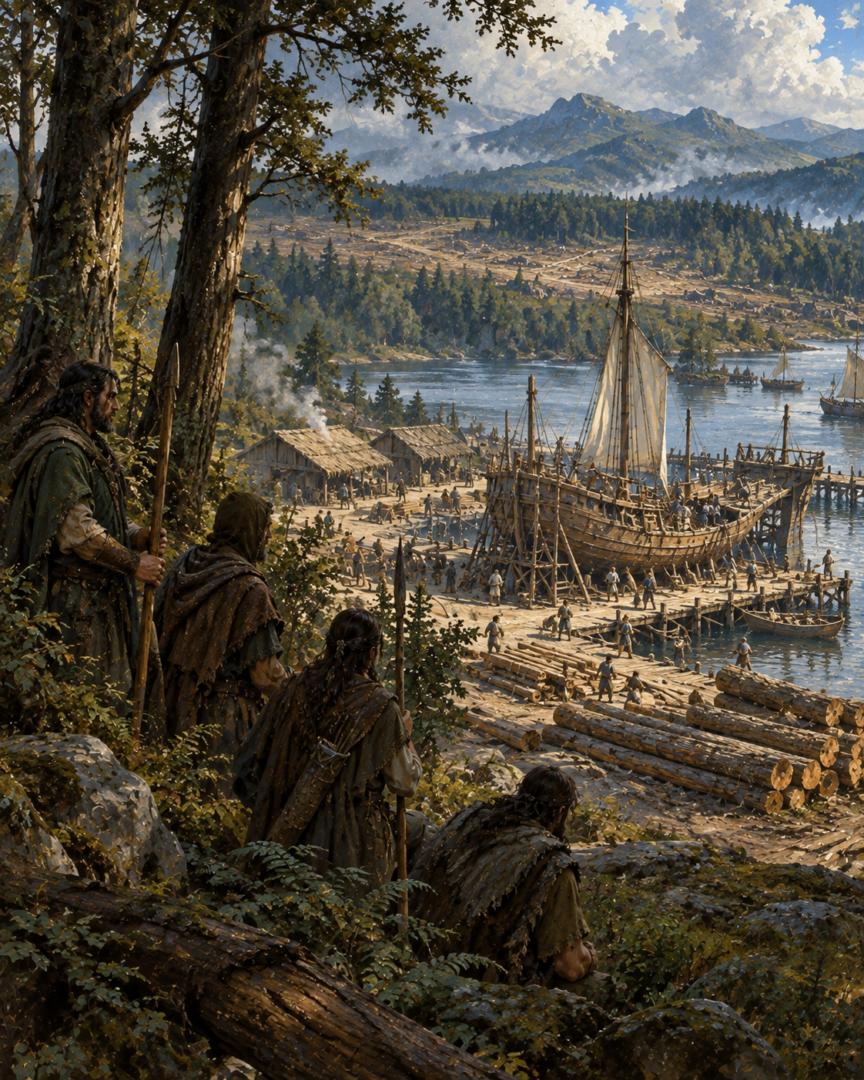
Ships needed repairs. Crews needed reliable places to land. Timber was essential for building and maintaining the growing Númenórean fleet.
At the mouth of the Gwathló, Aldarion established Vinyalondë, the New Haven.
This harbour was an important development because it gave Númenórean mariners a practical base on the mainland.
But Vinyalondë also revealed a tension that would become increasingly significant.
The surrounding forests provided valuable timber, and Númenórean shipbuilding created growing demands upon them.
The account of the Gwathló region in Unfinished Tales describes the destructive consequences of extensive tree-felling and the hostility that developed between the Númenóreans and the indigenous forest-dwellers.
The local inhabitants depended upon a landscape that the newcomers increasingly treated as a source of shipbuilding materials.
This was not yet the fully developed tribute system of later centuries.
Aldarion's haven should not be treated as though it already possessed the political character of the later imperial strongholds.
Nevertheless, it demonstrates an important practical problem.
A coastal station could serve the needs of visiting mariners while imposing serious costs upon the people living nearby.
Even before explicit imperial tribute became central to Númenórean policy, the unequal demands of maritime expansion could produce conflict.
From Temporary Havens to Permanent Settlements
As the Second Age progressed, Númenórean activity on the mainland became increasingly permanent.
The chronology preserved in The Lord of the Rings, Appendix B, places the beginning of permanent Númenórean havens around the year 1200 of the Second Age.
This development changed what a harbour could represent.
A temporary landing place primarily supported visiting ships.
A permanent haven could support continuing settlement, shipbuilding, storage, defence, and sustained contact with surrounding territories.
Such functions did not automatically make every settlement oppressive.
Indeed, Númenórean maritime power later played a crucial role in resisting Sauron.
When Sauron invaded Eriador, the forces sent by Tar-Minastir helped the Elves defeat his armies in the war of the late seventeenth century of the Second Age.
The western harbours were therefore strategically important as well as economically useful.
Yet permanent settlements also created the conditions for a different relationship with Middle-earth.
A visiting ship could depart.
An established foreign stronghold could remain, command territory, and support further expansion.
The surviving texts do not describe every stage by which individual havens acquired these functions. Nor do they establish a single date when all Númenórean ports changed their purpose.
The transformation was gradual, uneven, and closely connected to changes within Númenor itself.
The Turning Point: Wealth Became a Demand
The decisive change appears in the accounts of Númenor's growing pride and dissatisfaction.
During the reigns of Tar-Ciryatan and Tar-Atanamir, Númenórean power in Middle-earth increasingly became associated with the pursuit of wealth and the exaction of tribute.
The Akallabêth connects this development with the kingdom's spiritual decline.
The Númenóreans possessed long lives, extraordinary abilities, and immense prosperity. Yet many became increasingly troubled by the knowledge that they remained mortal.
Their desire for greater power and lasting possessions grew alongside their resentment of the limits placed upon them.
The western lands were forbidden to them, but Middle-earth lay open to their ships.
There, Númenórean strength could be exercised over peoples who lacked comparable maritime and military power.
Under Tar-Ciryatan and Tar-Atanamir, the extraction of wealth from Middle-earth became a prominent feature of royal policy.
The difference between trade and tribute is essential.
Trade involves an exchange between parties, although their bargaining power may be unequal.
Tribute is a payment demanded because one party possesses authority or coercive power over another.
A ship carrying goods obtained through exchange and a ship carrying wealth collected as tribute might look similar from a distance.
But the relationships behind those cargoes were profoundly different.
One depended upon negotiated transactions.
The other could depend upon submission.
What Changed Inside a Tribute Harbour?
The surviving texts do not provide detailed administrative descriptions of Númenórean tribute collection.
There are no established schedules of harbour taxes, standardized tribute rates, or surviving accounts showing how individual coastal settlements organized their revenues.
Nevertheless, the broader consequences can be examined without inventing those details.
A harbour serving reciprocal exchange connected local production with maritime commerce.
People might bring goods to the coast because they expected something in return.
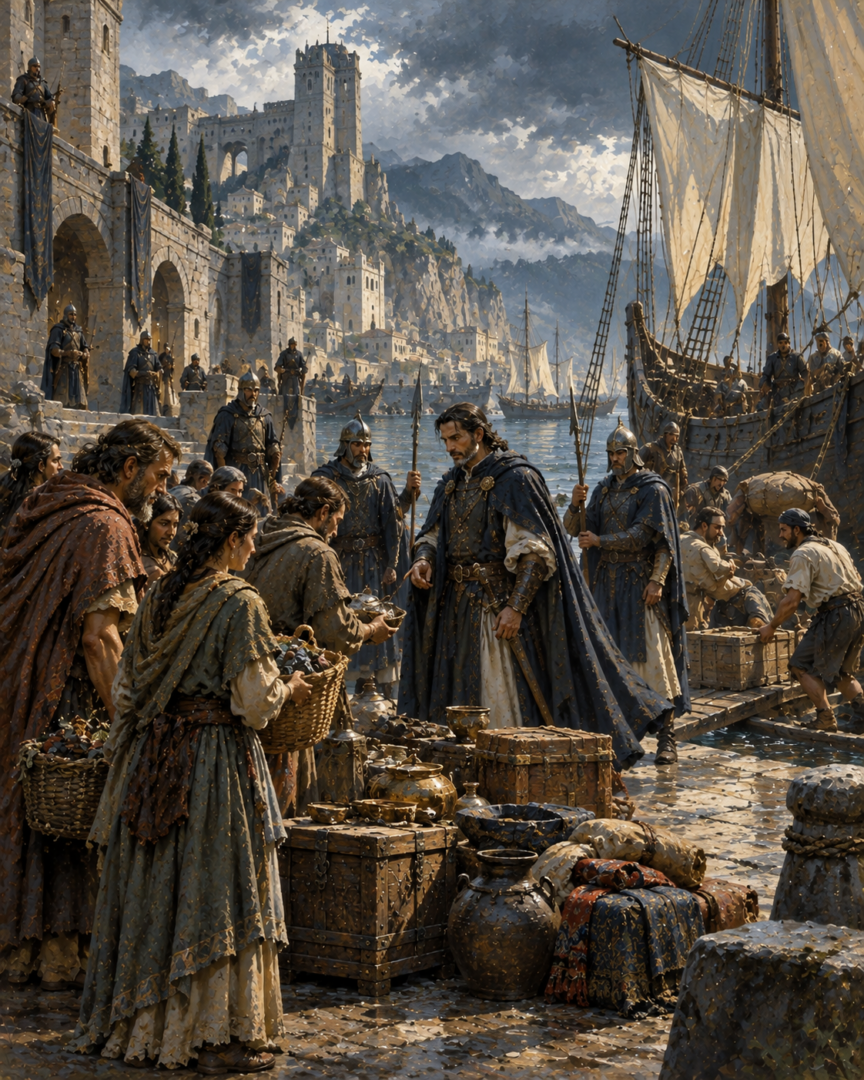
A harbour serving imperial tribute had another possible function: gathering wealth demanded by an outside power and transferring it across the sea.
This distinction changed the economic meaning of the settlement.
The needs of Númenor could take precedence over those of the surrounding population.
Local resources might be directed toward foreign demands rather than local exchange or consumption.
The Akallabêth specifically associates later Númenórean activity with the accumulation of wealth, while the traditions concerning their overseas expansion describe oppression and the gathering of tribute.
The texts also connect Númenórean expansion with precious metals and other riches brought from Middle-earth.
What they do not establish is a universal system in which every harbour collected the same commodities.
Nor can we confidently assign particular tribute quotas to individual settlements.
The important point is the change in obligation.
Where trade offered the possibility of mutual benefit, tribute made the demands of the stronger power central.
For coastal communities, the practical consequences could be substantial.
Wealth that might otherwise have remained within local society could be carried overseas.
The harbour became a point through which outside authority reached into the economic life of the mainland.
Timber, Labour, and the Hidden Cost of Maritime Power
The history of the Gwathló demonstrates why the economic consequences of Númenórean expansion cannot be measured only in gold and silver.
Ships themselves required enormous material resources.
Timber had to be obtained, transported, and worked.
Harbours and shipyards required construction and maintenance.
The forests of Minhiriath and Enedwaith suffered severely from Númenórean exploitation.
The associated conflict with the forest-dwellers shows that maritime prosperity could depend upon resources whose removal damaged existing communities.
This evidence concerns timber extraction rather than a documented system of timber tribute.
The distinction is important.
Not every destructive activity was necessarily organized through the same political mechanism.
But the two developments reveal a common imbalance: Númenórean demand could reshape mainland landscapes and livelihoods.
Labour was another necessary part of the system.
Forests did not become ships without workers, and wealth did not reach overseas vessels without human effort.
The texts do not allow us to reconstruct the precise labour arrangements of every Númenórean harbour.
It would therefore be misleading to describe a uniform workforce or compulsory labour system operating at all these sites.
What can be said is that permanent maritime settlements required sustained material support.
When such settlements became centres of domination, the question of who supplied that support—and under what conditions—became inseparable from their political character.
The Strongholds of the King's Men
The later division between the King's Men and the Faithful further complicates the history of Númenórean settlements.
The King's Men increasingly rejected the older friendship with the Eldar and supported the royal policies associated with Númenor's pride and estrangement.
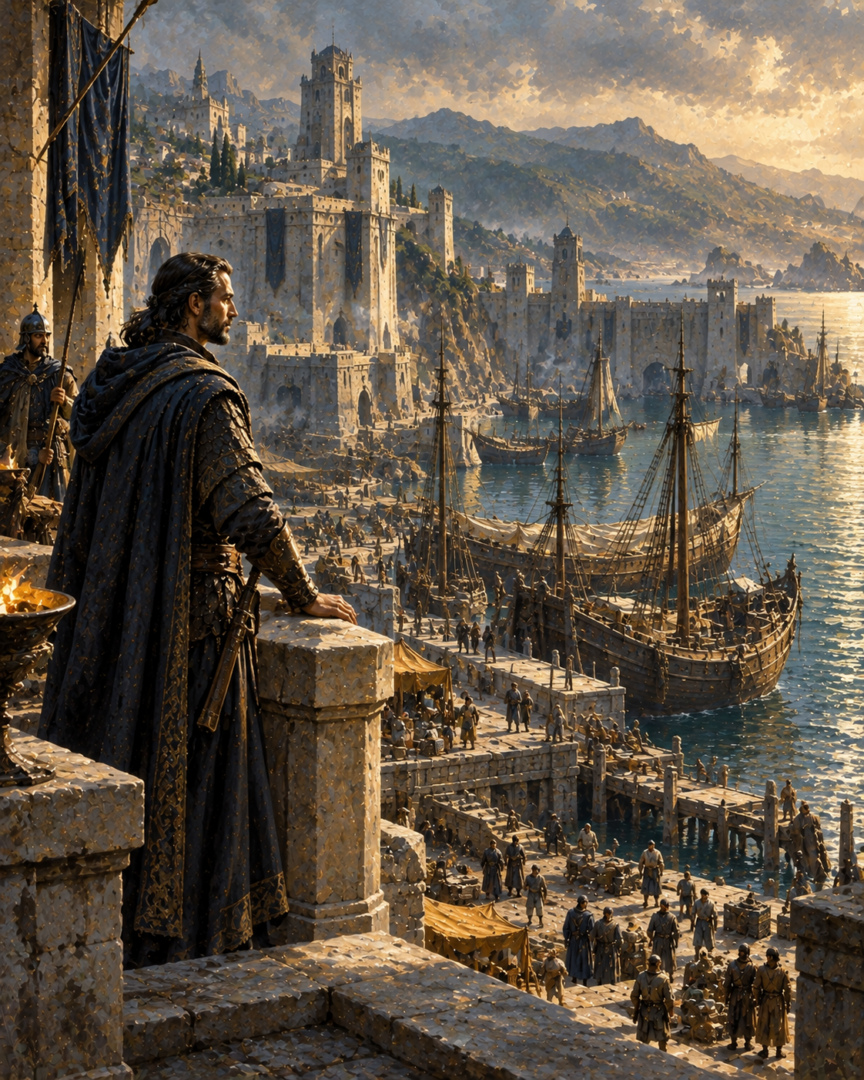
Their expansion along the coasts of Middle-earth produced powerful overseas settlements and lordships.
Umbar became one of the most important Númenórean strongholds in the south.
Its excellent harbour and strategic position made it a major centre of Númenórean power.
The wider southern expansion of the King's Men was closely associated with domination over other peoples.
Yet it would be inaccurate to assume that every Númenórean harbour followed precisely the same political path.
Pelargir provides an important contrast.
Founded in Second Age 2350, it became the chief haven of the Faithful in Middle-earth.
The Faithful maintained their allegiance to the older traditions of Númenor and their friendship with the Eldar.
Their presence demonstrates that Númenórean settlement overseas was not politically uniform.
The distinction between the King's Men and the Faithful mattered deeply, even though both belonged to the same maritime civilization.
A Númenórean harbour could be a centre of imperial ambition, a refuge for those increasingly alienated from the ruling power, or a settlement whose history changed across generations.
Geography alone did not determine its character.
Why Tribute Did Not Bring Contentment
The tragedy of Númenórean expansion is that growing material power did not resolve the dissatisfaction driving it.
The Akallabêth presents the desire for wealth and dominion as part of a larger spiritual disorder.
The Númenóreans increasingly resented mortality and the restrictions upon their freedom.
Possessions could be accumulated.
Strongholds could be established.
Other peoples could be compelled to acknowledge their superiority.
But none of these achievements could remove the limit that troubled them most.
Their lives would still end.
This gives the transformation of the harbours its deeper significance.
The overseas empire offered an answer to dissatisfaction through expansion and possession.
Yet the source of that dissatisfaction remained untouched.
The ships could bring riches home, but they could not bring immortality.
The later corruption of Númenor under Sauron's influence intensified a decline already underway. Its imperial ambitions did not begin with his arrival as a captive in the reign of Ar-Pharazôn.
By then, the kingdom had long been exercising power over the coasts of Middle-earth.
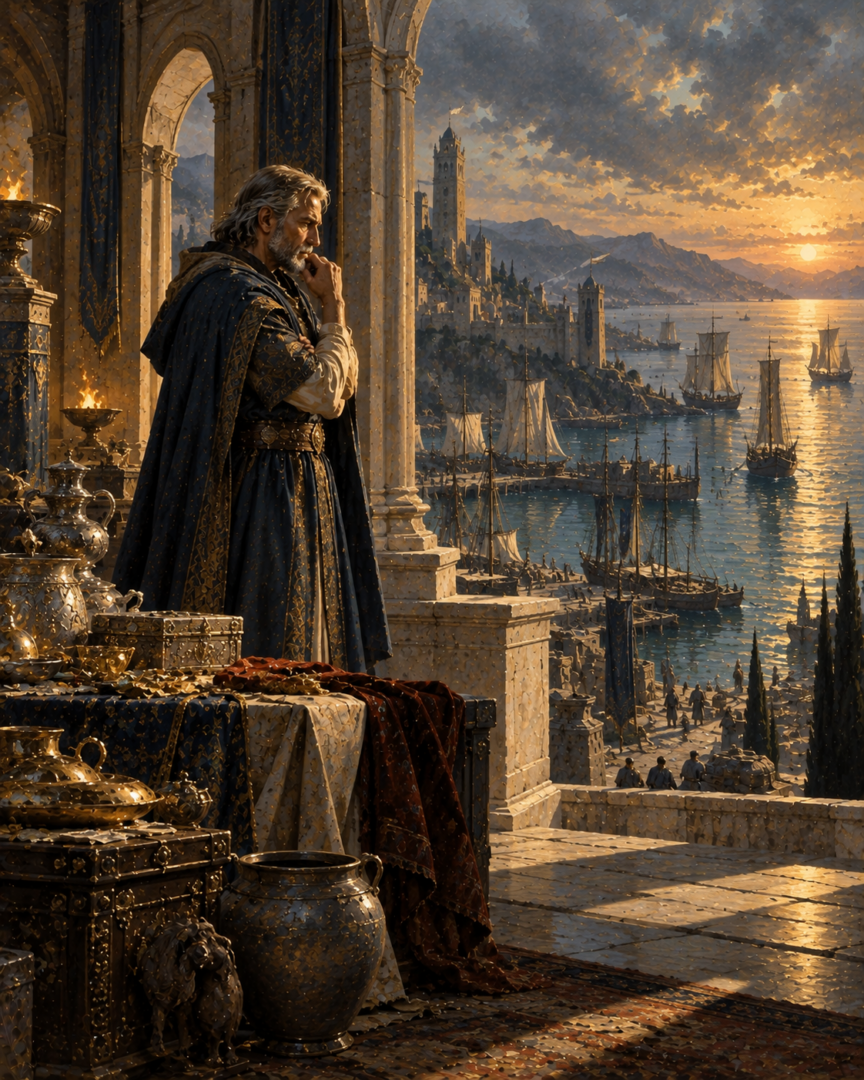
The Lasting Consequence of the Change
The shift from exchange stations to tribute centres was not a single administrative reform.
It was a transformation in the purpose of Númenórean presence overseas.
Early voyages renewed relationships and brought knowledge to Middle-earth.
Permanent havens supported navigation, shipbuilding, settlement, and military operations.
Later imperial expansion increasingly turned coastal power toward the acquisition of wealth and the domination of other peoples.
These phases overlapped, and individual settlements followed different histories.
The evidence does not justify imagining every harbour as an identical imperial institution.
But the broader direction is unmistakable.
The same maritime abilities that once allowed Númenor to reach distant peoples could also enable it to control them.
Its ships, harbours, and strongholds were not inherently instruments of oppression. Their purpose depended upon the ambitions of those who commanded them.
That is the central tragedy of the Númenórean ports.
The kingdom did not lose its extraordinary skill when its conduct deteriorated.
Its mariners remained capable. Its ships remained formidable. Its influence across the sea continued to grow.
What changed was the relationship between power and responsibility.
A harbour once associated with arrival, assistance, and exchange could become a place where wealth departed under the demands of distant rulers.
And in that change lay one of the clearest signs that Númenor's greatness was becoming something very different from the blessing it had once been.
Sources & Notes
- Tolkien Gateway — Númenóreans. https://tolkiengateway.net/wiki/N%C3%BAmen%C3%B3reans
- Tolkien Gateway — Lond Daer. https://tolkiengateway.net/wiki/Lond_Daer
- Tolkien Gateway — Tar-Ciryatan. https://tolkiengateway.net/wiki/Tar-Ciryatan
Primary text: The Silmarillion, “Akallabêth”; The Lord of the Rings, Appendix B; Unfinished Tales, “Aldarion and Erendis” and “The History of Galadriel and Celeborn,” Appendix D, “The Port of Lond Daer.” These references support early havens, timber conflict, and later tribute; they do not imply every port followed an identical administrative history.