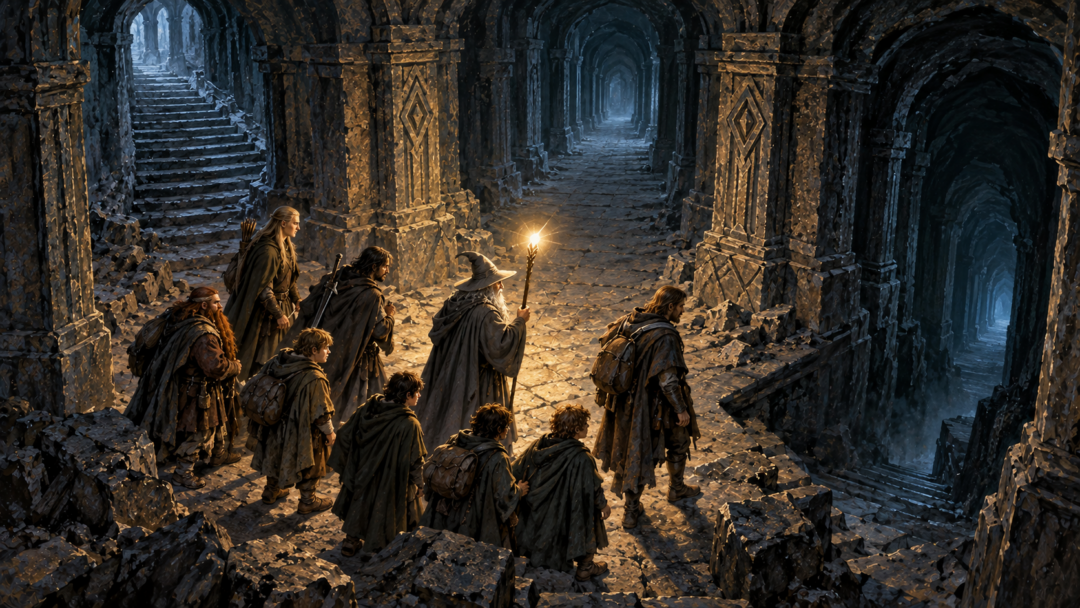
The Fellowship had survived the Watcher in the Water, passed through the Doors of Durin, and entered the darkness of Moria. But their first night beneath the mountains revealed a danger that no sword could easily answer: how do nine exhausted travellers rest in a place where even a small noise might betray them?
Their problem was not simply finding somewhere to sleep. The ancient Dwarven kingdom was filled with abandoned passages, broken chambers, unseen depths, and uncertain threats. A place that offered shelter might conceal a deadly opening. A harmless sound might travel into regions the travellers could neither see nor investigate.
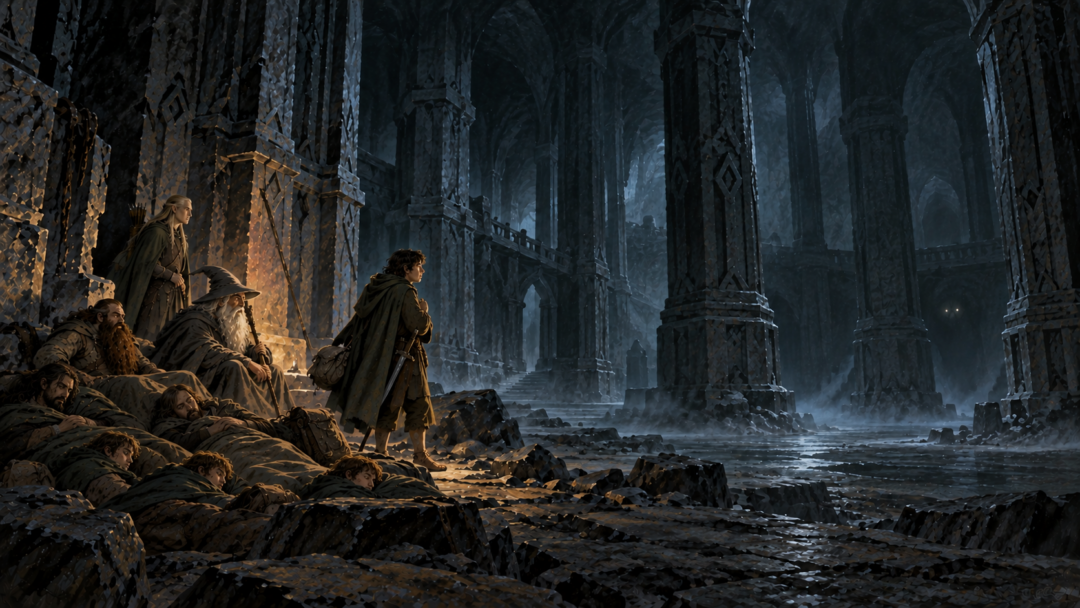
In The Fellowship of the Ring, Book II, Chapter 4, "A Journey in the Dark," the first overnight halt at a three-way junction offers a revealing glimpse of practical survival. Gandalf's caution, the choice of an old guardroom, Pippin's disastrous curiosity, and the arrangement of the watch all show how ordinary travelling habits must change underground.
The most revealing detail is that the Fellowship's immediate danger does not come from an attacking enemy. It comes from the difficulty of remaining safe while doing something as ordinary as sleeping.
Why Gandalf Stops at the Three-Way Passage
By the time the Company reaches the junction, the journey through Moria has already become physically and mentally exhausting.
The passages are bewildering. Gandalf remembers something of the Mines from an earlier journey, but his recollections cannot provide a reliable answer at every turning. Gimli's knowledge of Dwarven ways offers some assistance, yet he has never travelled through this vast underground kingdom himself.
At the junction, three passages lead onward. One descends, another runs more nearly level, and the third rises.
Gandalf cannot confidently choose between them.
This uncertainty matters because the Company's survival depends on finding a route through the mountains without becoming lost among countless abandoned workings.
Rather than make a tired decision, Gandalf orders a halt for what remains of the night. He knows that the outside world has passed midnight, although the darkness inside Moria gives no indication of the hour.
The decision establishes the first principle of their underground camp discipline: exhaustion is itself a danger.
Continuing to march is not necessarily safer than stopping. A mistaken turn might lead the Fellowship into impassable depths or force them to retrace their steps through dangerous territory.
Rest therefore serves two purposes. It allows the travellers to recover, and it gives their guide time to consider the road ahead.
Why an Ancient Guardroom Becomes Their Shelter
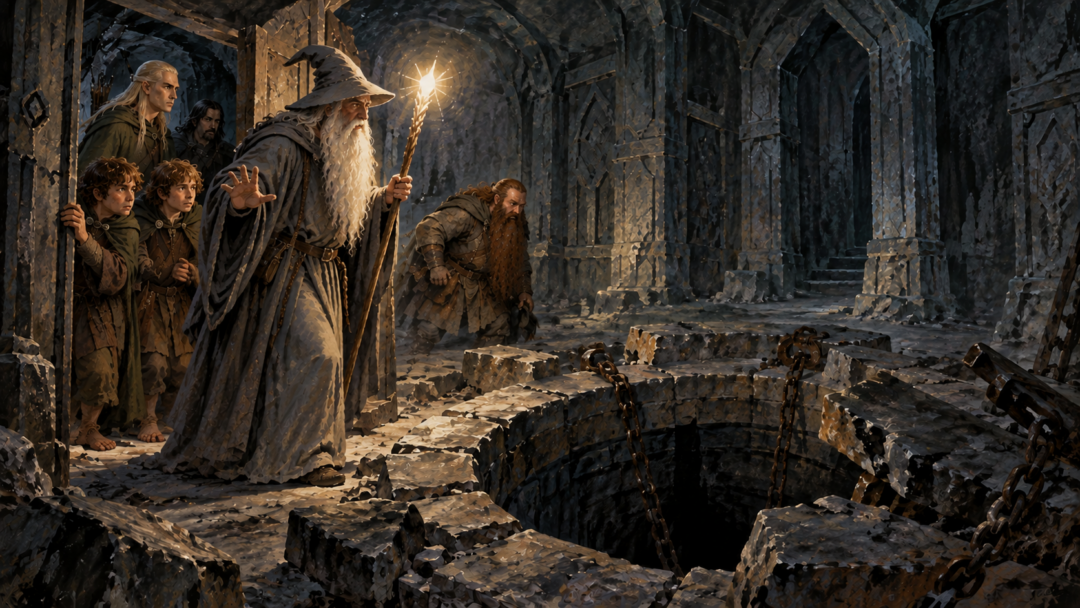
Beside the great archway, the Fellowship discovers a stone door leading into a chamber.
Merry and Pippin eagerly move toward it, relieved to find somewhere that appears more sheltered than the exposed passage.
Gandalf immediately restrains them.
He enters first, carefully examining the room before allowing the others to follow.
His caution proves justified.
Near the middle of the floor lies a large opening descending into darkness. Broken chains and fragments of stone surround it. Gimli identifies the chamber as an apparent guardroom, originally intended for watching the three passages, and explains that the opening was probably a well whose covering has been broken.
This makes the room both useful and dangerous.
Its location suggests that the ancient Dwarves deliberately placed watchers near an important junction. The stone chamber offers the Fellowship a more contained resting place than the passage outside.
Yet its original purpose does not make it safe after centuries of abandonment.
The uncovered well could kill someone who wandered carelessly through the darkness.
The Company responds by arranging their blankets against the walls, as far from the opening as possible.
It is a small but significant precaution.
The Fellowship does not repair the chamber or attempt to make it comfortable. They identify the immediate hazard and place their sleeping bodies away from it.
Their temporary camp is shaped by the dangers of the room rather than by the habits of an ordinary outdoor journey.
The Strange Problem of Light Beneath the Mountains
Light is another complication of travelling through Moria.
Outside, a campfire might provide warmth, illuminate the surrounding ground, and help companions gather together after a difficult march.
Underground, illumination has different consequences.
The Fellowship cannot depend on daylight to reveal its surroundings. Gandalf's staff provides light when necessary, allowing him to inspect passages and obstacles that would otherwise remain invisible.
But light does not remove the need for caution.
A brightly illuminated position could potentially be noticed by anyone watching from another passage. The text does not establish that an enemy actually observes the Fellowship's light during this first halt, nor does it describe a formal rule requiring complete darkness.
What it does show is that light must serve immediate practical needs.
The Company needs enough illumination to move safely, recognize openings, and avoid hazards such as the broken well.
At the same time, they are travelling through a place where they cannot know who else may be present.
Importantly, the guardroom episode does not describe a great communal fire blazing through the night. Its atmosphere is one of enclosed darkness, cautious movement, and uncertainty.
The lesson is not that the Fellowship possesses a sophisticated system of concealed lighting. It is that underground safety requires balancing visibility against exposure.
Too little light can be deadly. Unnecessary disturbance may carry risks of its own.
Pippin's Stone and the Danger of an Unnecessary Sound
The most memorable incident of the first night begins with a seemingly insignificant action.
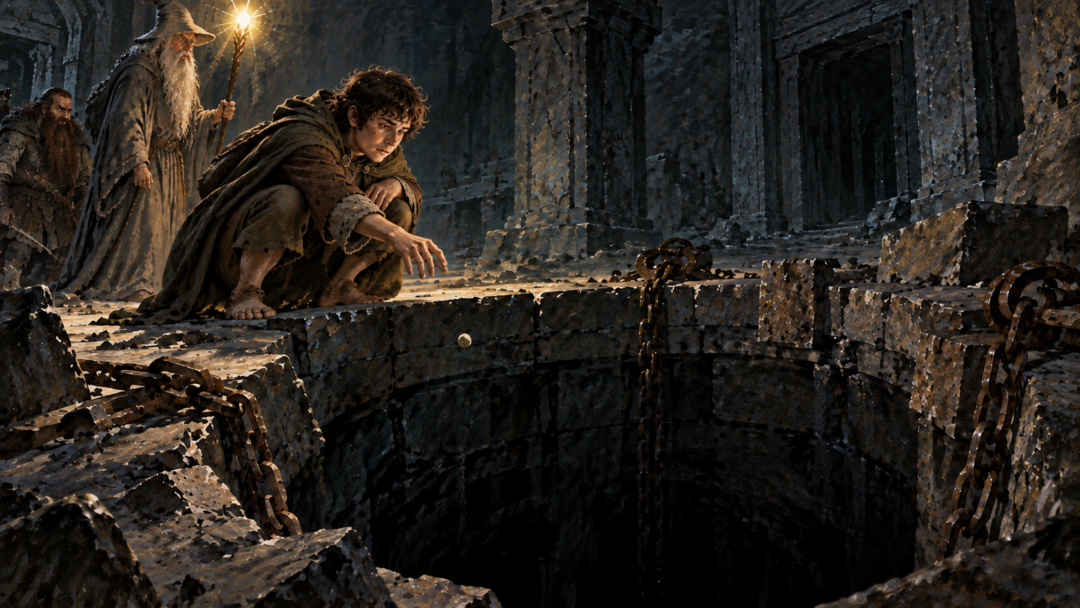
While the others prepare their sleeping places, Pippin approaches the well.
He feels strangely drawn toward its depths. Acting on impulse, he finds a loose stone and drops it into the opening.
For a long moment, nothing happens.
Then a distant sound rises from below, apparently from water far beneath the chamber. The hollow shaft magnifies and repeats the noise.
Gandalf is furious.
His anger is understandable within the immediate circumstances. The Company is attempting to cross an unknown and possibly inhabited underground realm. Pippin has deliberately created a sound whose destination and consequences cannot be controlled.
This is what makes the episode more than a moment of youthful foolishness.
On an open hillside, dropping a pebble might be almost meaningless. Inside Moria, the same action sends noise into a hidden space connected to depths beyond the travellers' knowledge.
The sound exposes an important limitation of their camp.
They can choose where to lie down. They can inspect the visible chamber. They can appoint a watcher.
But they cannot see where the well leads, or know what might hear a disturbance from above.
The danger is not the size of the stone. It is the uncertainty of what lies beneath it.
Did the Stone Alert Something in the Deep?
After Pippin's stone falls, another sound eventually reaches the Fellowship.
From far below come faint knocking noises, resembling hammer blows.
The sequence naturally suggests the possibility of a response.
Yet the text does not establish who or what produces the sounds.
It does not prove that the knocking is an organized signal, identify the beings responsible, or demonstrate that the stone causes the later attack on the Company.
Those distinctions matter.
The Fellowship subsequently encounters enemies within Moria, but the narrative does not provide a confirmed chain of communication beginning with Pippin's pebble.
It is reasonable to interpret the sounds as an ominous indication that the depths are not entirely deserted.
It is not reasonable to turn that possibility into a proven signalling system.
The episode is frightening precisely because the travellers lack an explanation.
They hear something that may indicate another presence, yet have no reliable means of determining its source.
The Company's practical response is therefore restraint. They cannot investigate every noise or abandon their journey whenever the darkness produces an unexplained sound.
They must remain alert without allowing uncertainty to paralyse them.
Why Pippin Receives the First Watch
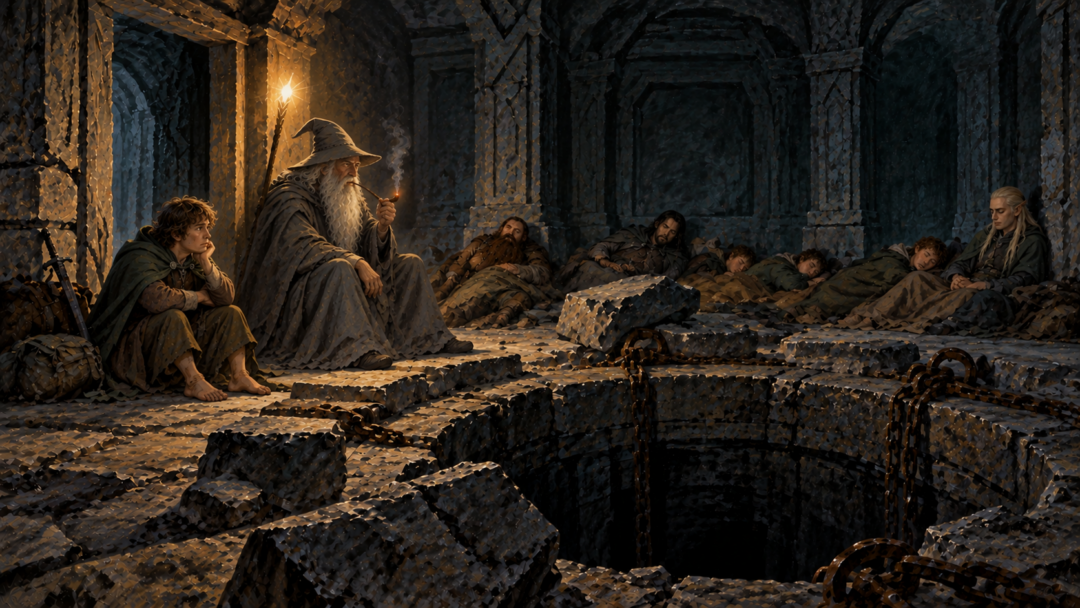
After the disturbance, Gandalf assigns Pippin the first watch.
The assignment carries an unmistakable element of punishment for his carelessness.
Instead of immediately settling down with the others, Pippin must remain awake while his companions rest.
The arrangement also reveals something important about the Fellowship's habits.
They do not simply lie down together and trust the chamber to protect them.
Someone remains responsible for keeping watch.
The guardroom offers shelter, but it cannot guarantee security. The nearby passages remain accessible, and the Company's knowledge of their surroundings is incomplete.
Pippin's watch does not last as long as he initially fears.
Gandalf, unable to sleep because he is troubled by the choice of route, eventually relieves him. The wizard remains awake, thinking over the possibilities and smoking his pipe.
This detail complicates any simple picture of strict military discipline.
Gandalf can be severe, but he is also considerate. He does not leave the young Hobbit indefinitely awake merely to make a point.
The needs of the journey matter more than punishment.
His own sleeplessness also shows that the burden of leadership continues after the marching stops.
While the others recover, Gandalf must still determine which passage offers the best hope of escape.
Why the Fellowship Does Not Simply March All Night
It might seem safer to continue moving rather than remain in a chamber connected to unknown depths.
But Moria makes that choice difficult.
The travellers are tired. Their guide is uncertain. The passages offer no obvious sign of which direction is correct.
Marching onward without a sound decision could create a greater danger than remaining temporarily in the guardroom.
Gandalf's choice illustrates the difference between movement and progress.
A party can cover ground while becoming less likely to reach its destination.
The first night's halt is therefore not a failure of courage. It is an acknowledgment that fatigue and uncertainty can undermine judgment.
When Gandalf finally chooses the right-hand passage, he has had time to consider the problem.
The Company resumes its journey, and the road eventually brings them into more spacious regions of the ancient kingdom.
Their rest has not made Moria safe.
It has made continued travel possible.
The Second Rest Shows How Conditions Change
The first night at the western junction should not be confused with the later halt in the great cavernous hall nearer the eastern side of Moria.
These are separate moments in the journey.
In the later hall, the Fellowship gathers close together in a corner to avoid a cold draught. The vast surrounding darkness makes the travellers feel painfully small amid the abandoned grandeur of Khazad-dûm.
Frodo takes a watch during this later rest.
He listens intently and eventually believes he sees two pale points resembling eyes in the darkness. He suspects he may have been close to dreaming, and Legolas subsequently relieves him.
This second watch reinforces the difficulties already apparent in the guardroom.
A watcher must remain attentive despite exhaustion, poor visibility, and fear. Even then, perception may be uncertain.
The two resting places also require different precautions.
At the first, an exposed well is the obvious physical danger. At the second, the immense hall, its draught, and the surrounding darkness shape the Company's choice of sleeping position.
There is no single perfect underground campsite.
The Fellowship must adapt to the particular hazards of each place.
What the First Night Really Reveals About Survival
The first overnight halt in Moria is easy to overlook because no battle takes place there.
Yet it contains several of the most revealing practical decisions of the underground journey.
Gandalf refuses to choose a route while too weary to judge confidently. He inspects the chamber before the others enter. The Company places its blankets away from the broken well. Pippin's impulsive noise demonstrates how little control they have over the unseen depths. A watch is assigned, and Gandalf eventually assumes the duty himself.
None of these actions is spectacular.
That is precisely why they matter.
The Fellowship survives not only through weapons, courage, and extraordinary powers, but also through attention to ordinary necessities: where to stop, where to sleep, when to remain silent, and who must stay awake.
The incident also reveals the limits of discipline.
The travellers cannot remove every hazard, prevent every mistake, or discover the meaning of every sound. They must make reasonable decisions with incomplete knowledge.
In Moria, a stone room may offer shelter without safety. A well may connect a sleeping place to unknown depths. A moment of curiosity may create a disturbance that cannot be recalled.
And a leader's most important decision may be to stop walking until he knows where to go.
The first night teaches a quiet but essential lesson: beneath the mountains, surviving the darkness begins long before an enemy appears.
Sources & Notes
- https://tolkiengateway.net/wiki/A_Journey_in_the_Dark — Tolkien Gateway: A Journey in the Dark; chapter overview and the two rests in Moria.
- https://tolkiengateway.net/wiki/Peregrin_Took — Tolkien Gateway: Peregrin Took; Fellowship of the Ring section, Pippin’s stone and Gandalf’s rebuke.
- https://stephencwinter.com/2021/11/13/fool-of-a-took-gandalf-and-pippin-at-the-well-in-the-guardroom-in-moria/ — Stephen C. Winter: Fool of a Took! Gandalf and Pippin at the Well in the Guardroom in Moria; commentary on The Fellowship of the Ring, pp. 303–306 (HarperCollins, 1991).
Primary text: The Fellowship of the Ring, Book II, chapter 4, A Journey in the Dark. Camp discipline is interpretation; the text does not identify the sender of the distant knocking or establish that Pippin’s stone caused the later attack.