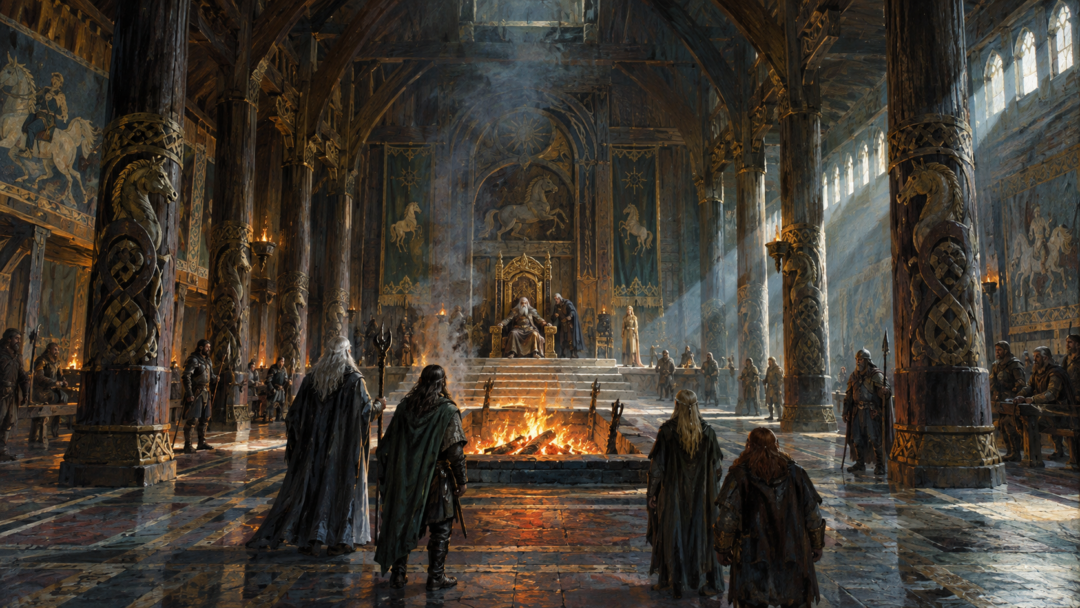
In the Golden Hall of Meduseld, a wood-fire burns in the middle of the room, while the King of Rohan sits upon a raised seat at its far end. Between the entrance and the throne lies a shared interior of carved pillars, ancient tapestries, colored stone, and firelight.
It is an architectural detail easy to overlook in The Lord of the Rings. Yet the arrangement reveals something important about how kingship is experienced in Rohan.
Théoden does not receive Gandalf and his companions in a secluded chamber, detached from the people who serve him. He sits at the end of a great hall, with his household, attendants, and counsellors occupying the same royal environment.
The central hearth matters because it makes Meduseld more than a throne room. It is an inhabited space, and the king’s authority is exercised within it.
The text does not establish a formal political system through architectural measurements or prescribed seating arrangements. Nevertheless, the description in The Two Towers, particularly the chapter “The King of the Golden Hall,” invites a revealing interpretation: in Rohan, royal power is made visible through the life of the hall itself.
A Royal Hall Built Above a Living Settlement
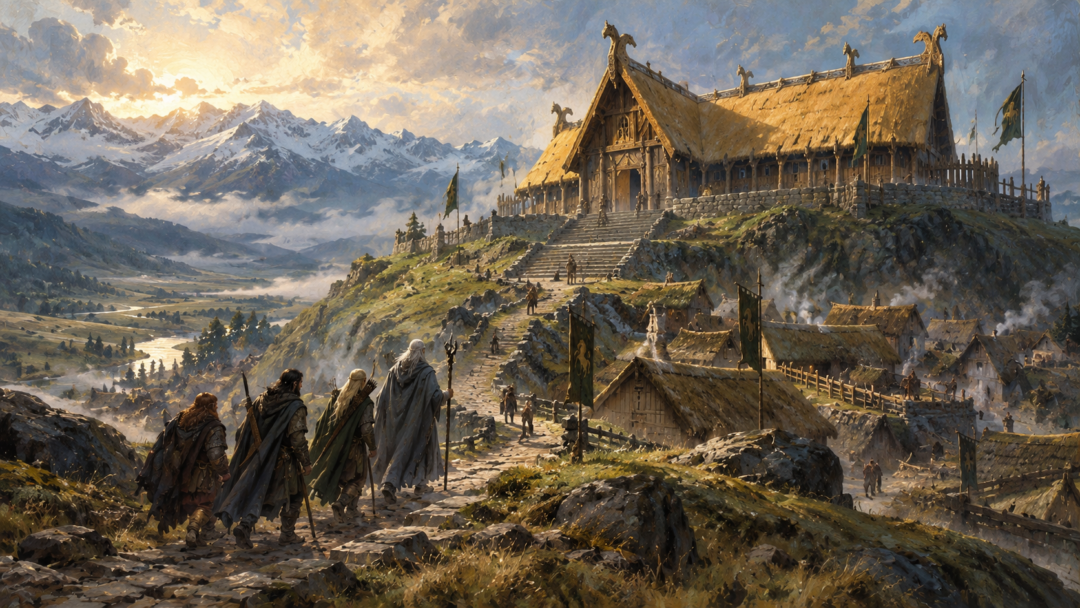
Meduseld stands at the summit of Edoras, above the houses of the Rohirrim and the roads that climb through their settlement.
Its position immediately distinguishes the king’s dwelling from the buildings below. The golden-looking roof catches the light, while the hall’s elevation makes it a landmark visible across the surrounding country.
This is architecture expressing rank.
Yet Meduseld is not described as an isolated fortress removed from ordinary habitation. It rises above a populated town, connected to it by a road, terraces, and steps.
That relationship matters.
The king occupies the highest and most conspicuous building, but his hall remains physically associated with the community over which he rules.
The Golden Hall was built by Brego, the second King of Rohan, after the kingdom had been established by his father, Eorl the Young. Its construction gave the royal house a monumental seat at Edoras.
The building therefore embodies both continuity and authority. It is a place where the kingship inherited from Eorl becomes a permanent presence in the landscape.
But the political meaning of Meduseld becomes clearer once the visitors pass inside.
The Hearth Occupies the Middle, Not the Margin
When Gandalf, Aragorn, Legolas, and Gimli enter Meduseld, they encounter a long, broad hall supported by great pillars.
The interior is initially shadowed, with sunlight entering through high eastern windows. A roof opening admits light and allows smoke to escape. Beneath it, a wood-fire burns upon a long central hearth.
The visitors move past this fire before stopping in front of the royal dais.
This sequence establishes a significant spatial relationship.
The hearth occupies the middle of the great room. The king’s seat stands beyond it, raised above the floor and facing the entrance.
Fire and throne are therefore distinct features, but both participate in the same architectural composition.
The hearth belongs to the common interior of the hall. The throne marks the exceptional status of the king.
One possible reading is that the building balances two aspects of kingship: the shared life of a royal household and the elevated authority of its ruler.
The fire suggests habitation, warmth, and continuity. The dais signifies precedence and command.
Neither feature cancels the other.
The king’s authority is set apart, but it remains visibly connected to the inhabited hall.
This does not prove that every visitor or member of the household possessed equal access to the hearth, nor that particular places around it carried legally defined privileges. The narrative provides no such seating code.
What it does provide is an arrangement in which royal distinction and communal space exist together.
Why the King Sits Beyond the Fire
At the southern end of Meduseld stands a dais reached by three steps. Upon it rests the great gilded chair of the King of the Mark, facing north toward the doors.
This positioning gives the king a recognizable place within the hall.
Someone entering encounters the length of the room before reaching the throne. The central hearth lies along that progression, while the raised chair provides the visual destination.
The arrangement creates hierarchy without separating the ruler into an entirely different architectural world.
Théoden can be approached and addressed within the great hall. His authority is displayed through elevation, placement, and the people gathered around him.
This is particularly important in the encounter with Gandalf.
The king’s words are not delivered from an inaccessible private sanctuary. His responses are heard in the presence of figures whose loyalties and interests matter to the kingdom.
Gríma Wormtongue is near the king. Éowyn is present. Háma belongs to the household structure that regulates entry to the royal presence.
The scene makes kingship personal.
Royal power is not merely an abstract institution. It has a face, a voice, a seat, and a surrounding circle of people.
The architecture allows those relationships to become dramatically visible.
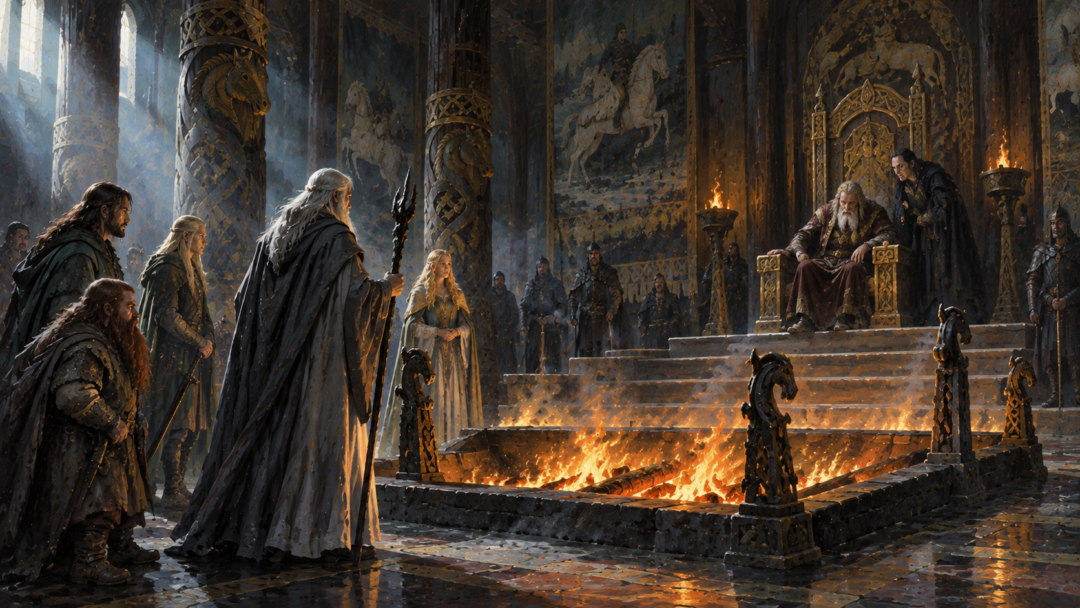
The Hearth and the Meaning of an Inhabited Court
A central fire is not automatically a political symbol. Its immediate purpose is entirely understandable within a large inhabited hall.
Nevertheless, its position contributes to the character of Meduseld.
Unlike a chamber designed exclusively around the display of a throne, this interior contains an unmistakable feature of household life.
The fire belongs to the experience of dwelling.
It also gives the scene a physical atmosphere. The travellers move from the clear air outside into a warmer, darker interior. Sunlight, shadow, smoke, and the glow of the hearth shape their perception of the room.
Such details make the royal court feel inhabited rather than ceremonial in every aspect.
The political implication is subtle.
The king rules from within a household whose relationships are visible around him. His personal condition and the conduct of those close to him can directly affect the exercise of his authority.
That is exactly what the narrative reveals in Théoden’s troubled court.
His weakness is not presented simply as a problem of administration. It appears through his speech, his posture, his dependence upon Gríma’s counsel, and his strained relationship with those who remain loyal to him.
The hall provides the setting in which these failures become apparent.
Its hearth continues to burn, but the king’s ability to lead has diminished.
That contrast is one of the scene’s most powerful implications: a royal household may remain physically intact even while the authority exercised within it has become dangerously compromised.
Gríma’s Influence Reveals the Vulnerability of Personal Kingship
Gríma Wormtongue’s position near Théoden is essential to understanding the political drama of Meduseld.
He does not need to occupy the throne to influence the king.
His power comes from proximity, counsel, and his ability to shape how Théoden understands the dangers surrounding Rohan.
When Gandalf challenges him, the confrontation takes place before the king and those gathered in the hall.
The issue is not simply whether Gríma has offered poor advice. It is whether the king can still recognize the condition of his kingdom and act according to his own responsibility.
This exposes a vulnerability inherent in the personal character of the kingship depicted here.
When royal authority depends heavily upon the judgment of an individual ruler, those who influence that ruler can exert extraordinary power.
Meduseld’s arrangement makes that danger visible.
The king occupies the highest seat, but someone standing close to him may shape the words spoken from it.
The architectural hierarchy remains unchanged even when the political relationships within it have been distorted.
Gríma’s influence does not require a new throne or a different hall. It operates through the existing court.
The central hearth becomes relevant to this reading not because the fire possesses any special power, but because it belongs to the shared space in which royal authority, household loyalty, and harmful counsel encounter one another.
The Tapestries Make the Past Present
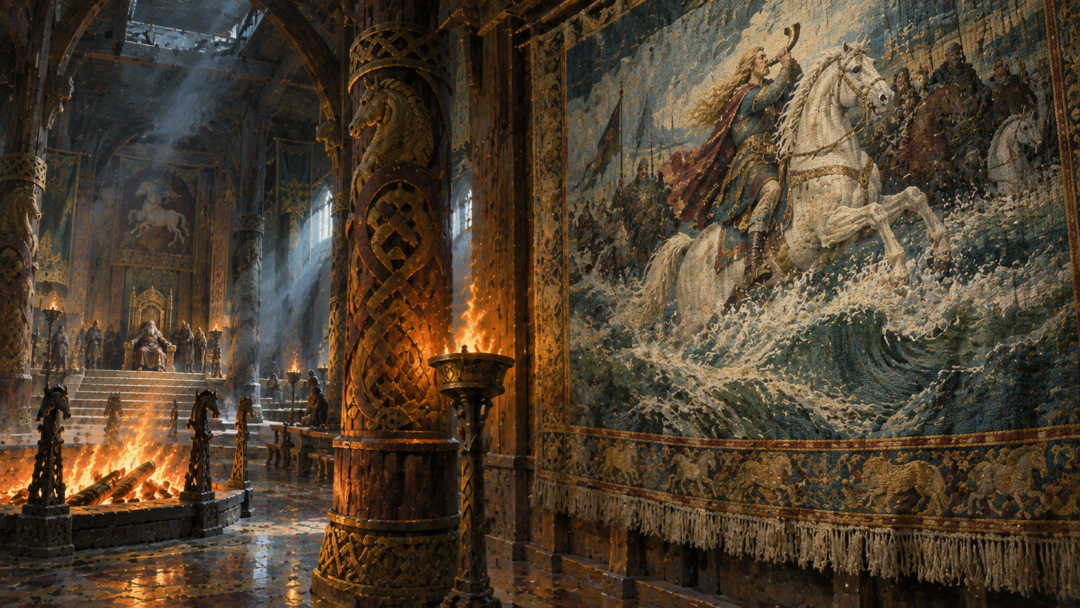
Meduseld’s walls are decorated with woven scenes from the history and legends of the Rohirrim.
One particularly striking image depicts Eorl the Young riding a white horse through rushing water, his hair streaming as he sounds a horn.
The scene recalls the heroic beginnings of Rohan and Eorl’s ride to the aid of Gondor.
Its presence within the hall creates another relationship between architecture and authority.
Théoden does not sit in an undecorated room where kingship depends solely upon his present commands.
He rules surrounded by representations of the past.
The tapestry recalls the courage, military service, and inherited identity associated with the royal line.
Alongside the hearth and the throne, these images create three different dimensions of the hall: lived habitation, present authority, and ancestral memory.
This is an interpretive grouping rather than a symbolic scheme explicitly established in the narrative.
Even so, it helps explain why the interior is more meaningful than a collection of luxurious furnishings.
The room surrounds its inhabitants with reminders of the people they claim to be.
For Théoden, whose courage has been weakened by despair and manipulation, that inherited example becomes especially significant.
The history displayed upon the walls offers a contrast with the condition of the living king.
Théoden’s Recovery Changes the Meaning of the Hall
The turning point of “The King of the Golden Hall” is not a change in architecture.
It is a change in Théoden.
Gandalf challenges the despair that has overwhelmed him and exposes the destructive influence of Wormtongue.
Théoden rises from his seat and eventually goes outside, where he looks upon his land beneath the open sky.
The movement is important.
At first, the king is encountered as an aged, diminished figure within the shadowed hall. Later, he stands outside, confronting the wider world and the obligations he has neglected.
The contrast between the enclosed interior and the open landscape does not make Meduseld itself corrupt. The hall is still the rightful seat of Rohan’s kings.
Rather, the episode shows that the building cannot supply the qualities its ruler lacks.
A golden chair does not create courage. Ancient tapestries cannot make a king act. A burning hearth cannot preserve the kingdom through warmth alone.
The hall gives royal power a visible setting, but Théoden must recover the will to exercise that power.
His renewed leadership soon produces consequences beyond Edoras, as he prepares to ride against the threat facing his people.
The court is no longer defined by the paralysis that marked the visitors’ arrival.
The same kingship, housed in the same royal tradition, begins to function differently because its ruler has changed.
What Meduseld Reveals About Rohan’s Political Order
The Golden Hall should not be treated as a complete constitutional diagram.
The narrative does not specify an official hierarchy of seats around the hearth, a formal schedule of audiences, or an exact division of administrative responsibilities within the building.
Nor does it establish that every political decision in Rohan must be made there.
What it does show is a royal order in which the person of the king, his household, his counsellors, and the memory of his ancestors are closely connected.
Meduseld gives that order a physical form.
The throne establishes the king’s precedence. The long hall provides the shared environment in which he is encountered. The hearth marks the building as an inhabited place. The tapestries preserve the history against which the present ruler may be judged.
This helps distinguish the experience of kingship in Rohan from the idea of government as something conducted entirely through impersonal institutions.
Rohan certainly possesses offices, military responsibilities, traditions, and obligations beyond the king’s household. Its political life cannot be reduced to one room.
Yet in the central scene at Edoras, the health of the kingdom is revealed through the health of the relationships surrounding its ruler.
That is why the hall matters so much.
It makes power personal without making it invisible.

The Fire at the Heart of the Kingdom
The most revealing feature of Meduseld may be the distance between its central hearth and the king’s raised chair.
They occupy different positions, yet belong to one continuous interior.
The fire is associated with the lived reality of the hall. The throne distinguishes the person who bears royal authority. Between them unfolds the drama of counsel, loyalty, memory, weakness, and renewed responsibility.
Nothing in the text proves that the hearth was deliberately designed as a political emblem. Its deeper significance emerges from the way the narrative places it within the royal environment.
And that is the distinctive achievement of Meduseld.
Rohan’s kingship is not represented only by a crown, a weapon, or a seat of gold. It is experienced through an inhabited hall where the ruler can be seen, addressed, misled, challenged, and ultimately called back to duty.
The central hearth reminds us that this is a house as well as a court.
The raised throne reminds us that it is also the seat of a kingdom.
Together, they make the essential tension of Rohan’s political order visible: the king stands above his household in rank, but his authority is inseparable from the human relationships and responsibilities that fill the hall beneath him.
Sources & Notes
- Tolkien Gateway — Meduseld. https://tolkiengateway.net/wiki/Meduseld
- Tolkien Gateway — The King of the Golden Hall. https://tolkiengateway.net/wiki/The_King_of_the_Golden_Hall
- Tolkien Gateway — Edoras. https://tolkiengateway.net/wiki/Edoras
Primary text: The Two Towers, “The King of the Golden Hall,” and Appendix A, “The House of Eorl.” The hall and audience provide the textual basis. The political reading of hearth and throne is interpretation; no formal seating code or constitution is established.