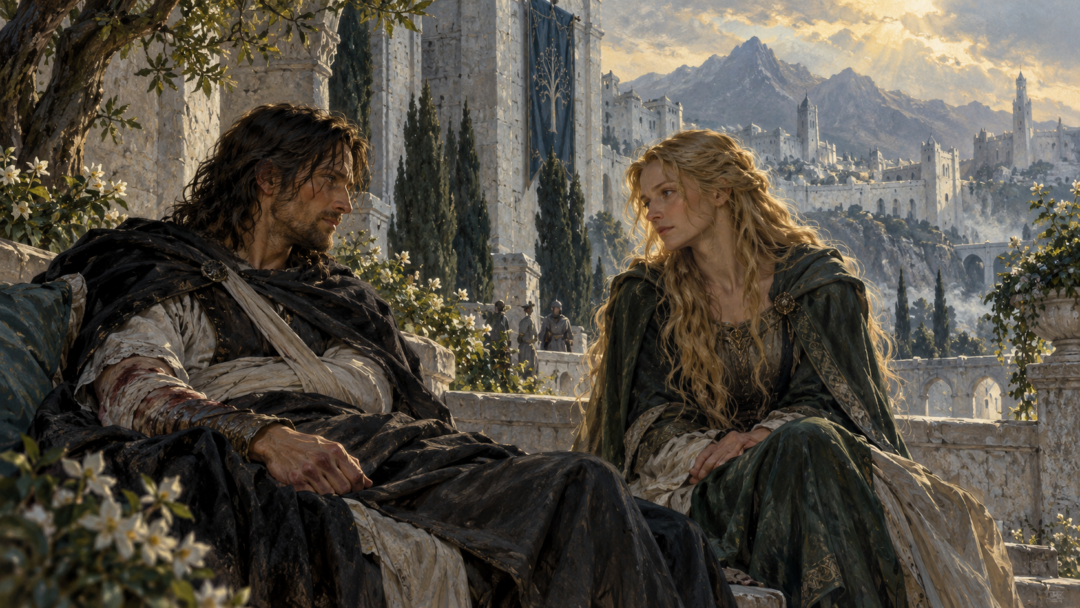
When Éowyn and Faramir first meet, neither looks like the beginning of a new political household.
They meet in the Houses of Healing in Minas Tirith, after both have been brought close to death. Faramir has survived the disastrous retreat from Osgiliath, wounds, fever, and the despair of his father. Éowyn has survived the Battle of the Pelennor Fields and the destruction of the Lord of the Nazgûl, yet her recovery is complicated by a deeper unhappiness that physical healing alone cannot resolve.
Their eventual marriage is unmistakably personal. In “The Steward and the King,” Faramir falls in love with Éowyn, and Éowyn ultimately chooses him freely. Nothing in the text presents their union as a diplomatic arrangement negotiated between Gondor and Rohan.
Yet the marriage has an extraordinary public context.
Faramir is the surviving son of the last Ruling Steward of Gondor. Éowyn is the sister of the new King of Rohan and niece of the king who died on the Pelennor. Both belong to ruling families that have just endured devastating losses. Their marriage therefore does something quietly significant: it joins two surviving branches of the leadership that carried Gondor and Rohan through the War of the Ring.
It does not create their alliance. It gives that old alliance a new family form.
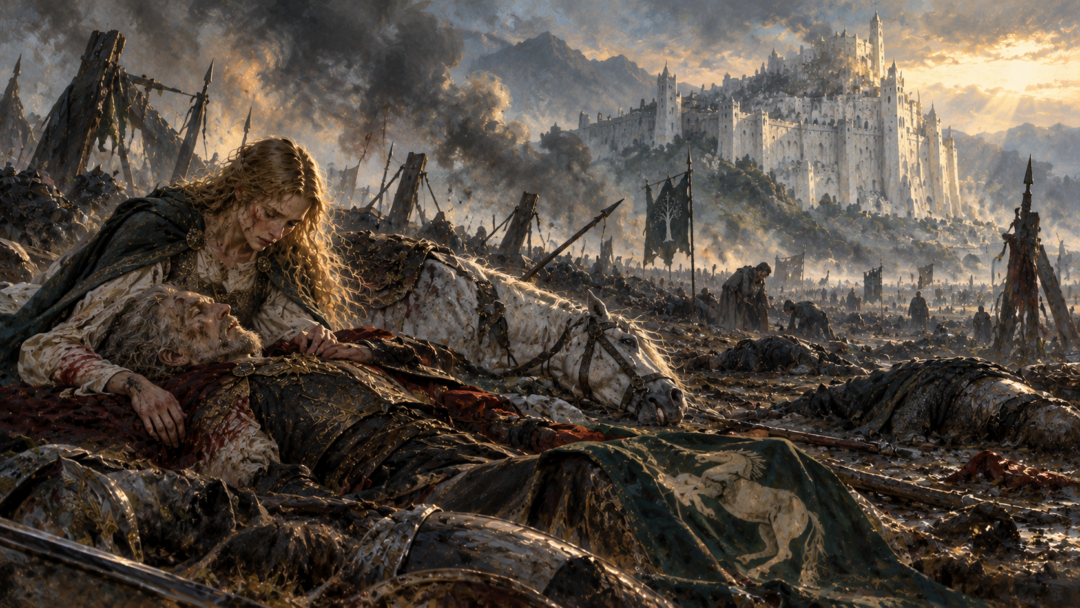
Two Houses Emerging From Catastrophe
The political importance of the marriage becomes clearer when we consider what has happened to both families.
Gondor’s House of the Stewards has been shattered. Denethor II, the Ruling Steward, dies during the siege of Minas Tirith after falling into despair. Boromir, his elder son and heir, has already died at Amon Hen. Faramir survives, but he does so as the remaining son of a household that has lost both its head and its expected successor.
More fundamentally, the political order in which his family ruled is ending.
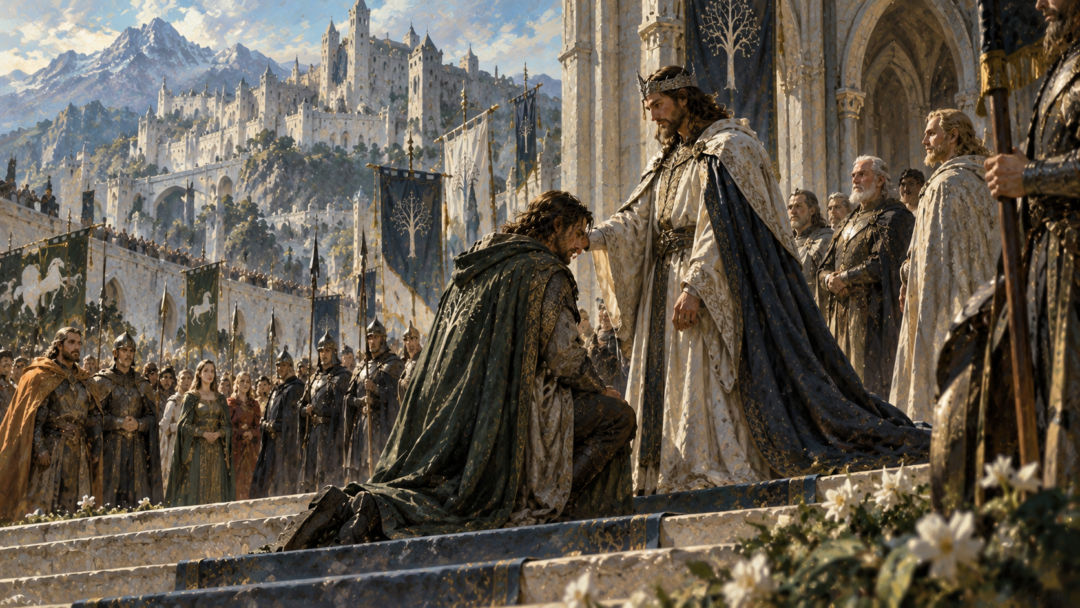
For centuries the Stewards governed Gondor in the absence of a king. After Sauron’s defeat, Aragorn is crowned as King Elessar. Faramir accepts him, formally surrendering the stewardship of the realm at the coronation. Aragorn then confirms Faramir as Steward and grants him the princedom of Ithilien.
The Rohirrim have suffered a parallel, though not identical, dynastic blow.
Théoden dies on the Pelennor Fields. His son Théodred had already been killed at the Fords of Isen. The kingship therefore passes not from Théoden to his son, but to his nephew Éomer.
Éowyn belongs at the center of this damaged household. She and Éomer are the children of Théoden’s sister Théodwyn and Éomund of Eastfold; after their parents’ deaths, they were brought into Théoden’s household. By the end of the war, Éowyn has lost the uncle who was effectively the head of her royal family, while her brother has unexpectedly become king.
Both Gondor and Rohan survive.
But the families at the summit of both realms have been painfully reduced and transformed.
Their Marriage Does Not Create the Alliance
It is important not to exaggerate what happens next.
Éowyn and Faramir’s marriage is not the origin of friendship between Rohan and Gondor. That relationship is generations old.
The kingdom of Rohan itself arose through Gondor’s grant of Calenardhon to Eorl and his people after they came to Gondor’s aid. The Oath of Eorl and the long relationship between the two realms precede Éowyn and Faramir by centuries. During the War of the Ring, Théoden answers Gondor’s need and rides to the Pelennor before any marriage between the ruling families is contemplated.
Nor does the marriage merge their governments.
Éomer remains King of Rohan. Elessar rules the Reunited Kingdom, while Faramir serves as Steward and Prince of Ithilien. Éowyn does not become a mechanism through which Rohan acquires authority in Gondor, and Faramir gains no claim to the throne of Rohan through marrying her.
There is no textual basis for imagining a secret succession compact, constitutional settlement, or arranged dynastic bargain.
The significance is subtler.
An alliance that had previously existed between realms now also exists inside a household.
Faramir Represents Survival Without Restoration of the Old Order
Faramir’s position after the war is especially interesting because his family survives without simply returning to what it was before.
The Stewards do not continue ruling Gondor in place of the kings.
Aragorn has returned.
Yet Faramir is not discarded as a relic of the old regime. At the coronation, his office is preserved under the restored monarchy. Aragorn makes him Prince of Ithilien, and Appendix A records that the descendants of Faramir became Princes of Ithilien and remained hereditary Stewards.
That makes Faramir a bridge between political eras.
He is Denethor’s surviving heir, carrying forward the lineage and dignity of the Stewards, but he does so within the restored kingship rather than instead of it.
His marriage follows the same pattern.
The old Stewardly house is not erased after its greatest catastrophe. It enters the new age with a new role, a new territorial center in Ithilien, and a new connection to the royal house of Rohan.
This is political continuity without political reversal.
Éowyn Also Stands at a Turning Point
Éowyn’s side of the marriage carries a different kind of transition.
During the war, she is trapped between duty and a desperate hunger for escape. In the Houses of Healing, she initially remains restless even after her bodily wounds begin to mend. Her encounter with Faramir belongs to the resolution of that inner conflict.
Their relationship should therefore not be reduced to dynastic symbolism.
Éowyn’s eventual choice is presented as a personal transformation. She turns away from her earlier fixation on death and martial glory and looks instead toward healing and life. Faramir does not acquire her as a diplomatic prize, and Éomer does not appear as a brother negotiating her into a useful Gondorian marriage.
That distinction matters precisely because the public consequences are real.
Éowyn can freely choose Faramir for personal reasons while their union simultaneously carries dynastic significance.
Those ideas are not contradictory.
The marriage brings the sister of Rohan’s king into the household of Gondor’s Steward and Prince of Ithilien. The resulting connection is politically meaningful even though politics is not presented as the reason they marry.
From the Pelennor to Ithilien
There is also a striking geographical dimension to their story.
Éowyn and Faramir are both nearly destroyed in the struggle for Minas Tirith. Their future, however, lies east of the city in Ithilien.
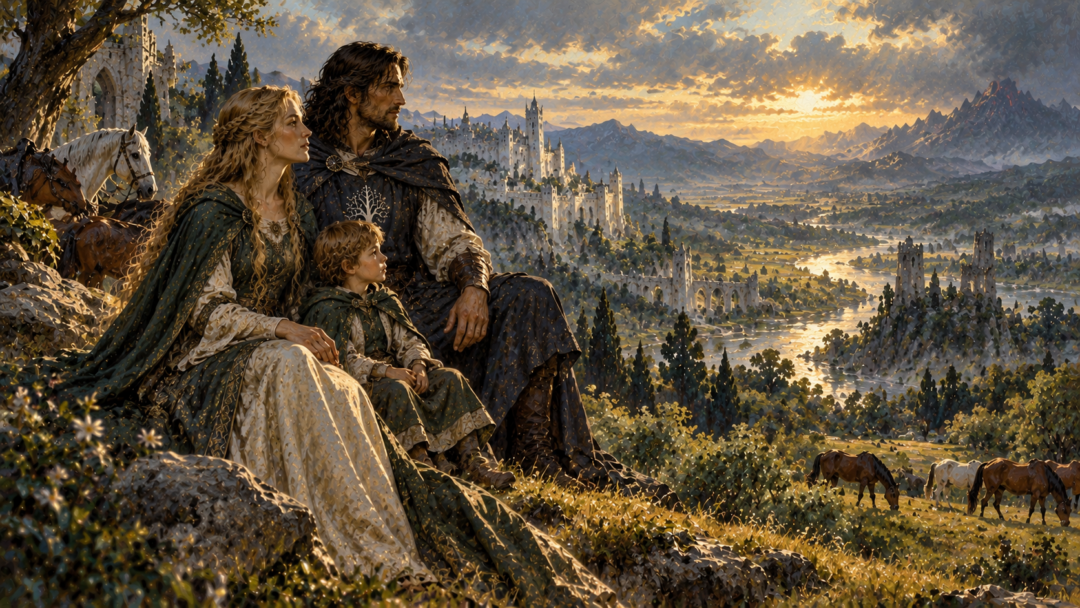
That region had long suffered from its proximity to Mordor. Faramir himself had fought there before the siege. After the victory, Aragorn makes him Prince of Ithilien, and Éowyn becomes the Lady of Ithilien.
The move gives their marriage a significance beyond the Houses of Healing.
Two survivors of the war establish their household in a land deeply marked by the conflict with Sauron.
It would go beyond the text to turn this into an elaborate political program devised through their marriage. But as a literary and historical pattern, the contrast is difficult to miss: their shared future belongs not to the battlefield where both nearly died, but to a recovered region entering the peace.
The symbolism fits their personal stories without requiring us to invent motives Tolkien never gives them.

The Family Connection Becomes Permanent
Appendix A records the continuing hereditary offices. The genealogy in The Peoples of Middle-earth supplies the name of the next generation.
The family tree in “The Heirs of Elendil” names Éowyn and Faramir’s son Elboron. The line of the Princes of Ithilien therefore descends from both the House of Húrin, through Faramir, and the royal family of Rohan through Éowyn’s mother, Théodwyn.
That does not unite the crowns.
It does something more modest but still historically important: it turns political friendship into kinship among major ruling families of the postwar world.
Éomer himself also establishes another important family connection beyond Rohan. Appendix A records that he marries Lothíriel, daughter of Prince Imrahil of Dol Amroth. The restored political landscape therefore contains overlapping bonds of loyalty, friendship, service, and kinship rather than a simple diplomatic marriage system.
Éowyn and Faramir’s household is one part of that broader pattern.
Their son inherits no combined Gondor-Rohan monarchy. But his ancestry embodies the closeness of two peoples whose histories had repeatedly converged in war.
A New Relationship Between Rohan and Gondor
The War of the Ring could easily have left behind political survival accompanied by dynastic emptiness.
Théoden and Théodred are dead. Denethor and Boromir are dead. Éomer inherits a throne he was not born as the king’s son to inherit. Faramir becomes the principal survivor of a Stewardly household whose centuries-old form of rule has ended.
Yet the conclusion is not merely about institutions surviving.
It is about relationships being remade.
Aragorn and Éomer renew the friendship between their realms. Faramir retains high authority under the returned king. Éowyn finds a future beyond the despair that drove her toward the battlefield. Ithilien gains a prince and lady whose household belongs to the peace rather than merely to the emergency of war.
Their marriage sits quietly at the intersection of all those changes.
It does not explain them, cause them, or legally bind them together. But it gives them a human shape.
The Deeper Meaning of the Marriage
That may be the most important distinction.
Éowyn and Faramir are not valuable because they can be exchanged between political houses. Their political significance arises because two people who survived the destruction of those houses choose a life together afterward.
Faramir carries the Stewardly line beyond Denethor’s despair without perpetuating Denethor’s final rejection of the returning king.
Éowyn carries the family of Théoden beyond the king’s death without remaining imprisoned by the hopelessness that had consumed her.
Their household therefore links two wounded dynastic stories precisely at the moment both are beginning again.
Gondor and Rohan did not need their marriage in order to become allies. They already were allies, tested across generations and finally on the Pelennor itself.
What the marriage adds is something different.
After kings, heirs, fathers, brothers, soldiers, and cities have paid the cost of the war, the alliance is no longer represented only by oaths, armies, and rulers riding to one another’s aid. It is also present in a family living in the peace those sacrifices purchased.
Éowyn and Faramir’s marriage does not merge two kingdoms.
It reconnects two surviving houses — not through political calculation, but through the lives of two people who nearly died with the old world and instead became part of what followed.
Sources & Notes
- Tolkien Gateway — Éowyn. https://tolkiengateway.net/wiki/%C3%89owyn
- Tolkien Gateway — Faramir. https://tolkiengateway.net/wiki/Faramir
- Tolkien Gateway — The Steward and the King. https://tolkiengateway.net/wiki/The_Steward_and_the_King
Primary text: The Return of the King, “The Steward and the King,” and Appendix A. The marriage and the new princedom are textual facts; their significance for the two families is interpretation, not evidence of an arranged diplomatic marriage or merged governments.