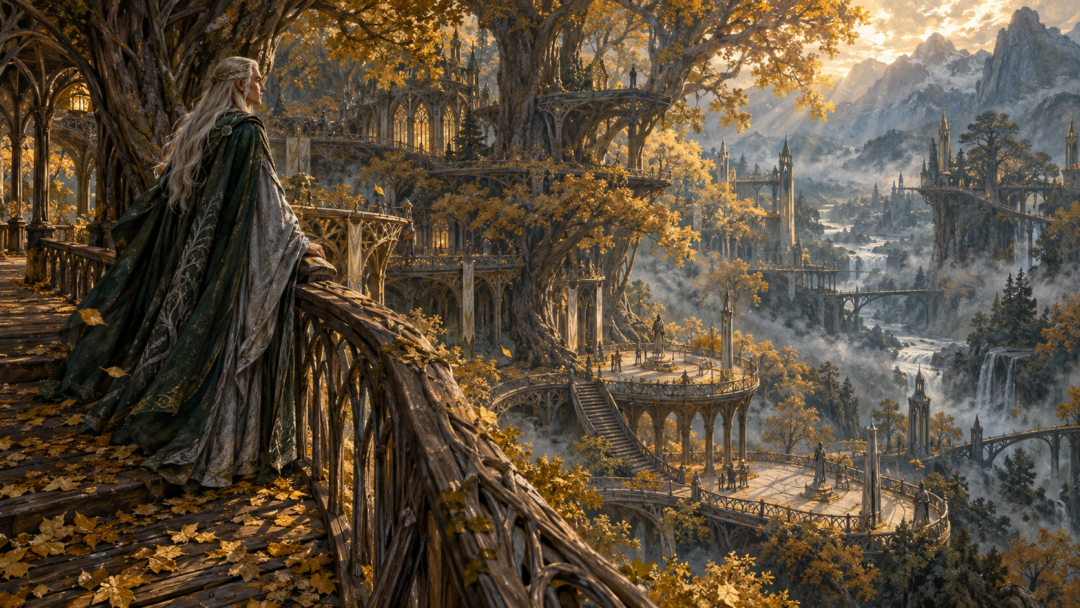
When Frodo first enters Lothlórien, he discovers a place that seems almost untouched by time. Golden leaves shine above the paths, ancient trees shelter the dwellings of the Galadhrim, and Celeborn and Galadriel preside over a realm unlike anything the hobbits have seen.
Yet this extraordinary kingdom has a surprisingly quiet ending.
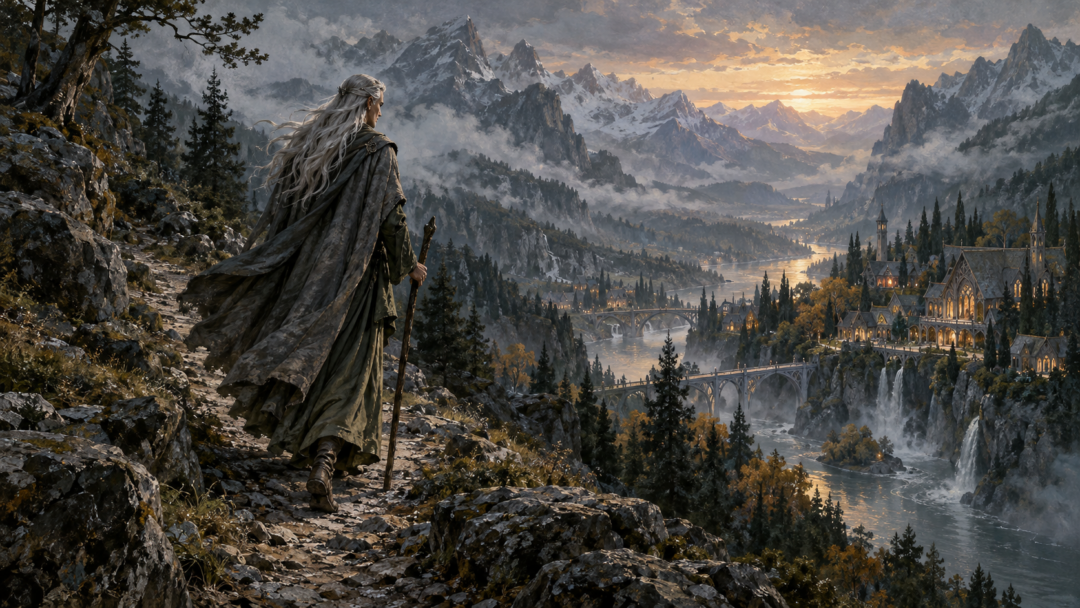
After Sauron's defeat, Galadriel eventually sails into the West. Celeborn remains in Middle-earth, but he does not spend the rest of his known history ruling the Golden Wood. Later, he grows weary of his realm and goes to Rivendell, where the sons of Elrond still dwell.
That small geographical detail deserves more attention than it usually receives.
Why would one of Middle-earth's oldest Elven rulers leave a territory that had survived the War of the Ring? Why choose Rivendell, especially after Elrond himself had departed?
The answer reveals something important about the changing place of the Elves in the Fourth Age.
Celeborn's move suggests that the surviving centers of Elven life were becoming fewer and more closely connected, even as the remaining Elves followed different paths.
This is an interpretation of the evidence, not a recorded policy of organized Elven migration. Nevertheless, the contrast between Lothlórien's decline and Rivendell's continued habitation offers a revealing glimpse of Middle-earth after the great Elven powers had begun to pass away.
Celeborn's Realm Was Not Simply Destroyed
Lothlórien had faced a terrible threat during the final struggle against Sauron.
According to Appendix B of The Lord of the Rings, the forces of Dol Guldur attacked Lórien three times. Each assault was driven back.
After Sauron's downfall, Celeborn crossed the Anduin, and the destruction of Dol Guldur began. Galadriel cast down its walls and laid bare its pits.
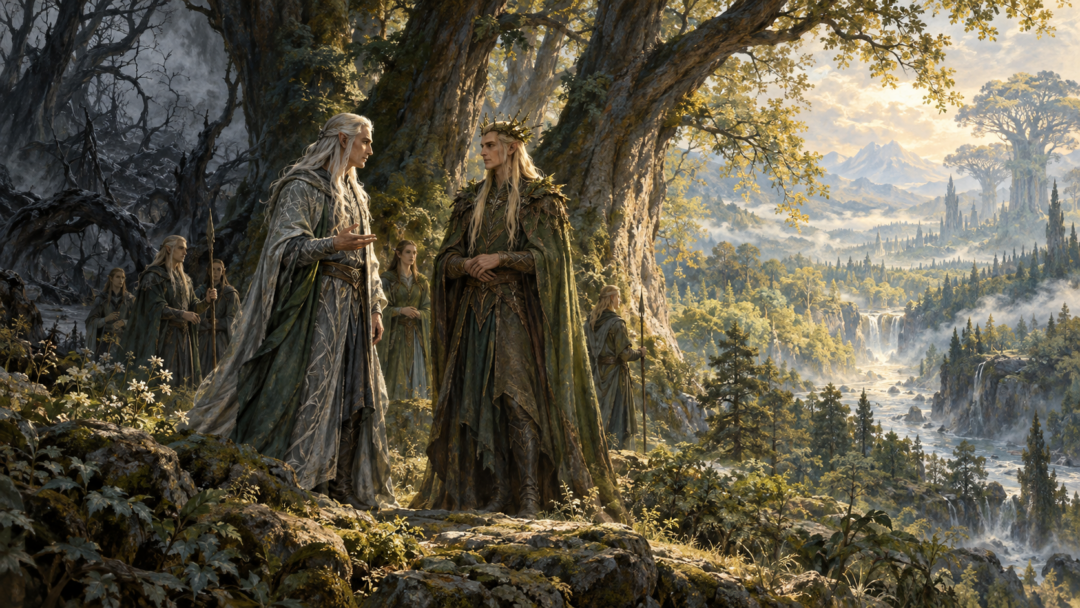
On the Elven New Year in 3019, Celeborn met Thranduil in the forest formerly known as Mirkwood. Together, they gave the cleansed woodland a new name: Eryn Lasgalen, the Wood of Greenleaves.
The territories were divided.
Thranduil received the northern region, Celeborn took the southern woodland below the Narrows, and the broad territory between them was assigned to the Beornings and the Woodmen.
Celeborn named his new territory East Lórien.
This matters because it complicates the idea that the Elves immediately abandoned their lands after Sauron's defeat.
At the very moment when the Third Age was ending, Celeborn participated in a territorial settlement that recognized a continuing Elven presence east of the Misty Mountains.
Indeed, the destruction of Dol Guldur removed the great nearby stronghold from which Lórien had been threatened.
Yet the victory did not secure an indefinite future for Celeborn's rule.
The contrast is striking: an Elven lord could win the war, gain territory, and still find that the age of his kingdom was ending.
The Quiet Decline of the Golden Wood
The decisive passage appears in Appendix B, which records that Celeborn grew weary of his realm and went to Imladris, the Elven name for Rivendell.
The same account describes what remained behind in Lórien.
Only a few of its former inhabitants lingered there, and Caras Galadhon had lost the light and song that once distinguished it.
Caras Galadhon had been the heart of Lothlórien: a city among the trees, illuminated by Elven craft and inhabited by a people whose lives reached back into a much older world.
The Fellowship had experienced it as a place of extraordinary beauty and living memory.
Yet the later account presents a radically different picture.
The city was not described as having been burned by Orcs or conquered by Men. Its loss was quieter.
Its population diminished, and the life that had made it remarkable faded.
He was not necessarily escaping a battlefield or fleeing an advancing enemy. The text instead connects his movement with weariness, while separately recording the dwindling population of Lórien.
Nevertheless, the juxtaposition suggests that political survival and cultural survival were no longer the same thing.
A realm might retain its forests, its former boundaries, and even some of its people while losing the community that had given it its distinctive character.
Why Rivendell Was Different
Celeborn's destination is just as revealing as the realm he left.
Rivendell was not a newly established refuge.
It had existed since the Second Age, when Elrond founded his stronghold in the aftermath of Sauron's destruction of Eregion.
Over the centuries, it became a place of shelter, learning, counsel, and preserved memory.
In The Hobbit, Bilbo and the Dwarves find hospitality there during their journey east. In The Lord of the Rings, Frodo is brought to Rivendell after his wound at Weathertop, and the Council of Elrond gathers there to decide the fate of the Ring.
Rivendell's importance was never measured simply by the size of the territory it controlled.
Unlike Lothlórien, whose identity was closely associated with its woodland realm and the lordship of Celeborn and Galadriel, Rivendell functioned as a household and refuge where travelers, histories, and different peoples could meet.
Elrond sailed West in September 3021, accompanied by Galadriel, Gandalf, Frodo, and Bilbo.
Yet Rivendell did not immediately become deserted.
The Prologue to The Lord of the Rings records that Elrond's sons remained there for a long time, together with some of the High-elven folk.
It also preserves the tradition that Celeborn came to dwell there after Galadriel's departure.
Thus, while one famous Elven center was losing its population and its former splendor, another continued to house members of the older Elven world.
This does not prove that Rivendell became the administrative capital of the remaining Elves.
But it does suggest that Rivendell retained a role as a place where important surviving figures could continue to dwell together after the great events of the Third Age.
The Importance of Elrond's Sons
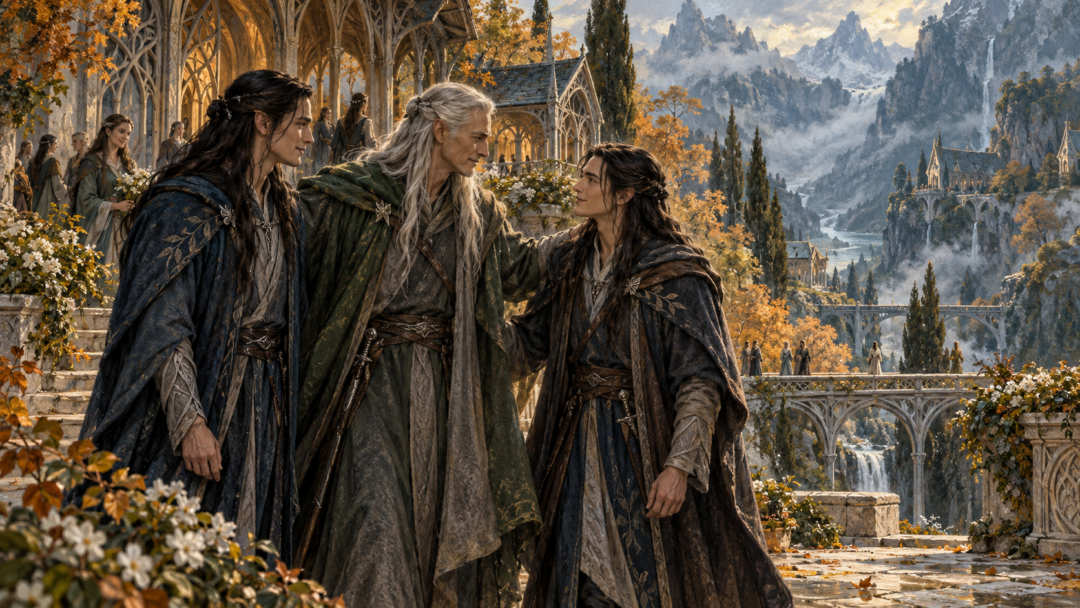
Elladan and Elrohir were Celeborn's grandsons: their mother Celebrían was the daughter of Celeborn and Galadriel. Their presence gives his destination a personal significance that is firmer than an imagined political agreement.
By the opening of the Fourth Age, Celebrían, Galadriel and Elrond had gone West, while the sons of Elrond remained. The texts record Celeborn dwelling with them; they do not record a council ordering all remaining Elves to assemble at Rivendell.
One reasonable interpretation is that this household offered continuity through family, company and memory rather than through the possession of a whole woodland kingdom. That is an interpretation of the destination, not a confession of Celeborn's private motives.
What Elven Consolidation Actually Means
Consolidation here does not mean a central government or the evacuation of every Elven settlement. No such general policy is recorded. It describes a narrower possibility: as one prominent realm diminished, surviving figures could continue their association in another inhabited household.
Celeborn's journey also crossed a meaningful geographical divide. After receiving East Lórien in the cleansed Greenwood, he eventually left that eastern woodland sphere for Imladris in Eriador. This was not simply a move between residences in the same forest.
The account describes his personal movement. It does not say that he transferred an army, court or substantial population. His arrival cannot establish a general census of the remaining Elves, but it does show how an important figure could remain connected to the Elven world after leaving his former seat of power.
Not Every Elven Realm Followed the Same Path
The Fourth Age did not begin with every Elven community vanishing. Appendix B records the Silvan Elves in Greenwood remaining untroubled. Appendix A also describes Legolas bringing Elves from Greenwood into Ithilien during Elessar's reign, contributing to its renewed beauty.
These are important counterexamples. Some communities endured; some people settled elsewhere; others sailed West. Celeborn's move belongs to that variety, not to a documented merger of every Elven kingdom into one surviving state.
A Realm Can Outlive Its Purpose
Nenya helped sustain the extraordinary preservation associated with Lothlórien. When the One Ring was destroyed, the power of the Three came to an end. The setting in which the Golden Wood had preserved something of the Elder Days could not continue unchanged.
That broad change is context, not proof that Nenya's fading directly caused every choice Celeborn made. His detailed reasons are not supplied. The more defensible distinction is that continuity might endure in people and households even when a realm could no longer retain its former character.
Sauron had been defeated, but victory did not preserve the old world indefinitely. Rivendell still offered an inhabited household connected to the history of both realms.
The Final Journey We Cannot Date
Celeborn's story does not end with a precisely recorded departure from Rivendell.
The Prologue preserves an important limitation: there is no record of the day when he finally sought the Grey Havens.
His ultimate departure is remembered, but its date is not supplied.
That gap prevents us from constructing a detailed chronology of Celeborn's final years or confidently identifying the last moment of Elven habitation at Rivendell.
Nor can we assume that Celeborn's departure meant the immediate disappearance of every Elf who remained in Middle-earth.
His journey marks the passing of an extraordinary survivor, not a documented census of the remaining Elven population.
The Prologue associates his departure with the passing of the last living memory of the Elder Days in Middle-earth.
Celeborn had witnessed the long transformation of the world, from the ancient Elven kingdoms to the restoration of the kingship of Men.
He had known Lothlórien in its splendor, survived the struggle against Sauron, and remained after Galadriel sailed away.
Yet his last known residence was not the kingdom he had ruled.
It was Rivendell, among descendants and surviving members of an older people.
That ending gives his movement a significance greater than its modest description might suggest.
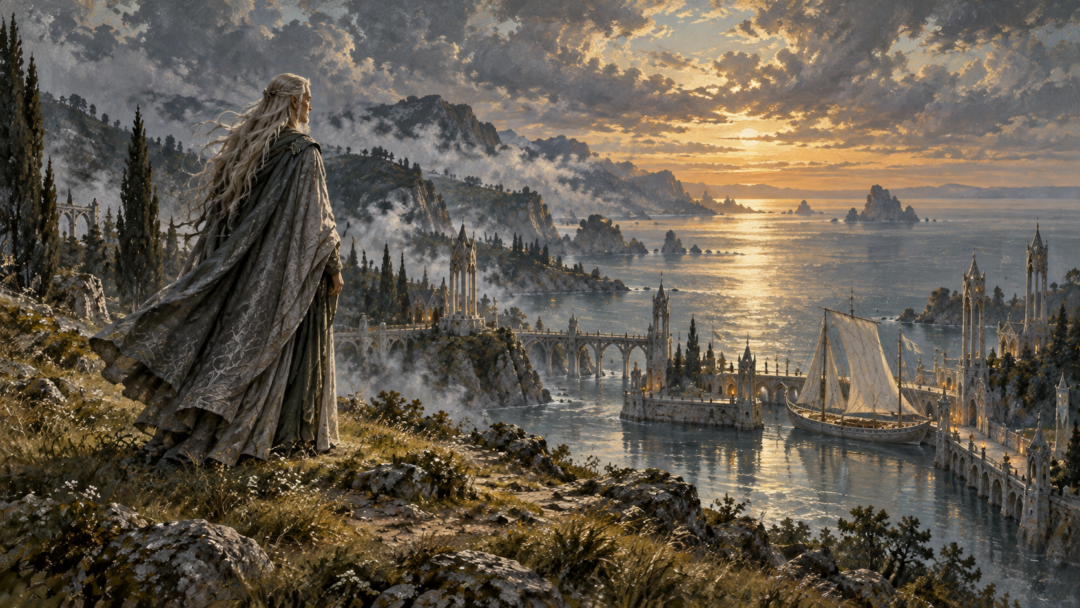
The Changing Map of the Fourth Age
Celeborn's move happens after the great victories, without a recorded council or dramatic account of his arrival. Its quietness makes the detail revealing.
Lothlórien survived Sauron's armies, yet its population dwindled. Rivendell lost Elrond, yet his sons and some High-elven inhabitants remained. Those observations suggest continuity through surviving households, not a coordinated evacuation or a new central government.
The old kingdoms could fade before the last of their people departed. Celeborn's road to Rivendell captures that uneven transition—and somewhere beyond the surviving record lay his final journey to the Sea.
Sources & Notes
- The Encyclopedia of Arda — Celeborn. https://www.encyclopedia-of-arda.com/c/celeborn.html
- Tolkien Gateway — Rivendell. https://tolkiengateway.net/wiki/Rivendell
- Tolkien Gateway — Lothlórien. https://tolkiengateway.net/wiki/Lothl%C3%B3rien
- Tolkien Gateway — East Lórien. https://tolkiengateway.net/wiki/East_L%C3%B3rien
- Tolkien Gateway — Elladan and Elrohir. https://tolkiengateway.net/wiki/Elladan_and_Elrohir
Primary text: The Lord of the Rings, Prologue, ‘Note on the Shire Records,’ for Celeborn's dwelling with Elrond's sons and the unrecorded date of his final departure; Appendix B, ‘The Great Years,’ for the assaults on Lórien, the fall of Dol Guldur, East Lórien, and Celeborn's later withdrawal to Imladris; Appendix A, ‘The Tale of Aragorn and Arwen,’ for the later deserted Golden Wood, and ‘Durin's Folk’ for Legolas's settlement in Ithilien. These reference pages document the surviving household, family connections, territorial settlement, and decline of Lórien. ‘Consolidation’ is the article's cautious interpretation of those observations, not a documented migration policy, population census, or new Elven government.