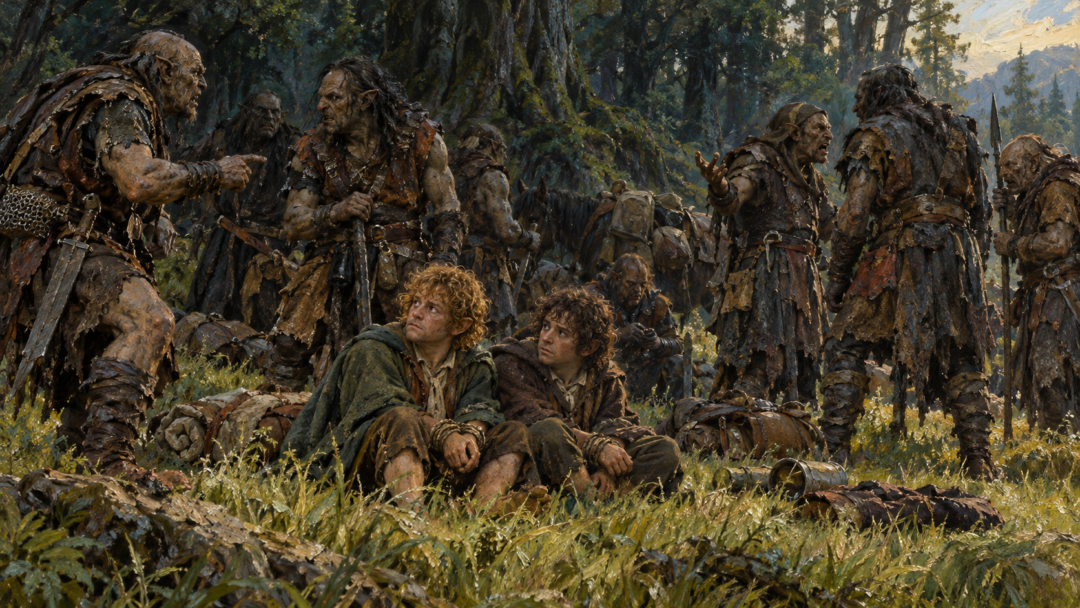
Merry and Pippin do not escape the Orcs because they suddenly become warriors. They have no hidden army coming specifically to rescue them, no secret weapon capable of breaking the camp, and no plan that guarantees survival.
Instead, at the edge of Fangorn Forest, two exhausted prisoners recognize something their captors do not fully appreciate: the Orc-band holding them is already coming apart.
The Riders of Rohan have surrounded the Orcs. Different Orc factions are quarreling over what should happen to the captives. Grishnákh has his own dangerous interest in the hobbits. And in the darkness, with battle approaching, the rigid control that carried Merry and Pippin across Rohan begins to fracture.
Their escape is therefore one of the most carefully constructed reversals in The Two Towers. The Rohirrim create the crisis, Orc rivalry makes that crisis worse, Grishnákh unexpectedly removes the hobbits from the center of the camp, and Merry and Pippin seize the brief opportunity that follows.
They survive not by overpowering Middle-earth, but by noticing when larger powers have stopped watching them.
The Orcs Are Already Divided
Long before Merry and Pippin actually get free, Tolkien establishes the weakness inside their captors' company.
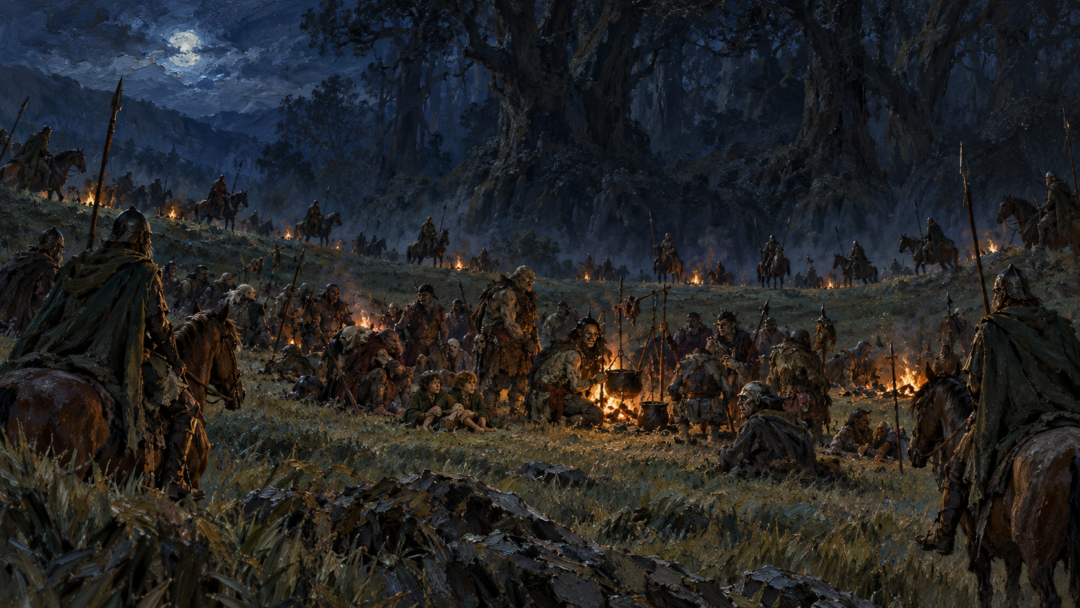
The Orcs who seized them are not a unified force with a single loyalty. Uglúk leads the Uruk-hai of Isengard and is determined to carry out Saruman's orders by bringing the prisoners west. Grishnákh belongs to a different command and represents interests connected with Mordor. Other Orcs in the company have their own complaints and priorities.
Their captors know that the prisoners are important, but the hobbits themselves gradually realize that the Orcs do not all understand that importance in the same way. That gives the captives information. They listen to arguments that reveal competing commands and suspicions among their enemies.
It is an important distinction. Merry and Pippin cannot defeat Uglúk's company themselves. What they can do is observe it.
Their helplessness is real. They have been captured after the fighting at Amon Hen, carried and driven across the plains, bound, threatened, and forced onward. Yet captivity also places them close enough to hear things that a distant observer could never know.
The Orcs possess overwhelming physical power over them. The hobbits begin acquiring something different: knowledge of the Orcs' divisions.
The Riders Turn the Camp Into a Trap
The Orcs reach the edge of Fangorn, but the Rohirrim prevent their escape.
Éomer and his riders surround them. From the Orcs' perspective, the forest is close, but the mounted enemy controls the open ground around their position. What had been a brutal forced march becomes an encirclement.
For Merry and Pippin, this is both hopeful and terrifying.
The arrival of the Riders does not automatically make them safe. The Rohirrim do not know that two hobbits are trapped among the Orcs, and the hobbits cannot simply run across open ground and expect everyone in a night battle to identify them correctly.
Until now, the Orcs have largely controlled the pace and direction of events. They could carry their prisoners, force them onward, and punish resistance. Once surrounded, they must think about survival. Their attention shifts outward toward the horsemen waiting beyond the camp.
The prisoners are still guarded, but they are no longer the only urgent problem.
This is the first great condition of the escape: Merry and Pippin need their captors' attention to be divided, and the Riders of Rohan divide it on a scale the hobbits could never have produced themselves.
Yet even this is not enough.
The decisive disruption comes from inside the Orc camp.
Grishnákh Makes His Own Move
Grishnákh's interest in the hobbits is one of the darkest pieces of the episode.
From what he has heard and inferred, he suspects that the prisoners may possess something extraordinarily important. Merry and Pippin, meanwhile, understand enough of his behavior to recognize what he is searching for.
They exploit that suspicion.
This is a remarkable moment because the hobbits do not need to tell Grishnákh the truth. Instead, they play upon his desire and his uncertainty. Their behavior encourages him to believe that they may know more—and possess more—than they actually reveal.
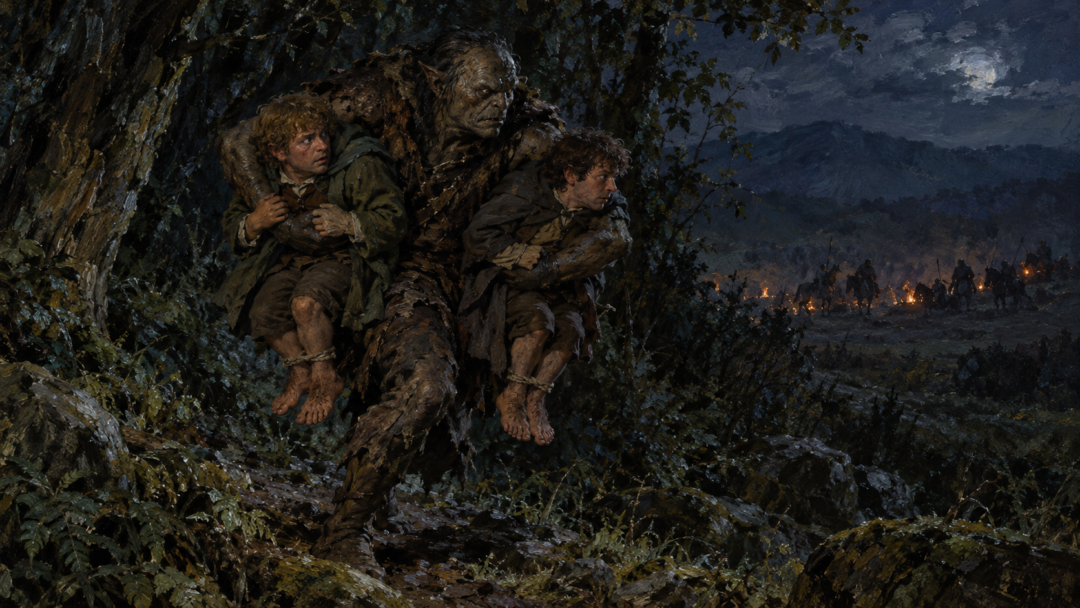
Grishnákh eventually takes them away from the other Orcs.
His intentions are plainly dangerous. This is not a rescue. The hobbits have exchanged one form of captivity for a more private threat.
Inside the main company, Merry and Pippin are surrounded by Orcs. Grishnákh isolates them because his interest conflicts with that of the larger group. By trying to gain control of the suspected prize for himself, he removes the prisoners from the very concentration of Orc strength that made escape almost impossible.
That does not make Grishnákh secretly helpful. It means selfishness within an evil alliance produces consequences its leaders did not intend.
Merry and Pippin recognize the opening.
Pippin Has Already Been Preparing for a Chance
Their escape also works because this is not the first moment in which Pippin has tried to influence events while apparently powerless.
During the forced march across Rohan, he deliberately drops his Elven brooch as a sign for possible pursuers. It is a tiny act, but an intelligent one. He cannot know that Aragorn, Legolas, and Gimli will find it. He cannot even know with certainty that anyone is close enough to follow.
He acts anyway.
That episode reveals the habit of mind that becomes crucial near Fangorn. Pippin does not wait for complete control before doing something useful.
He works with whatever narrow freedom remains.
Earlier, Pippin has already made his apparent helplessness less complete. With his hands tied in front of him, he works the wrist-cord against a knife held by a dead Orc. Once it parts, he reties the cord into loose loops and wears them as though he is still securely bound. His legs remain tied: he has prepared a possibility, not escaped.
Merry contributes a similar alertness. Together, the two hobbits listen closely to their captors, understand that Grishnákh's suspicions can be manipulated, and recognize that the confusion around the encircled camp is more valuable than any attempt at direct confrontation.
The Battle Creates the Final Opening
When Grishnákh takes Merry and Pippin away from the main body, the Rohirrim's encirclement becomes decisive.
The Riders are watching the perimeter precisely because they expect Orcs to attempt escape. Grishnákh therefore cannot simply disappear into the night with his captives.
He is intercepted and killed.
For Merry and Pippin, this is the crucial break. Their immediate captor is gone, while the larger Orc company is occupied by the surrounding enemy and the developing battle.
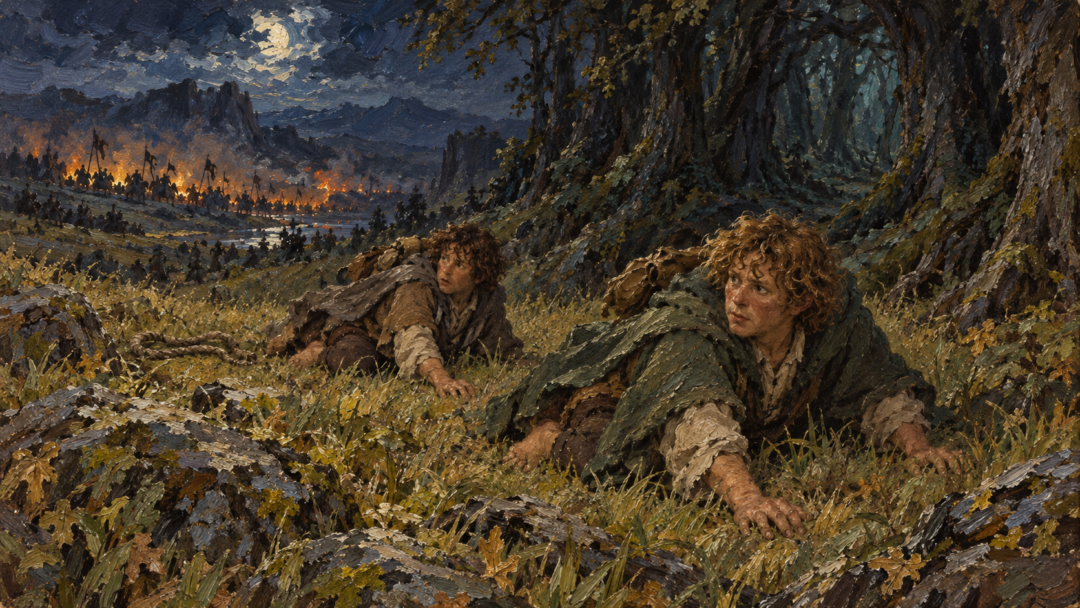
An attack by Mauhúr’s Orcs draws off some Riders and pulls the watching ring closer around the main company. The hobbits suddenly lie outside it. Pippin slips off his wrist-loops and shares lembas with Merry. Grishnákh’s sword is too cumbersome, so he takes a sharp knife from the fallen Orc and cuts their remaining bonds. Only then do they crawl away. The earlier quiet preparation makes the sudden opening usable.
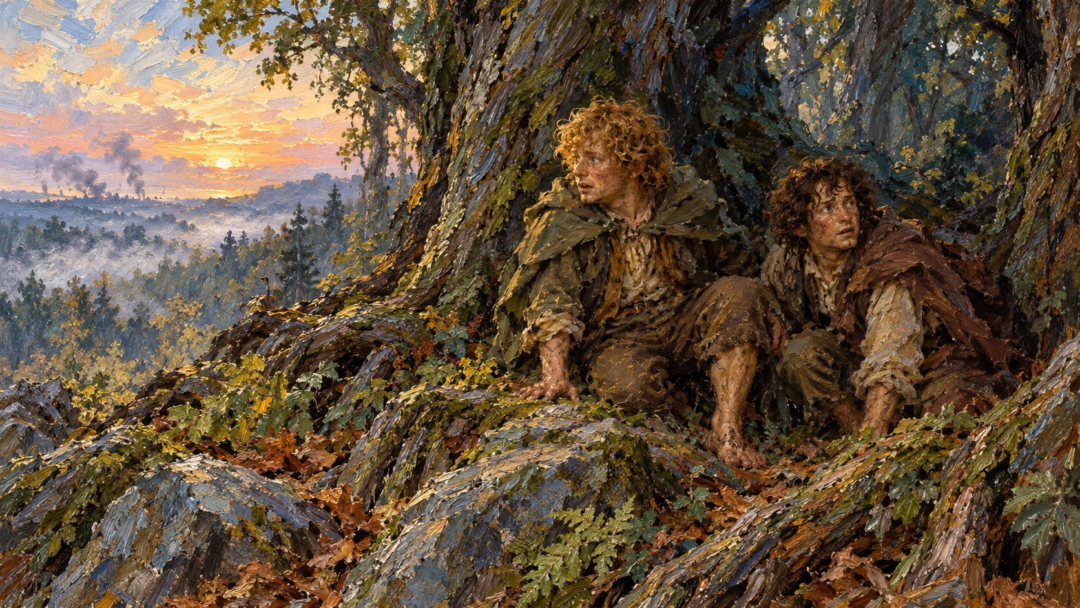
The two hobbits still have to move carefully. They cannot assume that the Riders will recognize them in darkness and confusion. Their safest destination is not the open plain but Fangorn Forest, the enormous dark refuge beside the battlefield.
They crawl and move away from the fighting toward the trees.
This is where it becomes misleading to describe the episode simply as the Rohirrim rescuing Merry and Pippin. Éomer's riders are indispensable to their survival because the encirclement creates the conditions in which the Orc company can be destroyed. But the Riders are not conducting a deliberate rescue operation for two known hobbit prisoners.
Merry and Pippin escape during this night skirmishing. The Riders’ main charge comes at dawn, after the hobbits have reached the forest.
They have to understand the opportunity themselves.
Why Fangorn Offers Cover
Fangorn Forest is frightening even before Merry and Pippin enter it.
Old stories and the reactions of other characters establish it as a place with an unsettling reputation. Yet during the battle it offers something the open grassland cannot: cover.
The Orcs have been driven against the forest's edge, while mounted warriors dominate the surrounding plain. For two small fugitives trying to disappear from a violent night engagement, the trees provide the obvious refuge.
So Merry and Pippin enter Fangorn.
They do not know that this choice will lead them to Treebeard. They are not following a grand design visible to them. From their perspective, they are simply getting away from Orcs and avoiding the lethal confusion outside.
The Quiet Victory at the Edge of Fangorn
The Orc-band will be destroyed, and Aragorn, Legolas, and Gimli will later reach the site and try to discover what happened to their friends. But Merry and Pippin's real escape occurs before anyone from the Fellowship can reach them.
They are not passive objects waiting to be recovered. Nor are they transformed into conventional warriors to earn their freedom. Their contribution is smaller in scale and more characteristic of who they are at this point in the story.
They listen.
They remember.
They mislead a dangerous enemy without pretending they can defeat him.
They recognize confusion as opportunity.
And when the moment comes, they move toward the one place that offers concealment.
The irony is that nearly every powerful actor around them is thinking about something larger. Saruman's servants are trying to deliver valuable prisoners. Grishnákh is pursuing what he suspects may be the great prize his masters seek. The Rohirrim are fighting an enemy force on their borders.
Amid all those competing designs, Merry and Pippin want something much simpler.
They want to get away.
At the edge of Fangorn, the ambitions of stronger beings collide so violently that, for a few crucial moments, nobody can completely control two hobbits.
Merry and Pippin make those moments enough.
Sources & Notes
- Tolkien Gateway — The Uruk-hai (chapter). https://tolkiengateway.net/wiki/The_Uruk-hai
- Tolkien Gateway — Uglúk. https://tolkiengateway.net/wiki/Uglúk
- Tolkien Gateway — Grishnákh. https://tolkiengateway.net/wiki/Grishnákh
- Tolkien Gateway — Mauhúr. https://tolkiengateway.net/wiki/Mauhúr
- Tolkien Gateway — Éomer. https://tolkiengateway.net/wiki/Éomer
- The Encyclopedia of Arda — Grishnákh. https://www.encyclopedia-of-arda.com/g/grishnakh.html
Primary text: The Two Towers, Book III, Chapter 3, “The Uruk-hai,” with Book III Chapters 1–2 for the capture at Amon Hen, the forced march across Rohan, and the Rohirrim pursuit. Tolkien Gateway records the chapter synopsis (the two quarrelling Orc groups, Pippin cutting his wrist-cord and hiding it as loose loops, the loss of his Lórien brooch as a sign, and the escape into Fangorn), Uglúk as the Uruk captain carrying out Saruman's orders for Isengard, Grishnákh as the Mordor captain killed by Éomer's riders near Fangorn, Mauhúr as the Orc sent to reinforce Uglúk who attacked the encircling Rohirrim, and Éomer as Third Marshal of the Riddermark whose riders surrounded the band. The article's argument that the escape results from Orc disunity, divided attention, and the hobbits' own small preparations is interpretation of that material, not a claim made by the sources.