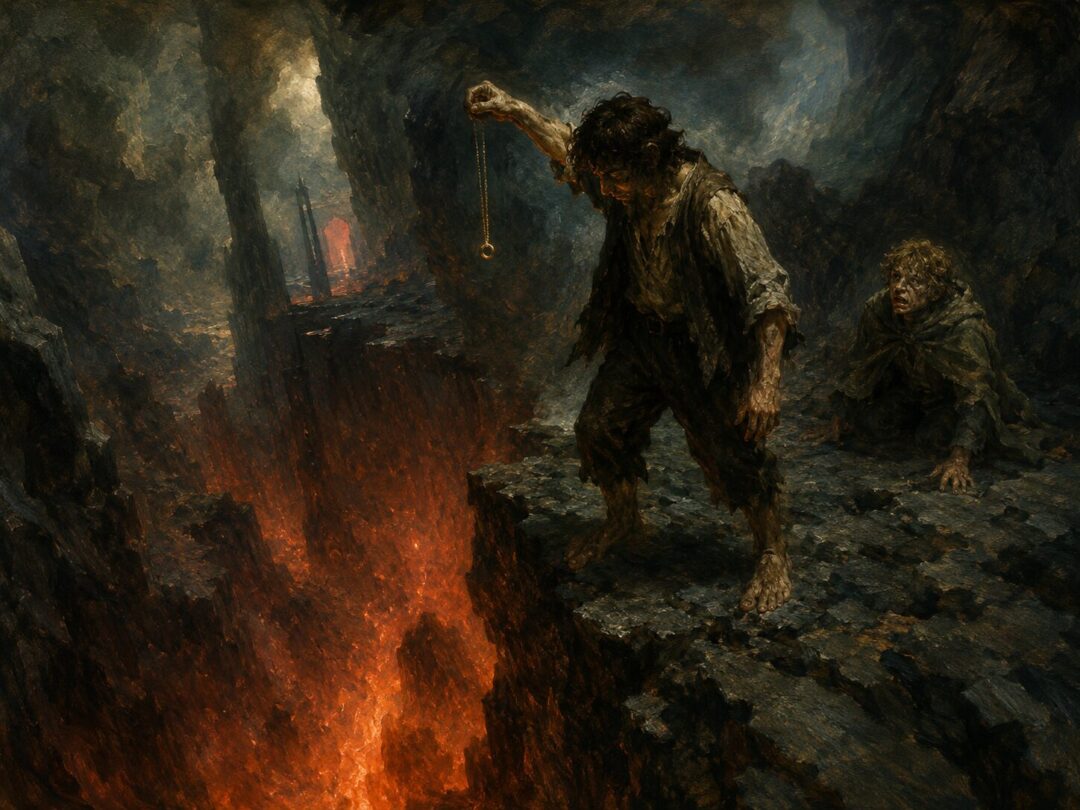
At the end of The Lord of the Rings, Frodo Baggins reaches the place where the One Ring can finally be destroyed.
Not Rivendell.
Not Minas Tirith.
Not some battlefield where kings and captains decide the fate of the world.
A dark chamber inside Orodruin.
The Sammath Naur.
The Chambers of Fire.
This is the place where Sauron forged the Ring, and the only place where it can be unmade. Frodo has carried it across Middle-earth, through terror, hunger, betrayal, wounds, and despair. Sam is beside him. The Crack of Doom is before him.
And then Frodo does not destroy it.
He claims it.
That moment has troubled readers for generations, because it appears to overturn the entire quest in a single sentence. Frodo has come further than anyone expected. He has endured more than almost anyone could imagine. But at the final instant, he says he will not do what he came to do.
The Ring is his.
Then Gollum attacks. He bites the Ring from Frodo’s hand. In his joy, he falls into the fire, and the Ring is destroyed.
So what actually happened?
Did Frodo fail?
Or was the quest only possible because Gollum was there?
The answer is not simple. But the story gives us the pieces long before Mount Doom.
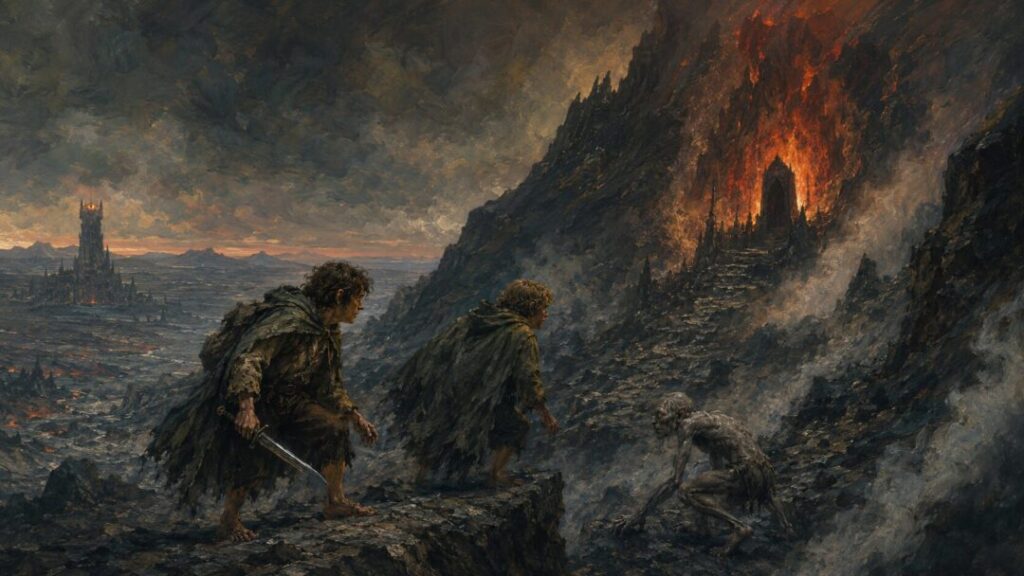
The Quest Was Never a Test of Strength
The first mistake is to treat Mount Doom as if it were a normal test of willpower.
As if Frodo simply needed to be brave enough.
As if the Ring were only a heavy object.
As if the final act was no different from throwing away a weapon or refusing a crown.
But the One Ring is not merely tempting.
It is made to dominate.
Its power is bound to Sauron’s will, and it works by desire: the desire to possess, to command, to preserve, to rule, to escape fear, even to do good through power. It does not need its bearer to be openly wicked. It only needs something in the bearer to grasp.
This is why the Wise fear it.
Gandalf refuses it.
Galadriel refuses it.
Elrond does not claim it.
Boromir, desiring to save his people, is still overcome by the thought of using it.
The danger is not limited to evil hearts. In fact, the Ring is especially dangerous because it can twist good intentions into domination.
Frodo’s task, then, is almost impossible from the beginning.
He is not simply carrying an object to a destination. He is carrying a will that grows heavier, more urgent, and more possessive the closer it comes to the place of its making.
Frodo’s “Failure” Begins Much Earlier
The scene at Mount Doom can feel sudden if it is read in isolation.
But the story warns us early.
In the Shire, when Gandalf tells Frodo that the Ring must be destroyed, Frodo cannot even throw it into his own fireplace without inward struggle. This is before Mordor. Before the Nazgûl wound. Before Shelob. Before hunger, thirst, and exhaustion.
Already, the Ring has a hold.
That matters.
If Frodo cannot easily cast it into an ordinary fire in Bag End, then the Crack of Doom is not a smaller test. It is the greatest possible test. It is the Ring at the height of its pressure, at the edge of the only fire that can destroy it.
By the time Frodo reaches Mount Doom, he has been worn down almost beyond recognition.
He has carried the Ring longer and farther than anyone else in the quest. He has been wounded by the Witch-king’s blade. He has been poisoned by Shelob. He has crossed Mordor with little food or water. Near the end, he can hardly remember the Shire clearly.
So when he breaks, the text does not present this as an ordinary act of cowardice.
It presents it as the final collapse of someone who has endured to the limit.
What Frodo Actually Says
At the Crack of Doom, Frodo does not say, “I am afraid.”
He does not say, “I cannot.”
He says, “I do not choose now to do what I came to do.”
That wording is chilling.
The Ring has not merely exhausted him. It has turned his will at the very end. Frodo claims it openly and puts it on.
In that moment, Sauron becomes aware of him.
The entire war turns on a knife-edge.
The armies before the Black Gate are doomed if Sauron regains the Ring. The West has no second plan. There is no hidden army, no greater weapon, no last-minute strength waiting behind the curtain.
If the story ended there, the quest would fail completely.
But it does not end there.
Because someone else is in the chamber.
Gollum.
Gollum Was Not an Accident
Gollum’s presence at Mount Doom is not random.
From the beginning, the story keeps drawing attention to him.
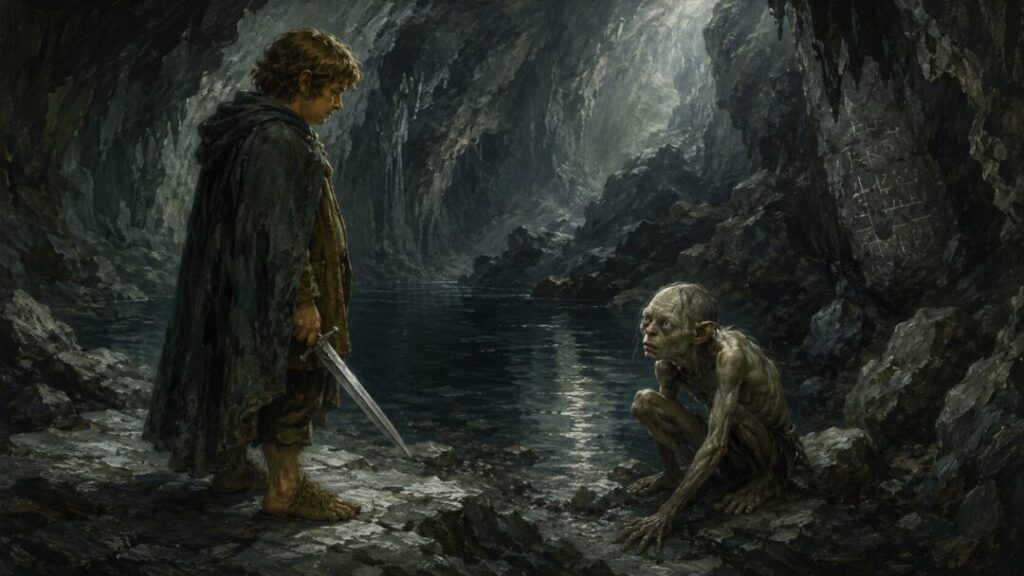
When Frodo first hears Gollum’s history, he wishes Bilbo had killed him. Gandalf corrects him sharply. Bilbo’s pity, he says, may rule the fate of many. Gandalf also suggests that Gollum has some part to play yet, for good or evil.
This is one of the great moral seeds of the story.
Bilbo spares Gollum in the dark under the Misty Mountains.
Frodo later spares Gollum.
Sam, at the slopes of Mount Doom, also refrains from killing him.
None of these acts make Gollum good.
That is important.
Gollum lies. He betrays. He leads Frodo and Sam toward Shelob. He remains enslaved to the Ring in a way that is pitiable but also dangerous.
The story does not pretend that mercy magically reforms him.
Instead, it shows something more complicated: mercy keeps open a possibility that power would have closed.
If Gollum had been killed earlier, the Ring would still have reached Mount Doom in Frodo’s hand.
And Frodo, standing alone at the brink, would not have thrown it away.
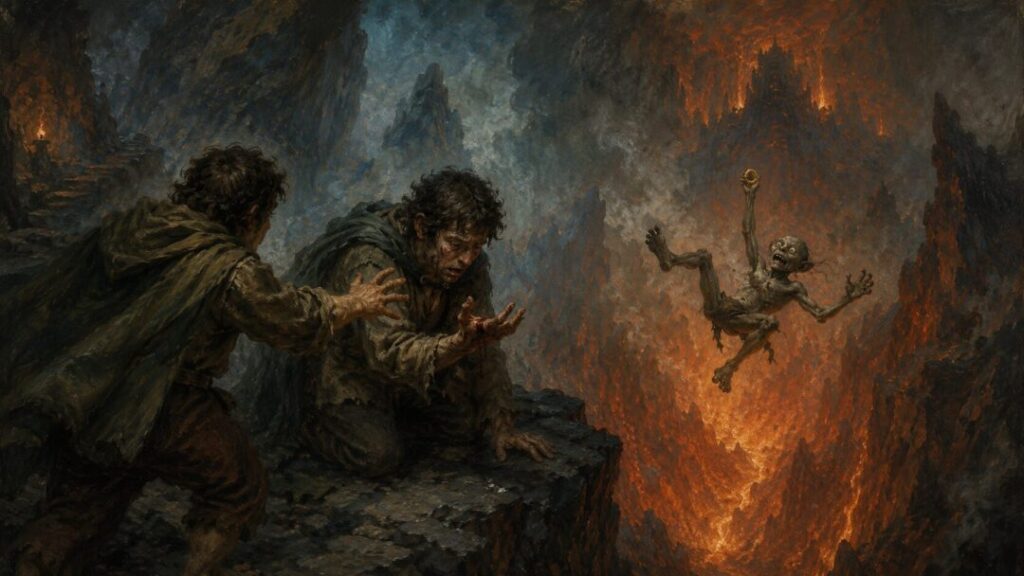
Frodo Could Not Finish Without Gollum
After the Ring is destroyed, Frodo himself understands something essential.
He tells Sam that if not for Gollum, he could not have destroyed the Ring. The quest would have been in vain, even at the bitter end.
This is not Frodo excusing himself.
It is an honest recognition of the pattern that has been unfolding since the beginning.
The Ring cannot be overcome simply by someone deciding to be strong enough. Its destruction comes through a chain of choices that no strategist could fully control.
Bilbo’s pity.
Frodo’s mercy.
Sam’s restraint.
Gollum’s obsession.
The Ring’s own power over him.
And the perilous edge of the fire where it was made.
Gollum does not destroy the Ring out of wisdom or repentance in the final text. He seizes it because he wants it. He rejoices because he has recovered his “Precious.” Then he falls.
That fall destroys Sauron’s power.
So yes, Gollum is necessary.
But not because he is secretly the hero in a simple sense.
He is necessary because the quest is built on mercy rather than mastery.
Was Frodo Morally Guilty?
This is where the question becomes delicate.
Did Frodo fail?
In one sense, yes.
He did not do the deed he came to do. He claimed the Ring. That is what happens in the text.
But if “failure” means that Frodo was simply weak, faithless, or unworthy, then the story strongly resists that conclusion.
Frodo gets the Ring to the only place where it can be destroyed. No one else in the Fellowship does that. He endures the burden until the last possible moment. He preserves Gollum long enough for Gollum to be present. He creates the situation in which the quest can be completed, even though he cannot complete the final act by his own will.
That distinction matters.
Frodo does not triumph by overpowering the Ring.
He triumphs, if we can use that word carefully, by giving everything he has until there is nothing left.
The final step is beyond him.
And that is precisely why the ending is so powerful.
The Ring Destroys Itself Through Its Own Logic
There is a deep irony in the Ring’s destruction.
It survives by corrupting desire.
It makes people want to possess it.
It makes them unwilling to surrender it.
It turns need, fear, pride, and longing into chains.
But at Mount Doom, that same possessive desire becomes the path to its undoing.
Frodo claims the Ring.
Gollum attacks to reclaim it.
Gollum’s joy blinds him to the edge.
The Ring falls into the fire.
This is not a clean heroic victory in the usual sense.
It is darker than that.
The Ring is destroyed not because someone proves immune to it, but because its power has produced a situation so unstable that it collapses into the only fire capable of ending it.
Evil, in this moment, is not defeated by becoming stronger than evil.
It is defeated because mercy allowed its own contradictions to reach the place where they could finally consume it.
The Meaning of Mercy
The ending at Mount Doom is sometimes misunderstood because mercy can look passive.
Bilbo does not kill Gollum.
Frodo does not kill Gollum.
Sam does not kill Gollum.
These can look like failures to act.
But in the moral world of Middle-earth, refusing to strike without need is not weakness. It is one of the most consequential forms of strength.
Mercy does not guarantee a happy outcome. Gollum does terrible harm after being spared. Frodo suffers greatly because Gollum remains alive. Sam’s suspicion of Gollum is often understandable.
Yet without mercy, there is no ending in which the Ring is destroyed.
This is the strange pattern.
The quest depends on military courage, wisdom, secrecy, endurance, and friendship. But at its deepest level, it depends on an act that looked small when it first happened: Bilbo pitying a miserable creature in the dark.
That act echoes all the way to the fire.
The Quest Was Possible Because Frodo and Gollum Were Both There
So was the quest only possible because of Gollum?
Yes—but that answer is incomplete unless we also say this:
Gollum could only be there because Frodo and Bilbo had spared him.
And Frodo could only reach that place because Sam carried him, guarded him, and refused to abandon him.
And the Ring could only be destroyed because Frodo had brought it to the brink.
The ending does not replace Frodo with Gollum as the true hero.
It binds them together in a terrible pattern.
Frodo is the bearer who brings the Ring to the fire.
Gollum is the broken creature whose obsession finally carries it over the edge.
Sam is the faithful companion without whom Frodo would never have reached the chamber at all.
None of them alone is enough.
That is the point.
The Ring cannot be defeated by isolated greatness. It is defeated through a web of endurance, pity, loyalty, and providence.
Why Mount Doom Still Hurts
The ending hurts because Frodo is not allowed a perfect victory.
After everything, he does not get to stand triumphant and cast the Ring away in pure freedom. He does not defeat temptation in a clean, shining gesture. He breaks at the end.
But that wound is part of the truth of the story.
Some burdens cannot be carried without damage.
Some victories do not feel victorious to the ones who paid for them.
Some evils are so great that survival itself is already a kind of triumph.
Frodo’s failure, if we call it that, is not the failure of a small soul.
It is the breaking point of a soul that has carried too much for too long.
And because he carried it as far as he did, mercy had room to finish what strength could not.
The Real Answer
Did Frodo fail at Mount Doom?
Yes, in the narrowest sense. He did not throw the Ring into the fire.
But no, not in the deeper moral sense.
He was not meant to prove that he was stronger than the Ring. No one in the story is shown to be safely stronger than the Ring at the place of its making. Frodo’s task was to bring it there, to endure beyond hope, and to preserve the possibility that mercy had opened.
Gollum was necessary.
But Gollum was not an accident.
He was the result of pity.
He was the consequence of mercy.
He was the living reminder that even the ruined and wretched may still have a part to play before the end.
Mount Doom is not a simple story about Frodo failing.
It is a story about the limits of strength.
And about how, when strength finally fails, mercy may still be waiting at the edge of the fire.
Sources & Notes
- J.R.R. Tolkien, The Lord of the Rings, Book VI, Chapter 3, “Mount Doom” — Frodo claims the Ring at the Crack of Doom, Gollum seizes it, and the Ring is destroyed in the fire.
- J.R.R. Tolkien, The Lord of the Rings, Book I, Chapter 2, “The Shadow of the Past” — Gandalf explains Bilbo’s pity, Gollum’s possible part in the Ring’s fate, and the need to destroy the Ring where it was made.
- J.R.R. Tolkien, The Lord of the Rings, Book IV, Chapter 1, “The Taming of Sméagol” — Frodo’s mercy toward Gollum keeps him in the story rather than ending his part by force.
- J.R.R. Tolkien, The Letters of J.R.R. Tolkien, Letter 246 — Tolkien directly discusses Frodo’s failure at the final moment, the overwhelming pressure of the Ring, and why Frodo still deserves honour.