Most people have heard the claim:
Samwise Gamgee is the true hero of The Lord of the Rings.
It sounds simple. Almost too simple.
Frodo carries the Ring. Aragorn returns as king. Gandalf guides the free peoples. Éowyn faces the Witch-king. Gollum, by a strange turn of pity and ruin, becomes essential at the end.
And yet Sam is the one many readers remember most tenderly.
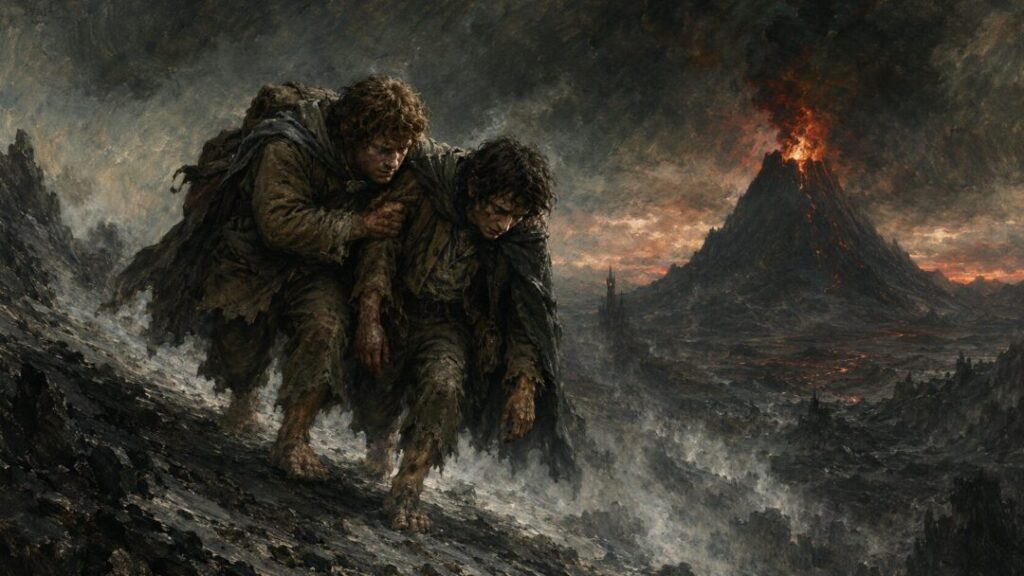
He is the one who keeps walking when hope has almost disappeared. He is the one who returns the Ring after briefly bearing it. He is the one who rescues Frodo from the Tower of Cirith Ungol. He is the one who carries Frodo up the slopes of Orodruin when Frodo can no longer carry himself.
So did the author really consider Sam the hero?
The answer is yes—but not in the simple way the phrase is often repeated.
The real meaning is deeper, stranger, and much more faithful to the moral center of Middle-earth.
The Famous “Chief Hero” Line
The strongest evidence comes from a letter in which Sam is called “the chief hero.”
But the context matters.
The remark does not appear as a casual ranking of characters, as if Frodo, Aragorn, Gandalf, and the others are being placed below Sam on a list. It appears in a discussion of Sam’s love for Rosie Cotton, and of why that simple, ordinary love matters to the meaning of the entire story.
The wording connects Sam’s character to “ordinary life”: breathing, eating, working, begetting, and the contrast between that life and quests, sacrifice, causes, beauty, and the longing for Elves. In other words, Sam is not called the chief hero merely because he performs great deeds. He is central because he joins the immense matters of Middle-earth to the plain life they are meant to save.
That distinction is everything.
Sam’s heroism is not built on power.
It is built on attachment.
He loves gardens. He loves food. He loves stories. He loves Frodo. He loves the Shire. He loves Rosie, though that part of his life remains mostly quiet in the narrative.
And because he loves those things, he can endure horrors that were never meant for someone like him.
Sam Does Not Replace Frodo
The mistake is to treat “Sam is the hero” as meaning “Frodo is not.”
That does not fit the story.
Frodo bears the Ring for nearly the whole Quest. He accepts the burden at the Council of Elrond when no one else claims it. He carries it through fear, pursuit, exhaustion, spiritual pressure, and increasing isolation.
The Ring is not merely a dangerous object. It is a power made for domination. It works on desire, fear, pride, pity, ambition, and the will to possess. Frodo’s long resistance is therefore not small. It is one of the central acts of endurance in the book.
At the end, at the Crack of Doom, Frodo does not willingly destroy the Ring. He claims it.
But the story does not present this as proof that Frodo was secretly weak all along.
By that point, he has been brought to the edge of what any will could bear. The Quest succeeds through a pattern that has been prepared long before: Bilbo’s pity, Frodo’s pity, Gollum’s oath, Gollum’s obsession, and the fact that mercy has consequences no one can fully control.
Frodo is not erased by Sam’s heroism.
He is the Ring-bearer whose suffering makes the end possible.
Sam is the companion whose faithfulness allows Frodo to reach that end at all.
The Kind of Hero Sam Is
Sam’s greatness begins in a very unheroic place.
He is not a prince in exile.
He is not a wizard.
He is not an Elf-lord.
He is not a warrior of ancient lineage.
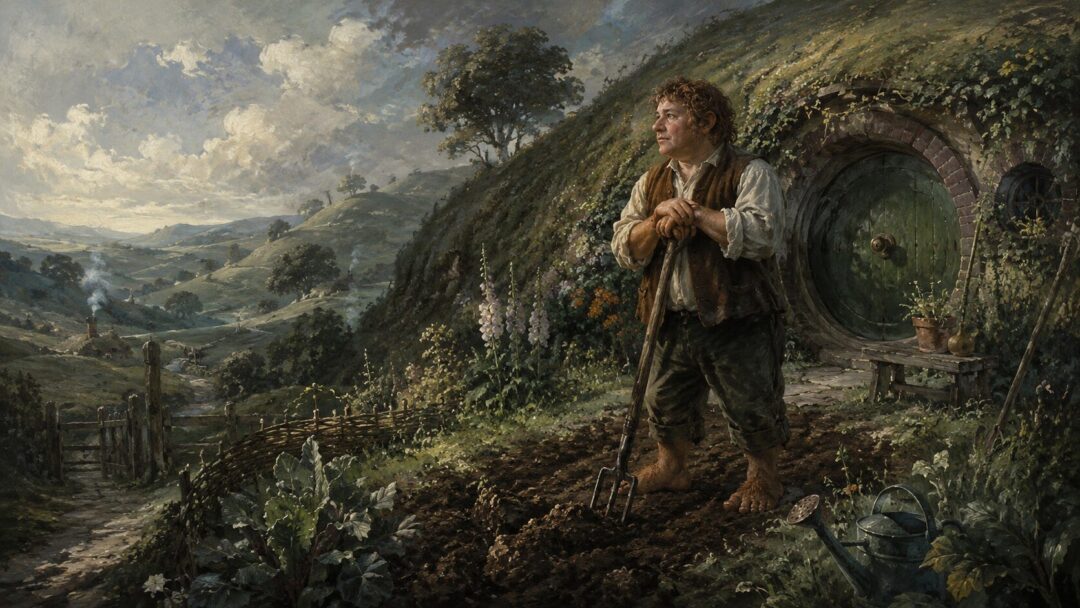
He is a gardener.
That matters because The Lord of the Rings repeatedly gives enormous weight to small, overlooked things. Hobbits enter the story as people outside the calculations of the great. They are not physically mighty. They do not command armies. They do not seek dominion. Their strength is found elsewhere.
Sam embodies that pattern more directly than anyone.
He is practical when others are abstract. He thinks about rope, food, rest, and the next step. He remembers home. He notices what Frodo needs. He grumbles, hopes, fears, sings, cooks, and keeps going.
This could be mistaken for mere sidekick behavior.
It is not.
In Mordor, these ordinary acts become acts of resistance.
To give Frodo water is to oppose Sauron.
To keep a little hope alive is to defy the Ring.
To remember the Shire under a poisoned sky is to insist that the world is not made for darkness.
Why Giving Back the Ring Matters
One of Sam’s most important moments is also one of the quietest.
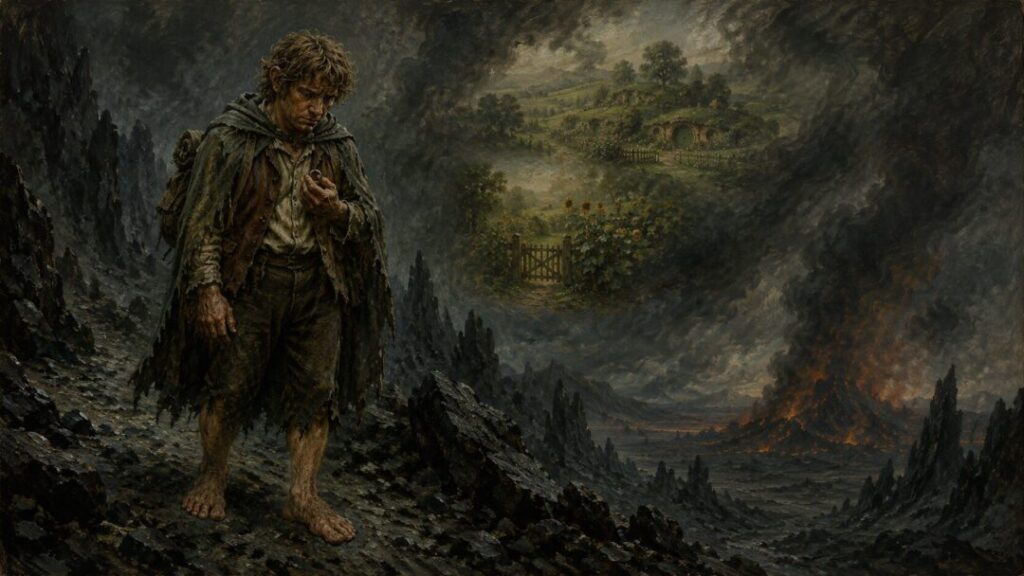
After Frodo is taken by orcs, Sam bears the Ring for a short time. He is tempted by visions of himself made great: Samwise the Strong, a hero ordering the world according to his own designs.
But the temptation does not master him.
Part of this is because Sam’s imagination remains rooted in the small and homely. A grand world remade under his command does not truly fit him. What he really wants is a garden.
That does not mean Sam is immune to the Ring.
No one should be treated as immune simply because he resists for a time. The Ring works according to the bearer, the situation, and the desires it can use. Sam bears it briefly compared with Frodo. His trial is real, but it is not the same trial.
Still, what he does afterward is extraordinary.
He gives it back.
That act is one of the clearest signs of his moral strength. He has carried the Ring, felt its pull, and yet relinquishes it to Frodo. The moment is painful. Frodo reacts with possessiveness and suspicion. Sam is hurt. But he obeys the deeper necessity of the Quest.
He does not seize the role for himself.
He remains faithful.
Cirith Ungol and the Lonely Courage of Sam
Sam’s rescue of Frodo from the Tower of Cirith Ungol is one of the great turning points of the Quest.
It is not a battlefield victory in the usual sense. No army follows him. No horn announces him. No king names him champion.
He enters a place of terror because Frodo is inside it.
His courage is personal before it is historical.
That is one of the reasons Sam’s heroism feels so powerful. He does not act because he understands all the designs of Providence or the full history of the Ring. He acts because his master and friend is alone, stripped, tormented, and in danger.
The fate of the world depends on that loyalty.
But Sam does not experience it as world-saving grandeur. He experiences it as doing the next necessary thing.
That is the hidden shape of his greatness.
Again and again, Sam saves the Quest not by becoming larger than himself, but by remaining himself when terror should have emptied him.
“I Can Carry You”
The most famous Sam moment comes near the end.
Frodo cannot go on. The Ring has become too heavy. The mountain remains before them, and there is no strength left for triumph.
Sam does not say he can carry the Ring.
He says he can carry Frodo.
This distinction matters.
Sam cannot take Frodo’s spiritual burden away. He cannot become the Ring-bearer in Frodo’s place at the final moment. He cannot solve the Quest through strength.
But he can carry the person who bears the burden.
This is perhaps the purest form of Sam’s heroism.
He does not master evil.
He does not defeat the Ring by force.
He supports the sufferer.
In a story where the desire to dominate is the central mark of evil, Sam’s greatest act is not domination but service. He does not rise by making another person smaller. He rises by lifting someone who has fallen.
That is why the moment feels larger than its physical action.
Sam carrying Frodo is not merely a dramatic scene. It is a statement about what kind of strength can survive Mordor.
Why Rosie Cotton Matters
At first glance, Rosie Cotton may seem like a small part of Sam’s story.
She appears only briefly compared with the great movements of the Quest. Her relationship with Sam is not developed in the way modern readers might expect. Yet the “chief hero” comment is directly tied to Sam’s love for Rosie and to the ordinary life represented by that love.
That tells us how to read him.
Sam’s heroism does not end at Mount Doom.
It points beyond Mount Doom.
The destruction of the Ring is not valuable because it creates a world of endless battles and songs. It is valuable because it allows gardens to be planted, marriages to happen, children to be born, meals to be shared, and ordinary days to continue.
Sam’s love for Rosie anchors the Quest to the life after the Quest.
This is why he can return.
Frodo cannot fully return in the same way. His wounds remain too deep. The Shire is saved, but not for him in the same complete sense. Sam, however, comes back into the life the Quest preserved.
He marries Rosie.
He has a family.
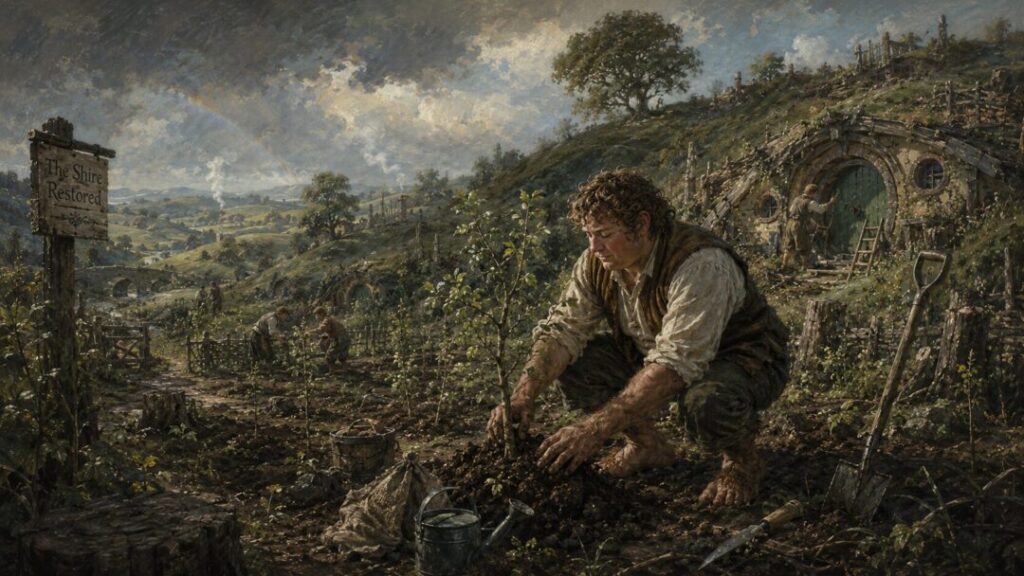
He helps restore the Shire.
He becomes, in a quiet and deeply fitting way, a guardian of ordinary peace.
Sam and the Scouring of the Shire
The Scouring of the Shire is essential to understanding Sam.
When the hobbits return, the Shire has been damaged. Its trees have been cut down. Its mills and rules have become ugly. Its familiar life has been violated.
Sam’s grief is especially tied to the destruction of trees and gardens.
This is not incidental.
The great war has come home, and Sam’s response is not to become a conqueror. His response is restoration.
With the gift given to him by Galadriel, he helps renew the Shire’s growth. The story does not treat gardening as trivial. In Sam’s hands, gardening becomes a form of healing after domination and waste.
This completes the arc that began with his ordinary life.
He goes from gardener to Ring-bearer and back to gardener.
But the return is not a demotion.
It is the point.
Sam’s greatness is that he can pass through epic darkness and still understand the worth of a growing tree.
So Is Sam the True Hero?
The safest answer is this:
Sam is truly called the “chief hero” in an important interpretive sense, but that does not mean he replaces Frodo as the central Ring-bearer or cancels the heroism of others.
He is the chief hero of the story’s moral center.
Frodo carries the burden.
Aragorn restores the kingship.
Gandalf guides and labors against Sauron.
Gollum, through pity and corruption, becomes the instrument by which the Ring is finally destroyed.
But Sam reveals what all of it is for.
Not power.
Not fame.
Not victory for its own sake.
The Shire. The garden. The meal. The beloved face waiting at home. The possibility that after all the terror, someone may still plant, marry, laugh, work, and live.
That is why Sam matters so deeply.
He is not the hero because he is the strongest.
He is the hero because he remains faithful to the small goods that evil overlooks and power cannot understand.
The Quiet Answer
Samwise Gamgee does not begin as someone who looks fit to change the world.
He begins with earth under his fingernails.
And perhaps that is exactly the point.
Middle-earth is not saved only by the wise, the noble, and the mighty. It is saved by pity, endurance, loyalty, and the stubborn love of ordinary things.
Sam’s heroism is not a correction to Frodo’s story.
It is the key that helps us understand it.
Frodo shows the cost of bearing evil.
Sam shows why the world is worth saving from it.
And that may be why the “chief hero” of The Lord of the Rings is not crowned in Minas Tirith, does not rule a kingdom, and does not seek a song for himself.
He goes home.
He plants trees.
He marries Rosie.
And when he finally returns to Bag End, after all the wonders and horrors of the world, his last words are not about glory at all.
They are about being back.
Sources & Notes
- J.R.R. Tolkien, The Letters of J.R.R. Tolkien, Letter 131 — calls Sam the “chief hero” while tying his importance to Rosie and ordinary, fruitful life.
- J.R.R. Tolkien, The Lord of the Rings, Book IV, Chapter 10, “The Choices of Master Samwise” — Sam bears the Ring after Frodo’s capture and chooses loyalty over despair.
- J.R.R. Tolkien, The Lord of the Rings, Book VI, Chapter 1, “The Tower of Cirith Ungol” — Sam rescues Frodo and gives the Ring back despite its pressure and Frodo’s possessiveness.
- J.R.R. Tolkien, The Lord of the Rings, Book VI, Chapter 3, “Mount Doom” — Sam cannot carry the Ring for Frodo, but carries Frodo himself toward the end of the Quest.
- J.R.R. Tolkien, The Lord of the Rings, Book VI, Chapters 8–9, “The Scouring of the Shire” and “The Grey Havens” — Sam helps restore the Shire, marries Rosie, and returns to ordinary life.